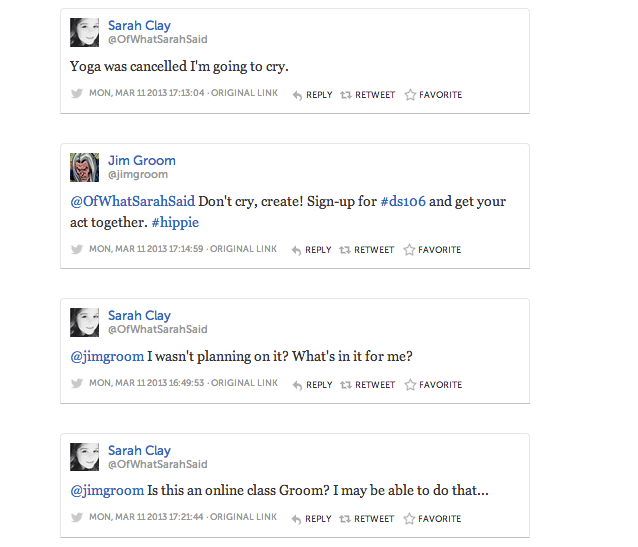
Today was the first day of registration for Summer classes, and I am planning on teaching ds106 in the first five-week session (May 20th through June 18th). The class filled up the allotted 15 spots before noon, and I started getting emails from students wanting to force add. I already have close to ten on a waiting list, and I have asked the registrar to double the amount of seats. What’s more, I started picking on the #emboilers (Freshman who took the Hardboiled course) to take ds106. Sarah Clay, who spends a lot of time on twitter being very emo, happened to tweet about being upset about missing yoga and I joked with her about taking ds106. I like talking smack to former students on Twitter, it is almost becoming a pastime.
But as you can tell my students dish it back as well, referring to me as Groom, and generally asking the essential question: “What’s in it for me?” I mean this is the most valid question in the word is you are paying to take a class some professor you had is stalking you on twitter to take. What is in it for her? I know she is creative and has fun experimenting, I know she’ll do good work (which is ultimately good for me too), and I think she will lock into some of the creative experimentations across the media.
On top of the question “What’s in it for me?” which is pretty hard to answer, the question of whether it will make her hate her life is clear: YES! But that question in the middle “how much does it cost?” looms large.
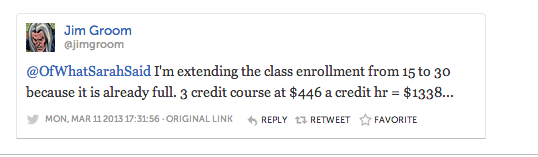
I don’t need to increase enrollment, I want to. I’m finding more people enrolled in ds106, to a point, can be better for the experience. I found that to be the case last Spring, and I am ready to experiment with that even more this Summer. But, it’s not cheap, at least for the students (as an adjunct I am very cheap labor¹) $1000 is a lot of money to ask someone to come “have fun.” Why should she have to pay to have fun? That is a huge question, especially if they can get it for free and still have the credits to finish college.
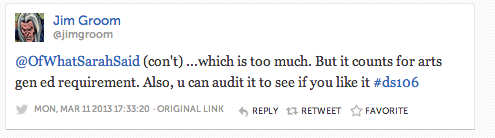
But, there are requirements that might entice….although you quickly realize how much the pursuit of a degree holds the whole thing together.
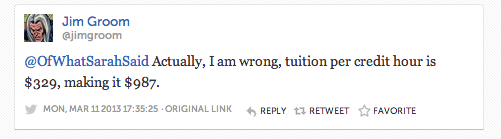
Wherein I correct an accounting error…
Or you can just audit it, which allows you to get sense of the class, the professor, what you’re getting , and answer the questions “is it worth the money?” “Will it make her life hell?” and “What’s in it for her?”
The idea of ds106 being full is more and more puzzling to me, part of the design is that it can;t fill in that way. And while there is a definite limit to how much I can do, it doesn’t stop at 15. And, in my mind, it doesn’t cap out at 30 given how amazing the framework for the class has become. I did 23 in the Summer of Oblivion.
That is where the money goes, towards the credit! The idea of getting that degree, there is the rub, and she doesn’t even need it!
“A fun thing to keep me thinking,” maybe she is just being nice on Twitter (and probably so) but what if we had experiences built into the community for this? Why aren’t we designing experiences to create ways to keep our students engaged in a variety of ways, over the Summer and beyond? I wonder if we aren’t missing something here, something I’m convinced a model like ds106 at a residential, liberal arts college gets at some of the issues of teaching, online. Rather than following suit with the rest of the social media douche bag lemmings in search of a pseudo-topical blog post that ignores the potentially horrendous impact their misguided philosophy about education they unknowing picked up from a media embedded Pearson advertisement does to the student experience, faculty jobs, and the noble, public service of educating a nation of free thinkers. This is still an experience both countries and people who fund them should want to pay for (even if it is too much money, but more on that soon).
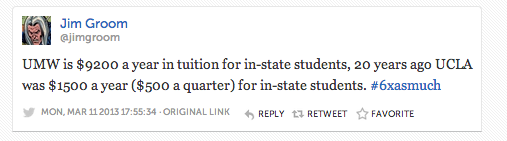
Tuition inflation is nothing new, but this conversation pushed me to check out the exact tuition at UMW as of now. More than six times as much as I paid 20 years ago for a state university in California (as a side note UCLA is now $12,686 for tuition a year (almost nine times what it was 20 years ago).
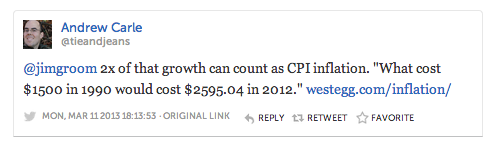
And Andrew Carle found a neat inflation calculator that reminded me that the cost of state university has outpaced inflation of everything else by four times when comparing prices in 1990 to 2012. Insane.
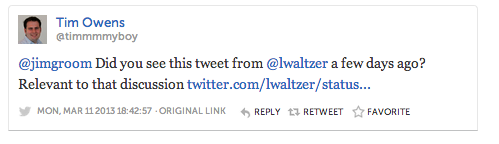
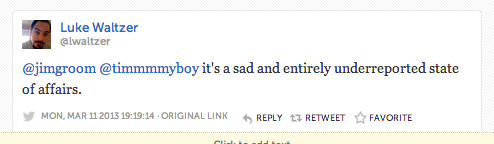
And Timmyboy seals it with a pointer to this awesome stat from Luke Waltzer I missed…
Indeed!
Mike Caulfield has written about this extensively and far more intelligently than me, but few others I read have. What we are doing to shift the bulk of the costs for higher education on the student is shameful, I don’t disagree with folks on that point, but how we are going to fix it is not through venture-funded corporations filling in the “gaps.” We have to start making it affordable (which is the wedge venture-capital driven MOOCs from Silicon Valley is using with the San Jose State Experiment being the most compelling example), keep the public funding coming for education, and foster the idea of college as a space to experiment and create rather than endlessly labor to pay the bills for an education that is starting to live up to the Wal-Mart brand of quality we are trying to fight.
________________________________
1. Given I want to take on more students and work I should get paid for twice the labor, right? I believe it is only fair, but that’s not what I am focusing on here because as it stands now I am not allowed to teach more than one section, so I have to get creative here because I want to see what’s possible, and that can’t happen in a system that ossifies the idea of labor.
When I was in graduate school I took a course about labor and cinema that had a wide range of post-war films coupled with readings from critical film studies, post-structuralist Marxism, etc. —you get the general late 1990s grad school drift (picnic, lightening). Anyway, at the same time I was also working piecemeal as an adjunct as well as moonlighting with my brother, who was and still is, a floorlayer in New York City. I did pickup jobs as I could, and it paid a lot better than adjunct work. That said, it was brutal labor. (This weekend I was reminded how brutal when I installed 220 square feet of cement board on my kitchen floor in preparation for ceramic tile.) One of the things the films we watched always elided was the actual labor they were commenting on—-the very raison d’être of their politics. It is obviously an issue of narrative timing and all that, but at the same time it seems to have seeped into mass culture as an embarrassingly common visual/narrative reality. Just today whiel waiting in a doctors office I was forced to watch an HGTV show on cable—I spent the whole time hearing annoying rich people talk about their shopping sprees for deluxe amenities while the actual labor of the renovations was relegated to 30 second long clips at 16x the original speed. These are commercials, not DIY shows. They focus on the product of the labor, and sell you that—their is no attention paid to how painstaking it all is. This is exactly what’s happening with the narrative around the labor of teaching and learning right now more generally—talking head videos with venture-backed, profit-driven cures—but I digress.
The point of this post was simply to say how blown away I was by Jacques Becker’s 1960 prison break masterpiece Le Trou (translated as The Hole). This is the second film I have seen by him this week (I wrote about Touchez pas au grisbi in my last post) and I can’t get enough. Le Trou puts five prisoners in a room (mostly non-actors) and creates a world within the cell in which the most minute details become elongated cinematic poetry of beauty and possibility. What is interesting to me about Le Trou against the vision of labor that you often see in “representative” films about work is how abject it is abstractly—I’m thinking here of the British kitchen sink dramas like Alan Sillitoe’s Saturday Night, Sunday Morning, or labor movement dramas like Norma Rae in the 70s, and especially Michael Moore’s sentimental Roger and Me in the 1980s—is how the labor is insisted upon as a way out rather than an abject trap. The work of breaking up a cement floor with a bed leg to get beneath the cell is the subject of a 9 minute scene in Le Trou. What’s more, the actors are actually working, they are taking turns breaking up the cement and for me watching it was insane because breaking up a cement floor with a metal bar is excruciating labor I can clearly imagine. I have a clear sense of how hard it is rip up a floor with hardcore power tools, no less a simple metal bar taken from a cot. I couldn’t help but marvel at this moment of work being documented—it spoke more to me about the intense realities of labor than any of the films I have seen before it. What’s more, it was not abject labor, it was labor with a purpose to escape the abject system of prison—it was unbelievably hopeful in that regard. What the entire 9 minute scene below, if you dare 😉
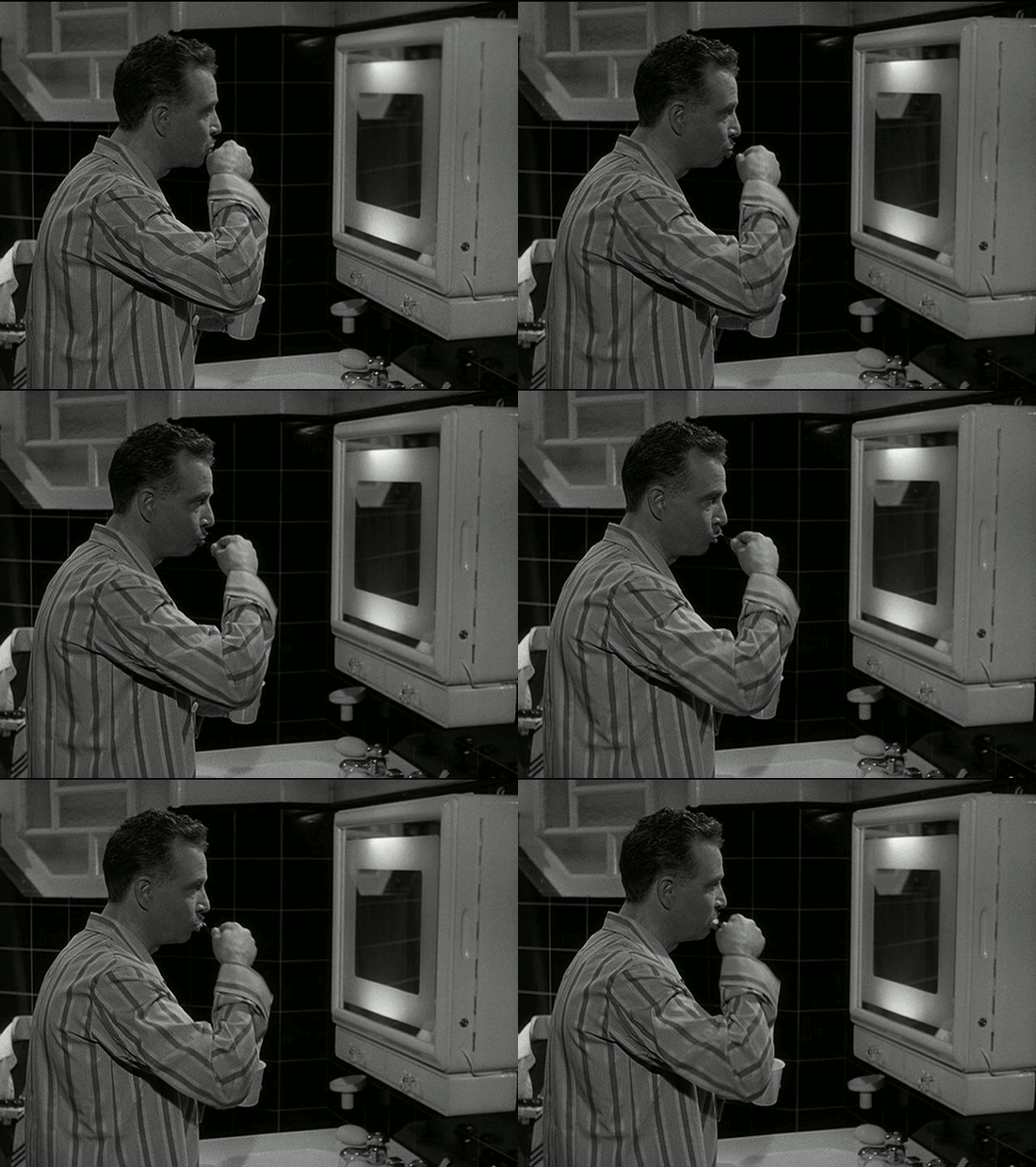
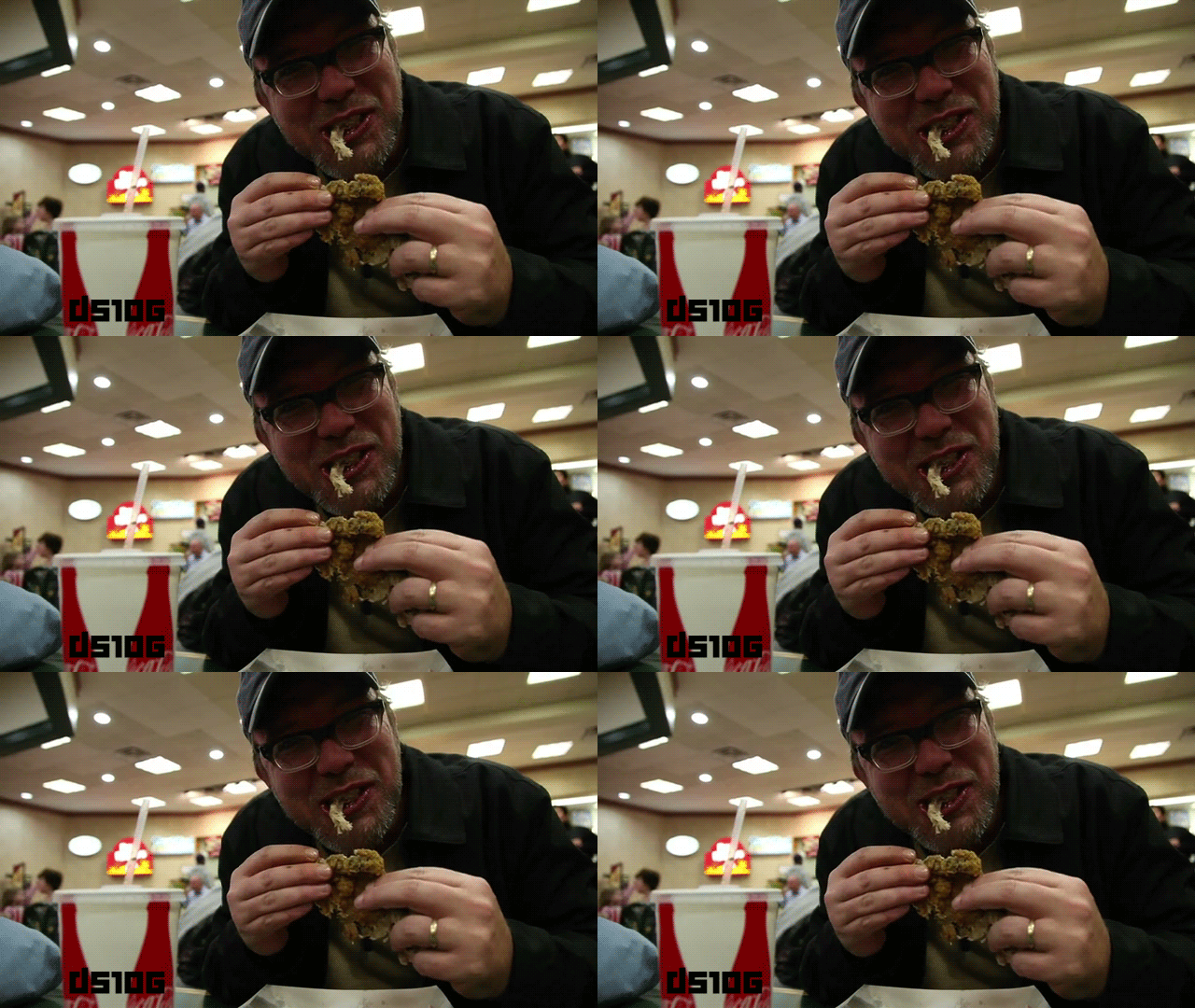
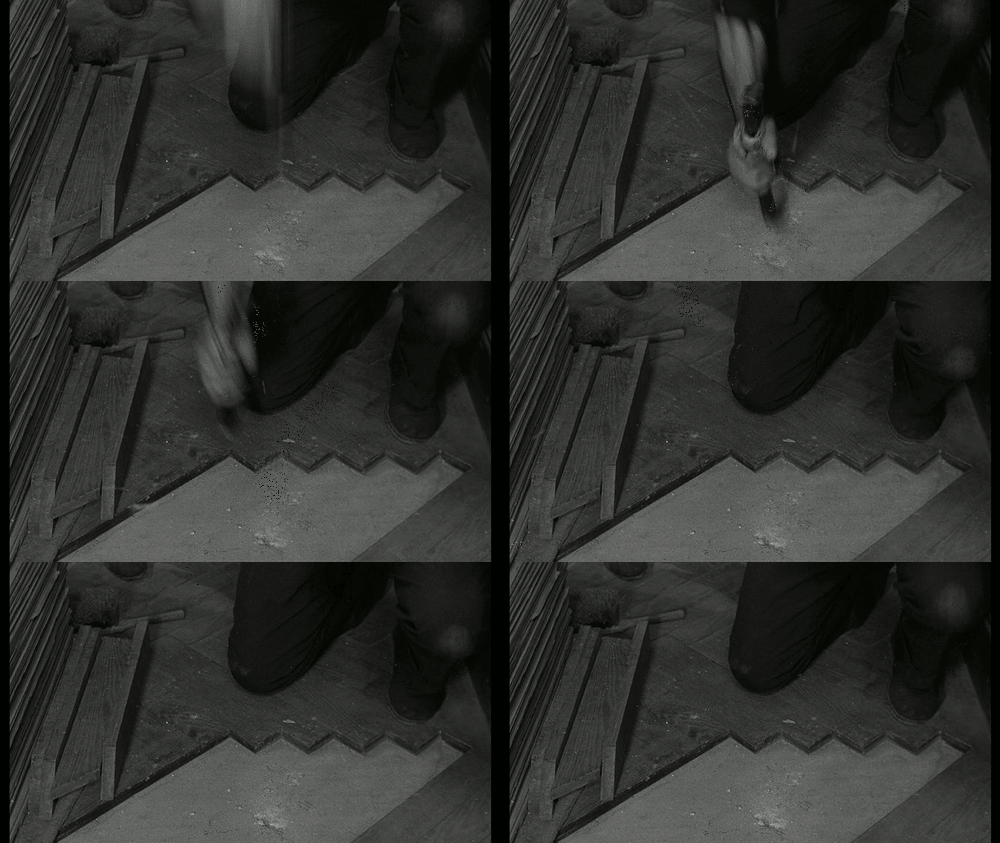
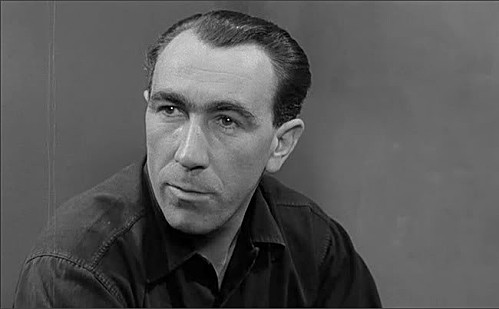
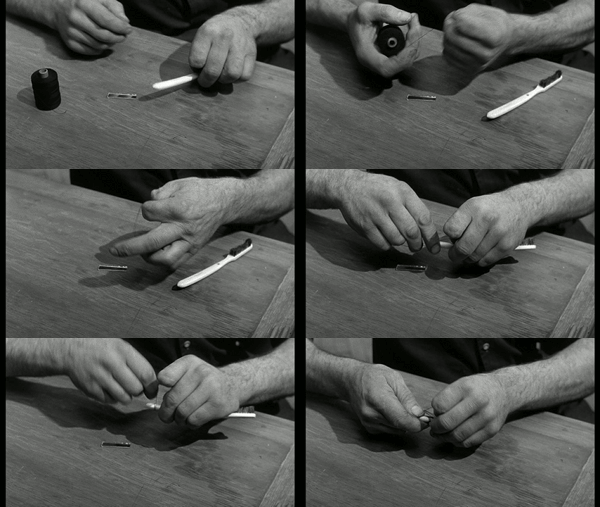
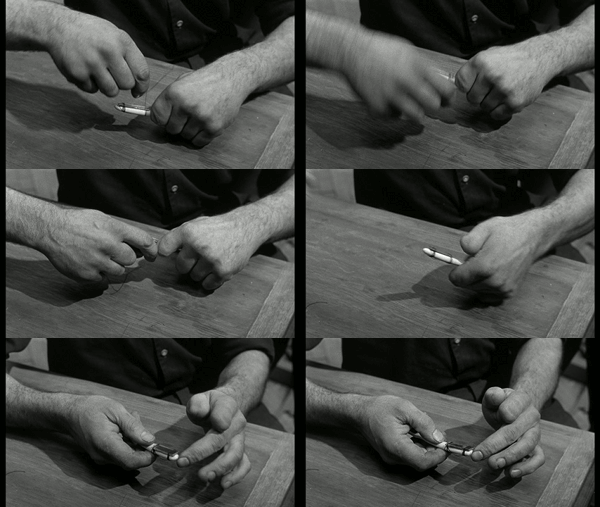
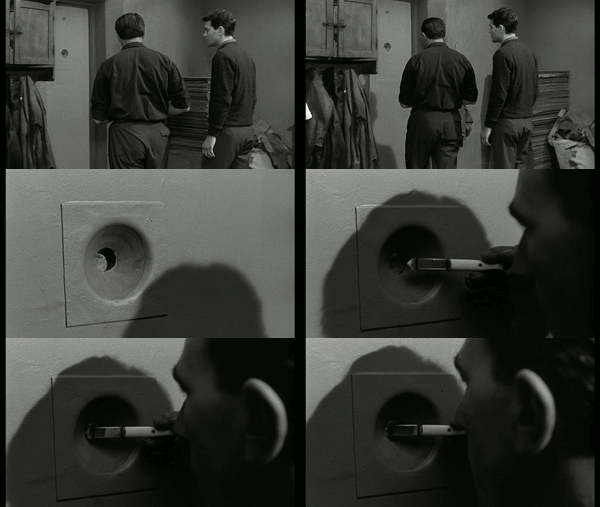
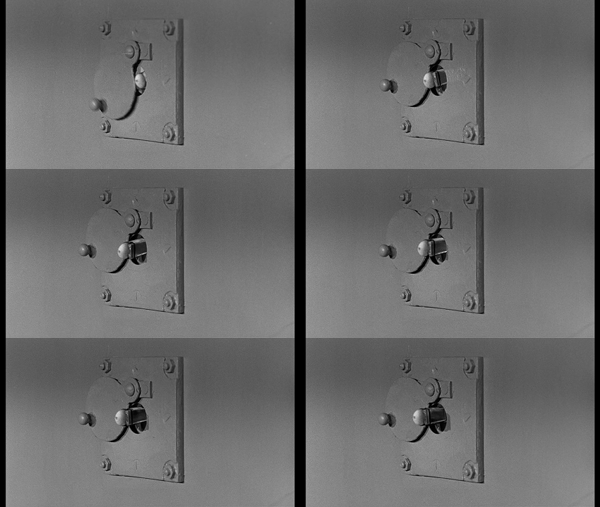
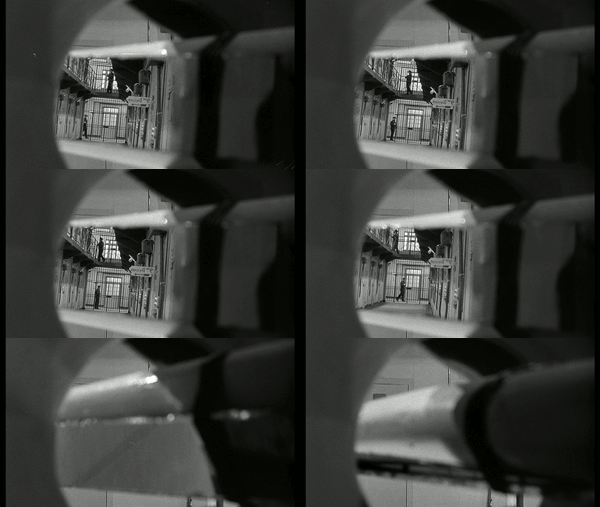
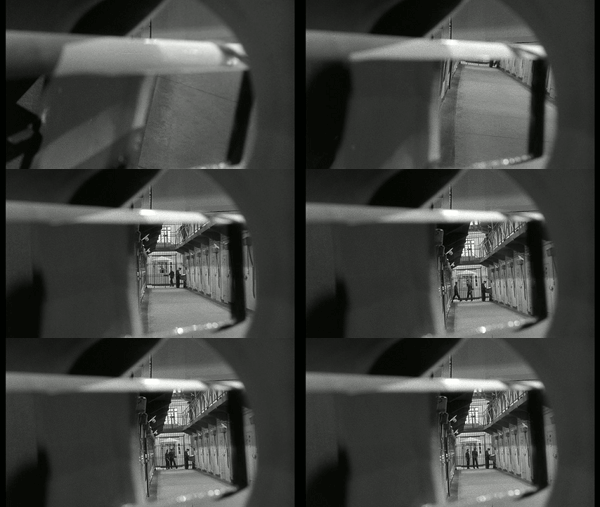
The other thing I loved about Le Trou was how compelling the character Roland Darban (played by real-life prison escape artist Jean Keraudy) was throughout the film. His exactitude and brilliant improvisation on everyday details to escape from La Santé Prison kept me riveted. Everythign around him was a tool, and the way Becker focused on how he uses his hands to make amazing tools out of everyday objects throughout the film was nothing short of genius. For example, Darbant makes a periscope for looking out of the prison door peep hole using a broken piece of glass and a tooth brush. The film is no simply focused on the act of making, but the beautiful the beautiful cinematic shots that result from it having been made. Watch the short 55 second sequence, and check out my experimentation with multi-shot GIFs to reproduce this moment below.
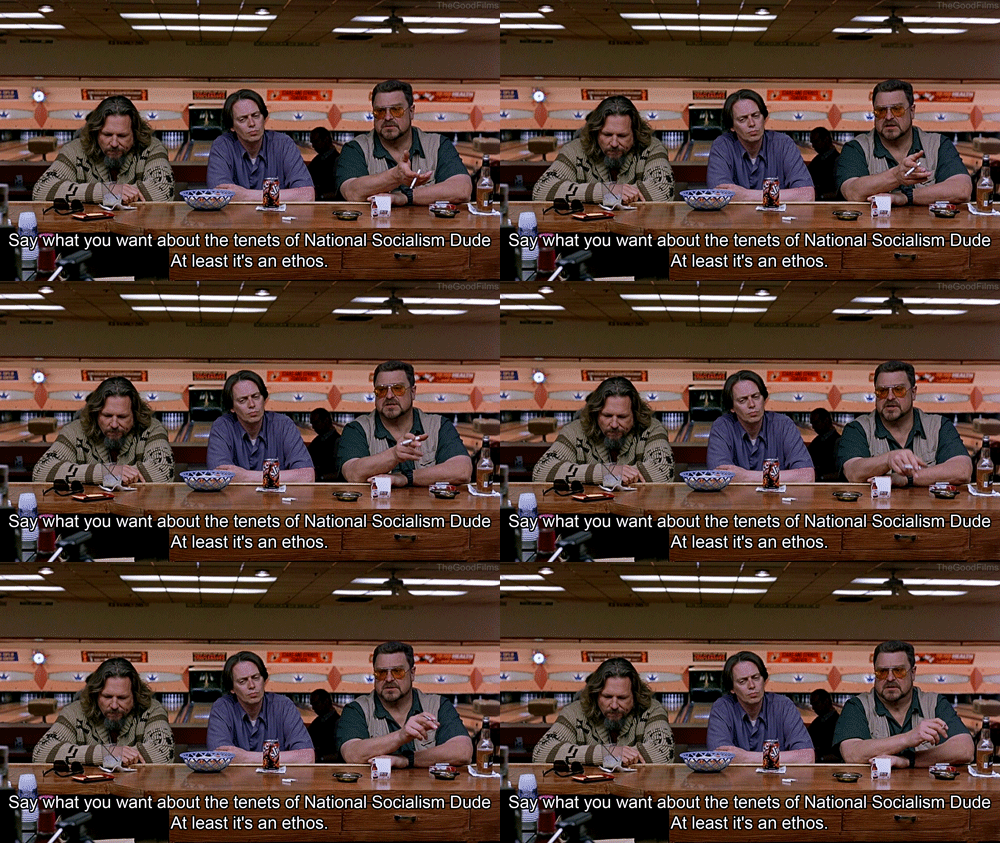
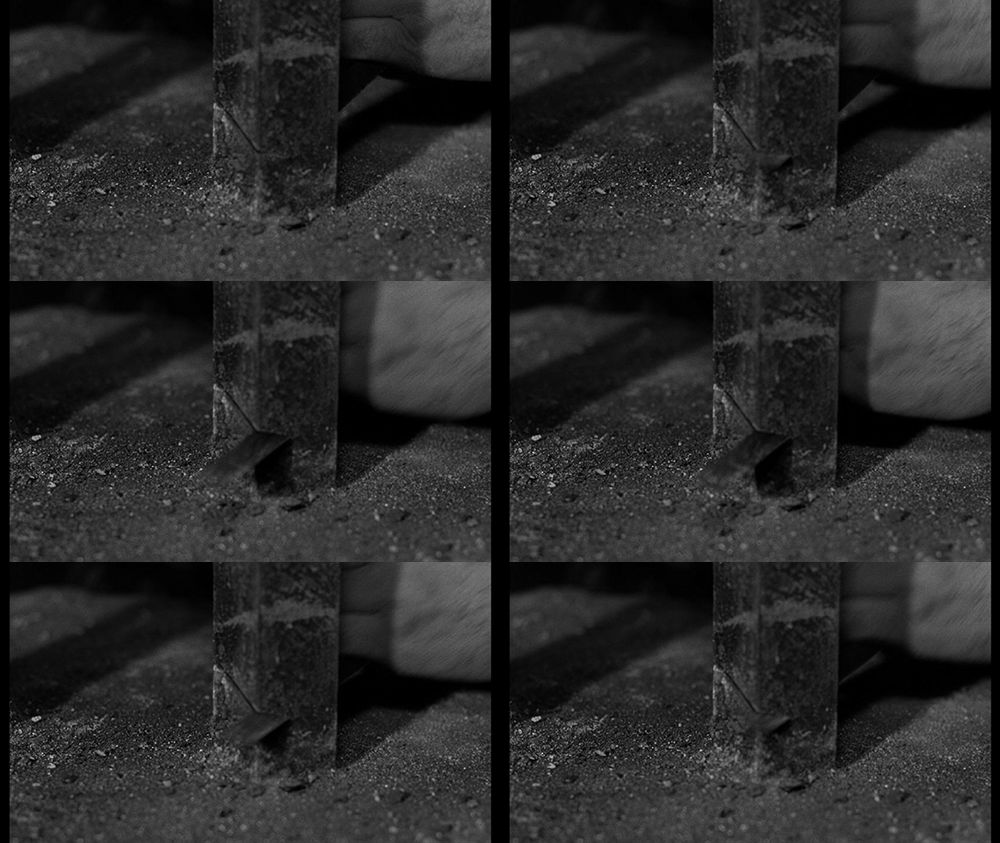
Darban also makes short work of a metal prison bar with a hack saw blade (he also makes a master key with that hacksaw as well). The prolonged focus on the hacking of a prison bar is one of many labor intensive scenes that provides the opportunity to focus in on the film and try and consider its ethos. It’s all about precision, seeing possibility everywhere, doing a lot with nothing, and more than anything work. Hard work! The tools are barebones, they’re everywhere around us, but they make for a beautiful narrative of escape from the systemic logic that has us all cell bound to some degree. It’s a cinematic ethos that Becker establishes in this film, too bad he died soon after making it. It reminds me a lot of the “Internet of Attractions” idea I have written about previously, and I want to return to that concept with Becker’s film in mind. Here’s to cutting through those bars!
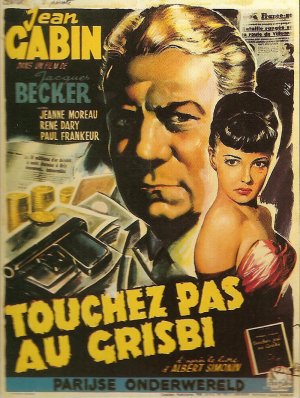
Jean Gabin is at his most wearily romantic as aging gangster Max le Menteur in the Jacques Becker gem Touchez pas au grisbi (Hands Off the Loot!). Having pulled off the heist of a lifetime, Max looks forward to spending his remaining days relaxing with his beautiful young girlfriend. But when Riton (René Dary), Max’s hapless partner and best friend, lets word of the loot slip to loose-lipped, two-timing Josy (Jeanne Moreau), Max is reluctantly drawn back into the underworld. A touchstone of the gangster-film genre, Touchez pas au grisbi is also pure Becker—understated, elegant, evocative.
What’s interesting about the film is that the trailer is completely misleading. It suggesters there is all kinds of explosions, gangsters marauding with machine guns, and high-speed chases—nothing could be further from the truth.
The action scenes highlighted in the trailer are all from the last 10-15 minutes of the film. The real brilliance of Touchez pas au grisbi lies in its first hour wherein aged gangster Max le Menteur articulates the harsh realities and limits of growing old, the very thing his friend and accomplice, Riton, refuses to come to terms with. What made this film so great were the ways in which this sense of growing old was brilliantly captured in small details on film. For example, the moment when Max and Riton are hiding out in an apartment Max keeps as an investment. Rather than this becoming a scene of the two “hitting the mattresses” in some gritty dive—a scene you might expect from a noir—these two are found eating Pâté and biscuits in a luxury apartment before putting on their silk pajamas, brushing their teeth, inspecting the bags under their eyes, and then settling in for the night. I’ve never seen anything like it in a film noir before, the focus on the domestic elements of two gangsters past their prime moves the narrative away from the expected atmosphere of hardboiled action and dialogue and towards a sense of homeboiled realities. Aged gangsters who become humanized through the camera’s lingering on such quotidian, if not outright banal, tasks as brushing their teeth.
Gangster Riton brushes his teeth…WTF!
See the entire three minute domestication scene below:
The film reminded me a lot of Peckinpah’s The Wild Bunch (1969), a Western about a band of aging outlaws who need to start thinking “beyond their guns.” I can’t help but think the one inspired the other. And to Becker’s credit, he’s even more insistent then Peckinpah in avoiding the urge to immortalize the outlaws, they can barely keep their eyes open after midnight. If you are looking for a meditative, understated noir about growing old and coming to term with the end through an existential frame, I’ve yet to see a better take on the theme. Now to find and watch Jacques Becker’s Le Trou (The Hole), a 1960 prison break film, I am officially a fan!
….maybe everybody does. The following scene is a classic Hollywood moment from Vincente Minnelli‘s 1952 melodrama The Bad and the Beautiful between Lana Turner and Kirk Douglas —and both prove why they are masters, though Douglas steals this one at the 3 minute mark with the classic tirade which includes the cutting: “Maybe I like to be cheap once in a while, maybe everyone does! Or don’t you remember?” Brilliant, and the “GET OUT!” at the end seals it.
I discovered Minnelli’s classic after re-watching Curtis Hanson’s 1997 film adaptation of James Ellroy’s L.A. Confidential over Christmas break. (So much better than DiPalma’s shit show that was an adaptation of The Black Dahlia, which Ellroy somehow finds it in himself to defend.) L.A. Confidential is one of the masterpieces of Hollywood from the 1990s in my mind, and when reading up on the film, thank you Wikipedia, it turns out Hanson had a mini-film festival of 1950s L.A. films to prepare the actors and crew for the period they would be immersing themselves in:
To give his cast and crew points and counterpoints to capture L.A. in the 1950s, he held a “mini-film festival,” showing one film a week: The Bad and the Beautiful, because it epitomized the glamorous Hollywood look; In a Lonely Place, because it revealed the ugly underbelly of Hollywood glamor; Don Siegel’s The Lineup and Private Hell 36, “for their lean and efficient style; and Kiss Me Deadly, because it was “so rooted in the futuristic 50s: the atomic age.” Hanson and the film’s cinematographer Dante Spinotti agreed that the film would be shot widescreen, and studied two Cinemascope films from the period: Douglas Sirk’s The Tarnished Angels and Vincente Minnelli’s Some Came Running.
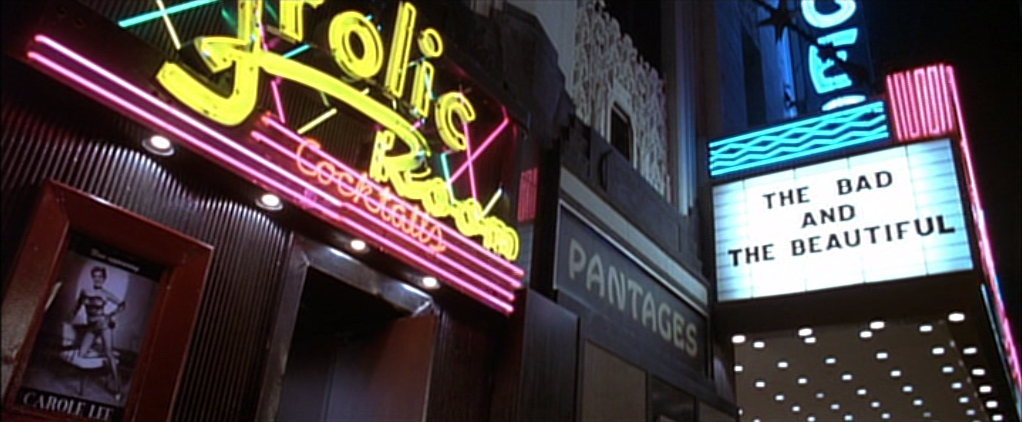
Man, I can’t help but think this this kind of studying and history helps make great films. It’s like a syllabus, each film represents a thematic, stylistic, or aesthetic approach they are trying to incorporate into the actual thing they are creating. And more and more this is why I can’t fully understand the haters when it comes to Tarantino. I love the way he studies film with such a hardcore eye, and then creates from that inspiration. You can argue it’s a bit over-the-top, but the older I get the more I realize how hard it is to do any one thing well, no less a series of things based on your passion. I can’t help but admire his breadth and depth of knowledge and affectionate allusions. What’s more, Hanson seems to be operating in much the same vein as Tarantino in L.A. Confidential, and while the allusions aren’t as in-your-face, they’re still very much omnipresent, take the Pantages marqueee (right next to the Frolic Room) as a subtle homage to the films that inspired his vision:
What’s more, I can’t help but love the fact that Hanson had Russell Crowe study Sterling Hayden’s performance in Kubrick’s The Killing“for that beefy manliness that came out of World War II.” Sterling Hayden may be the coolest looking man on the silver screen outside of Terence Stamp, and given the choice between the two I would have to go Hayden because he was a 6′ 5” badass, had six kids, sailed around the world in a boat named the Wanderer and wrote books. Anyway, here’s to directors like Tarantino and Hanson that love cinema and study their artform with a cultural critics eye!
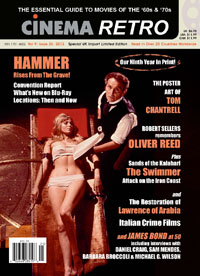
When Anto was in New York City a couple of months ago she picked me up the latest issue of Cinema Retro, which is similar to my favorite film magazine Filmfax. The main differences being it’s a British publication and it focuses specifically on 1960s and 70s films. The writing is interesting enough, though the focus on James Bond in this issue is a bit tiresome for me—especially given the recent Daniel Craig-led series has mistaken itself for a Bourne film. I despised Skyfall, not only was it predictable and trite–but it continues the tradition of recent Bond films of making fun of its own history in a way that insults longtime fans. I’m done with any Bond films after Pierce Brosnan (although Roger Moore remains the beesknees bond for me), the Daniel Craig films have been nothing short of an abortion of the franchises’ credibility.
That said, the current issue of Cinema Retro had more than a few things that intrigued me. In a sidebar titled “That Was the Week That Was,” the magazine re-prints stories from Boxoffice magazine from a specific date in its publication history. One of the reprints was a short blurb about Veronica Lake’s final film from October 5th, 1970:
John F. Rickert, CineWorld Corp. president, reports from his Miami base of operations that the first 150 play dates on the Veronica Lake starrer Flesh Feast have proven that the new Viking International Pictures production is an exceptionally strong grossing horror film. It may also, says Rickert, re-establish Veronica Lake as a box office name, as he has received several inquiries from U.S. producers regarding ehr availability for film work. Miss Lake, prior to leaving Hollywood in 1951, starred in more than 25 feature films, which made her one of the “hot properties” of the 1940s.
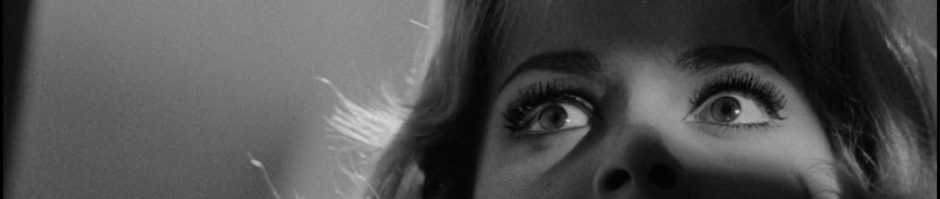
The idea that this film was going to be a box office success was a joke, it was panned at the time and is still panned today. It was a the last ditch effort for Lake that she personally financed with the proceeds of a memoir of her turbulent life. Lake died impecunious three years later at the age of 50. A sad story of a fallen star, which is actually kind of a submerged theme for this issue given there’s another compelling article about the train wreck of a career that belonged to British actor Oliver Reed—he was awesome in his comeback role in Gladiator, too bad his return was cut short, for unlike Lake he still had real presence. Anyway, after reading this bit I couldn’t help but seek out more about Flesh Feast, so I got the plot as told by Wikipedia, which is brilliant:
Lake plays Dr. Elaine Frederick, a mad scientist working on developing maggots that prefer human flesh, while her services are used to make a clone of Adolf Hitler. She cooperates with the plan to resurrect Hitler as a way of exacting revenge for the death of her parents, political prisoners executed in a concentration camp. While convincing everyone the flesh-eating maggots are for regeneration research, she simply wants to throw them in the resurrected Hitler’s face, which she does.
Flesh-eating maggots? Zombie nazies? The only problem with this film is it was made 40 years too early 😉 As for actually spending the time to watch the film, I actually might after this seven minute clip of her interacting with the zombie Hitler (go to minute 2).
But the real draw of this issue, and why I will be subscribing to the magazine was Dean Brierly’s Crime Wave International article that focuses on the Italian poliziotteschi(or police films) from the 1960s and 70s. He provides a great list of ten films from this genre which includes filmmakers like Fernando Di Leo, Enzo Castellari, Umberto Lenzi and Ruggero Deodato (better know for his Cannibal Holocaust films than his one poliziotteschi) to name just a few. I haven;t seen any of the films and I am working on getting them all right now, going through his list. For anyone interested here they are:
Milan Caliber 9 (1972)
Directed by Fernando Di Leo, this is the first film in his Milieu Trilogy, and again is said to have been inspired by Jean-Pierre Melville’s noirs and has gone on to inspireQuentin Tarantino’s Pulp Fiction (1994). Tarantino claims Di Leo as the undisputed master of the poliziotteschi. What’s more, Brierly has the money quote for the whole issue in his description of Milan Caliber 9: “Di Leo’s films are also noteworthy in their rejection of the sentimentality that mars the overrated Godfather trilogy…” Wow. That is bold!
High Crime (1973) Italian: La polizia incrimina la legge assolve
Directed by the Enzo G. Castellari and starring the great Fernando Rey, this one takes place in Genoa and according to Brierly its box office success paved the way for numerous films that were to follow in this genre. And as with all the poliziotteschi, the focus on drug lords, the mob, terrorists, and general violence spilling out in the streets spoke to that extremely bloody moment in Italian history known as “The Years of Lead.” In fact, I imagine all of these films are inspired by the intense, political violence occurring in numerous cities around Italy.
The Violent Professionals (1973) Italian: Milano trema: la polizia vuole giustizia
Directed by Sergio Martino, the film stars Luc Merenda (Giorgio Caneparo) who goes undercover as a getaway driver for the mob so he can wage a one-man war on crime to avenge the death of father-figure cop Gianni (Silvano Tranquilli).
Here is the trailer:
And here is the entire film on YouTube (score!)
Gang War in Milan (1973) Italian Milano rovente (a.k.a Burning City)
Directed by Umberto Lenzi, according to Brierly this is one of Lenzi’s more stylized and harsher films of the genre (he made several) though like his other films is “incredibly sleazy and misogynistic.” The plot is might spell some of that out given the war breaks out when a French mobster tries to use the prostitutes of the pimp protagonist to distribute heroine. The horrific deaths, mostly of the prostitutes, punctuate the rest of the film. Hmmm.
Tomas Milian…stars as Ispettore Tomas Ravelli, a[n] interpol cop. Ravelli’s wife was killed years ago during a robbery and he’s never quite got over it and time has only made him hungrier for revenge against the men who killed her. When a similar robbery takes place in the city, Ravelli is convinced the men responsible are the same ones that killed his wife, due the similar circumstances of both cases. From there the hunt is on and Ravelli will risk his job to get his revenge.
Rome Armed to the Teeth (1976) Italian: Roma a mano armata
Here’s another directed by Umberto Lenzi, I love the plot sumamry by Il Commissario in this post on the euro cult movie forum Love Lock and Load , the Euro cult movie
Inspector Tanzi…is driven over the edge by the rampant violence and bloodshed from the criminal elements in Rome. Crooks he catches are released for various reasons- lack of evidence, his soft hearted psychologist girl friend (Maria Rosaria Ommagio). Tanzi, meanwhile, has his hands full with The Hunchback (Tomas Milian) and a rapist kidnapper (Ivan Rassimov) whom Tanzi has much trouble nailing them for their crimes. It all comes to an incredibly violent finale when the Hunchback commandeers an Ambulance just moments after Tanzi has killed off crooks robbing a bank. An impressive chase sequences follows where the Hunchback goes about mindlessly shooting people in the streets to escape Tanzi’s grasp. One of the least subtle action films you’ll ever see, Lenzi is in total over the top, take no prisoners mode with the violence so overdone it becomes comical. The film never slows down for a minute and is an adrenaline rush of bloody shootouts, car chases and grimy criminals having their way with society.
The Big Racket (1976)
Another film in the genre directed by Castellari, this one was described by Italian film critic Morando Morandini as follows: “It’s a fascist film. It’s a vile film. It’s an idiot film.” Here’s a good plot summary by Jason Buchanan at Rotten Tomatoes:
A by-the-books cop struggling to bust a brutal protection racket in Rome is forced to throw the rules out the window when the vicious gang attempts to cement their status by moving into the drug trade in director Enzo G. Castellari’s tough-talking poliziotteschi. As the citizens of Rome continue to suffocate in the cold grip of fear, it’s up to determined inspector Nico Palmieri (Fabio Testi) to take back the streets from the murderers and rapists who terrorize the population and give the cruel thugs a hard lesson in street justice. When the only language that the criminal element understands is violence, Inspector Palmieri is more than willing to communicate in terms that will get the message across.
Live Like a Cop, Die Like a Man (1976) Italian: Uomini si nasce poliziotti si muore
This is director Ruggero Deodato’s only foray into the genre, but according to Brierly it left its mark: “Even within the politiziotteschi canon, some films are so transgressive and over-the-top as to beggar description. So a film is this mind-bending slice of cinematic incandescence from director Ruggero Deodato.” Nice! The film was written b Fernando Di Leo, and it is described by Brierly as the “most violent and politically incorrect Italian cop film ever.” I like Trevor Willsmer’s description over at Amazon:
Live Like a Cop, Die Like a Man plays like a bright and breezy and bloody cross between Dirty Harry and Starsky and Hutch as Ray Lovelock and Marc Porel’s inseparable cops cheerfully go about their business of killing street scum a la Roma, whether they’re seriously injured or haven’t actually got round to starting the armoured car robbery they’re planning, all to the accompaniment of Lovelock’s easygoing ballads on the soundtrack. They may be a two man death squad, but the film retains a surprisingly bright and breezy tone as they go about their business with little in the way of opposition from their boss Adolfo Celi, the violence at once extreme but over the top – this is the kind of film where it’s not enough to shoot assassin off a motorbike, he has to crash into a car and fly off. And then get crushed by another oncoming car. Like the Dirty Harry films, most of the action scenes have little to do with the plot that sees them trying to track down Renato Salvatori’s elusive mobster but are just vignettes thrown in to keep things lively, but it manages it so well that it’s more a strength than a weakness.
The Last Round (1976)
Directed by Stelvio Massi, a plot summary can be found on Amazon:
…is a gritty, violent updating of A FISTFUL OF DOLLARS and FOR A FEW DOLLARS MORE. Former middleweight boxing champion Carlos Monzón stars as a drifter who arrives in town with nothing but a music box and pictures of two dead women. Offering himself as a hired hand to the murderous Manzetti clan….Marco makes a side deal with the Manzetti’s rivals, the Belmondo family….setting the two gangs against one another in a bloody power struggle that will leave more dead than alive. Revenge is the motive… and hell to pay for both guilty and innocent.
After a quick search I found five of the above ten films are available as DVDs on Netflix: Milan Caliber 9, The Big Racket, Milano Rovente, Emergency Squad, and The Last Round . Violent City and Live Like a Cop, Die Like a Man are listed in Netflix but both DVDs are not currently available. None of these films are streaming—though I did discover Mario Bava’s Rabid Dogs (Cane Arrabiati) is streaming in the U.S. under its DVD title Kidnapped.
Now that’s pretty cool, a top ten list of films I have never seen before, and thanks to Dean Brierly I have my next few weeks of 70s film mapped out, I am now officially a fan and Cinema Retro!
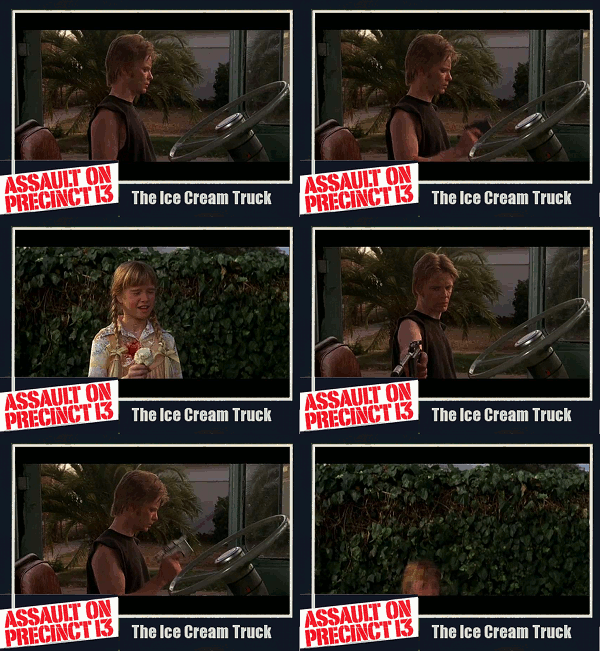
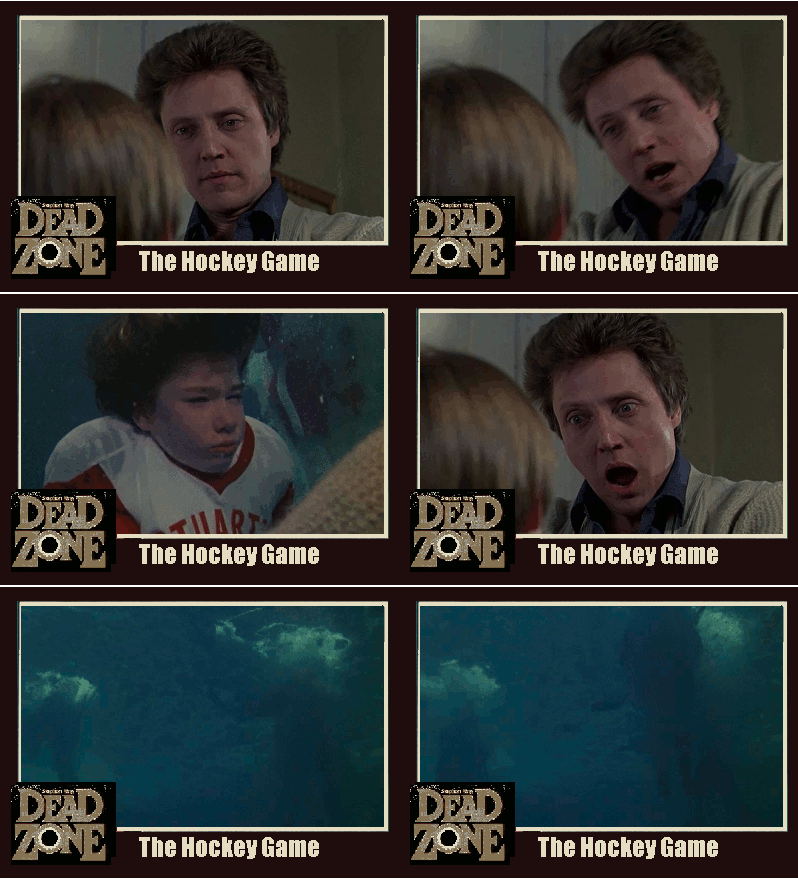
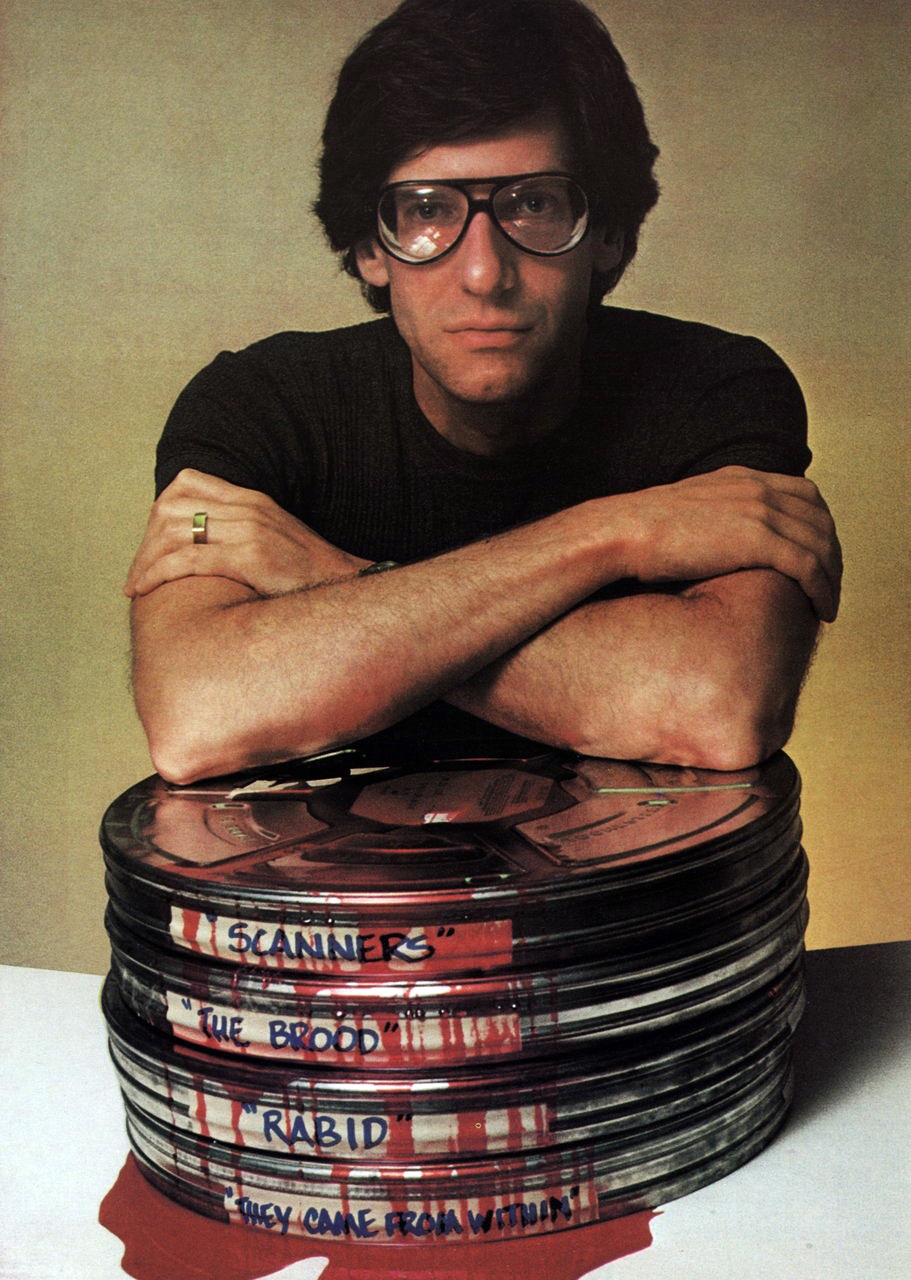
Just finished up my Animated Movie Trading Cards tutorial, and I figured I’d share my most recent creation that was made alongside documenting the tutorial. It’s inspired by the mad genius of David Cronenberg’s early films. This is one of the most disturbing visions Johnny Smith (Christopher Walken) has in the film wherein he sees a potential future wherein the kid he is tutoring (along with his friends) falls through the ice while playing hockey. I can see a whole series of these for several more scenes from The Dead Zone (not to mention Rabid, Scanners, Shivers, The Brood, and I’ll throw in Videodrome for good measure) in my future.It’s hard to compete with early Cronenberg, and this image I came across on Tumblr today says it all!
As promised, I’ve created a tutorial for the “Movie Trading Cards—Now With More Animation!” assignment I did earlier today. The tutorial was written in the spirit of the Animated GIF tutorial I wrote a while back which seems to have proven useful to more than a few people. Man, I’ve been doing assignments and tutorials for #ds106 this weekend, what has gotten into me 🙂
is an ongoing conversation about media of all kinds ...
Testimonials:
Generations from now, they won't call it the Internet anymore. They'll just say, "I logged on to the Jim Groom this morning.
-Joe McMahon
Everything Jim Groom touches is gold. He's like King Midas, but with the Internet.
-Serena Epstein
My understanding is that an essential requirement of the internet is to do whatever Jim Groom asks of you while you're online.
-James D. Calder
@jimgroom is the Billy Martin of edtech.
-Luke Waltzer
My 3yr old son is VERY intrigued by @jimgroom's avatar. "Is he a superhero?" "Well, yes, son, to many he is."
-Clint Lalonde
Jim Groom is a fiery man.
-Antonella Dalla Torre
“Reverend” Jim “The Bava” Groom, alias “Snake Pliskin” is a charlatan and a fraud, a self-confessed “used car salesman” clawing his way into the glamour of the education technology keynote circuit via the efforts of his oppressed minions at the University of Mary Washington’s DTLT and beyond. The monster behind educational time-sink ds106 and still recovering from his bid for hipster stardom with “Edupunk”, Jim spends his days using his dwindling credibility to sell cheap webhosting to gullible undergraduates and getting banned from YouTube for gross piracy.

 Or you can just audit it, which allows you to get sense of the class, the professor, what you’re getting , and answer the questions “is it worth the money?” “Will it make her life hell?” and “What’s in it for her?”





 When I was in graduate school I took a course about labor and cinema that had a wide range of post-war films coupled with readings from critical film studies, post-structuralist Marxism, etc. —you get the general late 1990s grad school drift (picnic, lightening). Anyway, at the
 Thanks to my special lady friend,