
Movie Trading Cards—now with animation!

The Thing Trading Cards: FlamethrowerInspired by the Sno-Cat movie trading card for The Shining (updated link), I started messing around with how I could do this in GIMP. While playing I started to think, why can’t we animate the movie scenes? A few hours later I figured it out and I’m currently working on a tutorial—I already submitted a new assignment for this in the Animated GIF category. There are a few things I need to clean up, like adding the trademark information below the Flamethrower title and making the card look a bit worn. Above is my first experiment with one of my all-time favorite films The Thing (1982)—and if you know the film you know how important the flamethrower truly is!

Posted in digital storytelling | Tagged , , , , , , | 5 Comments

Belated ds106 Valentine

#1 fan ds106

I’ve been crushed lately, so my ds106 assignments have fallen to the wayside, but as I begin to emerge from the crazy—which is all good—I find I am just in time for the design assignments (my personal favorite). What’s more, given all the awesome stuff happening in the community this semester, I know I have to bring my A-game cause these kids are good!

In my previous post a tongue-in-cheek response to Jared Stein’s comment gave me the idea for a new ds106 alternative Valentine’s Day card. The idea is to take an image of Kathy Bates from Misery and address it to someone letting them know you are their “number one fan.” I’ve been having fun saying “I’m a big fan” to people for the last six months (just ask Andy Rush), so I am trying to see if this localized UMW meme has internet wings 🙂 Either way, it seems good to me cause it fits in with my general mindset these days: I am a big fan of yours! So, in the example above I am officially ds106’s number one fan [cue sledge hammer] 🙂 Get the original image of Kathy Bates here, or find your own, and give the gift of hobbling this Valentine’s Day.

Posted in digital storytelling, fun | Tagged , , , , , | 1 Comment

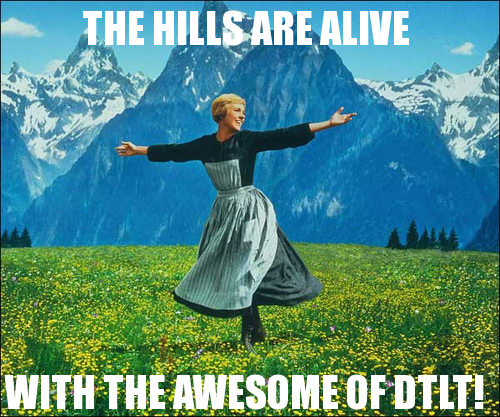
If I were to sum up this week of work in an image….

….it would look something like this.

sound_of_music

Yep, it was that good, and when I am not that exhausted I’ll try to elaborate.

Posted in dtlt, fun | Tagged | 3 Comments

My Favorite Witch

This past Halloween Anto got dressed up for Miles’s birthday (a good time to be born), and I promised myself I would make a GIF of my special lady friend in costume. Tada, four months later, here it is! That is what this year has been like, but what follows is a constant reminder of how scary my love is 🙂
anto_scary 01

Posted in fun | Leave a comment

Can Universities Reclaim the Web Too?

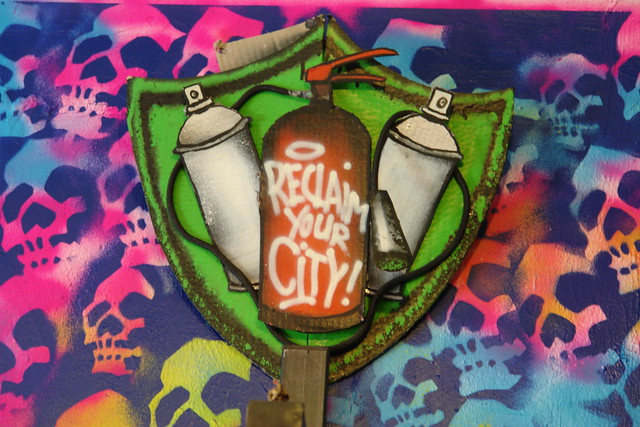
Image credit: seven_city’s “reclaim the city”

In the chapter on “The Public Engagement as Collateral Damage” in Martin Weller‘s The Digital Scholar he talks about the fact that traffic to user-generated content on commercial sites is far greater than free, open content on higher education sites:

In terms of traffic to sites, the user-generated content sites have impressive statistics: more than 100 million monthly for YouTube, 4.3 million for Scribd and 1.75 million for Slideshare (figures from http://www.compete.com for July 2010). These dwarf the statistics for most higher education projects; for instance the most well-established OER site, MIT’s OpenCourseWare site (http://ocw.mit.edu), has 200,000 visitors monthly, the OU’s OpenLearn 21,000 and the learning object repository MERLOT 17,000.

The argument being if you use commercial, user-generated sites like YouTube, SlideShare, Scribd, etc., the potential for your work to reach a wider audience is much greater. This is an idea I agree with (and have personally experienced through YouTube), but at the same time the lifespan of these sites is another question, one which D’Arcy Norman has been writing about intelligently since Posterous announced they are closing this April.

Even more problematic for me (again based on personal experience), is the fact that colleges and universities leave questions of fair use and copyright arbitration up to third party sites like YouTube when it comes to faculty and students critically examining media and sharing resources—something that remains an essential role of the academy. So, when I saw the numbers of higher ed sites like MIT’s Opencourseware, OpenLearn, and MERLOT I got to thinking that UMW Blogs has comparable stats to all of them on a monthly basis. Just this month we had  243,086 visits (177,069 of which were unique) and 478,462 pageviews. That’s coming out of a small, fairly obscure liberal arts college that is embracing the digital, networked, and open philosophy espoused in Weller’s book.

It got me thinking what institutions could do if they started approaching academic publishing platforms as collaborative, open spaces for user-generated content. What if educational institutions start reclaiming the web? If little Mary Washington can generate this kind of traffic, which is not that much less then SlideShare in the end, then what could all the public (and private for that matter) universities in Virginia do working together? I wonder if we might be approaching a moment where the vision of the digital, open, and connected Weller talks about can be supported and encouraged by educational institutions as a way of becoming hubs of open content.

What’s more, as we encourage faculty and students to take ownership of theses spaces and move away from share cropping on third party sites (a lĂ  Domain of One’s Own)—-universities should be managing sophisticated syndication networks that enable individuals to manage and control their own work but aggregates it intelligently for better search engine optimization, generative juxtaposition of content, and intelligent filtering and relational organization via tags. We have only just begun to explore the possibilities of what it would mean for institutions to own these resources and share them through free and open platforms! I AM SO FRIGGIN’ EXCITED!!!

But wait …. the rise of the corporate MOOC has rendered these pursuits passè—any sense of innovation around publishing on the web has gotten lost in the hype, and elite universities are dumping their content into an LMS on steroids in a vain pursuit for raw numbers that is anything but open. A deal with the devil, BlackBoard all over again. Ah Bartleby! Ah Humanity!

All that said, I remain encouraged by Stephen Downes’s assessment of a million flowers blooming in the wake of this wave of elite university MOOC madness, I’m all for optimism these days. And the fact that the MOOC crash will have served to establish open, online learning as a reality that is fundamental to every educational institution’s mission from here on out might very well be the case. And if so, the approach outlined above is just a damn good head start  😉

Posted in Domain of One's Own, Faculty Initiative, UMW Blogs, YouTube | Tagged , , , , , | 10 Comments

From Punk to Policy

1118lovestreams
For over a year now I’ve been part of the Digital Learning Resource working group (along with 15 other representatives from a range of public colleges and universities) run by the State Council of Higher Education for Virginia. I’ve already written about my excitement at witnessing this committee morph from a routinized exploration of e-textbooks to a much more relevant focus on the broader landscape of open, online learning. It’s been a wild ride, and I have been having a lot of fun all the while talking about some of the implications if public colleges and universities start sharing and collaborating on the work we are doing in this space.

It’s been a vision of DTLT’s ever since UMW started experimenting with WordPress MultiUser Multisite (which eventually became UMW Blogs), and its seemingly limitless possibilities for aggregating and connecting work from students and faculty from around the state. A framework for illustrating how networked, open, and digital technologies could augment the work we all do as public colleges and universities within Virginia. Realizing such visions are slow going, but I can’t help but get excited as the fruits of the last year of labor with the Digital Learning Resources working group manifest as the OpenVA conference in two weeks (registration closes this Friday, see the draft schedule here).

There are many folks who discount out-of-hand the power of working within institutions to effect cultural change, but I’ve since fallen out with the reactionary rhetoric of  crisis in higher education since the heady days of EDUPUNK in 2008. As corporate-driven MOOCs frame the perfect narrative for cutting public funding in higher ed, there’s never been a more crucial moment to reinforce the importance of the state’s sustained investment in public education. And for me that’s exactly what OpenVA is about. I’ve seen the amazing things happening in public higher ed around the state of Virginia, and if we can’t come together as an entity and start demonstrating why the public’s investment in us, the people who work for the people of the Commonwealth of Virginia, is far greater than its lifeless, imagination-bereft investment in conglomerated, corporate solutions when it comes to educational technology, digital resources, etc. then shame on us. It’s our responsibility to step up and demonstrate there is another way.

I’m tired of the complaining. I’m tired of hearing this and that isn’t possible. I think UMW’s DTLT has made it insanely clear anything is possible within this space, and it is time the state government understand that as well. Joe Ugoretz wrote recently about the idea of an emerging Doitocracy, the idea that credit comes after doing, not before. And those who do most get the most credit, I like that, particularly given how many times I’ve heard nothing could be done with a state agency like SHCEV in such a working group—why not? They’re state workers too, and I can’t but help believe that people truly want to see education thrive in the future, and that public institutions like UMW will remain affordable spaces that fund critical thought, research, experimentation, teaching, and learning outside of the crass market pressures that everywhere pervade. It’s essential to the health of our culture, and it’s worth working very hard for. Hell, it’s worth fighting for! Who wants to sit by idly and call the play-by-play on twitter as MOOCs rip through our institutions leaving a shell of an already decimated public funding base? Not me, I want to fight that vision of the future with one we can create together.

In two weeks UMW will be hosting a statewide conference that Virginia Secretary of Education Laura Fornash will be attending. The day will contain a rich, diverse series of ideas and practices that will showcase the wide array of homegrown innovation happening around Virginia’s pubic institutions.  What’s more, the state is looking to us to help them identify new innovations for promotion and policy emphasis. I’m not a politician, hell, I’m downright impolitic, but god knows we need to start taking the innovations and experimentations we are doing around the state of Virginia and making them visible so that they can be funded. What’s more, we need to start remembering that we make this system run, we are the people it wants us to elide. We need to set an agenda around open education in Virginia, we need to influence that policy, and start framing the future of public higher education in this state beyond the vulture-ridden vision of capital-driven efficiency. We need an investment in the people that have been framing those innovations all along. This is EDUPUNK with a policy, don’t let them sell us back out ideas, make them further fund what we all have already paid for!

Posted in edupunk, open education, openva | Tagged , , , , | 4 Comments

What about the UMW Students?!

Image credit: Megan McMillan”s Awesome!

Lest I forget after paying all sorts of love to the UMW faculty for the emergence of the digital at UMW in my last post that there’s another part to this whole equation: the students! I always find myself in a strange place when talking about students because I don’t want to be that middle-aged creep pretending to know what’s best for the “milenials” in the worst patronizing ways (if you’ve been part of edtech for any amount of time, you know what I am talking about). In fact, I’m probably the worst person to talk about empowering students given how much DTLT student aides like Tyler Crump hate me (straw, ego, lightening, picnic).

That said, everywhere in my network there are awesome UMW students who continue to blow my mind. Take UMW student and ds106 alum @captmorrgan who just tweeted out a link to a survey for her senior research project about attributing responsibility in rape:

That was just a few minutes ago, what’s not to love about UMW students? I kinda take them for granted, they are cool, gritty, freaks, and geeks. There general awesomeness make all the middle-aged fumbling we do around technology that much better, because for some of them it clicks and they proceed to blow our minds.  I mean look at recent graduate Sarah (@cali4beach)—another #ds106 alum—who continues to rock the blog while teaching in South Korea with a mashup of Calvinist fire and brimstone and Catholic guilt —I love it:

Or fellow classmate and ds106 alum Megan McMillan who two years after graduate refuses to stop rocking the design assignments like a boss.

Are you kidding me, how much more awesome does it get?

Image of EmilyWell, I guess there is Emily Potosky, who for more than two years has been regularly updating her blog about her time in South Korea as a Fullbright fellow, and beyond. There’s an amazing archive of her work as an English teacher (and she is damn good), as well as an American abroad, a UMW alum, and all around compelling storyteller. She has been one of my favorite reads for almost two years now. Crazy!

As for the group of ds106 maniacs from UMW killing it this semester with Alan Levine, I don’t even know where to start, they make me feel old—“remember the days when ds106 actually taught you something?” They are working at another level right now.

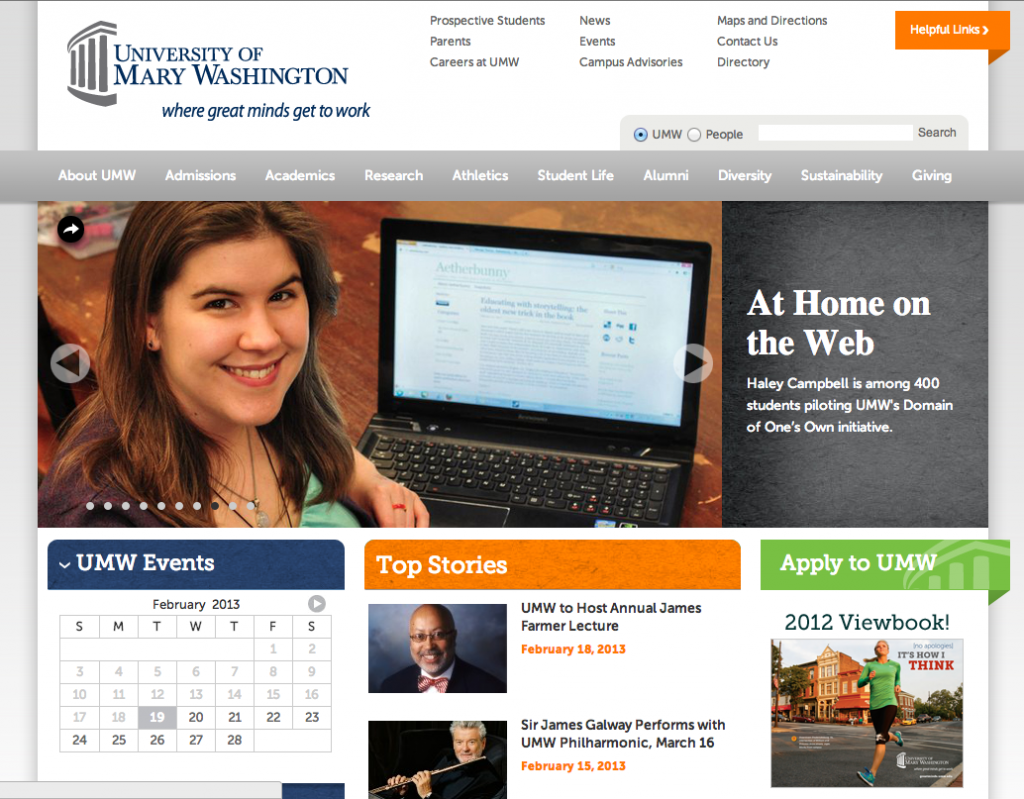
Screen Shot 2013-02-19 at 12.38.31 AMI don’t want to be a creeper, I swear, I’m just deeply compelled by all their awesome narratives, and the amazing things they do on a regular basis. Just last week ds106 alum and DTLT’s own student aide Haley Campbell is currently featured on UMW’s site based on her amazingly articulate and compelling vision of the web as part of a rising generation who can’t imagine a moment before it, but in a far more rich and complex way than any of the digital native tripe. Don’t believe me? Listen to this bit on the “realism of the web” and tell me if she doesn’t sound like another Campbell who has a thing or two to say about the web.

So, in the end, I don’t claim to understand their generation at all, although I think they’ll write the poetry that will truly elucidate the impact this space has on our individual and cultural sense of self (paging Brad Efford and Shannon Hauser), with them it will become mature, not the vestigial marketing organ that we’ve mistaken it for. UMW students are the hope I have every day I come to work, I want them to live in the web and interrogate it. I want them to hate it, love it, break it, dream it, and inhabit it in ways they never thought possible. That’s the empowerment I pretend to, but I know it is itself weak and feeble, but that’s all I got—they will have to fill in, correct, and re-imagine all the omissions, mistakes, and downright misrepresentations I am assuredly guilty of. But I’ll try not to speak for them cause they can do this too. They can type out the words that might just hit a nerve with someone else out their in the amazing void just beyond the screen. I love UMW students, but I’m a terrible amnuesis—their story is for them to own.

Posted in umw | Tagged , , , | 2 Comments

It Takes a Liberal Arts Village to Raise a Digital Campus

daisy_chain

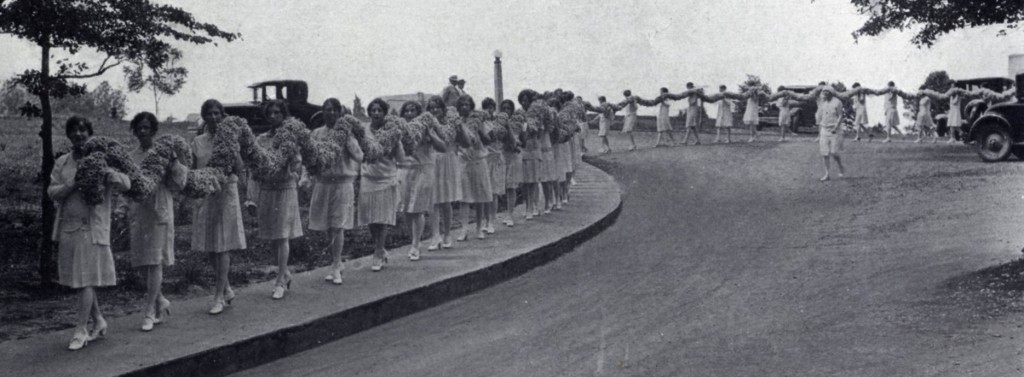
UMW Daisy Chain (it takes a village to sew a giant serpent out of daisies)

UMW alum-cum-journalist Lindley Estes wrote an article today in the local Fredericksburg paper, The Free-Lance Star, about the brave new digital world emerging at UMW (forgive them the ads and video commercials, online publishing has confounded more than a few newspapers). It’s pretty cool to read about a legacy of work that’s been happening at UMW for almost a decade now (yes even before I was at UMW Andy, you bastard!), cast in a frame that starts to acknowledge the various “pilot” projects that have fomented a widespread movement on campus and beyond. From the early Bluehost experiment to UMW Blogs to ds016 to Domain of One’s Own (and countless course blogs, research sites, and faculty-driven experiments in between) the UMW community is being recognized for its pioneering work in the digital arena, and that’s a tremendous source of pride for all of us.

And while we all know credit is a fickle lover, it’s still important to try and be clear about such things not only so that every one gets their due (which is important), but even more so to resist the urge to make any shift in the culture of UMW about a single person or thing. It’s a tempting narrative (“‘Hey, Sebastain Thrun, we need to fix Higher Ed in California!’ said Governor Jerry Brown into the phone receiver one dark and moocy night.” Thanks for the inspiration Audrey Watters 😉 ), but in the end it’s not good history. And I’m not suggesting Linley Estes is doing this in her article because there is a long history of experiments in this regard, but when talking about the minting of a brand new Digital Studies minor at UMW I think it’s essential to recognize that this new minor at UMW is the work of a whole host of faculty from 15 disciplines led specifically by Jeff McClurken and Zach Whalen. And, in many ways, ds106 is one part of a larger constellation of courses that breathed life into the minor.

It’s important to do a roll call of faculty folks at UMW every once in a while so that we don’t turn the movement into a monolith: Mara Scanlon, Leanna Giancarlo, Rosemary Jesionwoski, Marjorie Och, Nina Mikhalevsky, Karen Anewalt, Chris Foss, Gary Richards, Carole Garmon, Claudia Emerson, Mike McCarthy,  Melanie Szulczewski, Jeremy LaRochelle, Betsy Lewis, Steve Gallik, Sue Fernsebner, Steve Harris, Jess Riggelhaupt, Mark Snyder, and many, many more. That’s awesome, just doing the roll call. Just seeing all the faculty who have a million other things on their plate, taking the time to do the digital work that needs to be done, and doing it really well! I’m proud to watch the era of the open, connected, and digital emerge at UMW. I’m proud to be an integral part of it all. But more than anything else,  I’m proud to support a faculty that’s done it all pretty selflessly while DTLT (and you can read that as me) has been galavanting around the country talking about all the awesome work our faculty has been doing. It’s time start sharing the credit far and wide. It takes a liberal arts village to raise a digital campus 🙂

Posted in digital identity, digital storytelling, Domain of One's Own, umw | Tagged , , | 3 Comments

Rambo Kills

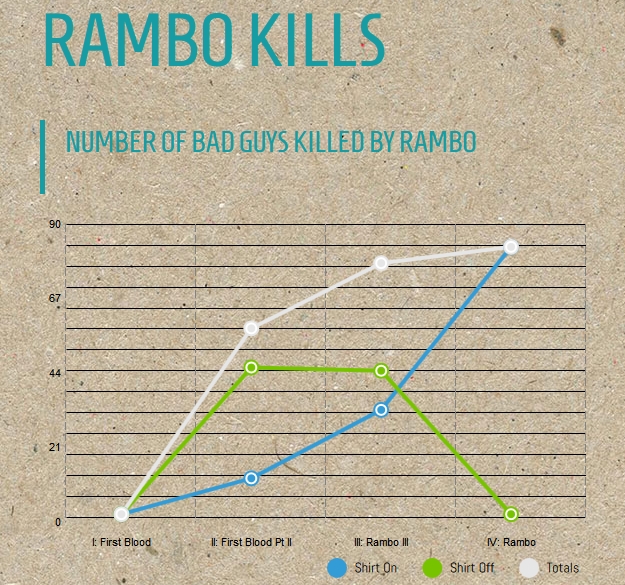
The other day in our Domain of One’s Own faculty initaitive cohort we were talking about embedding media in a blog, and one of the faculty pointed us to the site infogr.am, and while looking for an example to embed we came across this awesome chart of Rambo Kills mapped by those killed with and without a short on.  This is the kind of data I am interested in! Analytics #4life (and death!).

ScreenShot120

Posted in Domain of One's Own, Faculty Initiative, fun | Tagged , , , , , | 3 Comments

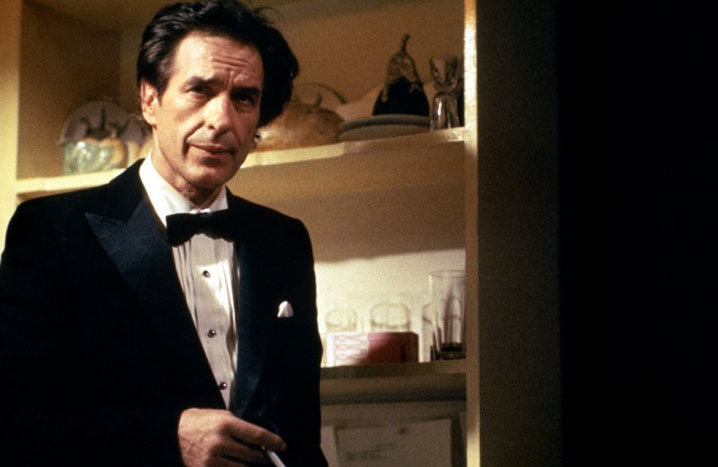
The Ice Man Killeth or, Dr Oblivion….is that you?

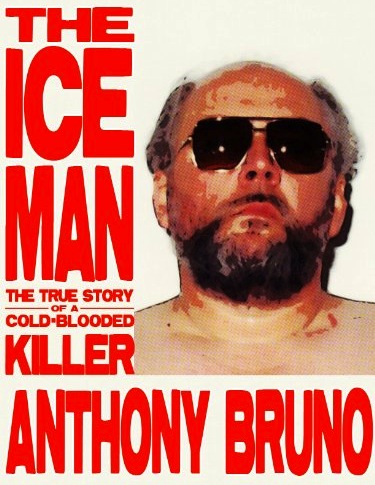
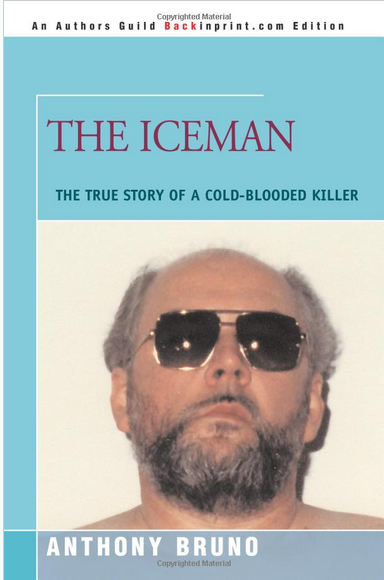
The great George Meadows sent the image below of a book about a cold-blooded killer who lived a double life as a suburban New Jersey family man. Crazy story, from what I could glean, having killed over 100 people during his career as a mob hitman, but the most striking thing about this figure was just how much he looks like Dr. Oblivion, which is deeply unsettling. I really hope the True Crime class Paul Bond and I are teaching this Fall doesn’t take a wrong turn—there is portion of the class dedicated to the mob in the 1970s and 80s. It’s easy to forget just how dark this stuff is until you start reading up on people like the Ice Man, it’s a chilling topic—I hope I am ready for it.

The Ice Man Killeth!Screen Shot 2013-02-14 at 12.41.29 PM

Posted in digital identity, digital storytelling | Tagged , | 12 Comments