
I’ve heard Gardner Campbell talk at length about Networks of Networks as a way to describe what’s happening in a course like his own New Media Studies or ds106. You can listen to him wax poetic on the concept in this talk given to ds106 back in January of 2011. The idea here is that rather than understanding courses like these as MOOCs in terms of massive, broadcast learning experiences, they become localized, fractal relationships that form a loose, yet dynamic, community born out of the web (not unlike the metaphor Mike Caulfield has been exploring with Inter Library Loan and online learning here). I love this idea, and for me it’s a jumping off point for beginning to understand scale in new, more complex and compelling ways. The idea of numbers is compelling only insofar as you are trying to monetize those numbers, the figures of fractal course frameworks and transformative learning networks are much harder, though not impossible, to assess because it begins to outline the contours of humanity in these courses. In fact, the very idea of constantly using and re-using new relationships between ideas to explain these technologies seems distinctly human—but I have to admit I don’t speak dog 😉
The occasion for thinking about the Networks of Networks idea came while playing around with Jeff Mcclurken’s ds106 blog last night. And let me say it’s awesome to see Jeff playing around with ds106, and his reasons for doing so are exemplary—walking the walk is always awesome. What’s more, mcclurken.org is actually a mapped network on UMW Blogs, not a mapped domain but a mapped network, and the difference is significant. Jeff can build a series of sites within his own domain that remain within the larger network of UMW Blogs, a network of networks that anyone and everyone inside (or outside of UMW Blogs) can create. As we move forward with the Domain of One’s Own project (which is a done deal and provides 400 faculty and students their own domain and web hosting the first year) we can start approaching the idea of setting up these spaces as networks of thought and interaction rather than the more static connotation of a site.
What I ‘ve always loved about WordPress is as a technology it provides a solid metaphor for the concepts of networked learning, web-based platforms, and distributed openness—it’s not surprising either because it’s an application of and on the web—a result of years of web thinking, to quote Jon Udell. So when I was fixing a bug in Jeff’s network that was preventing comments on the site (basically the Cookies for Comments plugin had a rewrite in the .htaccess file that was borking all comments on networks other than UMW Blogs) it occurred to me that Jeff’s mcclurken.org is not just a mapped site, but a network of his work that other faculty and students can also create. From there the question of how we think about syndicating and aggregating these networks so that they make sense and provide possibilities for serendipitous discovery. This is just one of many questions that we have to grapple with in regards to the Domain of One’s Own pilot that we are starting at UMW. Let’s not force people to use the web hosting as much as we let them decide from a menu of options for mapping on an external service, networking on UMW Blogs, creating their own, etc.
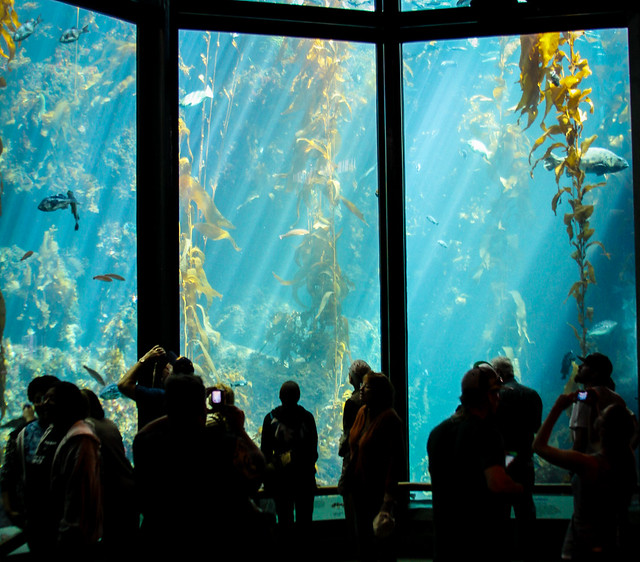
Image credit: Scott Schrantz's "Monterey Bay Aquarium"
More than anything though, the macguffin that will be driving my thinking for the next year is how can we use aggregation and syndication to bring individuals, courses, and departments to the umw.edu website in a seamless way so that our university’s WordPress install can leapfrog UMW Blogs and become the public platform for syndicating and aggregating the activity around the community in order to demonstrate the life of the mind at UMW and beyond. This is an idea Cathy Derecki and Curtiss Grymala have been pushing for a while, and I outlined it at a recent talk I gave at Penn State University that the great Brad Kozlek was kind enough not only to attend, but also to take pretty comprehensive notes. The “university website is not a brochure – but a fish tank providing a view into the activity of community,” and the fact that UMW is soon to have numerous levels of engagement at the individual, course, and department level will allow us to start imagining what this might look like in terms of representing the work being done throughout the community in some simple, dynamic, and enagaging ways on the web.


 I recently watched