Data Domains are Beautiful

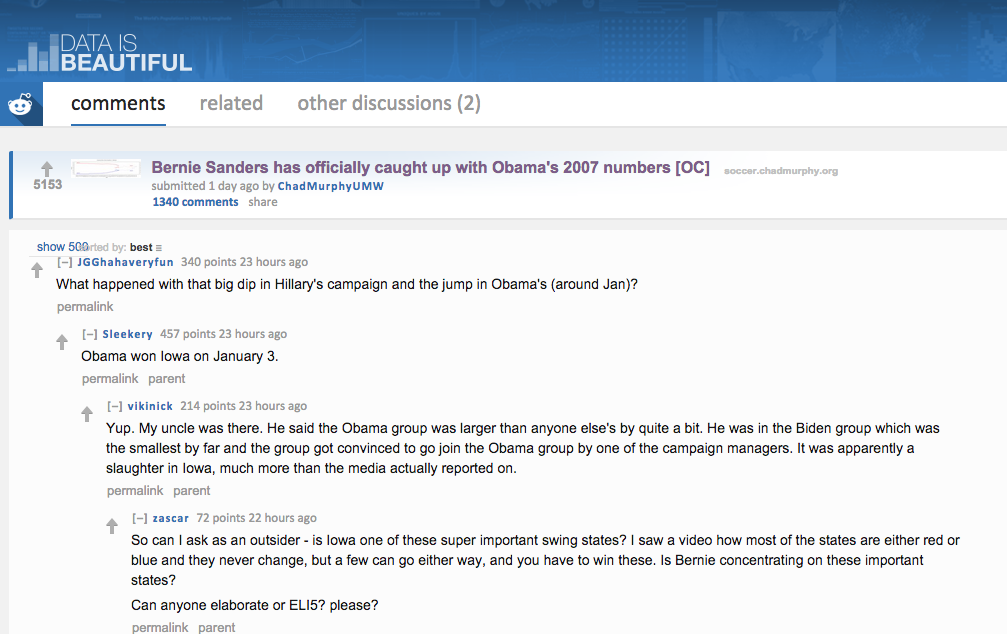
Screen Shot 2015-08-27 at 3.40.29 PM

Tim Owens pointed out the fact that Chad Murphy’s post about Bernie Sander’s catching up with Obama’s 2007 poll numbers went bonkers on Reddit last night.

Democrats-0825-1

Click image for larger view.

It’s a pretty telling graphic, and if historical data is, indeed, a predictor of things to come, this will prove an interesting road to the 2016 election. Special thanks to Chad for helping us stress test UMW Domains 😉

What was even cooler was that the image led me back to Chad’s personal domain. He’s been using his domain to do some intense data analytics and predictions around the world of Soccer. Who knew he was a soccer statistician with predictive models around late season success?  The things you learn when you give your community their own personal web spaces to cultivate and publicly narrate their passions. I love seeing stuff like this. so awesome.

Posted in umw domains | Tagged , | 2 Comments

From the #ds106 Valley of the Shadow of Death

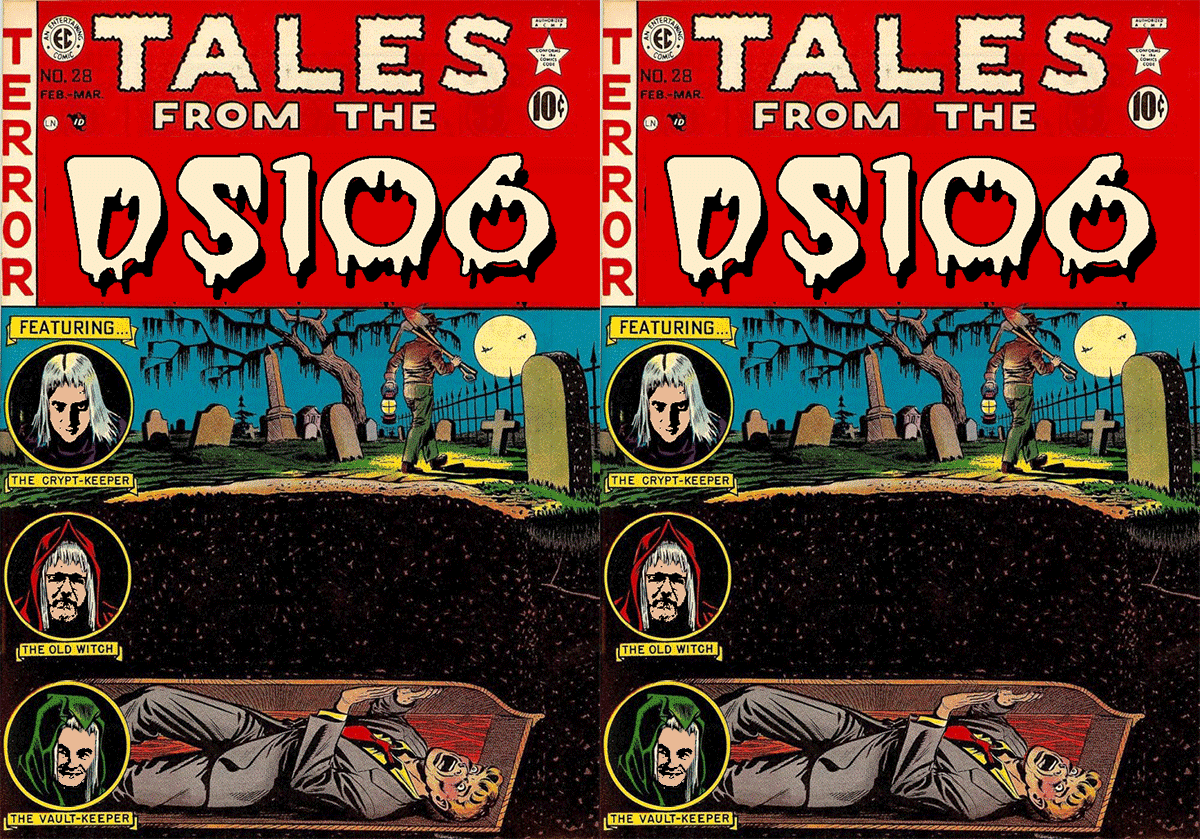
Paul Bond and I are collaborating on yet another iteration of ds106 this semester: Tales from ds106. Like Noir 106, this class is inspired by a specific theme, namely horror. Early on we’ll be using some of the 1950s EC Comics Tales from the Crypt to explore the genre.

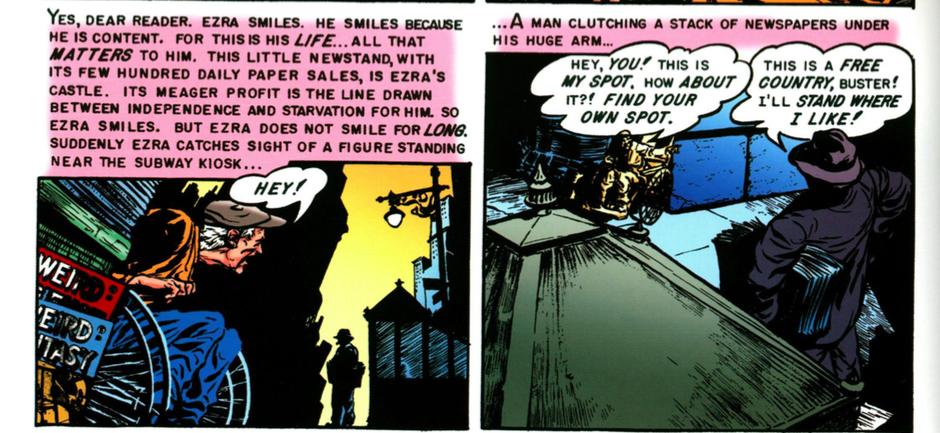
Why Tales from the Crypt? You could argue these comics helped define the imagination of a whole generation of horror artists and filmmakers—the aesthetic is unmistakable and the narratives are often an updated version of the classics for 1950s America. Take, for example,  “Shadow of Death” (#39 1954) illustrated by Graham Ingels and written by EC Comics masterminds Bill Gaines and Al Feldstein.
Screen Shot 2015-08-26 at 8.17.28 PMThis story features a disabled news stand owner (Ezra) whose business allows him to just eke out a living. But shortly into the tale even that meager existence is soon threatened when an abled-bodied man tries to steal his business by selling papers to his patrons as soon as they come out of the subway. The threat of losing everything torments Ezra, so much so that his shadow takes matters into its own hands. It might be seen as a twist on the Dr. Jekyll and Mr Hyde tale, and the magic is in the artwork and the details. The idea of there being no safety net for our victimized hero in this dog-eat-dog world is set against a newspaper headline decrying “Reds” —a derogatory term for Communist sympathizers popular in the 1950s. The dark humor of Tales may have provided a popular outlet for many potentially marginalized readers with its thinly veiled critique of this white-washed, apple pie period in American history.

Screen Shot 2015-08-26 at 8.16.35 PMBelow is the Discussion Paul and I had about this story. If you are crazy enough to take the twenty minutes to watch it, I  highly recommend you follow this link and spend the 5 minutes it will take to read the comic first 🙂

https://www.youtube.com/watch?v=sPZcp17bU0s

Also, major kudos to Paul Bond for his jumping head first into the green screen video work, and blogging how he did. Selfdogfooding #4life. I absolutely love the intro for Tales from ds106 he made, and he scored big with the  find on the music  I’m sure we’ll be doing many more of these, as will the students.

Posted in digital storytelling | Tagged , , , | 2 Comments

A Domain of the Practical

tumblr_lsj3cvuLrW1r3h8j5o1_500

Adam Croom offered up a hypothesis in response to my post about the “Long Short History of Reclaim.” He argues that as much as Domains at the University of Oklahoma is deeply embedded in a philosophy of empowerment, ownership, and experimentation, it’s also extremely useful. Who knew?!

OU Create for us has became a practical tool for our community as much as philosophical one. It is indeed an infrastructure that makes building full websites possible to a much greater audience.It also gives us enough slack to build in a plethora of digital literacy components. This complexity is highly valuable in serving a range of needs.

I think the practical component of folks having their own space to publish easily to the web has been a huge draw. Tim has made the whole experience so seamless and dead simple that someone can literally help themselves to an Omeka or WordPress instance (or both) on a brand new domain in seconds. This is where the practical meets good design to make a near perfect marriage. When you take someone through a demo they’re incredulous, “That’s it?” And we’re convinced we can make it even more streamlined. While we’re driven by the ideals undergirding reclaiming the web, we are also deeply conscious of the fact that good design with practical applications will make that vision a reality quicker than any of the rhetoric.

Another interesting post that dovetails with this idea is the great Tony Hirst’s “Getting Your Own Space on the Web.”  Tony acknowledges the value of offering a space to folks who want to assume the responsibility of running their own applications for publishing to the web. But what about those who don’t?

What if you only want to share an application to the web for a short period of time? What if you want to be able to “show and tell” and application for a particular class, and then put it back on the shelf, available to use again but not always running? Or what if you want to access an application that might be difficult to install, or isn’t available for your computer?

I would add to this, what if the application you want to install doesn’t run on the widely popular LAMP stack we’ve built Reclaim Hosting on? This is where Tony’s explorations of virtualized server environments and containers over the last year have been fascinating. Tony has traditionally been the canary in the coal mine when it comes to pushing innovative edtech. The work he’s been doing and questions he’s been asking fit well with the work Tim and I having been pushing on for over a year (with some serious help from Kin Lane). How does this personal webspace also include virtualized apps and containers glued together with APIs to enable experimentation with a wide range applications across a variety of server environments and dependencies for short (or long) periods of time. How do we start realizing the possibilities of server infrastructure as a teaching and learning utility we can count on for fast, cheap, and out of control edtech?

Tony is thinking hard about how this effects deploying educational software for distance and online education, his role—assumed or official I don’t know—at the Open University. That practical use case provides some truly compelling challenges and possibilities for such work. The issue remains that it’s still not easy to work with virtual servers and containers, though Docker hosting services like Tutum are beginning to make some real headway in this regard. As my time at UMW comes to a close, more and more of my attention and focus will be pointed at this emerging virtual architecture of edtech, and what it might means in terms of the work we do at Reclaim.

Posted in reclaim | Tagged , , , , , | Leave a comment

A Long Short History of Reclaim Hosting

Earlier today Adam Croom shared that OU Create (the University of Oklahoma’s Domain initiative) would be open and freely available to the entire campus. That’s pretty remarkable news, and quite a testament to the unbelievable work folks like Adam, Mark Morvant, and Kyle Harper have done over the last year. It’s deeply rewarding on a personal level (and I imagine Tim might feel similarly) because Oklahoma’s interest, excitement, and faith in Reclaim helped us take the leap from giving free hosting and $12 domains to providing a full blown domain and web hosting infrastructure for an entire campus.

Descriptive_Zoopraxography_Boys_Playing_Leap-frog_Animated_13

History for me is always personal, and I track the history of Reclaim through the people who helped make it happen. It goes without saying the work Tim Owens was doing in the Winter and  Spring of 2012 with Hippie Hosting is foundational, and the inspiration for that shoeless co-operative started because folks like Alan Levine, D’Arcy Norman, Dave Cormier, and Scott Leslie were clamoring for options beyond Dreamhost and their ilk (amirite?). That’s the work that would come to define the Domain of One’s Own pilot at UMW during the 2012/2013 academic year.

Hippie Hosting

The birth of Reclaim Hosting as an idea to help universities run their own Domains projects will be forever connection with David Morgen and our trip to Emory University in January 2013. Tim and I hatched the idea on the VRE ride back to Fredericksburg after that trip while dreaming about the possibilities.

How Canadians are hatched

Reclaim’s embryonic stage is deeply associated, at least for me, with my first real crossing of paths with Audrey Watters and Kin Lane at the MIT Hackathon in March 2013—nicknamed Reclaim Open. We named the baby soon after 🙂 It was born July 31, 2013 thanks to $800 leftover from a Shuttleworth grant made possible by David Wiley, and a crazy push from Tim to say we could actually do this. We had a tremendous amount of interest when we first announced the idea, and we realized we might need some serious money for domains, so we did a community callout for a short-term loan, and raised almost $12K from our community within a week. A vast majority of it made possible by Mike Caulfield‘s unparalleled generosity. Turns out we overestimated how much we would really need (who knew 1500 people wouldn’t sign up in one day?) so we were able return the money within the month. But how amazing that folks supported our efforts from the get-go and helped us finance the beginnings of this adventure with no expectations of anything in return.

The following year was a roller coaster. We had over 1500 sign-ups from August through June, and we only charged folks $12, essentially the cost of a domain—we threw in a year’s hosting for free. At the same time I started digging in around the idea of the next generation of campus tilde spaces, and started presenting about Geocities, the long history of domains, and the fact that higher ed built the web, yet we continue to denature ourselves from its true potential for teaching and learning. Blah blah blah. [Much of this work was inspired by my co-teaching the Internet Course with Paul Bond, and my part at least fueled my portion of the Reclaiming Innovation article I co-wrote with Brian Lamb.]

It was the presentation at Sloan-C, “Domains in the Afterglow,” in April 2014 where all these elements finally came together in a semi-cohesive vision. That was also where and when institutions like Oklahoma and Cal State Channel Islands started to show some interest in the work Tim and I were doing. Interestingly enough, at that same moment Reclaim Hosting was down to it’s last couple of hundred dollars, and Tim and I were kind of ignoring the fact that we weren’t really sure what was next. We provided a compelling model for faculty and students getting cheap one-off sites for courses, as well as highlighting the real power of having a hosting company for the education sector run by folks who have a deep understanding of ed-tech. That said, we were doing everything at cost. And at least for a little while during late Spring I started thinking, “Well, that was fun, and it makes sense as an idea. But, alas, our bank account is near empty, so I hope someone with some business sense runs with it. What’s next?”

But then Tim and I got a call from Adam and Mark at Oklahoma (if you give any story enough time it gets back to its original point) who basically said they had gotten all the approvals and made everything possible logistically, they just needed to know if we could run a 1000 person pilot that coming Fall with Reclaim. I was sitting at the dining room table in my brother’s house in Montauk, L.I., it was late June and our vacation had just started. Listening to Mark and Adam commit marked yet another moment in Reclaim Hosting’s story. We had found partners at the institutional level who wanted to work with us. They knew we were a two person, rag-tag outfit with big mouths (that would be me)  and big archiTECHtural chops (Timmmmmyboy!) and they had faith in us. Tim and I were pinching ourselves.

That moment helped us re-calibrate for the coming year. And like dominoes, other schools started calling as well. Just a few days later Cal State Channel Islands committed to a pilot thanks to Chris Mattia, Michael Berman, Michelle Pacansky-Brock and Jill Leafstedt. All of whom, including the folks at Oklahoma, were at the Sloan-C workshop and presentation about Domains in the Afterglow.

Channel Islands pushed Tim and I on the idea of doing what we called a “Subdomain of One’s Own,”  which effectively provided all the affordances of web hosting as a subdomain of a top-level domain such as cikeys.com. So I could have jimgroom.cikeys.com and students and faculty could choose to purchase their own domain at the time of sign-up—a step which made Domain of One’s Own far more affordable for schools to run. This is exactly what Oklahoma is doing in their current roll-out campus-wide.

A few days after Channel Islands, Kristin Eshleman and Mark Sample of Davison College called to commit to a pilot. Insane. And to tie it all up in a neat package, David Morgen from Emory (the point of inception [INCEPTION!]) brought the Domains project they had already been running for an entire year over to Reclaim Hosting. What we might call the first Fantastic Four institutions of Reclaim Hosting.

The academic year of 2014/2015 is a blur. I don’t really remember given all that happened, but I do know we had four amazing institutional partners, over 2500 faculty and students on our shared hosting, and Reclaim was no longer a side project. It was bonafide. This fall we have 20 more institutions joining Reclaim Hosting, and our shared hosting service has been growing exponentially, and we are quickly approaching the 5000 mark. It’s been a really, really intense 14 months since that call with Adam and Mark in late June, but all the dreams and visions that flashed before my eyes on that call are coming true. And we really couldn’t have had better partners along the way. From faculty like John Maxwell at Simon Fraser University who early on believed in what we were doing (I love that guy!) to UMW graduates like Amber May who will soon be our newest reclaimer!

When I read Adam Croom’s post today yesterday (I spent a lot of time writing this) I simply meant to draw attention to it and note how they had realized the half-baked vision of the next generation tilde spaces for higher ed at an institutional level I would have thought impossible last June. Here’s the bit from the email Adam sent to the entire Oklahoma community that struck me:

Today I’m excited to let you know that, with the support of the Office of the Senior Vice President and Provost and OU Information Technology, OU Create is moving to full production and requests for use will no longer be required. Starting today, users can register a subdomain (yourname.oucreate.com) at no cost or purchase a top-level domain (yourdomain.com) for $12/year. This domain is registered directly to the user, owned by them, and transferable to any domain registrar at any point in time.

Because OU Create is now openly available to members of the OU community, OU IT will begin a process of decommissioning older web services. Students.ou.edu will be taken offline following the Fall 2015 semester and faculty-staff.ou.edu will be set to expire at the end of Summer 2016. All files maintained within these spaces that you wish to keep will need to be transferred to OU Create.

This email feels like another giant leap in Reclaim’s short history, and we could have only gotten to this point because we work with some seriously awesome folks who want to empower their community members to share far and wide.


Posted in reclaim, Uncategorized | Tagged | 3 Comments

Leaving UMW: the 2008 Edition

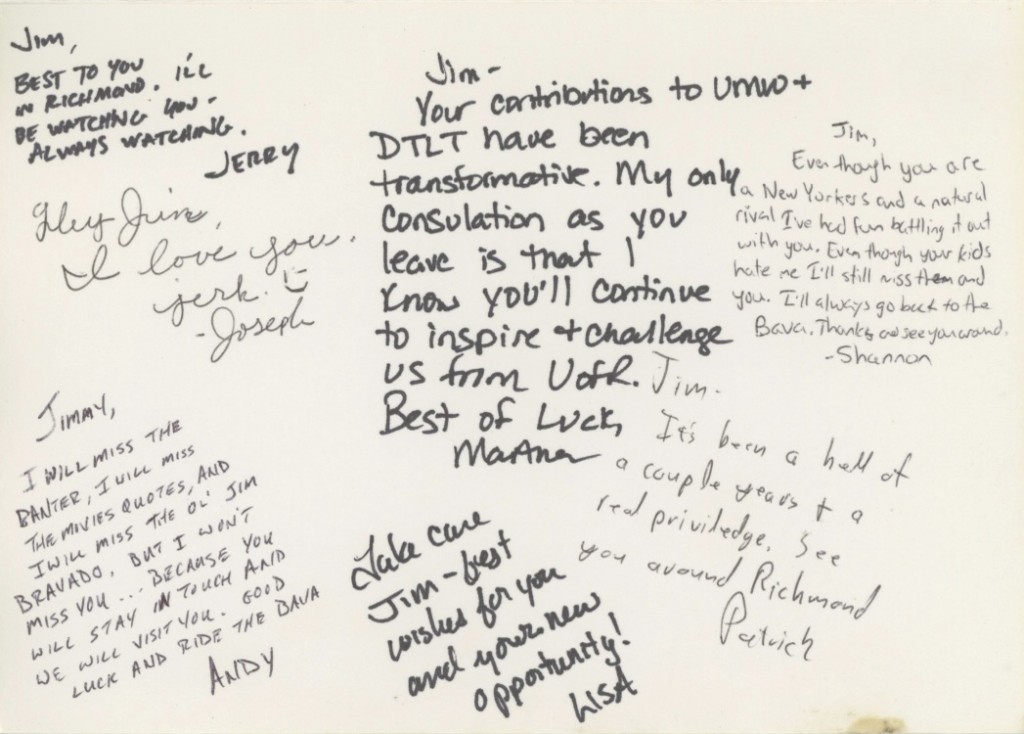
2008_goodbye_cardgoodbye_card2

While packing up the books in my house (I haven’t even started on the office yet), I found the above card from my DTLT colleagues wedged in a Captain America Mad Libs. They gave it to me back in February of 2008 on the occasion of my first remove from UMW to work at the University of Richmond, a period we affectionately refer to as my “sabbatical.” I have to admit it’s kind wild to find this as I prepare for the second remove. Things will be changing for me very soon, and that comes with it’s own excitement. But artifacts like this provide a pleasant reminder of just how important these folks have been in my personal and professional life over the last ten years. I’ll miss the salad days of DTLT. See that, I started the nostalgia before I’m even out the door 🙂

Posted in dtlt, umw | Tagged , , | Leave a comment

Sleazy Design or, the Ugly World of Web Hosting and Domain Registrars

I was transferring someone’s domain over to Reclaim Hosting from another domain reseller this morning, and I was appalled at how sleazy they made the whole process. The registrar goes through alternating strategies from wooing to scaring to trying to make it work to resignation to withholding during a simple process of transferring a domain from one company to another. What’s more, they’re up-selling you all the while. It’s very sinister design. Did I mention they’re charging 2 to 3 times the going rate of a domain? Insane.

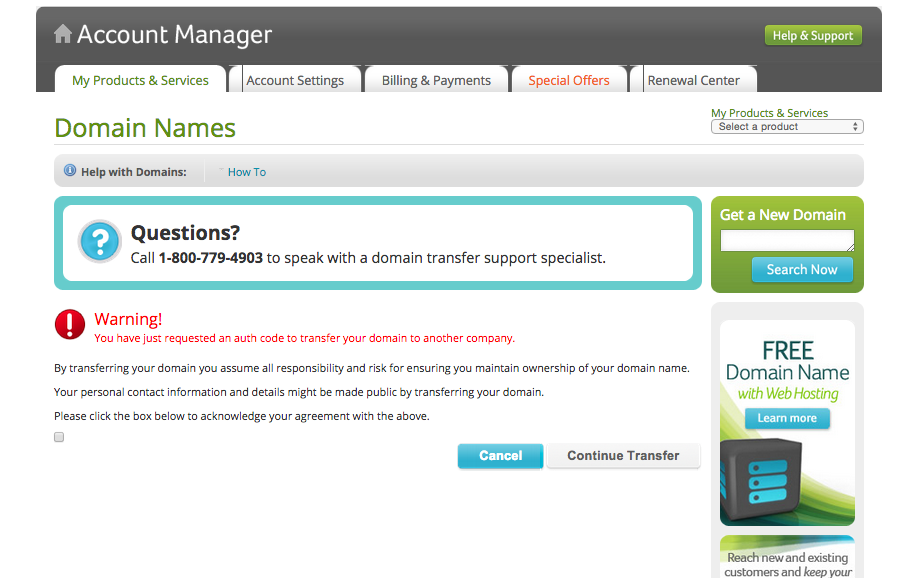
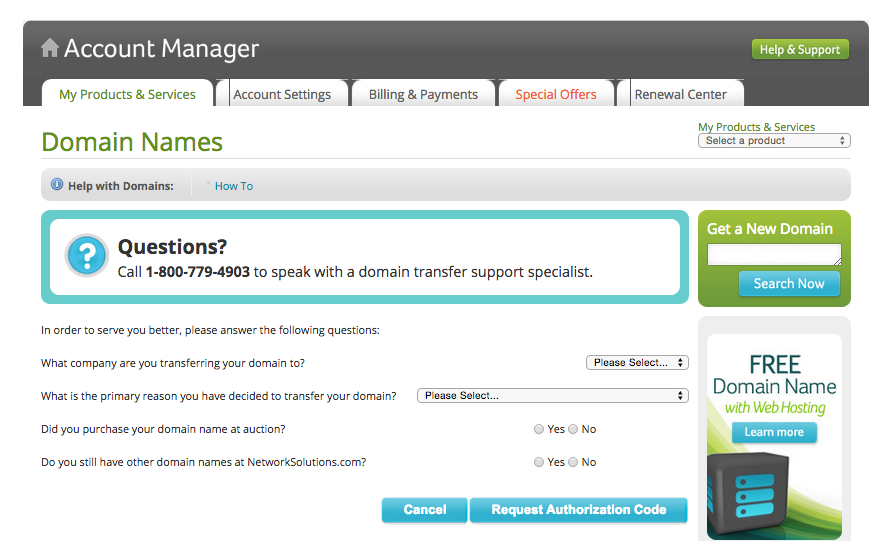
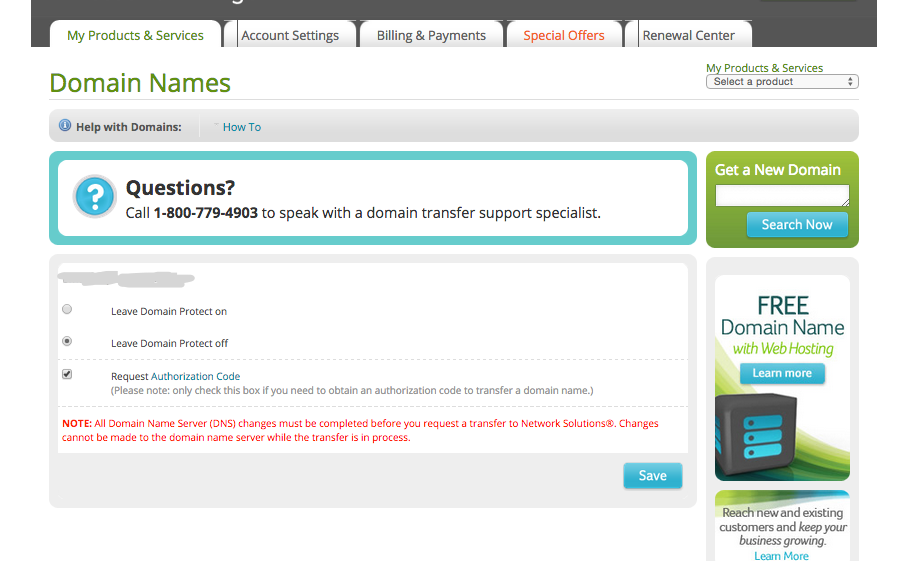
Here’s a quick screenshot play-by-play of trying to get the authorization code to transfer a domain. A process that should be transparent and made possible in a clock or two. Speaking of which, I had to click twice before getting to the first screenshot I feature below.

Screen Shot 2015-08-18 at 5.59.15 AM

First comes the wooing, “STOP!”, we know we’ve been gouging you, can we offer you a $10 domain? Also, don’t mind the asterisk—there are all kinds of strings attached, but you don’t need to know about them.

I call this the wooing, but it could also be seen as a cheap bribe.

Screen Shot 2015-08-18 at 5.59.28 AMNext comes the fear. WARNING! You actually want to leave us! We can’t help you once you do, and everything could go to shit and you’re own your own. Are you really ready for this. Don’t do it. We know you overpay, but you’re relatively happy, right? You still want to go? Well, then click this box which frees us of any responsibility of helping you. Goodbye

Screen Shot 2015-08-18 at 5.59.46 AM

But no, it’s not goodbye, we just want to take a moment and talk. What did we do wrong? Why do you want to leave us? Can we work this out? This is the attempt at reconciliation. We know we overcharge and merchandise you at every turn (notice the ads everywhere), but we want to do better. We swear!

Screen Shot 2015-08-18 at 6.00.10 AM

Penultimately we have the resignation. Don’t change anything on the site, just go! So, I’m there, right? I’ll finally get the code and be able to go, right? It’s been a fairly difficult breakup, but I can see the door. I’m just about out of it….

Screen Shot 2015-08-18 at 6.00.42 AM

Nope, I’m not. They’re going to make me wait 3 days before I can get the code.

No wonder people love Reclaim Hosting when this is the crap they have to put up with.

Posted in reclaim | Tagged , | 4 Comments

DTLT: The Next Generation

This year has been one of transition—to put it lightly—at UMW’s Division of Teaching and Learning Technologies. Andy Rush announced he’ll be joining University of Northern Florida in September, which means two-thirds of the group has left (or announced their leaving) since November. And while Andy’s leaving marks the end of an era (I’ll save my real feelings for another post 🙂 ), it also ushers in the possibility of a whole new generation of instructional technology at UMW. Last week I got a glimpse of what that might look like, and I am both excited and hopeful.

WZxJQuwLJessica Reingold started a week ago today in a new position DTLT created this Spring called the Entry-level Instructional Technology Specialist. The idea for this position came from UMW’s IT department which has been hiring recent college grads into entry-level positions for their Enterprise Application Services team over the last few years.* What was awesome about Jess’s hire is that we were almost immediately able to reap the benefits of the Digital Knowledge Center (we love you Mothra!). Jessica was one of the first tutors hired by the DKC, and her work there was phenomenal. [Those tutors are good!] What’s proving crucial for us is that she has a very good sense of the culture and how we work at DTLT. This means she hit the ground running last week. On her first day we made a visit to a faculty member to get her right in the mix, and over the course of the week we’ve been digging into the innards of how UMW Domains works as well as talking faculty development. She has a really solid working knowledge of WordPress, so next up is the venerable UMW Blogs.

It’s been a lot of fun having Jess in the office, she is already breathing new life into the group. My only issue is that I won’t be around long enough to witness firsthand all the wonderful things she’ll do. Let’s hope she blogs them so I can get a glimpse from afar. For all the uncertainty transition brings to any group, watching Jess settle in so quickly and self-assuredly has been humbling and hopeful all at once. There is a new day rising at DTLT, and with people like Jess there is no reason why it can’t be even greater than yesterday.

____________________________________

* The necessity for it came out of fewer and fewer resources.

Posted in dtlt | Tagged , | 2 Comments

Single Most Important Development in Edtech in Last 2 Years…

….has nothing to do with “innovation.”

Scott Leslie was prompting a bit of discussion on Twitter yesterday:

I couldn’t resist jumping in because I think about this very thing a lot.

I’ve been pushing small, easy tools (what folks refer to as SPLOTs) like Timeline JS a lot these days because they use popular services like Google spreadsheets, are dead simple, and are collaborative. With Timeline JS an entire class could work together to create an dynamic, attractive  timeline. That said, Timeline JS  isn’t all that new either, it’s been around a couple of years as well. Nonetheless, I really like the possibilities of using small, focused and really simple tools for getting faculty and students excited about digital projects.  I then soon followed up with my own fascination these days, namely higher ed finally digging into how virtual infrastructure, APIs, and even containerized applications might impact the field in the near future:

You see, I remain a believer. I think we’re always on the verge of realizing the next stage of augmenting human intellect. What else is there? Also, I refuse to let the perceived setbacks of the last few years throw me off the path to enlightenment. For all the turmoil, co-option, and hyperbolic virtual-ink spilt on MOOCs, I remain amazed by the fact that Siemens, Downes and Cormier were able to make such a colossal impact on higher ed as representatives of this rag-tag field of edtech. It remains a source of inspiration for me. But that by no means erases the constant struggle against the mindless MOOC-hype, nefarious narratives of labor efficiency, reification of Silicon Valley, corporatization of edtech, etc. Given how powerful some of the ideas born out of this ed-tech network have been, I can’t see the value of despair. 

Higher Ed has been playing catch-up for the last ten years when it comes to social media, and I have no problem serving as an ambassador to new applications for infrastructure, integrations, etc. It’s the job, in my mind. If we were on the edge, they wouldn’t need me. Also, I’m not so sure most other industries are all that better off in the end, and a bit of distance may have some value. 

The other issue that came up over a slice of pizza with Tim Owens, was that chasing the latest innovation could be its own trap. Frankly, Domain of One’s Own is trailing edge technology, and you could argue some of the most interesting stuff being done is dependent on that washed-up application WordPress 🙂

But my responses reflect my own blinders in the field of edtech. Thinking more about my answers, the truly important shifts have been around assumptions surrounding gender, race, and class. Arguably the most important voice in edtech the last few years, Audrey Watters, has been on a tireless intellectual campaign to challenge many of the most nefarious narratives as well as interrogate both the future past of the field. I would argue the true shift in edtech we’ve been experiencing has less to do with any particularly innovative technology, and everything to do with the recognition, interrogation, and challenging of pre-defined identities and nodes of power. This has been both both a difficult and hopeful shift because we might begin to apply this critical discourse around identities across a range of disciplines to a rich field of cutting-edge praxis. So thinking more about Scott’s original call, I think the most important development in the field has also been the most difficult: coming to terms with some of the deep assumptions of privilege and power, and figuring out how we integrate that conversation into the field of edtech purposefully.

Posted in Uncategorized | Tagged , , | 7 Comments

Digital Pedagogy as Empowered Choice

I had the pleasure of remotely participating in a conversation with Jared Stein and Bonnie Stewart at the Digital Pedagogy Lab this morning. The topic of our discussion centered around balancing the benefits of open and closed approaches to digital pedagogy. An exchange that often comes down to the LMS vs open tools like Twitter, blogs, wikis, etc. What was interesting for me about this conversation was that strict dichotomy is starting to break down in my mind. The question of open vs closed (one I have been harping on for years) is beginning to morph into one centered around ownership, agency, and control.

Pitting open against closed assumes one right approach: open=good and closed=bad. At UMW we’ve defaulted our various systems to open (save the LMS) as a way of pushing our community’s work out on the web. In this regard, UMW Blogs and UMW Domains have become synonymous with open, whereas the LMS has often been understood as the closed space for digital course work. And while this approach to open at UMW has come to define our ethos, one I very much believe in, it also became our prison. Such a stance makes it hard to draw the nuances that were necessary to recognize a spectrum between these two poles.

But increasingly the question seems to be moving towards whether or not faculty and students can control their data. I shift I think Audrey Watters and Kin Lane, amongst others, have done a ton of work to raise awareness around. More and more I find myself thinking about a distributed, API-driven architecture that enables folks to share the work on their own terms, while at the same time making the act of sharing seamless across all these systems, whether it be the LMS, one’s own domain, blogs, the university web site, etc. What intrigues me about this shift is that it returns the decision of sharing back to the individual, rather than a pre-determined choice between LMS versus blog baked into the design of the system. How to we foreground choice and empower folks to make an informed decision?

Such an architecture might help re-focus the question of digital pedagogy back to conversations amongst faculty and students—enabling agency beyond the either/or questions of which system. Andrew Rikard‘s recent article in EdSurge, “Do I Own My Domain If You Grade It?”,  argues that while the push for owning your own data and the greater potential for agency is important, the real shift should focus on a move from “data possession to knowledge production”:

I agree that owning data has the potential to give students agency and control. But it is not a guarantee.

I want to shift the emphasis from data possession to knowledge production. Gaining ownership over the data is vital—but until students see this domain as a space that rewards rigor and experimentation, it will not promote student agency. Traditional assignments don’t necessarily empower students when they have to post them in a public space.

I couldn’t agree with Rikard more here. The shift towards the vision of a personal cyberinfrastructure must be accompanied by a shift in pedagogy that is centered around this idea of creative experimentation. I think this might also open up all sorts of questions surrounding the the role of the domain as an individual versus communal space; the benefits of the traditional stream-driven web versus an alternative, federated vision preached by Mike Caulfield with Smallest Federated Wiki; whether the true revolution at the center of digital pedagogy is to surrender any sense of unilateral power in the classroom, etc.

What I like about this line of discussion is that it frames the questions of digital pedagogy around issues of agency that pertain to both ownership of data as well as ownership of one’s education. Digital pedagogy as a pathway to empowered choice. Both of these shifts require a relinquishing of centralized control, deep faith in collaboration, mutual respect, and a vision of education as empowerment. All things I dig, and a conversation that starts to move us away from discussions around open vs closed that seem increasingly overdetermined.

Posted in reclaim | Tagged , , | 11 Comments

Civic TV: the One You Take to Bed with You

Image credit: Zach Whalen’s “Civic TV”

I did some shopping online last week and picked up some #umwconsole appropriate leisure wear. This stunning Civic TV t-shirt was made possible by the good folks at StrangeLoveTees. You may not get the reference, in fact I’d be surprised if you did—it’s quite oblique. Civic TV was the small, independent TV station in Toronto Max Renn (James Woods) operated in David Cronenberg’s Videodrome.

Grant Potter gave me the head’s up about the shirt a while ago. And with all the nostalgic dreaming around the 1980s, VHS tapes, Atari 2600, and re-creating independent TV stations that come out of #umwconsole, I could no longer resist.

tumblr_nlzv3pPhmy1r6lrdfo1_500

Anyone remember the Atari 2600 in Videodrome? You can see it right above the great Brian O’blivion’s talking head in the following image .

oblivion-1

One way to read Videodrome is through the lens of the impact of the corporate consolidation of media in the 1980s, and its impact on independent TV stations. Therein lies a critical history of independent media. I need to investigate the broader history of independent TV during this period further. But in the meantime, all I got was this crummy t-shirt!  Did I ever tell you this shirt is a symbol of my lack of individuality and my belief in the new flesh? Big fan!

Posted in Console Living Room, fun, movies | Tagged , , | 2 Comments