Filmfax ode to the legendary Ray Harryhausen

Filmfax Cover Ray harryhausen


Just got the latest issue of Filmfax, and look what greeted me on the cover: the late, great Ray Harryhausen painting a miniature of Medusa from Clash of the Titans (1981). The article features an excellent interview by Mike Stein from 1999. The two of the coolest things about the article was how Harryhausen’s parents were his crew on his early, backyard animations, as well as how he got to meet Willis O’Brien, the animator for the King Kong (1933):

I met O’Bie [Willis O’Brien] through a friend when I was still in high school. I was in study hall and there was a girl with a book in her hand that had big illustrations and drawings of King Kong. I almost passed out, because that was my favorite thing. I went over and introduced myself, and she said that Willis O’Brien had given her the script, which was the script from King Kong illustrated with all these wonderful big drawings from Byron Crabbe and Willis O’Brien and other artists. I told her about my love of animation and King Kong and she said, “Why don’t you call him, he’s at MGM making War Eagles.” So, Idid and he kindly invited me over to the studio. At that time very few people were interested in animation. I must have been a novelty to him as much as he was to me.

I love this whole narrative of an unidentified girl ina high school study hall who changed the face of animation, special effects, and film more generally for generations of moviegoers, with this simple advice: “call him.” I’m glad he did, and it is also remarkable to me how so many of these genesis stories begin with an open hearted mentor and guide, apprenticeship #4life!

Posted in film, movies | Tagged , , , , | 1 Comment

Paris is Burning through Syndication

When I tweeted out how awesome UMW’s Study Abroad aggregator blog is a few folks asked me how we’re doing the syndication. Aggregation is something I’ve written about so often on the bava blog that I’m afraid I take for granted. That said, I really don’t want to because I truly believe it is the best way to foster distributed communities, enable ownership of one’s own work, and keep a centralized archive all at once. Aggregation by way of RSS-enabled syndication is still the simplest way at this stuff, and I’m gonna try and prove that once again 😉

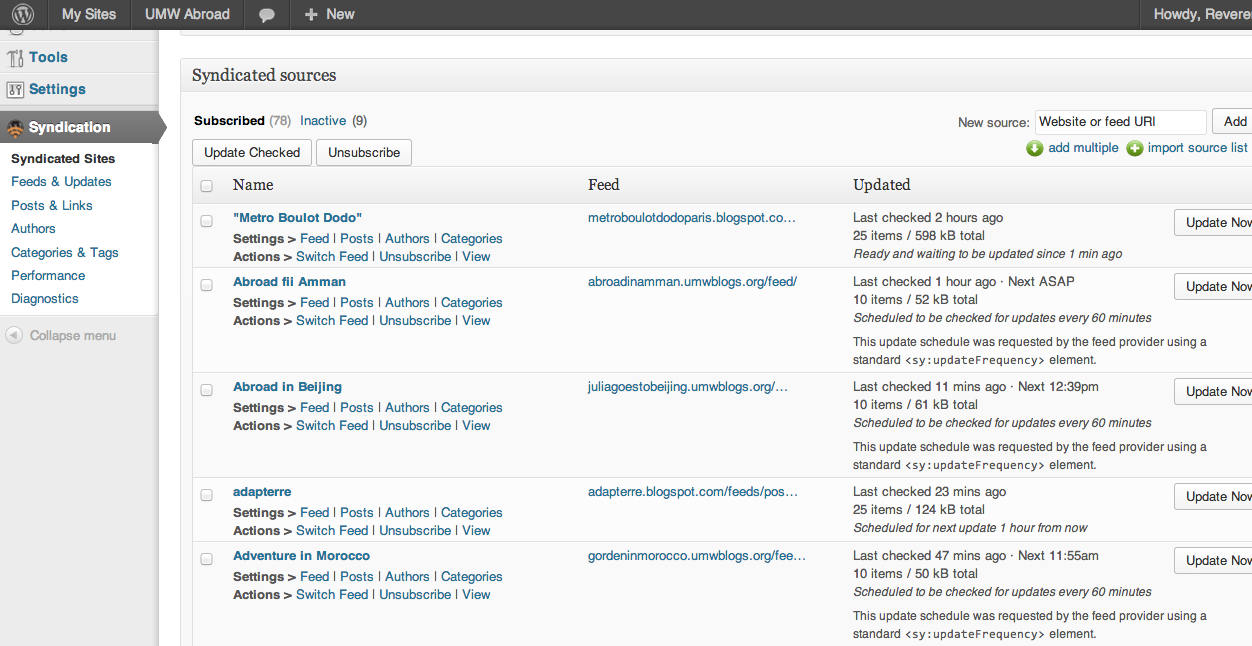
So with the aforementioned Study Abroad blog aggregator we have almost 90 feeds that have been added (self-service style) over the last two and half years that have syndicated more than 2300 posts. We do this using the plugin called FeedWordPress, which allows you to add and syndicate URLs from just about any service with an RSS feed. For example, the Study Abroad aggregator has feeds from worpress.com, blogger, tumblr, self-hosted sites, and UMW Blogs blogs. It allows anyone with an RSS enabled site to feed in.

Screen Shot 2013-07-22 at 11.33.36 AM

In order to make the process more streamlined, we are using another plugin called Add Link Widget which allows people to add a URL from the sidebar. Once it is added it’s categorized as “Contributor” which immediately adds it to FeedWordPress (I recommend password protecting this field in the sidebar to avoid spammers). You can check in on occasion to make sure added feeds have been auto-discovered properly, and then you are set.

So, using this simple two-plugin combination we have created a hub for thousands of posts from UMW student studying all over the globe.  Now, let’s add another layer of syndication into this equation. I setup the Study Abroad aggregator blog a couple of years ago on a lark because I started to see that students at UMW were just doing this of their own volition to share adventures with family and friends. But this is not an option limited to me, any faculty member or student that has a UMW Blog (or a self-hosted WordPress blog) can do the same exact thing—and after seven years of playing with this we actually have a number of faculty who do!

Exhibit P (for Paris!), Historic Preservation professor Andi Livi-Smith worked with Alan Levine last Summer to setup her Preservation Abroad aggregator blog which syndicates posts from various sites the students setup to document their experience abroad for a month in Paris, France. And while going to Paris would be preferable, being able to see all the amazing places the students visit and document made the fact I wasn’t there that much worse 🙂 But more seriously, it is an amazing distributed documentary of the class experience that Andi can use to centrally follow and grade their work in one space. Additionally, the students own and control the sites on whatever service they used, but a centralized archive of  the course remains beyond the course because each of the distributed posts are reproduced in preserved on the aggregator blog. Best of both worlds? I would say, “OUI, OUI”!

Now for the aggregators within aggregators twist. So Andi sets up this awesome course aggregator that is pulling in her students work to one central space of their study abroad experience. Why can’t we take the RSS feed from her course aggregator and add it to the Study Abroad aggregator site? Well, we can, we are, and it’s seamless. Aggregate ALL the aggregators! In many ways this is the prototype for how I wish academic department sites would start shaping the flow of the various work they are doing on social media, UMW Blogs,  Domain of One’s Own sites, course sites, etc.

We are doing this with our official DTLT page on umw.edu. What’s more, I’ve used the tags dtlt and featured on this post which are triggers for the DTLT site to syndicate this post and put it on the front page as featured news. How about that? Syndication and aggregation, baby, it’s the future. And while Paris, Rome, and higher ed is burning, we continue to blaze the trail. Come on now, isn’t it time you started aggregating and syndicating the future, hippies? And while I’ve said it a million times on this site before, it is still so right! That said, the fact that so much of it has been focused on WordPress has been a real limitation, but even that will soon be removed. There’s more in heaven and earth, edtech, than you dream of in your corporate, vendor-driven philosophy 🙂

Posted in dtlt, rss, umw, UMW Blogs | Tagged , , , , , | Leave a comment

DTLT Today: Episode 104, UMW’s Domain of One’s Own

Note: At two points in the above video (roughly at 12 minutes and 22 minutes) there’s cacophonous feedback when we go to the shot of the laptop. Andy picks it up and fixes it soon after the 22 minute mark. I’ll be editing this out sometime soon, apologies in the meantime. Those clips with heavy feedback loop have been edited out.

After a year and a half hiatus DTLT Today is finally back in action with episode 104. Even better, we had the whole old gold crew together (i.e. Martha Burtis, Andy Rush, Tim Owens, and myself) to talk about the Domain of One’s Own project we’re kicking off this Fall for 1000 freshman.

I pushed for this episode because I was blown away by how streamlined Tim Owens and Martha Burtis had engineered the sign-up using the client management software WHMCS. It’s extremely slick; a two step process that gives students and faculty alike their own domain and web hosting immediately. What’s more, the domain propagates in less than 10 minutes. It’s amazing to see how cleanly and professionally this project has come along. Martha and Tim talk a bit about their setup process in the above episode, which I find nothing short of fascinating, particularly the bafflement of the WHMCS community forums when they were inquiring how to give domains away for free and prevent anyone from buying anything else. A new kind of client software! 🙂

Given all our success we got a little cocky (royal we, it’s all TIM OWENS!) and decided to open a parallel project up to any interested teachers and faculty over at Reclaim Hosting. Over the next two weeks we are going to be knee deep in support documentation and videos for Domain of One’s Own, and what struck me today is that we can easily run this project in terms of support with an eye to the open web. Not unlike ds106, we can focus and build the project for our immediate community, but at the same time open it up to a larger community for anyone interested. Fact is, we aren’t duplicating efforts, we would be doing this stuff anyway. After Tim figured out how to make the process so smooth to clone such a model was simple, we just needed some money to float the server and software cost for an academic year, and thanks to the Shuttleworth Foundation flash grant I received (thanks to David Wiley) we could do it.

Another thing that struck me as we were doing DTLT Today yesterday was that we could also plan every Monday afternoon throughout the Fall semester on doing an episode of DTLT Today focused on getting people familiar with CPanel, installing open source applications, setting up aggregator blogs, etc. Seems to me we would be killing two birds with one stone, supporting the local students, staff and faculty at UMW as well as any interested teachers/faculty from any interested school, college, and/or university (hell, you don’t even have to be part of any of them). Initially this was the same reason we opened up ds106, because folks wanted to know how to manage their own web host, access their databases, setup subdomains, customize open source applications, and much more.

Even cooler, we can make it so that any interested faculty can control and manage their students accounts. They can set them up with domains, access their CPanels, and generally work with them if they are having issues. It gives the students their own space and gets them familiar with the possibilities of open source web-based applications while at the same time giving the faculty the ability to help them as they get started. I love this idea!

At lunch yesterday Tim referred to this model as “distributed ed tech” that we can all do if we simply point our work a bit more towards a community beyond our campus. What’s more, you have to provide a shared object of attention and invite people in so you can have a wider community. But not at the expense of the local, but rather to augment what’s happening locally, which has been proven to be the case with ds106.

I know firsthand there are a lot awesome people who not only could use some focused help with managing web hosting for themselves, as well as a community, but also would bring a mojo to community engagement that is remarkable. I am referring particularly to Todd Conaway’s post “Owning and Sharing: Like Buying a Coke” wherein he illustrates the various cultural issues that are wide spread across higher ed (anything from financial woes to limited human resources to despotic IT departments to a general institution bureaucracy and malaise) that such a community of distributed edtech might help a lot of people overcome for a real, compelling change in their local cultures. We’re all doing what we are doing anyway, it’s now time to just point it outwards a bit so that we can start sharing resources, working smarter, and build the cross-campus, inter-institutional connections our schools, colleges and universities seem to do everything in their power to prevent.


Posted in Domain of One's Own, DTLT Today | Tagged , , , , | 3 Comments

An Ode to UMW Faculty

An Architecture of Amazing Possibility

Andréa Livi Smith, who’s a Historic Preservation professor at UMW, found time on her blog to write a little ode honoring UMW’s DTLT. She contextualized it with an explanation as to why she is so enamored with this cutting edge, highly attractive group of instructional technologists 😉

They set up the blog aggregator for my Paris class. I love this thing: it keeps all my students’ blogs in one place, making for easy commenting and grading [the aggregator was the handy work of Alan Levine, I believe]. They also set up the system for my scavenger hunt which will be held in Paris later in the summer. (And no, you can’t see it yet. It’ll be the star of another post) All I had to do was explain what I wanted, what had not worked last year (seriously, it deserved an #epicfail) and voila! Now I have a system that will make it easier on the students and on me, and will be ready for the next trip, too.

I can just imagine how this would have worked at another school. One scenario: “you don’t use the CMS? Then figure this out yourself.” Another: “let’s figure out how to make the CMS do this.” This second option would actually be WORSE. Some things you can’t shoehorn to work well together. It’s like garlic and chocolate. I’m not saying Canvas can’t handle photos, but I would imagine that it would be a very
convoluted solution to have 40+ photos from different teams to be accessible on a single screen for easy comparison.

That’s right, it’s not like we don’t support learning management systems, we most certainly do, and Lisa Ames has been an amazing part of this group in that regard. But we only dedicate about 1/6 of our respurces to that, the vast majority of what we do is work with faculty to imagine what they want to do and how we can help them do it using a wide range of resources at our disposal. I love how Andi articulates what makes UMW special in this regard, it’s a matter of support and the ability to quickly scale a custmoized learning environment for faculty. We’ve become masters at that by experimenting with open source tools and cheap web hosting. Interestingly enough, this is exactly the approach we are trying to scale beyond UMW with Reclaim Hosting that Tim Owens framed beautifully here.

What’s more, Andi herself has become masterful at managing her own domain over the last six months. her work in the Domain of One’s Own faculty initiative was truly brilliant, and her Digital Bridging blog is the tale of the tape. She’s fired up about the digital, is an awesome person to work with, and has been breaking new ground with Martha Burtis on research applications for a customized WordPress blog for collecting data on historic structures around Fredericksburg (but I’ll let them talk about that).

Andi is a force of nature, and like most of the faculty at UMW, she came here because she loves teaching. In fact, we have no shortage of great teachers at UMW, and that is truly be the secret sauce behind DTLT’s success. We couldn’t do what we love to do, i.e. experiment wildly with technology in the classroom, if we did n’t have such awesome, engaged faculty that treat us as partners in the process. So here is an ode right back at Andi and the rest of UMW’s awesome faculty:

The UMW faculty, they teach 4/4,
And labor for love with an experimental galore.
But when it comes to the LMS, It’s nevermore, nevermore
They rock the open web, and innovation abounds
Augmenting learning with tech continually astounds

We’re making the myths at UMW because we’re working as a well-oiled community, rather than a machine. You can do a lot of great things when everyone involved is willing to experiment openly.#umwfaculty4life

Posted in Domain of One's Own | Tagged , , , , | Leave a comment

Gulou or, Public Scholarship in the Digital Age

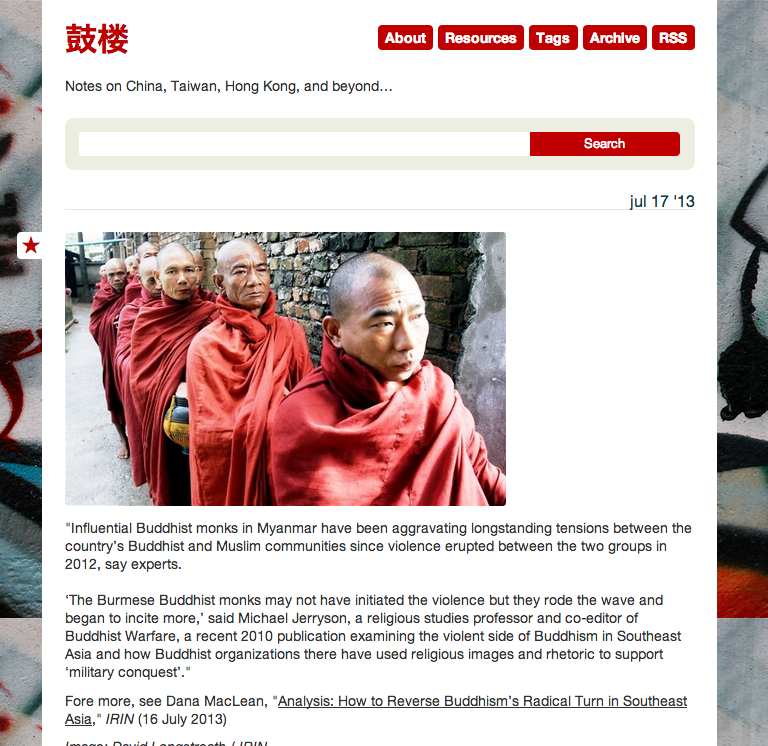
Gulou ScreenshotThis post is long overdue, and if I hadn’t checked out for a couple of months in April and May it would have been blogged on the bava a lot earlier. In fact, it’s criminal it hasn’t been broadcast more widely around the UMW community because the fact that Sue Fernsebner, a Chinese history scholar and faculty member in the History department at UMW, has a blog that has become a spotlight page for news on Tumblr is a kind of a big deal. Sue lays out the whole phenomenon far better than I ever could in this post. I love the way she ponders the implications of her blog being featured alongside major mass media new outlets:

It’s now introduced there alongside established media (Reuters, LA Times, CNN, USA Today, etc.) and also accompanies other, less traditional but equally popular sites for news consumption (e.g. The Daily Show) on the same page.

I’m just beginning to ponder the implications. What does it mean that an individual’s site—one person’s own, simple Tumblr—is beside the site of a news agency like, say, Reuters, a major news organization founded in 1851 (and now owned by The Thompson Corporation)? More immediately, at least for a scholar of China and Asian Studies, what does it mean that a microblogging, pop media site such as Tumblr is interested in featuring stories from that region at its top-most news page?

I love this! And if I might be so bold to try and answer some of these questions, I would argue it represents a new era of the scholar. I was first introduced to the idea of the public scholar back in the late 90s when I was at the CUNY Grad Center. The definition I heard was that a public scholar was an academic  who might give a few public lectures  a year and/or  write an article or column for a well-known, popular magazine. Morris Dickstein and Luke Menand (both big names in the field working in the English department at the Grad Center at the time) are considered public scholars as such, but it seemed to me that their scope was only public in a rarified , NY intellectual cultural frame. I don’t mean this as a criticism—I’m a huge fan of Dickstein’s—as much as a basis for some of the limitations of the idea of a public scholar in the academy before the web.

What happens when a scholar from UMW,  a small public liberal arts university all too often overlooked when it comes to scholarship, can turn a simple, free resource sharing site on Tumblr into a featured, popular news site read by tens of thousands of people daily? That’s pretty mind blowing to me, and given how cool and awesome Sue is (I mean she’s pioneering animated GIFs as film analysis in her Chinese film class!) it couldn’t have happened to a better person. We have had an amazing group of fellows in the Domain of One’s Own Faculty Initiative this past Spring, and while Sue’s work with Tumblr pre-dates that initiative, but still I would like to claim her as the poster child for Domain of One’s Own. But, in the end, that might turn into a faculty cage match given how many faculty stepped  up their game to Crouching Tiger levels of awesome! 😉 I love featuring faculty work, it has been too long since I have, maybe it’s time to start featuring just what all those amazing faculty fellows did as part of the Domain of one’s Own initiative.

GIF Submission from Sue Fernsebner’s Chinese History through Film

Posted in Domain of One's Own, Tumblr, umw | Tagged , , , , , , | 2 Comments

Y U NO Domain of One’s Own?

Screen Shot 2013-07-18 at 5.05.22 PMTim Owens just framed out in this post how we can scale the possibilities of UMW’s Domain of One’s Own project to just about any professor from any school that might be interested. What’s interesting here is that the “we” in that last sentence doesn’t really refer to UMW, or even DTLT (although both helped to make it possible), rather it begins to define a broader community of folks who might be interested in pooling their edtech resources to actually help faculty and students experiment with the web beyond the LMS (which, ironically, is quickly being conflated with MOOCs).

Think of this for a second, with the Reclaim Hosting idea Tim lays out in the above linked post, we’re essentially providing a space for interested teachers/faculty (and by extension students) to experiment on this  hosting space for free. But that alone wouldn’t be nearly enough, you can get free hosting elsewhere. What we want to do beyond that is use this space to provide support, encouragement, and, ideally, form a community of people that are interested in working collaboratively.  What might it mean to openly imagine and frame a course alongside a community of people who’ll help you do it? Would it look like a roving band of institutionally-agnostic, piratical ed tech folks who’ll support you in rethinking how you use technology to augment teaching and learning in your course? I hope so!

Brian Lamb has referred to this model as a kind of co-op for edtech people who don’t have the resources locally. Why not share those resources out that are most difficult to get? And if I were a betting man, I would wager moral support and encouragement from a community of folks who are interested in similar experiments is the most valuable resource available for just about anything you’re trying to do. I can’t really think of a precedent for this kind of community that builds good will through good deeds, can you? Was it #ds107, or something like that? Anyway, we’re taking our cue from Brian Lamb, and offering up one little bit of what we can, free-hosting and support for any teacher/faculty interested in experimenting with building a course there (and we define teacher/faculty and course as loosely as possible, so don’t feel excluded).  In fact, we aren’t necessarily new to this, back in 2008 we did something similar for Longwood University with UMW Blogs.

So, if you are interested, Join Us!

We can do this over the next five months for free in large part thanks to a flash grant I received from the Shuttleworth Foundation by way of David Wiley.  THANK YOU! This is just one of three micro-projects we will be experimenting with thanks to this grant. This particular experiment is focused specifically on providing support for using a free, open source toolkit in the form of LAMP web hosting for interested faculty. The other two facets will be focused on 1) a series of plugins for ds106 that makes building a syndicated course space that much easier and 2)  a broader, conceptual framing of what such a distributed architecture might look like for controlling one’s data online, and how might we cobble/build it.

Posted in Domain of One's Own | Tagged , , | 5 Comments

#Stallmen #Assange #Snowden are oddly senstive

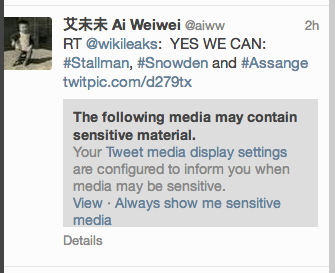
I follow the Chinese artist Ai Wei Wei on Twitter and a recent retweet of his was marked as having sensitive media.

Screen Shot 2013-07-13 at 12.21.45 AM


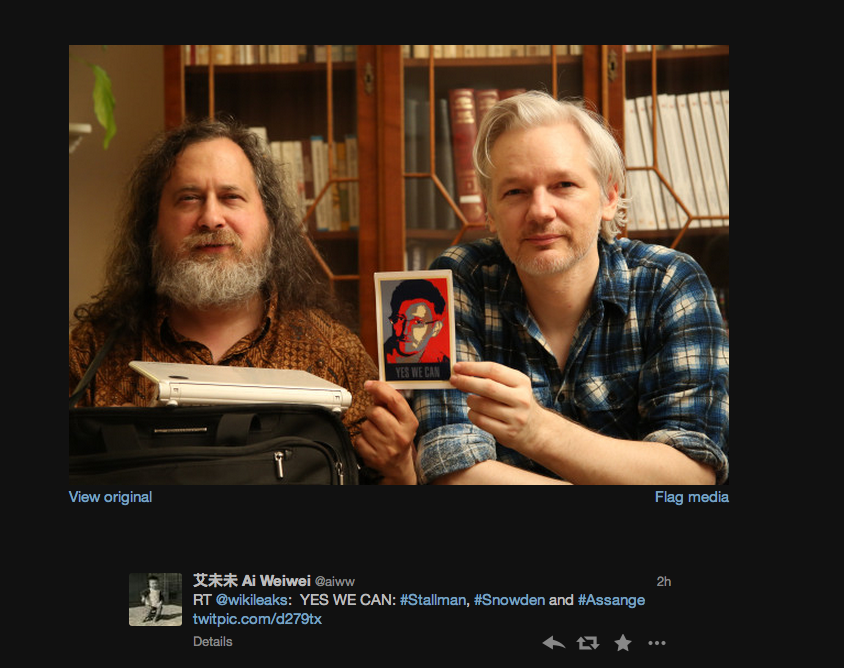
I got excited when I thought I was getting the latest leak of sensitive data, but alas all I got was the following picture of a couple of computer nerds. I kinda like the way Wikileaks (or was it Ai Wei Wei) used the sensitive media option in Twitter to make me click through to see the following image.

Screen Shot 2013-07-13 at 12.23.34 AM

Then I got to wondering if all WikiLeaks links on Twitter are marked as sensitive media. After that I wondered what it must be like to be an international whistle blower that no one really seems to care too much about or even listen to at this point.  Strange days.

Posted in fun | 3 Comments

ds106 acephalous: a headless online community that is #4life

BO1-yapCIAIHmbA

Thanks Todd Conaway!

I love Alan Levine’s idea about running a headless version of ds106 this Fall 2013.  I would relish the possibility of taking the course alongside a community of folks this time around rather than trying to teach it as well. And while I have contended that ds106 is centered around the actual students at various campuses who take it for credit, this was true for me because everytime I “took” ds106 I was also teaching it. I suspect a headless course of ds106 will have a very different sense of community, rhythm, pressure, and coherence, I also suspect the idea of breaking outside of some of those strictures tied to the course structure to see what a headless course is like in this regard might be a lot of fun.

Let’s face it, ds106 has never been massive in terms of participants, and there is a reason for that. You can’t have a sense of community within a massive, automated machine. You need to have a sense of affection for those you are creating alongside, and that’s a fact that is overlooked (or suppressed) when we jump from the idea of massive participants to massive data collection to number-drive generalizations about experience. Along those lines learning is processed and denatured into an abstraction that can be more readily salable. It’s all bullshit, the important thing is the learning within a community of people that provide you with a series of contexts for the experience (no matter how disparate), nothing else matters one lick to those who are not trying to commodify the whole enterprise.

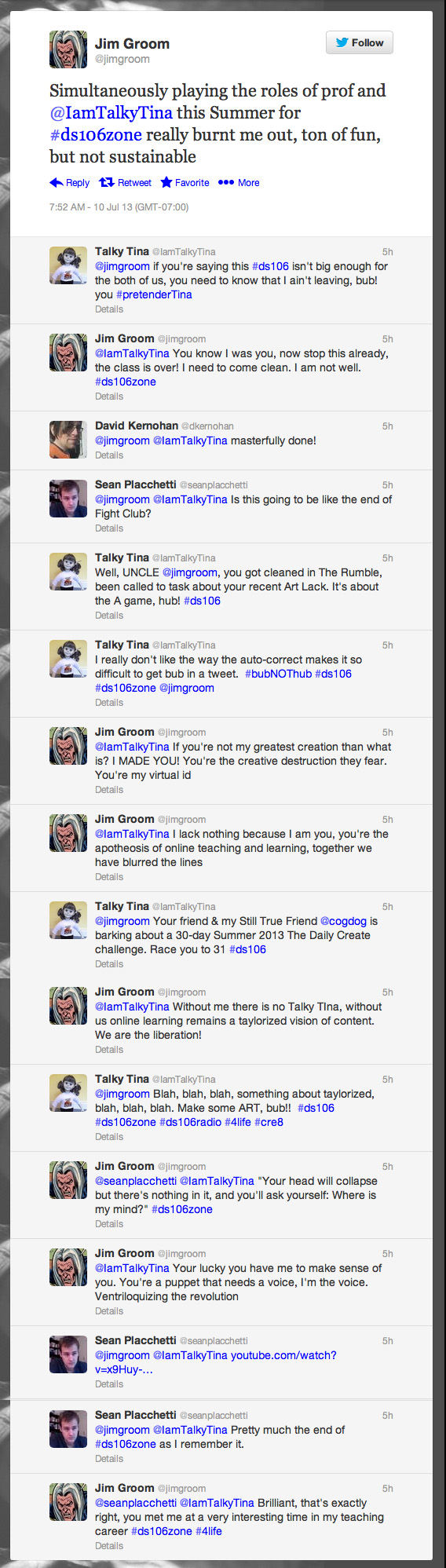
I had a hard time with ds106zone this Summer, it was a five week class and it was all I could do to stick with it for a variety of personal reasons. What’s interesting, however, is that everything I have been searching for in a physical community here in Fredericksburg has come together around the virtual community that is ds106. The need for help and a sense of support, even if I couldn’t  articulate how and why, came in the form of Scottlo’s three weeks of brilliant Lodown podcasts (where in effect he was the heart and soul of the course), Rocky Lou’s amazing follow-up to that work (and much, much more), Ben Rimes ongoing engagement on all things ds106, Christina Hendrick’s brilliance while down under (and she hasn’t really stopped!), Andrew Forgrave’s creative run that won’t stop, Paul Bond’s  partnership that is morphing into a teaching relationship, Brian Bennett’s brilliance, Bill Smith’s ongoing enthusiasm, and that’s just the tip of the iceburg. Talky Tina (and even Todd Conaway), although I am she, might just be a doll, but she’s a doll that saved me from the semester, she stepped up when I fell down those proverbial stairs. She completed me and continues to support me in a variety of ways, some of which are demonstrated in a conversation we had on Twitter earlier today that I ‘ve copied into the “appendix” section of this post below. I have yet to blog about the radio shows from the ds106zone, and I’ll do that by and by, but one of the things that really struck me about the ds106zone this Summer was how amazing the radio program “Not just for life, but for existence” (created by Christina Hendricks, Andrew Forgrave, Brian Bennett, Ben Rimes, Paul Bond, and Scottlo) truly was. It was a brilliant show that actually started to peel away the sham that I was actually running the course experience. The show started to suggest in some really uncanny and trippy ways that this group of open, online participants were actually the brains behind ds106.

As it turns out it they were absolutely right, this crew—along with a few others—ran the ds106zone far more brilliantly than I ever could. I think the illusion that I have ever truly “led” this class has started to finally fade, something that couldn’t have happened soon enough for me. I don’t want to lead ds106; I want to be a part of it, and the two can become confused sometimes, particularly for me. It becomes no easier when Kickstarters, grants, and the like get involved—but they too might have their place, within reason, to foster some technical development, architectural possibilities, etc..  But I think the true magic of ds106 is that it can be likened to an Acephalous society, a headless online community modeled on the web that has no established leaders or hierarchies. And that’s why Alan’s idea of a headless ds106 is so appealing to me, it starts to help educators shape learning experiences that try and get outside of the limitations of the rhetoric of hierarchies and leadership that is part and parcel of a course. I am not saying this is entirely possible, but what I have seen and experienced through ds106 gives me tremendous amount of hope that it might be. In fact, I know now, with certainty, that a single course can evolve to a community of affection wherein people are supporting and helping one another because they want to. It stands against all the data in the world, it is beautiful.


Appendix:

twitter

Posted in digital storytelling, Uncategorized | Tagged | 7 Comments

ds106zone Week 5: My Only Friend the End

Well, as you might have guessed from the last week ds106zone comes in like a lion and goes out like a lamb. The course officially ends this Friday so we’ll be having a somewhat abbreviated week in terms of both time and work.


I will be sharing more extensive resources on mashup shortly. But to get you started, you’ll be doing the following in terms of assignments:

  • Two DailyCreates
  • 10 stars of Video Assignments
  • 5 stars of Mashups Assignments
  • 5 stars using the ds106 Remix machine

As usual, I want you all to be commenting on each others work. What’s more, keep in mind you all need to have submitted at least two assignment and done two tutorials, please include a link to the assignments and tutorials you’ve created in this week’s write-up.

Also, for your final exam you’ll need to have completed two assignments:

  1. An audio self-reflection about your experience in ds106 this Summer. You can find the link to the assignment hereAnd if you feel this assignment forces you to be positive, try Sean Piachetti’s parody of this assignment here.
  2. Additionally, you need to add at least three examples of work that has inspired you this semester to the ds106 inspire site here: http://inspire.ds106.us/ Explain briefly why it has inspired you and include a screenshot.

Finally, I want everything you’ve done included in this week’s summary, along with final thoughts about the class. I will be sending each of you detailed emails about your work and final grades by early next week.

Posted in digital storytelling | Tagged , , | 1 Comment

ds106zone Lodown #27

ds106zone Lodown 27

scottlo-arabia-1

Image Credit: CogDog, of course

This is the second installment of the Lodown in the post-Scottlo era. I was joined by Mikhail Gershovich on #ds106radio early this morning to theorize about some of the unspoken possibilities behind Scottlo’s resignation from the Lodown. We cover every potentiality  from his joining a guerilla sect in the Syrian civil war to a cash money offer from Coursera for that Lodown thing he does. But at the end of the day your guess is as good as ours. Unfortunately the audio is a bit low and there is some competing audio, but that’s what happens when you are given such little warning to fill up eight podcasts by the end of the class. But the one uplifting fact we discovered on YouTube last night is that Scottlo has committed to carry on with the Driveby in some truly remarkable ways. See the embedded video from a Saudi Arabian highway for documentary evidence.

Posted in digital storytelling | Tagged , , , , | 2 Comments