So to teach that meddling kid a lesson, the bava gives you 3x the Judges.
And I’ll one up Judges by throwing in a classic scene featuring an Italian figure even greater than Battisti, the comic genius Totò (as great as Chaplan or any other comic figure of the 20th century) featured here singing in “Are We Men or Corporals?” (Siamo uomini o caporali?).
TorrentFreak’s at it again (my new, favorite EduBlog) and this time an article by Enigmax, Textbook Torrents has closed shop just three months after it found itself in the spotlight thanks in part to Jeffrey Young’s Chronicle article “Textbook Piracy Grows Online, Prompting a Counterattack From Publishers.” In fact, the site immediately was taken offline by its web host (Dreamhost) on July 5th (four days after the article was written), but re-emerged a month later. This time it seems this particular site is done for good.
But, it’s closing begs the question of whether or not the hydra effect will come into play. This site has been shut down, but will three more re-emerge in its stead? The demand for a “service” like Torrent Textbooks is undeniable:
January 2007 saw the birth of TextBook Torrents, a relatively small site initially, offering a BitTorrent tracker dedicated to the indexing of textbooks. In 6 months the site had accumulated 10,000 members. Just 3 months later, the number of users had doubled to 20,000 and by January 2008 the membership doubled again to an impressive 40,000. By the end of June 2008, almost 70,000 members were registered at TextBook Torrents and more and more people were becoming aware of its existence.
And all of this based on a technology that for many is still considered “technically difficult” (which it is ever increasingly simple), and these numbers represent the amount of users a month before the site was picked up by The Chronicle, SlashDot, and several other mainstream media outlets. So, in little over a year and a half a relatively unknown site sees exponential growth with 70,000 members. What might this forecast for the future of textbooks? All too often we have focused the P2P conversations around the music and movie industries, but I think this recent development frames a huge question to the textbook publishing industry: Do you follow the lead of the MPAA and RIAA (read Dodo Bird) and persecute your consumer? Or do you start to re-think your product on some fundamental levels? Moreover, do you finally start to take the Open Content movement seriously? For there can be no question that its audience is growing exponentially given that people are finally getting fed up with being robbed by the exorbitant prices of textbooks (and the economic climate will only expedite this process). And, finally, what would it mean for the publishers to consider the implications of open content?
TorrentFreak’s Ben Jones reports that UC Santa Cruz has decided to fight the RIAA’s lawsuits aimed at their students by throwing a wrench in their methods:
Santa Cruz (UCSC) has put a spanner in the procedural works of the RIAA litigation machine. As explained best in the article published a few months ago by RIAA ‘nemesis’ Ray Beckerman, the John Doe lawsuits are often just a legal ploy to get names and addresses, prior to starting a new campaign, and pre-litigation settlement.
However, UCSC has successfully argued that under the law – specifically the Family Educational Rights and Privacy Act (FERPA) – there are restrictions on the conditions for releasing student’s personal details, even in cases where there is a court subpoena. In this case (UMG Recordings v Doe), the court has ruled that the subpoena must have a ‘reply by’ date that is long enough to allow the university to notify the target of the subpoena, and their parents. This can give them the chance to get legal advice which can put them in a stronger position with the RIAA than getting a letter/demand out of the blue.
A new use for FERPA? A law that is certainly open for interpretation, and one which very well may serve to truly protect students and foster sharing, rather than being used as a blanket excuse to prevent a cross campus conversation using blogs, wikis, and their ilk. I like the new uses for what is often a wet blanket.
I got an early birthday present today from the Bionic Teacher, and all I can say is thank you, thank you, thanks you. Tom is not only one of the most creative dudes I have had the pleasure of working with in this field (despite him being K12 and everything 🙂 ), but he may very well be the funniest. Here’s to bringing down the CMS on the eve of my 37th (see all you edupunk critics, I’m no where near 40 yet, you suckers). Let the CMS burn, baby, burn!!!
Update: And then there is Peter Naegele’s riff on another Tom Woodward original:
For the first part of this semester I was in over my head with UMW Blogs. We had come up with the idea (through covert communication with other schools not to be named 😉 ) to use FeedWordPress as a syndicating engine. Quite simply, that students create their own blogs and tag posts for their respective courses, which would automatically republish them in an aggregating course blog.
For example, Sue Fernsebner’s History 299 course would tag relevant posts 08fern299, and those posts would be automatically re-posted in the course blog. How are they re-posted automatically? Well, Donncha’s Sitewide Tags Pages plugin collects all posts, tags and categories into one blog (http://tags.umwblogs.org), that by extension gives a single feed for all tags through the WPMu environment. You can see all of professor Fernsebner’s class blog posts one that blog here: http://tags.umwblogs.org/tag/08fern299/
And if you just smack the term “feed” at the end of the above URL you then have an RSS feed for every post in UMW Blogs that has the tag 08fern299: http://tags.umwblogs.org/tag/08fern299/feed
Now, FeedWordPress just consumes this feed and republishes all the distributed posts in one blog and allows the permalink to point back to the students original blog post on their blog. Perfect, right?
Well, almost. Fact is that the .2.x version of the Sitewide Tags was not actually working with FeedWordPress that well. What was happening was that FeedWordPress was not updating correctly and the permalinks would only point to the post on the course blog, effectively erasing the link back to the student blog. The only way to fix this was to go into the course blog and delete the posts that didn’t link back to the student blog, and update the feed again which works when you manually pull the feed but not when it is automatically pulled in (which was the root of the problem). Well, this issue is no more, the latest version of Donncha’s Sitewide Tags Pages plugin 0.3.1 fixes the issue with FeedWordPress and has put UMW Blogs back in the Syndicating cloud (I was worried there for a second, and I don’t miss all the duct tape fixes at all).
The moral of the story? It didn’t take long for the WPMu community to make things right, and it didn’t cost UMW anything but a little bit of experimentation, patience, and sharing. I mean who’s afraid of the open source wolf? These times demand many things, and one of them is cooperation and sharing, not fear and closing down. Open source is not proprietary 🙂
So, this got me thinking about Jefferson’s idea of permanent revolution, or that “every generation needs a new revolution.” A true mark of genius given the moment he was living. So last night I actually came across a scene in the HBO minseries John Adams (sorry Luke, I lied, I have forsaken Mad Men for John Adams -ironic?) which proffers Jefferson’s informal articulation of this idea, which is a fascinating one for me given the times we live in.
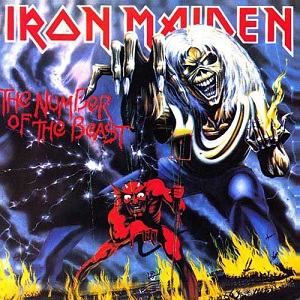
I think it would have to be “Killers” because I was younger and more impressionable. Not to mention the fact that I would stare at it for hours wondering about all the shady happenings in the windows behind Eddie and his victim (click on image for a larger view of some of the window crazies).
And, if I were forced to choose a single album cover it would have to be “Aces High,” Eddie as a WWII fighter pilot confused me for years after wards, I mean wasn’t he a murderous monster?
Update, I maye have to reprise my Aces High idea after re-discovering the “Somewhere in Time” single album cover, a little bit of “Maiden Runner”?
Thanks to endless fount of genius that is Carole Garmon, here’s a video of a 13 year drummer named Hannah, and she rocks out pretty hard. You can see all here videos on YouTube here, but I choose Iron Maiden’s “Run to the Hills” because it rules.
About a week or so ago I got Robert Crumb’s Heroes of Blues, Jazz & Country which I have been totally digging. The book has been reinforcing an informal education I’ve been getting through my various conversations with Folklorist Gary Stanton and Musician/Artist Kent Ippolito (who gave me the book –thanks Kent!) on early 20th century American music. It’s a series of sporadic discussions, and it has been a lot of fun for me to listen to some music from the various genres (which all seem to share some interesting relations) from the 1920s and 30s –which is the focus of Crumb’s book.
Crumb's Hereoes of Blues, Jazz, and Country
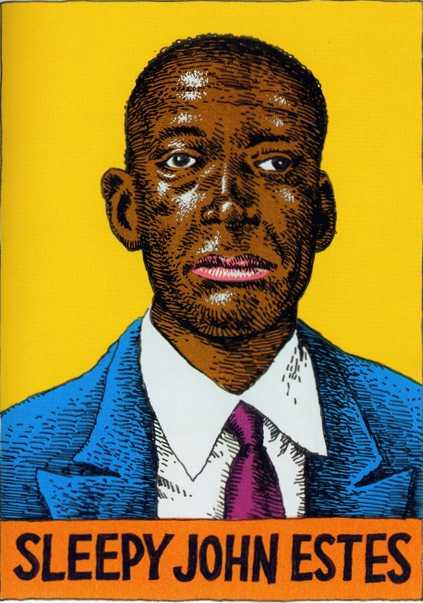
Crumb’s sketches of the artists are wonderful, my favorite is the one below of Sleepy John Estes. And each image is accompanied by a very short (one to two paragraph) discussion of the artist and their particular musical strengths along with how many “sides” they recorded ( a side of a 78 album was anywhere from 2:30 to 3:30 minutes long, which basically meant the length of popular song).
Sleepy John Estes
Anyway, along with the amazing assortment of Crumb’s interpretations of the artists there is a CD that features a sampling of their songs. I hadn’t heard any of them before except one, which was part of the soundtrack from O’ Brother Where Art Thou, which was Skip James’ “Hard Time Killing Floor Blues” found for your listening pleasure on YouTube here, and embedded below:
Skip James’ career is fascinating, here is a brief excerpt as told by his Wikipedia article:
As is typical of his era, James recorded a variety of material — blues and spirituals, cover versions and original compositions — frequently blurring the lines between genres and sources. For example, “I’m So Glad” was derived from a 1927 song by Art Sizemore and George A. Little entitled “So Tired”, which had been recorded in 1928 by both Gene Austin and Lonnie Johnson (the latter under the title “I’m So Tired of Livin’ All Alone”). James changed the song’s lyrics, transforming it with his virtuoso technique, moaning delivery, and keen sense of tone. Biographer Stephen Calt, echoing the opinion of several critics, considered the finished product totally original, “one of the most extraordinary examples of fingerpicking found in guitar music.”
Several of the Grafton recordings, such as “Hard Time Killing Floor Blues”, “Devil Got My Woman”, “Jesus Is A Mighty Good Leader”, and “22-20 Blues” (the basis for Robert Johnson’s better-known “32-20 Blues”), have proven similarly influential. Very few original copies of James’s Paramount 78s have survived.
[[The Great Depression struck just as James’ recordings were hitting the market. Sales were poor as a result, and James gave up performing the blues to become the choir director in his father’s church. Skip James himself was later ordained as a minister in both the Baptist and Methodist denominations, but his involvement in religious activities was sketchy.
For the next thirty years, James recorded nothing and drifted in and out of music. He was virtually unknown to listeners until about 1960. In 1964 blues enthusiasts John Fahey, Bill Barth and Henry Vestine found him in a hospital in Tunica, Mississippi. According to Calt, the “rediscovery” of both Skip James and of Son House at virtually the same moment was the start of the “blues revival” in America. In July 1964 James, along with other rediscovered performers, appeared at the Newport Folk Festival. Several photographs by Dick Waterman captured this first performance in over 30 years. Throughout the remainder of the decade, he recorded for the Takoma, Melodeon, and Vanguard labels and played various engagements until his death in 1969.
The release of his song about “hard times” coincided precisely with the Great Depression, making the market for his recording evaporate and his musical career that much tougher. Yet the song captures the haunting uncertainty of difficult times, while simultaneously providing a reassuring voice of someone who has not only endured them, but created something great within them.
is an ongoing conversation about media of all kinds ...
Testimonials:
Generations from now, they won't call it the Internet anymore. They'll just say, "I logged on to the Jim Groom this morning.
-Joe McMahon
Everything Jim Groom touches is gold. He's like King Midas, but with the Internet.
-Serena Epstein
My understanding is that an essential requirement of the internet is to do whatever Jim Groom asks of you while you're online.
-James D. Calder
@jimgroom is the Billy Martin of edtech.
-Luke Waltzer
My 3yr old son is VERY intrigued by @jimgroom's avatar. "Is he a superhero?" "Well, yes, son, to many he is."
-Clint Lalonde
Jim Groom is a fiery man.
-Antonella Dalla Torre
“Reverend” Jim “The Bava” Groom, alias “Snake Pliskin” is a charlatan and a fraud, a self-confessed “used car salesman” clawing his way into the glamour of the education technology keynote circuit via the efforts of his oppressed minions at the University of Mary Washington’s DTLT and beyond. The monster behind educational time-sink ds106 and still recovering from his bid for hipster stardom with “Edupunk”, Jim spends his days using his dwindling credibility to sell cheap webhosting to gullible undergraduates and getting banned from YouTube for gross piracy.

 TorrentFreak’s at it again (my new, favorite EduBlog) and this time an
  TorrentFreak’s