FUD Campus Piracy

FarSide Comic by Gary Larson
Creative Commons License photo credit: Invisible Hour

With questions looming about our post-modern malaise despite increased connectivity, the hyped hive mind, ever greater access to resources online, we still often find ourselves paralyzed agents in the undertow of information. With such realizations at times like these I try to take refuge in the little battles that are fought and seemingly won.

For example, over the last year TorrentFreak has been covering a focused, yet distributed, network of people that are fighting for their rights to share and access our digital culture freely. It’s a fringe battle (and it has been criminalized accordingly), yet TorrentFreak’s coverage of the rise and fall of MediaDefender is always an uplifting story for me, kinda like the Rudy of the 21st century piracy stories.

In short, MediaDefender is (and by the looks of their stock, soon to be was) a goon anti-piracy company hired by the MPAA, RIAA, and several other media production companies to “stymie peer-to-peer (P2P) traders through a variety of methods including posting fake files online, recording individuals who contribute copyrighted material, but also marketing to individuals using P2P networks” (link). They launched their very own video upload service called “miivi.com” for the sole purpose of trapping people into uploading copyrighted material, and then nailing them for it. A massive leak of MediDefender’s internal email correspondence over a year ago brought some of their highly questionable methods to light, and has since crippled the company to the point that a year later they are on the verge of bankruptcy (a process aided and abetted by their own missteps). This suggests the power of a distributed network to stand up and fight back. I’m often inspired by this story, yet at the same time I’m not a hacker nor a pirate. I’m just a meek instructional technologist who works at a public institution and wants to see the web as a space where culture can be shared and discussed freely so that we can better critique and understand the world we live in —is that so wrong?! I mean, what can I do?

Well, a recent series of articles on TorrentFreak by Ben Jones dealing with tackling campus piracy offers some ways of thinking about this. I particularly like his most recent article titled “Tackling Campus Piracy with FUD,” wherein he traces the use of Fear, Uncertainty, and Doubt (FUD) at universities as a means of dealing with piracy on campus:

In many ways [FUD] is the cheapest and easiest anti-piracy method. It doesn’t rely on facts, but on careful releases of information, and calculated small acts.

A small act could be starting a rumor or giving an interview to a student newspaper. Such tactics are cheap and often have much better returns than costly (and ultimately useless) technology-based methods. They also have the added advantage that if they don’t work, it doesn’t tend to count against you. That is, unless you’re caught at it.

The article goes on to detail the recent use of FUD at Elon University in Greensboro, NC.

In a file-sharing piece last week in the student newspaper, the strategy of intimidation was plain to see. If you are unaware of the law regarding copyright infringement, however, you might be taken in.

The article starts with talk of rumors, concerning all manner of things designed to instill fear; RIAA reps roaming the campus, being able to backtrack to things that happened years ago. Rumors that lead to uncertainty (how far back? Will that include something I did?) as well as doubt (anything I can do about it?).

Throughout the article, Assistant Vice President for Technology Chris Fulkerson makes it clear that students should be very careful. However, he’s not afraid to tweak the facts a little, or tell outright lies, for that matter. At one point he states that the fine is “$250,000 per infraction” which is a complete lie. As regular readers and followers of US copyright infringement cases know, the maximum damages that can be awarded per infraction is $150,000 not $250,000 (USC Title 17, § 504 (c)(2)). The most they have managed to get in these cases is $9,250, but even that turned out to be too much.

Of greatest worry was his position on the details of students. Fulkerson has said that when/if the RIAA asks for names and details that correspond to an IP, the university will hand them over if the person can be identified. As the RIAA’s strategy is to file many lawsuits, and try and force a settlement (by making it cheaper to settle than to contest), handing over details is in the worst possible interests of the students, and may be illegal. Regardless of its legality, or how true the statement is in practice, the impact of the statement is chilling to many students.

It is alarming that universities might increasingly become the space for the cultivation and dissemination of Fear, Uncertainty, and Doubt (a reality they are arguably designed to counter). The American people are no strangers to such a method recently, to be sure, for we have been deeply embedded in the politics of FUD for the last 8 years, a logic which is flowering in its most horrific logical extreme currently. So, while I don’t understand the economic crisis and I can’t see my way through the current malaise of national leadership,  I can be an advocate for fighting FUD on campus. it should be an integral part of my job, given that I am in the business of teaching and learning, of helping to open up the classroom viz-a-viz the web. So, I’ll leave despair for another day, and be on my merry fighting way.


Posted in Uncategorized | Tagged , , , , , , , , , | Leave a comment

The Death of Hollywood Confirmed

I saw the following post on WFMU by Brian Turner this morning (which has since has gone missing for some reason), and it confirmed my every fear: Hollywood is DOA.

Hollywood: Two Words

from WFMU’s Beware of the Blog by Brian Turner

Check, please.

That’s right, Beverly Hills Chihuahua grossed $29 million this weekend, taking the top place.


Beverly Hills Chihuahua, Disney’s canine comedy, edged out Shia LaBeouf’s Eagle Eye to take the top spot at the U.S box office this weekend.

The film about a wealthy pooch from Beverly Hills who finds herself lost while on vacation in Mexico stars Drew Barrymore, Jamie Lee Curtis, Andy Garcia, and George Lopez.

North American Box Office Top Ten:

1. “Beverly Hills Chihuahua,” $29 million.
2. “Eagle Eye,” $17.7 million.
3. “Nick and Norah’s Infinite Playlist,” $12 million.
4. “Nights in Rodanthe,” $7.4 million.
5. “Appaloosa,” $5 million.
6. “Lakeview Terrace,” $4.5 million.
7. “Burn After Reading,” $4.08 million.
8. “Fireproof,” $4.07 million.
9. “An American Carol,” $3.8 million.
10. Religulous, $3.5 million.

This is why I look forward to the release of video games, or recent additions to UBUWEB and the Internet Archive.  The era of our pop culture as told by Hollywood is dead. The Wire is without question the best series I have seen in the last 20 years, better than anything from Hollywood or even all the other series from HBO. Moreover, the recent sensation over AMC’s Mad Men is over rated in my opinion. I watched the first 9 episodes of season 1, and by the fouth episode was burnt on how “correct” the show is. It tries to implicate the viewer by re-framing all the racism, sexism, and religious intolerance at work in the late 50s, early 60s, yet it is far too academic. It’s argument is clear, and there is none of the moral ambiguity and more complex examination of a system that frames the impossibilities of a moment like The Wire. The push to make sure the viewer doesn’t mistake the 1950s and 60s as the good old days, seems empty when it erases the complex realities of those who lived then, just to capitalize on the issues that make good drama now. I don’t know, Mad Men justs seems like a paper some one wrote about advertising in the golden age, and how screwed up it was from our vantage point, and then decided to adorn it with some two-diminsional characters and turn it into a TV series. A blanket critique of the 1950s and 60s is as much an interpretation of that moment as an unchecked glorification of it, and neither make for a comeplling narrative.

Posted in Uncategorized | Tagged , , | 10 Comments

Survival Research Laboratories

It’s Funny the things you begin to find once you explore a certain subject. And I have been thinking more and more about this as it pertains to learning on the web, versus the kind of radically open (yet in many ways traditional) models that are on everyone’s mind as of late. I’ve been out of love with the course model these days, rather I have been consumed by all things survivalist for the last month or so. This is not based on any class, nor is it rooted in a theory or extensive research. Rather it’s an idea cum metaphor that Brian Lamb (once again) inspired while we were having an unwieldy conversation about our COSL conference demonstration. It’s born of a kind of creative compulsion to imagine narratives for the work we do, and it is at it’s core fun.

So with that preface out of the way (which is the basis of a much longer post I have brewing), I just wanted to share something I recently discovered via UBUWEB in my incessant search for all things related to Survivalism. This one is tangential, yet central at the same time. The Survival Research Labs (SRL)

…has operated as an organization of creative technicians dedicated to re-directing the techniques, tools, and tenets of industry, science, and the military away from their typical manifestations in practicality, product or warfare. Since 1979, SRL has staged over 45 mechanized presentations in the United States and Europe. Each performance consists of a unique set of ritualized interactions between machines, robots, and special effects devices, employed in developing themes of socio-political satire. Humans are present only as audience or operators.

I love the whole concept, and the video below, Virtues of Negative Fascination “is a documentary covering the performance activities of Survival Research Laboratories, Mark Pauline, Matt Heckert and Eric Werner, from 1985-1986.” It features a number of these mechanized presentations as well as an incisive look into the political logic behind such a group. Yet, another gem from UBUWEB, and more fuel for the survivalist fire. Enjoy.

Download Virtues of Negative Fascination

Posted in Uncategorized | Tagged , , , , , | 7 Comments

EdTech Survivalist: Episode 2

“Embedded!”

In this episode the EdTech Survivalist tries to help a war buddy unembed himself from the web. But first he has to help him navigate a long, abusive history of being at the mercy of centralized IT, a reality that might just push Johnny Embed over the embedding edge.

Credits:
Tom Woodward, my confirmed partner in crime, brilliantly portrays Johnny Embed, and is responsible for all his own effects and camera work.

Serena Epstein is the technical/artistic wizard who has consistently aided and embedded me with the camera work and editing, any and all mistakes in this department are squarely hers 🙂

Posted in edtech survivalist, edupunk | Tagged , , , | 13 Comments

Syndication-Oriented Architecture, or a Feed Frenzied Framework!

Jon Udell has mentioned the idea of Syndication-Oriented Architecture a couple of times over the the last year of so. One of the things I’ve been trying to spell outabout UMW Blog is how it in many ways is trying to approximate a Syndication-Oriented Architechture using a very hodgepodge collection of plugins and widgets.

What does this mean? Well, for me it means that a university publishing platform shouldn’t only be limited to the sites created within that system (in our case WordPres Multi-User), but rather should be able to incorporate work that students and faculty may be doing on other, externally hosted services that are RSS-enabled—like, for example, Blogger, WordPress.com, Drupal, Flickr, YouTube, etc.

In other words, folks within the campus community should be able to add their feeds to a publishing platform like UMW Blogs and have what they are doing on their own spaces join the general flow of the syndicated data already in UMW Blogs. They should appear in the site wide RSS feed (or even a single class feed); they should show up in the flow of data on the front page; and they should also be searchable in the WPMu archive. Yet, it shouldn’t necessarily be a republishing of their work to another blog space they need to create and maintain, but rather a quick way to drop of their feed so that their work is discoverable by the UMW Blogs community, leaving a trace of their work that will lead people within the community (or a specific class) back to their own space, wherever it is hosted.

We’ve been experimenting with this in a couple of ways recently using Feed WordPress on the Tags blog for UMW Blogs (the tags blog is automatically created when you install Donncha’s Sitewide Feed Tags Page plugin). For example, I can bring in the all the posts for three course being taught by professor Zach Whalen (which he is hosting on his own site in Drupal) by simply adding the feed for each of the courses. The posts are automatically brought into the Tags blog and the permalink directs the user back to the original post in the Drupal course site. The categories can also be imported, comments can be turned off,  and you can assign a specific tag for each of the courses if you want to make the work more visible in the tag cloud.  Additionally, the posts will show up both on the front page and in the searchable archive.*

So, here’s another example of this in action, Andy Rush has created a pretty bitchin’ New Media blog, and he is hosting it outside of UMW Blogs. Yet, what he blogs about there is of great use and interest to the UWM Blogs community. So, all we have to do is grab his feed, add it to Feed WordPress in the Tags blog, and tag it New Media. After that all his posts will be automatically syndicated into UMW Blogs, and they will also be tagged New Media so that he might be discovered in the tag cloud.  Further more, his posts can all be found in the searchable archive, which is just really the search field for the Tags blog.You can see his posts in the  UMW Blogs archive here.

Next step is creating something like a self service widget for Feed WordPress so that mebers of a WPMu community can add their feed (or feeds), tag it, categorize it, and then we’re off to the races.  The end result is that anyone can publish anywhere as long as it has a valid feed, and their work can still be accessible and searchable by their community as well as the world at large.

Now, with all that said, exploring and discovering work on UMW Blogs is still not that easy, you have to see the flow in real time, or wade through hundreds and hundreds of posts in the sitewide feed.  So, my next post on UMW Blogs will be looking at the experimental work Patrick Murray-John is doing with MIT’s Simile Project which he is documenting  vernacularly here and more technically here (I’m like a fish out of wter when it comes to the Semantic Web). Andrew Murphy of Metapizza nails it, “Put in an interested use of metadata and web 3.0 and we’re flying …” That is the logic behind this experiment. How might we be able to make the work happening on UMW Blogs easier to search, browse and filter using Semantic Web tools from the Simile Project like Exhibit? It seems the next logical step to try and open up this space further, and try and make the amazing amount of work being done more apparent and finadable by the community at large.

____________________

* Much of this is inspired by Bill Fitzgerald’s Drupal setup that he outlines here, and while Drupal can do this much better than WPMu, I still think the ease and feel of the individual spaces provided by WPMu makes it worth the extra work, but that is really just a matter of preference and comfort level in the end.

Posted in experimenting, Uncategorized | Tagged , , , , | 3 Comments

Filmfax, my connection to another world

As much as I love the internet, I have to be frank, it has never really come close to the magic that is reading the b-movie rag that is Filmfax. I may be wrong here (but I’m not), there is really no comparing the articles, black and white images, and endless ads (that are often as enjoyable as the articles themselves) in Filmfax with the b-movie blogs and websites I have come across on the internet.

This may seem counter-intuitive, or just plain nostalgic (guilty as charged), given that on the internet you can embed clips from YouTube, emblazon your posts with screen shots in technicolor, or even link to a million and one resources on any given movie or personality. But for me all the internet’s power pales in comparison when it comes to a well imagined and executed issue of Filmfax, just like the most recent one I received in the mail.

The cover image says it all…

For a while now I have had two dreams: the first is to have my own movie rental store that kicks ass and brings back the old gold of the early 80s movie stores, and the second was to create a space online that is as thoughtful and engaging around movies, tv, and retro-culture as Filmfax. But I get the feeling sometimes that neither may be possible any more. I mean look at that issue of Filmfax above, it has a four page article about They Saved Hitler’s Brain, which is based on a 60s low-budget film that was re-edited with footage added in the early 70s when it was released on television.

Add to that another article that catches up with Holly Marshall (Kathleen Coleman in real life), the young girl from the 1970s TV series Land of the Lost. Which brings back some amazing memories of sitting in front of the television at 4 pm on school days waiting for the Sleestaks to emerge from the depths of the endless caves, creatures who were simultaneously cheesy and deeply creepy.

And what about the ads in Filmfax, the ads, the ads, the ads! I men check out this ad titled “Wasn’t the Future Wonderful” selling retro model rockets.

And where else can you get a page full of Italian Sword & Sandal b-movies?

How do you compete with this kind of genius? So, just like last year, this year I have one, and only one, thing on my list for my birthday: a year long subscription to Filmfax. It’s gonna be another good year!

Posted in Uncategorized | Tagged , , , , , | 1 Comment

Publishing Platforms and Cross-Campus Cultivation

Shawn Miller from Duke’s Center for Instructional Technology re-published my post “The UMW Blogs Story” that chronicles the work we have been doing over the last several years at the University of Mary Washington. I am pretty excited that the approach of UMW’s Division of Teaching and Learning Technologies is providing others with fodder for thought. The group here is second to none in my mind, and we play just as hard as we work. But I’m not sure this post is about the people I work with, though I love them, each and every one.

The example of UMW Blogs is just one amongst many. So as a follow-up to “The UMW Blogs Story” which may appear myopic in some ways, I wanted to take a moment to point out some of the work other people at other institutions have been doing with publishing platforms (often called “blogging” platforms 🙂 ).

There’s Mario Nùñez-Molina‘s RUM Edublogs, who was the first person I started collaborating with while doing ELS Blogs back in the Winter of 2007. His advice, guidance, and help was (and continues to be) invaluable to the imagining of this space at UMW. Moreover, his own publishing platform at the University of Puerto Rico at Mayagüez has an attractive new front page, and is doing some great things with syndication in the “planeta” blogs.

Cole Camplese’s thoughts about re-imagining a blogging platform as much more has been immensely useful for us here at UMW. His team’s work is always pushing the limits of these tools to be far more than what they seem, and PSU Blogs is probably one of the best examples of this. I highly recommend Cole’s posts on thinking about campus-wide blogging platforms as publishing spaces/portfolios here and here, as well as a syndicated publishing framework here –important conceptual stuff.

Barbara Sawhill and Ryan Brazell’s work at Oberlin College with blogging and the languages (though a quick look at the “Class Sites” tab suggests many more departments) frames one of the most important conversations in my mind: how can language departments all over the country (if not the world) be tapping a publishing platform like this to harness the unbelievably rich archive for language learning that is the open web?

Mikhail Gershovich and Luke Waltzer have launched Baruch Blogs this semester and it is a beauty. I particularly love the Baruch Teaching blog they have created which features a number of professors sharing their thoughts and opinions about the best approaches for teaching in a variety of scenarios. What an excellent idea for a blog! You can see it here or read Luke’s post about it here.

D’Arcy Norman’s stealth launch of U. Calgary Blogs has quickly been delivering the goods. I’m jealous already at how slick and pimped his WPMu install is –those folks at UCalgary are spoiled with this guy! He has also been thinking honestly through the value of a campus blogging platforms, and what it might mean as a learning community publishing platform as well as a vehicle for Open Education. Plus, once D’Arcy gets started on something, you know the tips, tweaks, and general tech goodness is soon to follow, making him the Reverend’s most strategic convert 🙂

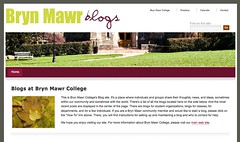
I recently peaked over at Laura Blankenship’s Blogs at Bryn Mawr, I love the new theme, but more than that I am amazed at how they seem to be planning on using this space as a way of bringing together their campus community as well as the alumni from all over the country, particularly if the “Who’s Blogging at Bryn Mawr” sidebar widget is any indicator. Using a blogging platform as a space for allowing the students, faculty, and staff to create quick and easy club and organizations spaces online is huge. This is a space to watch in my mind, we are finding much of the same activity here at UMW and I think it marks a changing tide in just how popular and powerful a user-friendly and open publishing platform will be on campus.

Image of Smith College BlogsEsther White’s recent work on Smith College Blogs is opening up some interesting ways to both think creating a dynamic front page for a campus blogging platform as well as using blogs as sites for faculty to create there own personal sites.

And then there is Tony Hirst at the Open University who is developing ways of turning a blogging platform such as WPMu into an automated publishing platform fueled by the RSS from the course sites created at Open Learn. In short, a way for other institutions with flexible publishing platforms to pull in these resources and re-arrange, edit, and re-contextualize as they see fit. A mashup engine for educational resource that can be pulled in within seconds, that is a potentially rich road for simple, syndicated publishing platforms.

In short 🙂 , “what we have here is the non-failure to communicate.” Above is a distributed group of people doing awesome work at their respective institutions and sharing it widely. What comes out of this is a loosely formed community of folks that have together framed one way of thinking about the future of sharing the work done online quickly and easily with very little overhead. What we have here is a community dedicated to sharing and openness, a model for open education that is firmly embedded in their respective institutional communities, yet always already within the community of the open web. Feeds from other campus blogs, online resources, etc. can be brought in easily and shared readily, but that’s the subject of my next post….

Posted in Uncategorized | Tagged , , , , , , , , | 6 Comments

New bavaframes

Well, back in May my loving children broke a pair of glasses that I had owned and worn for almost twelve years. Since then, I have been wearing glasses with only one arm, primarily out of necessity and a staunch refusal to buy a crap pair of glasses.  And while I flirted with the idea of playing the contact game, in the end it isn’t my bag. I have to admit that for the first month or so it felt kind of weird walking around with one-armed glasses. I often tried to tape them up or hide the lack with a hat or a fake hippie wig. But time is  a funny thing because now, over four months later, I have become pretty comfortable with my one-armed glasses—I almost feel kinda like the one-armed boxer. Eventually my colleagues and neighbors stopped asking me when I was going to get them fixed, and I stopped caring if and when they did ask. I figure it’s a kind of mental training for the tough times that lay ahead (in fact, I have been in such training most of my adult life).

So, having survived for 120 days with one-armed glasses I am excited to both announce and introduce a new, integral member of the bava family. After searching on EBay for just a half hour today I found the perfect eyeglasses for the low, low price of $39.99! So tonight marks the beginning of a new and improved era of bava eyewear that, my children allowing, will last for the next decade. So, without further ado, here are the new and improved (and specially reinforced) bavaframes:

Posted in Uncategorized | Tagged , | 14 Comments

“You’re so cool, Brewster!”

That was then….

….and this is now (actually last week at the NuArt theater in LA–my favorite!):

Stephen Geoffreys delivering his classic line from Fright Night (1985).

Posted in movies | Tagged , | 2 Comments

TerrorVision (1986)

Image of Terror Vision DVD CoverI have a longer post, a kind of “opus” tracing the impact of the VCR on b-movies during the 80s. I’ll save the details for later, but while doing my extensive research I came across a gem from the past: TerrorVision. I re-watched it again last night, and I had totally forgotten the Grandfather (played by the great Bert Remsen) was a survivalist. He had his own bomb shelter and artillery room built into the basement of the home, and he was pushing a survivalist campaign for sustainable food, namely eating lizard tails given they will always grow back. And early moment of survivalism in film, pre-dating the 1987 b-movie The Survivalist and Burt Gummer first appearance in Tremors in 1990.

Burt Gummar from Tremors

Anyway, TerrorVision is wonderful 80s camp, an experience I was afforded by browsing the shelves of a local, independently owned video store (the likes of which populated strip malls across America during the 1980s) for the most outlandish cover and tagline. The era of the independently owned video store is all but gone, but its legacy may have made possible one of the greatest periods in variegated film consumption ever known to a generation of waylaid youth. OK, I guess I gotta write the post after that teaser, but until then check out the trailer for TerrorVision, or watch the whole thing on YouTube in 9 easy pieces. Also, the theme song for the movie composed and performed by the Fibonaccis is an 80s gem in its own right.

TerrorVision Trailer

TerrorVision Theme Song

Posted in Uncategorized | Tagged , , , , , | 4 Comments