The other reverend Jim…

Interesting how the reverend conflates radicalism, liberalism, leftists, and communism in his “God’s People” speech (disambiguation please!). More than that, it is frightening how his rhetoric seamlessly frames all these political positions as perversions that have come way too far “out of the closet” for his liking. You have to hand it to him for being able to effectively attack and condemn an immense cross-section of the world’s population in one fell swoop. However, I guess leaving tolerance to “God’s People” is not really much of an option, now is it?

Tagged , | 2 Comments

divShare plugin for WordPress and WPMu

Recently I have been corresponding with Mario A. Núñez Molina, a professor at the University of Puerto Rico, Mayagüez Campus, who has been also working on integrating a WPMu blogging solution (RUM Edublogs) for the College of Arts and Sciences. He is also blogging the process, so it looks like I have yet another person to share with and learn from. He is trying to get BDP RSS to play nice with his WPMu install (which is the same version as the ELS Blogs and was the spark that initiated our relationship), and as usual I have offered him little in the way of technical support – lo siento, Mario. I am much better at moral support, but I will continue to search for some answers as to why the plugin is borking for that install while working fine for ours -very strange. In the mean time, as is often the case these days, he has turned me on to a really interesting plugin call divShare uploader that may very well change the game for uploading and managing uploaded files for WPMu, or any WordPress installation for that matter. many thanks to Mario for giving far more than he has received!

So what is divShare? Well, it’s not really a plugin per se, rather a free online file uploading and storage service that integrates directly into the upload field of a WordPress blog’s backend (see figure 1 below). It works seamlessly with WPMu as well, and the way to integrate it is relatively simple. Sign up for a free account at divShare ; download the WP plugin and install & activate it; finally, get your divShare Uploader Key from your divShare account settings and enter it where appropriate -you’re then ready to roll.

Figure 1: divShare upload field embedded within a WP blog

Continue reading

Posted in plugins, video, WordPress, wordpress multi-user | Tagged , , , , , , , , | 22 Comments

A musical interlude from Sam Fuller’s The Naked Kiss (1964)…

The children sing “Mommy Dear” and given the logic of this film it is just a downright chillingly beautiful scene.

Posted in film, films, movies, YouTube | Leave a comment

WPMu Smackdown: RSS, Autoblogs, Aggregators, o-matics, and more…

So, it’s just about time to ckeck-in on the work that has been happening on the WordPress Multi-User front. First and foremost, Gardner Campbell is my Godhead. He is teaching two classes this Summer session and they are already abuzz with all sorts of amazing blog action. You can see his New Media Studies “blog portal” here and his Film Text and Culture “blog portal” here. I can’t begin to tell you how amazing Gardner’s vision for this space is, and I think a quick perusal of his student’s work will attest to this almost immediately. More than that, he is willingly doing this in the face of some technical hiccups -taking some lumps this Summer so that many folks can enjoy the same benefits for their classes. So, in short, thank you Gardner for all the amazing work you are doing.

Ok, here’s the tale of the tape thus far:

ELS Autoblogs: The first thing worth mentioning are the experiments with WP-Autoblog for WPMu (I talked about it briefly here). This plugin has really afforded some very interesting versatility for class blogs, in my opinion. WP-Autoblog is basically an aggregator plugin that pulls feeds from ATOM, RSS, & RSS2 into a blog post (which is very similar to WP-o-Matic -which does not work just yet with WPMu). What I like about this plugin is that anyone with a blog on ELS Blogs can enable and add feeds to it. It’s a cinch.

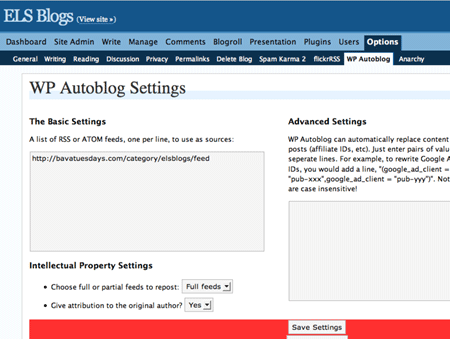
Now let’s think through the implications of this, a professor creates a class blog, enables WP-Autoblog, and then adds the students as administrators to this, and only this, blog. The students are then asked to login in and add their feed to the wp_Autoblog aggregator (which you can see below) and there it is. An aggregated class blog that constantly provides a trackback to the original posts. So you can republish the student’s work in this class blog, making sure that they know that they should create a separate category for this class so only the relevant posts will feed out, and wham -you have a quick and easy class blog that does not disrupt the flow of the student’s blog nor overburden a professor with a whole lot of hacking and devising to make these resources show up in one, centralized space for the duration of the class.

Wp-Autoblog

OK, now what about the student? Well, why couldn’t they use these “autoblogs” to feed out their own work to separate blog spaces that they control to highlight their best work or particular subjects, etc. -what we have here is an infinitely malleable eportfolio? Can you dig it? I knew that ya could.

So Wp-Autoblogs is a huge, simple, out-of-the-wpmu-box solution to aggregation, I really like this. Not to mention it gives a central feed for all the relevant posts for a single class. We have three autoblogs running currently
on ELS Blogs: Film Text and Culture autoblog, New Media Studies autoblog, and All Els Blogs autoblog. Check them out.

BDP RSS 0.6.2: I have talked at length about this slick aggregator plugin for WordPress here. And I recently checked back at the OzPolitics blog to find out that Bryan has updated this brilliant WP plugin. And the upgrades are pretty major, namely he has updated his aggregator so that it is widget ready! How, pray tell? It took me a little bit to figure it out, but you can actually load feeds into the aggregator and configure it accordingly (the ability to configure BDP RSS is unparalleled as far as I can tell) to create a single feed for any combination of blogs you choose. For example, I installed the latest version of BDP RSS on this blog, and I am currently aggregating a unique combination of ELS Blogs and comments into the sidebar. This is now something that students and faculty have the ability to do with the activation of the plugin, and while it is not as dead simple as WP-Autoblog, it makes up for it with customizing option which would be welcome for more experienced users. The BDP RSS upgrade offers an impressive addition for allowing users to work through their own unique aggregation possibilities. I’m still a huge fan of this plugin. We are using BDP RSS to aggregate the all blog posts and comments into the Sitewide Content page here.

King RSS WordPress Widget: Now it gets interesting, the King RSS plugin (powered by SimplePie) allows you to get really specific with where and how you want to place your feeds. And once you get the collated feeds from BDP RSS, you can plug that feed url into King RSS and decide where you want particular aggregated elements to show up on your blog. That’s right, customize where the aggregation shows up in the sidebar from page to page -sick, right! This plugin will take a little bit of getting used to, for it is not totally user-friendly just yet, despite its being a widget.

These three plugins for WPMu in combination, or individually, begin to suggest some interesting ways to feed, aggregate, and re-combine posts to create a rich, connected, and constantly evolving connections with one simple WPMu install.

Upgrading to WPMu 1.2.3: The bestest thing about this whole post is that Gardner and I upgraded WPMu from version 1 to version 1.2.3 to see if it might fix some database bugs (the verdict is still out on that, fingers crossed), and it went as smooth as upgrading a single WP installation. Can you believe that? Almost 100 blogs, and not a hiccup with the upgrade, I know 100 blogs is nothing by WPMu standards, but try upgrading a 100 single installs manually -even if via Fantastico.

Ok, this post is almost over, and if you made it this far I commend you. Andy Rush had mentioned to me today that the ELS Blogs site seemed a bit cluttered (oh, how sharper than a serpent’s tooth is a colleague’s ingratitude!). Which in turn made me think about whether this site would prove completely undecipherable to the unacquainted user? Well, do me a favor and go to ELS blogs and take a look and let me know what you think. More than that, give me any recommendations you may have to make it more user-friendly.

Posted in wordpress multi-user | Tagged , , , , , , , | 10 Comments

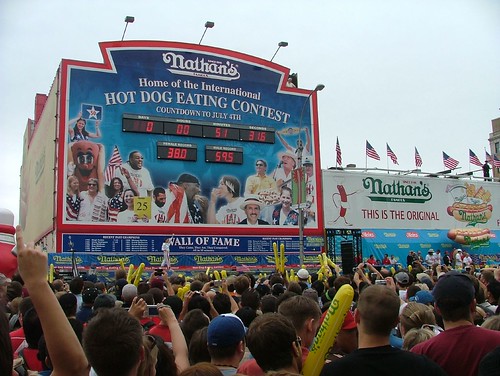
Nathan’s Hot Dog Eating Contest 2007

Image of the Coney Island Hot Dog Eating Contest 2007

Images courtesy of acordova

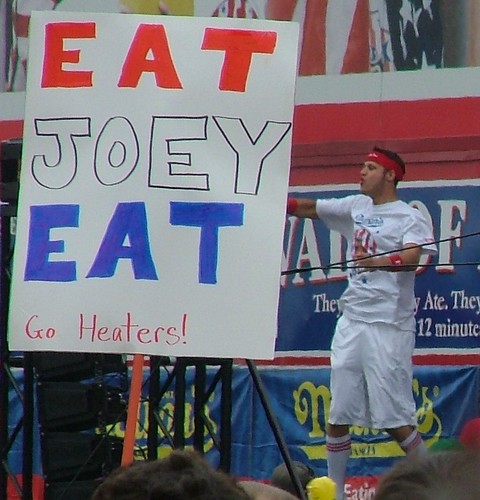
I saw a link on digg.com this morning for the results of the annual Nathan’s Hot Dog Eating Contest, a particularly intense competition this year which was televised on ESPN. Now it goes without saying that I am extremely proud that the gold has finally been brought back to US soil, for it has been a long, difficult six years in which we have had to tolerate the foreign hot dog eating prowess of Takeru Kobayashi. Congratulations Joey Chestnut -what a name, what a guy!
Sign that reads Eat Joey Eat

Beyond the intense nationalistic pride I derive from one of this country’s most important sporting events held in its most important city by the sea, I actually got a fun reminder of the wikipedia-as-journalism phenomenon that the New York Times talked about recently here. The digg.com link was to wikipedia wherein I found such a wealth of information about the contest with the most up-to-date information along with an in-depth history of the event that I started to realize yet again, just how much I love wikipedia. I mean come on, Joey Chestnut and Takeru Kobayashi already have their own articles, and they are both extremely substantial. We live in interesting times, indeed.

Tagged , | 8 Comments

Video mashups using 1970s softcore to learn about Vietnam?

“The visual is essentially pornographic…”
From Fredric Jameson’s Signatures of the Visible

I’ve been thinking a lot about video mashups for teaching and learning recently. It is a lot of fun using the mashup as a prism through which to rethink contexts and possibilities for teaching and learning technologies. Moreover, it allows for these examples to emerge in the strangest of places. BoingBoing linked to a video made by a student that uses the narrative filler of a 1970s softcore film to narrate the history of the Vietnam War. At first glance such a link may seem to garner unwarranted attention because of its lurid relationship to pornography. However, after watching the video it was fascinating to hear a brief history of the Vietnam War constructed through cheesy, throw-away narrative filler (there are no sex scenes at all in the mashup) within a bonafide 70s setting.

[youtube]N-mpRLvfRlY[/youtube]

The director/author of this mashup re-frames these scenes (using his own voice-overs) to talk about the war within the mise-en-scene of the period being discussed. While at the same time placing that discussion in the most unlikely places: at the beach, in front of a food truck, or in a doctor’s office. The dialogue is forced, and you can see that the project required a certain amount of factual information -yet the characters acting out the author’s ideas work on the viewer on a completely different register -making for a quite disjunctive and memorable viewing experience. This short “history” uses a conversational manner to impart information and varying viewpoints about the Vietnam War. The re-employment of the narrative elements of this 70s film within an educational context forces us to once again consider the power of re-using and re-mixing content in a variety of different, and yet unimagined, ways. Moreover, how might already rich online archives of videos like the Internet Archive or the Library of Congress further open up these possibilities for re-framing narratives for various disciplines using archival instructional videos, industrial videos, commercials, cartoons, film features, newsreels, etc.

Thinking through the 20th century as both teachers and learners affords us a tremendous amount of primary material that are not strictly textual, and to ignore the visual texts for their potentially “pornographic qualities” would be to miss the opportunity to present research, arguments, and discussions in a myriad of multi-modal ways.

Posted in video, YouTube | Tagged , | Leave a comment

Happy 4th of July…

…and be careful of those fireworks of mass destruction, kids. Yet another gem from the Internet Archive.

Posted in film, movies, YouTube | Tagged , , , | Leave a comment

Video “Transmission”

Using found footage on the Internet Archive to create my own music video. So feel free to “Dance, dance, dance, dance, to the radio…”


Posted in YouTube | Tagged | 3 Comments

How to use a dial telephone

A reposting of the viral video “The Medieval Helpdesk” (a comical look at the new technology of the book during the middle ages) has a description that frames the point of the video as follows:

This video makes fun of modern newbie computer users by illustrating – in a way fully understandable to them – how silly some of their questions are by creating a similar problem in the Middle Ages.

According to this description, the video was intended to ridicule “newbie computer users” for their obvious incompetence. While an easy framing of the video, I’m not so sure that such a reductive reading even begins to capture the myriad reasons why this video resonates with so many people in our own particular moment. I think an alternative way to think about this video would be to view it through a less anachronistic historical lens. Imagine a moment wherein a general conceptual shift was necessary in order to adapt to new ways of knowing, communicating, and socializing with one another. Take, for example, a quite similar example to the “Medieval Helpdesk” video that is not at all sarcastic, titled “How to use a dial telephone” which is a silent film from 1927 that offers a quick tutorial for, well, dialing a telephone. Strange, right, how could there ever have been a need for a seven minute tutorial for something so simple, intuitive, and natural as dialing a telephone? I don’t know, might they be saying the same thing about RSS sometime soon?

So, lest we take what we are doing for granted, take a look at this “screencast” from 1927. Before we explain away our moment as some ahistorical phenomenon in relationship to new and emerging technologies, it might be useful to seriously consider the video below as an earnest and important document that directly informs the work so many of us are doing in a similar moment today.

Posted in film, movies, YouTube | Tagged , , , | 4 Comments

Clare Quilty, or my excuse for talking about the limits of auteur theory

In the early 90s (probably 1993), I went to the Directors Guild of America to see a Peter Sellers retrospective. I was not a huge Sellers fan at that point. I had seen him a couple of times on the Muppet Show, and mainly associated him with the Pink Panther series. It was a pretty wild retrospective because the folks who were running it spent some time talking about the significance of Sellers as a comic genius, and how it was completely ludicrous that he did not have a star on Hollywood Boulevard. Now I don’t know if he ever got that well-deserved star, but I did come away from this retrospective with a new found love of Peter Sellers. The retrospective introduced me to films like Blake Edwards’s The Party (one of my personal favorites), Being There in all its unintentional genius, and, of course, the unbelievable tour-de-force of Sellers in Dr Strangelove. All brilliant performances, but there were many more -most of which I still haven’t seen like I love you, Alice B. Tolkas.

That being said, the character that I continue to mentally quote more than any other Sellers’s performance I have seen is Clare Quilty from Stanley Kubrick’s 1962 film Lolita. This character is relatively minor in Nabokov’s brilliant novel, but takes on a much more significant role in the film. In fact he in many ways becomes on of the centers of the film which is evidenced by Kubrick’s daring creative choice to reorganize the narrative sequence of the novel by making “Dr. Humbarts” murder of Quilty the first scene of the film. Quilty is a protean character that is dogging Humbert Humbert throughout the film in the form of several imagined characters that very much foreshadow Sellers more celebrated performances in Dr. Strangelove. Quilty acts as a deranged conscience for the audience, constantly finding the opportunity to remind Humbert of his moral crimes while at the same time waiting for the moment to engage in it as well. Below are four scenes from Lolita that highlight some of the amazing dialogue and acting that has continually brought me back to the idea of genius in the context of a film.

I recently had the good fortune to talk with Gardner at length about a whole host of things recently, and when we meandered around to the subject of auteur theory in film studies I told him that “C.H.U.D. and Barry Lyndon are one and the same for me.” I know, I know, I really do try and get Gardner’s goat, but it’s only because I love him so damn much! I guess the problem for me with auteur theory on a very practical level is echoed by Paulene Kael’s articulation of the problems with this approach in The New Yorker magazine during the 1960s. Namely, she argues that such a theory tends to reify one figure of genius, often cutting out the more complex series of relations between a director and the myriad talents that bring any given film together. When anyone talks about a Kubrick film, it often focuses on the genius, vision, and power of Kubrick, I don’t discount any of this in relationship to Kubrick -I mean he was from the da Bronx and he had an unbelievable vision for film. Nonetheless, Kubrick worked in collaboration with thousands of people to produce his oeuvre which makes his vision constantly dependent upon the distributed genius of so many other people. Such a synecdochic figure whereby one part of a production gets distilled to the source of one person’s brilliance (the great individual theory of film?) characterized by box sets like “The Kubrick Collection” is potentially reductive and pushes film scholars and fans alike to attribute genius in a unilateral manner.

Another problem with auteur theory is the ways in which it attempts to rein in meanings by reading film according to a director’s intentions. When we think about the film as text does the question of intentionality begin to dictate a hermeneutic approach? Does a director’s vision (even if clearly articulated in the commentary) necessarily prescribe a reading? The power of creative works are their ability to defy intentionality, to exceed meanings, and to imbue the viewer, reader, etc. with a possible readings that are both unintentional and generative. Thinking films through directors is a valuable approach, but still only one approach among many to understand a film. In fact, I often think it’s more of a marketing tool to sell a brand than to highlight the complex organism that is the psychic life of the visual synapses of film. Thinking film through genres is one way of thinking about form and style as a constant conversation between films, a way in which actors, directors, cinematographers, set designers, gaffers, and production assistants may be working in relationship to larger cultural issues that are not so easily isolated to the genius of one mind. Reading Kubrick’s films as an exploration of genre is one way of placing his work in a bit more context, offering more cross-fertilization and possibility for complex connections and readings rather than some essentialized focus on the often abused notion of genius (I am one of the biggest offenders of this word mind you).

All this to say, how much of the power of any Kubrick film has to do with the folks he has surrounded himself with. Gardner mentioned that 60-70% of any great film might be attributed to the casting of parts. So with that, I’d like to thank James Liggat whose brilliance needs to be recognized once and for all, for he has silently labored in the shadow of the looming genius of Kubrick to humbly bring you a character whose innumerable guises in Lolita represent one of my favorite film characters of all time: Quilty!. Enjoy.

Posted in film, films, movies | Tagged , , , , , , | 13 Comments