Online petition in VA to repeal unjust traffic fines

Update: To view a pdf version of the House Bill 3202 under question click here. Thanks Martha!

A little online democracy at work right here in Virginia. Bryan Ault started an online petition to repeal the enormous traffic fines imposed in House Bill 3202, also know as the “civil remedial fees” (how’s that for a euphemism!).

Below is a quote from an article on WTOPnews.com:

How upset are people about Virginia’s new fines for driving-related crimes? Pretty upset, if an online petition is any measure of public sentiment.

Bryan Ault of Alexandria, Va., believes the fees are too steep, so the 28-year-old software tester started an online petition in an attempt to get them repealed. Ault plans to send the petition to his state representatives.

Nearly 12,000 people had signed the petition by Thursday morning.

I just signed the petition, and that figure of 12,000 is now up to almost 75,000 three days later. Are the people speaking, or is this just more primordial yawping from the masses?

Well, either way, if you don’t want to pay outrageous penalties for traffic violations (who does this really penalize? -those who don’t have any money to begin with) then sign the petition.

Posted in politics | 7 Comments

ELS Blogs rock!

Even if I must say so myself. Ok, so Gardner Campbell is at it again with ELS Blogs and the results are nothing short of amazing -did you expect any less from him? I try and keep up with the the student blogs as much as possible, but such a task is not always easy because there is always so much action coming down the pipes. Let me highlight a few gems I have come across, while acknowledging that these are a small cross section of a much richer series of conversations:

“How I learned to stop worrying and love the blog”:

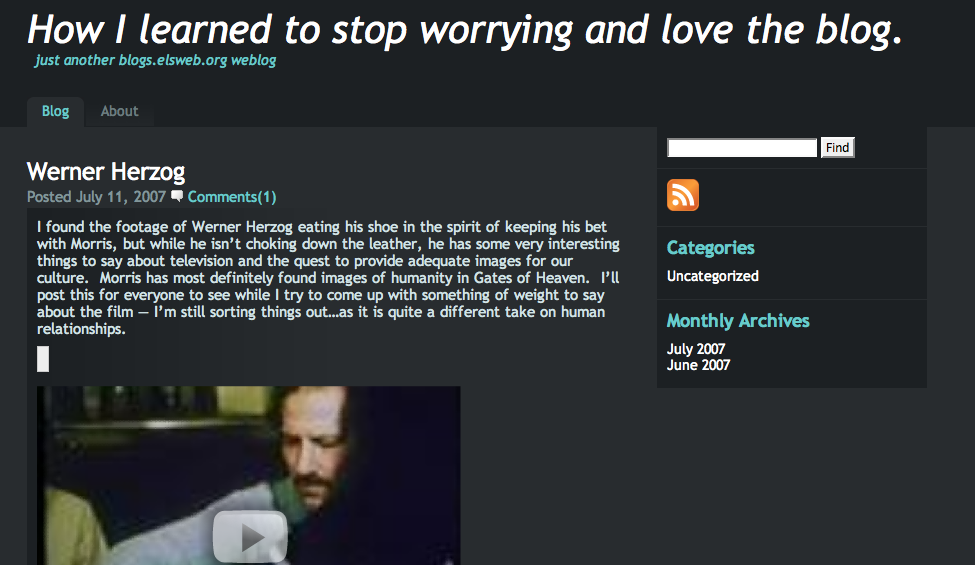
  • How I learned to stop worryingA recent post on this blog had the video clip of Werner Herzog publicly eating his shoe to fulfill a bet he made with Errol Morris. Namely, if Morris would finish his brilliant first feature Gates of Heaven, Herzog said he would eat his shoe. And so he does, but in fact he uses this occasion to go on a tirade about the state of contemporary culture in 1980. This was a particularly special find for me, because I have quoted this story to others on a number of occasions, but never thought about actually trying to find footage that documented the event. I had no idea it was even filmed. Many eyes… (Link).
  • For an added bonus, check out another post on this blog that discusses how the book Little Women was re-imagined as a pulp fiction novel. The image of the cover is well worth the price of admission.

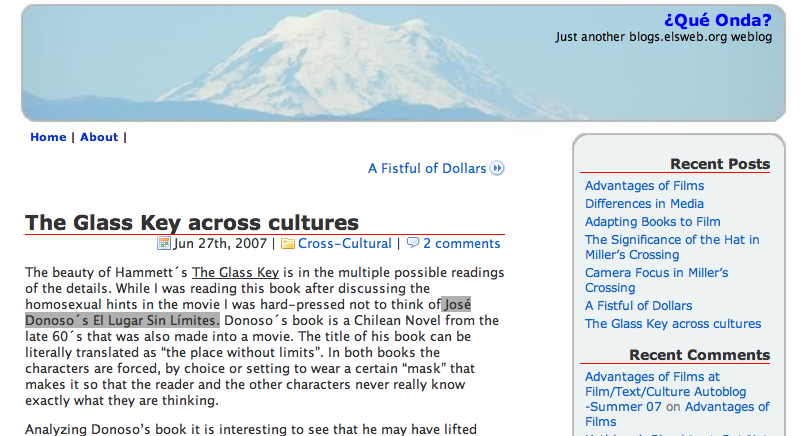
¿Qué Onda?:

  • Que OndaA post on this blog offered up a preliminary cross-cultural examination of the hard-boiled novel. Linking Dashiell Hammet’s The Glass Key with an Argentinian novelist, José Donoso´s El Lugar Sin Límites (The Place without Limits). A link to a novel I am now quite interested in reading, how would an Argentine writer invoke the Noir to talk about their culture? I wouldn’t be surprised to imagine a framing of the Pinochet nightmare or the disappeared. But I can only imagine, but I didn’t even think to do that before reading this post. (Link.)

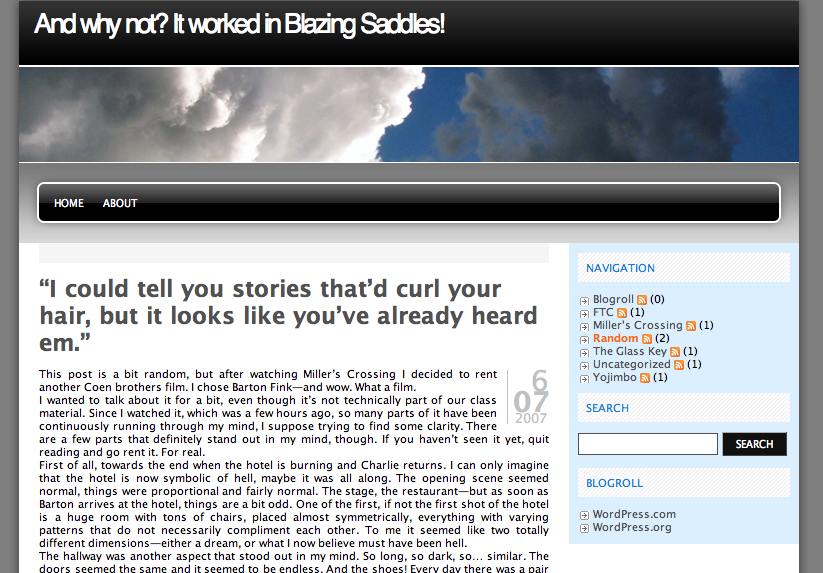
And why not? it worked in Blazing Saddles:

  • Blazing SaddlesThis example illustrates just how willing students are not only to do extra work, but to blog about them in order to make connections.

    This post is a bit random, but after watching Miller’s Crossing I decided to rent another Coen brothers film. I chose Barton Fink—and wow. What a film.I wanted to talk about it for a bit, even though it’s not technically part of our class material.

    Moreover, the analysis of the hotel in Barton Fink as representative of the Dantean spirals of Hell is very engaging to boot. (Link.)

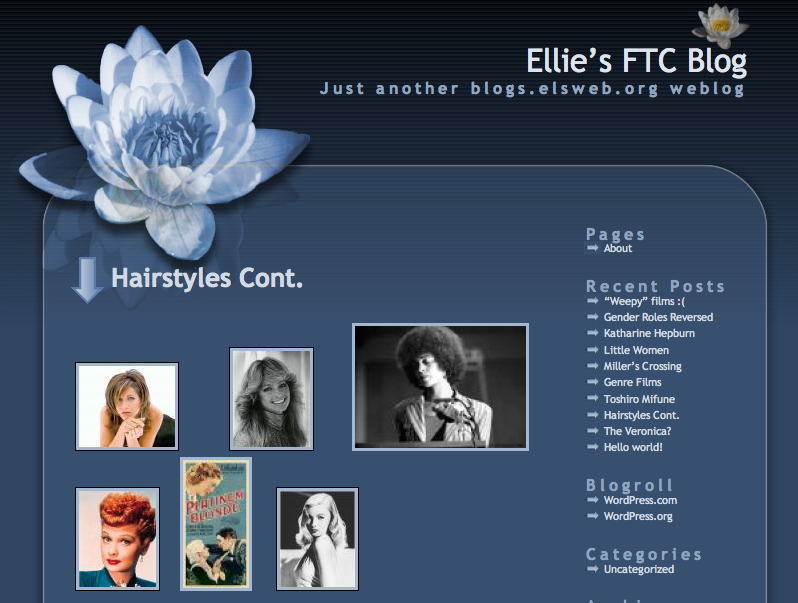
Ellie’s FTC Blog:

  • Elie’s FTC BlogThese two posts about hairstyles are really a fascinating way to imagine film. These post deal with the impact of fashion and style in film upon the culture at large. This blog traces hair styles throughout the decades in order to suggest the role film plays in defining a more pervasive cultural identity. See “The Veronica” and Hairstyles Cont..

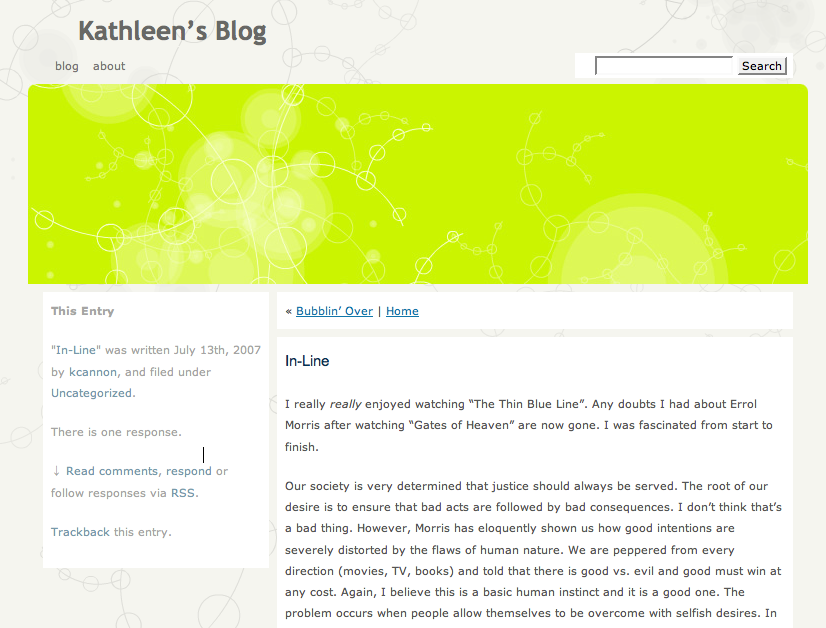
Kathleen’s Blog:

  • Kathleen’s BlogA post on Kathleen’s Blog discusses the implications of The Thin Blue Line by Errol Morris. She offers a nice overview of her impressions of Morris’s film-making acumen, and then includes a clip from the film that profiles David Harris which is a perfect example of the unbelievable moral imperative driving this film. It is really exciting to see that students have the ability to meaningfully quote films like this within their reflections. Moreover, the shots of the cassette tape towards the end of the highlight Morris’s unbelievable ability to inform his documentaries as much through the aesthetic of the shot as the compelling stories he so tightly weaves together. Brava!

I’m continually blown away by all the great stuff coming out of these blogs, and I have only focused on one of Gardner’s two classes. How does he do it? And if that wasn’t enough, UMW is currently preparing the next iteration of WPMu that will be a much broader, campus-wide multi-user blog initiative that even has working dynamic sub-domains -boooyah! You can get a sneak preview here, though keep in mind that this space is still very much in its infancy as of now.

Posted in wordpress multi-user | Tagged , , , , , | 2 Comments

Yo, Drupal, what’s up with you!

I’m sorry, but the Cog Dog put me up to it!

Posted in drupal, fun, WordPress | 6 Comments

Saturday the 14th

“Just when you thought it was safe to look at the calendar again!”

Saturday the 14th

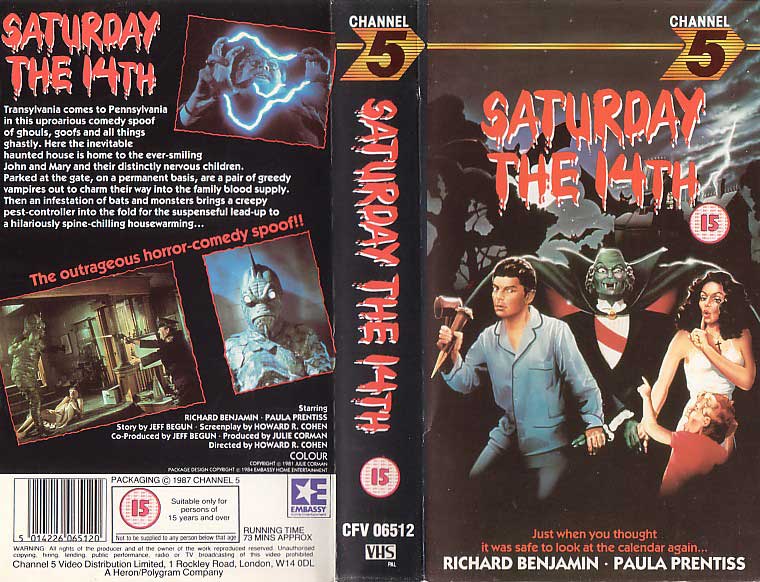
Saturday the 14th (1981) was perhaps one of the worst films I saw as a 10 year old (and I saw many, many bad movies back then) in large part because I had such high expectations for it. I was so looking forward to this movie primarily because I was already a huge fan of the Creature from the Black Lagoon, alas there was little in the way of character development on this score.

This film marks a really interesting moment for me. The over-sized single screen moviehouse up the block was my mecca, yet the brand spanking-new VCR in our living room had opened up some unbelievable doors (never realized just how many it would close simultaneously). There needs to be a long series of posts on the bava about the Century Baldwin (the theater I grew up around the corner from) in relationship to the death of the movie-going experience in the US. It is something I often lament, but I am not sure whether it stems from a displaced notion of nostalgia on my part or a larger sense that the end of the single screen movie theaters with their elaborate marquees and detailed facades marked the end of something for all of us. How can the Cineplex 150 on the edge of nowhere that every one must drive to ever compete with the temple of smoke and mirrors at the center of our neighborhood?

Anyway, this is the kernel of a much larger sequence of posts, it’s just that the day Saturday the 14th always reminds me of the dark, Coke, popcorn, and Dots filled excitement of interacting with a beautiful 35 mm screen in a building that cradled and fostered my seemingly limitless sense of wonder.

Posted in film, movies | Tagged , , | 5 Comments

The Killers (1946): What’s the idea?

I posted a little while back about a few of my favorite noirs, and decided to re-visit one of the films from the list: The Killers (1946). I truly love this film, and on yet another go round I’m beginning to understand a bit more as to why. To start with, the movie does an excellent job of directly lifting the flashback-based narrative from Citizen Kane. The only difference is that the figure piecing together the life of Charles Foster Kane was a journalist, whereas Jim Reardon (Edmund O’Brien) was an insurance investigator doing routine follow-up on the murder before paying out a ‘nickel and dime’ insurance policy. The shift of the principal investigator from a journalist to an insurance man reflects how Noirs seldom, if ever, focus on a figure of standing and greatness that is newsworthy for the life they lived, but rather for the crimes they committed. Noirs often focus upon the deranged, criminal, impoverished, or forgotten characters -a style of film dedicated to the unspeakable elements of society who spend their time moving from one boarding house to the next.

And while the narrative logic of The Killers is ultimately fleshed out with Welles-inspired flashbacks, I would argue it gains all of its momentum through one of the most hard-boiled and downright brutal sequences in cinema. A sequence which is taken almost verbatim from Ernest Hemingway’s 1927 short story of the same title. I quote the first three minutes from the opening scene below (the whole sequence runs around nine to ten minutes) in order to give you a sense of the darkness (both cinematic and psychic) that pervades the opening scene. Hemingway’s story was a tale about a man (the Swede) who refuses to run away from death and ultimately faces it with both resignation and dignity -an unfathomable reality for most- and for Hemingway the zenith of a darker sense of heroism. The director of this film, Richard Siodmak, was a German-born Jew who fled the rise of Nazism during the 1930s, arriving in the US in 1939 and begam making films in Hollywood as early as 1941. He was also a filmmaker in Germany and his experience with sophisticated studio shooting and the brilliant lighting of black and white (prevalent in many films from Germany throughout the 1920s and early 1930s) brings much to the Hollywood noir style of the 1940s, some of which is readily apparent in the clip below.

THE KILLERS Intro from Jim Groom on Vimeo.

One of the things that occurred to me while watching this film for the umpteenth time was the ways in which the horrific, yet shadowy, realities of Nazism inform the first 10 minutes of this film. Adorno’s famous claim that ”After the Holocaust there can be no poetry,” or, as Daphne Merkin explains this quote, “in the wake of such mind-numbing atrocity, there can be only linguistic diffidence, an exhausted heap of words” (link) informs the ways in which the popular appeal of film Noir may have started immediately trying to speak to such an atrocity indirectly through allegorical images. Almost immediately after this global atrocity, a Siodmak adapts a short story by Hemingway to filmically comment on the unutterable horror of the legacy of Nazism using the figure of the Noir killers. Moreover, the ultimate violence of their being no perceivable idea, as they communicate to Nick Adams in the clip above, dramatically captures that sense of unfathomable horror that remains. The first 10 minutes of The Killers is noir at its meanest and most brutal, particularly because it is framed by a historical moment in which the is world reeling from the realization of the violent extremes that humanity is all too capable of. Film Noir in many ways marks the end of humanism through the filmic language and ushers in the rise of our modern era.
Posted in film, film noir, films, movies, YouTube | Tagged , | 8 Comments

Underwhelmed by iTunes U

Locked in at Apple
Used courtesy of -t- [formerly dtc]

Can I just say how unimpressed I was with the demonstration of iTunes U we had yesterday. In short, iTunes U offers universities a free, mildly customizable space on the iTunes client that allows students and faculty to upload and access digital content such as podcasts, vodcasts, etc. The organizing logic is that iTunes U does the aggregation for the university and offers a half terrabyte of storage space. But are either of these elements necessarily unique given the tools we already have at our disposal? I mean what can iTunes U do that a WordPress install with PodPress and a few aggregation plugins cannot? Hey, Drupal might even be able to handle this one without too much fuss. And guess what, unlike iTunes, these applications are web-based and provide easily accessible RSS feeds. A few things irk me about the iTunes U package:

  • The assumption that “everyone” is doing it. In Virginia it seems like UVa, William & Mary, VCU, Radford, Va Tech, and many more have jumped on the bus. Why are they doing it? It could be because they haven’t been playing with more sophisticated, web-based options for media-casting, aggregating, and customizing their own space with free, open source applications that have easily accessible RSS feeds built in. No buried feeds to dig out as Jon Udell pointed out over a year ago here.
  • iLife quickly becomes the defacto means for authoring and importing multimedia into iTunes U -namely because it just works. How many students and professors have MACs? The figure is far less than PCs, and I would venture a guess that it is fewer than 10%. So you sell iLife during these presentations in order to sell MACs. No need to sell iTunes U (that’s “free”), you just sell an OS (which you can’t load on a PC legally) and its programs to make the whole thing work without a hitch. Questionable.
  • Finally, I’ll echo Gardner’s sentiment from last year which brilliantly traces how Apple is really trying to create a situation of “vendor lock-in” by providing a branded digital management system that offers little beyond a customizable homepage for selling their products. All this under the assumption that what they are doing is somehow philanthropic. How is it philanthropic? They are giving you a program that they have already designed which costs them nothing, they throw in some storage space (which is cheap and plentiful) in the hopes that every student every where will be getting their music, TV shows, videos, texts, etc. through iTunes. Not exactly OLPC, now is it?

So whether or not we go ahead with iTunes U -and I see no compelling reason why we should- it will have little, if any, impact on the work I do at UMW. Not only is iTunes a less than intuitive program to begin with, but it’s primarily a product and a brand, and I think we have had enough of them on campuses throughout the US over the last 10 years. I think it’s time to introduce applications more concerned with open, accessible, and easily re-purposed content, rather than cornering market share and selling units. In my opinion, what we are doing at UMW is a movement, it ain’t a mall!

Tagged , , | 14 Comments

Do the hustle: the pinnacle of instructional videos

This epitomizes everything an instructional training video should be: kinetic, flared, and headless. Rumor has it that Marky Mark spent countless hours watching this video while preparing for Boogie Nights. And now, for the low, low price of free you can too! Enjoy.

Posted in fun, YouTube | Tagged | 6 Comments

Ubuntu graffiti on Brooklyn Bridge

Is this a sign for me that it’s time to jump ship? I know some other folks have begun the move, is it time to leave behind the hideous chic of MAC OS X once and for all?

Grafitti on Brooklyn Bridge
Image by Urban_Data via Digg

Tagged , | 2 Comments

Semiologic Theme: WordPress as a CMS that much closer

Once again, Mario A. Nuñez-Molina is fueling this blog and I can’t thank him enough. He recently turned me on to the Semiologic theme for WordPress -designed by Denis de Bernardy- which really pushes the possibilities for thinking about a blogging platform beyond the often conceptually limiting logic of the blog. If you take Dennis’s excellent theme, customize a skin (see more on this at the Semiologic site here) and integrate it with the divShare uploader -the implications are kinda radical!

Why? Well, because between these two plugins you begin to get closer and closer to a distributed and flexible CMS that can scale to an enterprise-level using an application like WordPress Multi-User. How so? Well, divShare offers you a free and simple file management system that integrates seamlessly with WordPress, and the Semiologic theme (like the K2 theme) offers you a presentation package that builds in the possibility for a whole host of simple customizations for the look and feel of your site. Unlike K2, however, the Semiologic theme has built in a series of skins that sit on top of it allowing you to choose from one of several or create your own customized skin by building on the CSS of a blank skin provided. So, in other words, you can re-skin your theme, making the theme not so much about the design or aesthetics (as most themes are) as it is focused on affording the ability to do more with the presentation elements of the site -such as side bars, font style, font size, fixed or flexible width, customized captions search engine optimization, customized header, customized page navigation 🙂 , customized page elements, various page templates for different content, etc. (you can read about all of these goodies and more here).

What impresses me most about this whole thing is that as we push further with WPMU as a blogging platform at the University of Mary Washington -it is quickly becoming apparent that we could just as well be thinking about this tool as a distributed Content Management System for the University more generally. With an simple, customizable, and highly functional theme like Semiologic along with a file management solution like that offered by divShare -two of the most important elements of content management are taken care of. All we need to do at UMW is customize a skin for this theme and give it a whirl. I plan on playing with this at length shortly. If you are interested in seeing a Semiologic theme in action, I have set one up here, and you can login using the following name and password to play around with the presentation options:

login: testuser
pw: semiologic

Have fun!

Posted in WordPress, wordpress multi-user | Tagged , , , , | 8 Comments

darcynorman.net on an iPhone

Darcynorman.net on an iPhone

Not sure if anyone has given you a snapshot of your blog on an iphone yet, D’Arcy -if not, here it is! And notice the required reading in the upper right-hand corner of this image.

Tagged , | 2 Comments