Citation Needed

Screenshot 2016-07-28 14.52.32

Citation Needed blog at CUNY Academic Commons

I’ve been working with CUNY’s Academic Commons teams over the last five or six months to help highlight the work happening there. Promoting good work in and around communities is something I’ve done for years with UMW Blogs and UMW Domains, so it should come naturally, right? Well, I thought so too, at least until I tried doing this for the Commons last semester. I couldn’t find my groove. I am so used to blogging about whatever I want whenever I want however I want here on the bava that I forgot what it meant to write with intention for a bit a more focused audience. I struggled along with a number of disconnected blog posts on the Commons News blog highlighting work happening around the Commons, but nothing that really congealed for me.

ldqwb2evus6swbhc7lo0

This came to a head this June during the Commons retreat when it was made clear my blogging wasn’t really up to the level of my predecessor Brian Foote, whose Footenotes blog was a huge part of the Commons success for the first 3 years. WTF?! I’m Jim Groom, dammit! I’ve been blogging since you you were battling with your Pokemon cards in your parents attic. We all react differently to criticism, I know. But I what I have always appreciated about New York, and CUNY in particular, is folks pretty much tell you it straight.

you-suck

I went away and licked my wounds while listening to Morrissey. I also spent some time reading Footenotes and getting a sense of his style and approach. It was a great exercise for me to start thinking anew about blogging for the CUNY audience and stop assuming I could just blog as I always did and that would be enough. It was equal parts lazy and presumptuous on my part, and while it wasn’t necessarily terrible—it also wasn’t great.

hmc

If I am going to be honest with myself (which I sometimes pretend to be), what I was told at the retreat was no surprise. I knew as much myself, but I couldn’t see my way clear of how to fix it. And while it was suggested a few times I take a closer look at Footenotes,  I was thinking they wanted what I’ve been doing, not what someone else already did. But that was me oversimplifying, they obviously wanted me to blog for them because I have a track record of doing just that to build community, but the Commons community has its own rich history of community and I should have paid more attention to just that.
giphy

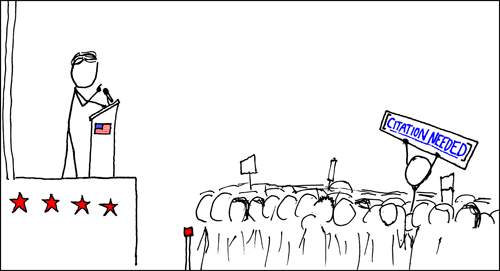
Anyway,  over the last few weeks I regrouped. I created a distinct blog from bavatuesdays (a big step for me), and imagined this work as something else entirely. I titled the blog Citation Needed because I love the XKCD cartoon of the Wikipedian Protestor from years ago, and it never seems more appropriate then now (Brexit and the Trump presidential campaign—and to a lesser degree Hillary’s—highlights the more depressing side of social media many of us downplayed in the mid to late oughts while we were in search of the digital El Dorado).
wikipedian_protester

The idea is a weekly round-up post wherein I highlight the work happening around the Commons, incorporate crazy GIFs, and even find an outlet for some of my own repressed political feelings—stuff like why doesn’t anyone talk about Turner & Hooch (1989) anymore.  What’s more, I have some excellent models to build on in addition to Footenotes. One of the blogging genres I have been fascinated with more recently are daily/weekly round-ups that share thoughts, politics, links, poetry, etc. They are usually a cornucopia of resources that focus around a topic, for example Audrey Watter’s now legendary Hack Education weekly newsletter is without question the definitive resource for weekly edtech news in the field, no one does research like the Pigeon…NOBODY!

200_s

I also dig Chris Lott’s Katexic. I am a major fan of how this newsletter marries literary works with words with interesting links. Both of these examples use the application tinyletter for their newsletter. And while my work will be first and foremost a weekly blog post, I created a tinyletter account to handle the email subscriptions piece (not that I foresee a major rush). I’m looking forward to playing with this format over the next few months. I already published my first weekly round-up post this past Tuesday, and while nothing earth shattering I do believe it gets me closer to what I should be doing for the Commons. What’s more, it felt good to write. I liked exploring the interweaving of GIFs with links to posts and various bad jokes and inside references. It’s how I write anyway, just with a bit more focus and attention, to open up a map and see between 1 and 2.

EscapeFromNewYork_136735_Trailer-1024x576

The other kool thing, as I already wrote about in preface here, is that I am giving myself a time-released cyanide capsule on this job. Like Snake Pliskens, if I don’t get the job done in the next six months those capsules will pop and I will hit the eject button from the Gullfire. But, let’s hope it doesn’t get to that and I am able to rescue the president from the prison that is Manahatta.

Posted in Citation Needed | Tagged , , , , | 2 Comments

Steal from Work


I recently listened to Jason Scott‘s “Now and Then, Here and There” talk for the Eleventh Hope (Hackers on Planet Earth) Conference. Jason is a free-range archivist working at the Internet Archive. His work with browser-based software emulation over the last few years has been amazing, not to mention his ongoing work since 2009 as a member of the Archive Team—the folks who saved Geocities.

Anyway, during his recent talk he has a great bit about why people should “steal from work.” It starts at about 25:30 and lasts a couple of minutes and he makes the point that history has shown stuff does not so much get archived institutionally (as I was bemoaning in regards to the New Media Consortium recently) but rather in the attic of the one-off closet archivist. He tells the story that Atari’s prototype artwork for their classic video games was not saved by the company, but rather by someone who bought two filing cabinets from Atari that happened to be filled with these historical documents. Companies, educational institutions, non-profits, etc., change leadership, personnel, direction, etc., and as a result stuff gets lost, forgotten, and discarded. Some of this is inevitable, but at the same time it is made worse by the prevailing logic that this is not our work—and by taking it and archiving it we are somehow stealing it. This is often true based on out warped ideas of intellectual property, a mindset that continues to impoverish the critical history of our culture.

if you’ve worked at one institution for any significant amount of time it’s fairly easy to see the value of the “steal from work” mantra. What’s been different in regards to my work at UMW for a decade was that I made the choice to openly narrative, document, and archive just about everything I did for UMW on my own domain, and it may have been the single best professional and personal decision I’ve ever made. I was “stealing” back the way we should work. I understand this is not possible in many scenarios for all sorts of reasons, but it will be interesting to see how much of institutional history we begin to get from self-hosted blogs, websites, archives, etc., in the not-too-distant future. There is a vast history of teaching and learning across thousands of universities that took place beyond the campus network that sits on servers at blogger, wordpress.com, Twitter, Facebook, Tumblr, etc. It would be an interesting archive project to try and preserve the history of teaching and learning during the age of social media. In many ways, that is what UMW Blogs represents for me when I think about it. An ongoing historical record of a new way of thinking about teaching and learning online.

Posted in Archiving, copyright, umw, UMW Blogs | Tagged , , | 3 Comments

Reclaim Hosting Turns 3

Screenshot 2016-07-25 21.30.06

Earlier today I was talking with my partner in crime Tim Owens about the fact that Reclaim Hosting turns 3 years old this week. I was under the impression it was July 28th for some reason, but turns out it was earlier than that. Tim sent along this article from the Chronicle dated July 25th, 2013 that formerly announced the launch of our little experiment. As an added bonus, Tim reminded me what our website looked like that summer care of the Internet Archive’s Wayback Machine. Three years has gone pretty fast, and this fairly modest experiment has become part of a broader community of practitioners that want to reclaim the possibilities of the web for higher education and beyond. It’s been an awesome privilege to help folks stake their small claim on the web. And while waxing nostalgic about the spirit of Geocities, I am reminded thanks to a recent talk by rogue archivist Jason Scott (one of the handful of individuals who helped preserve the history of Geocities before Yahoo! deleted it) that the individual web we create and preserve is part and parcel of the digital culture we inhabit. To abdicate control and stewardship of that culture to those that would commodify and then wantonly discard every last bit of it (see Yahoo! and Geocities above) is a serious cultural problem. And we can only count on folks like Jason Scott and the patron saints of the internet at the Archive to a certain extent. It’s up to us to take responsibility for and make plans to preserve the integrity of the trails we blaze on the world wide web. Reclaim Hosting emerged as part of an educational community to make this easier and more affordable—that remains the mission. Avanti!

Posted in Archiving, Internet Archive, reclaim | Tagged , , , , | 2 Comments

The Talented Mr. Ripley

The_Talented_Mr._Ripley_Cover

This is the front cover art for the book The Talented Mr. Ripley written by Patricia Highsmith.

I’ve been trying to catch up on my reading list this summer. Like with all things for me (expect for maybe watching films), reading is often all or nothing. I tend to read most when preparing a course. In fact, I have come to rely on imagining new courses to inspire my reading lists. Few things are more enjoyable than imagining a series of books and/or films that create a discursive arc around a topic or genre. The Hardboiled class in 2012 or the True Crime course in 2013 (both co-taught with Paul Bond) were two recent highlights along those lines.

That said, my mind has been relatively far away from the classroom over the last year, a break I’ve truly appreciated. While clocking far more than 40 hours a week at Reclaim Hosting, it hasn’t felt like a job. Between working at home, being constantly surrounded by my family, traveling less (and when I do with Antonella and the kids), and having the fresh context of living abroad, the last 10 months has felt like the sabbatical I would never have gotten from higher ed. What’s even better is that it doesn’t seem to be temporary. Reclaim turns three years old this week, and it has never been greater!

So while at some point in the future I’d like to return to the classroom, it’s not in the cards anytime soon. That being the case, I need to find my reading groove independently because nothing is more generative for the imagination than good books, except maybe good movies. I’ve been toying with Martin Weller’s book-a-week run in 2015, but given how hot and cold my reading can be I’m afraid I’ll miserably fail and then resent the idea of meeting a quota. So, I don’t have a plan other than saying I need to read more, and hopefully as a result I’ll blog about what I’ve read and the virtuous cycle of the bava will continue. Also, I want to publicly commit to reading as little nonfiction as humanly possible 🙂

Anyway, all this is just self-indulgent foreplay to the point of this post: I finally finished a book! The last fiction book I finished before this was back in March, I re-read Cormac McCarthy’s Blood Meridian because I needed the strongest antidote possible to the constant sense of elation I was was feeling since moving to Italy.* Since then I have been reading four different books on and off: The Talented Mr. Ripley (1955), The Shrinking Man (1955),  The Crossing (1994), and Europe Central (2005). I’m not sure the link between these novels other than they’re all by American authors, but I finally decided to lock-in and knock one out this week.

purple_noon

The lucky winner was The Talented Mr. Ripley, a perfect summer brew. I was inspired to read Ripley after watching the 1960 French film adaptation of the novel titled Purple Noon (Plein Soleil) a couple of months ago. I was struck by the ending of the French version of the film (starring the young Alain Delon) because it was so bizarre. In this version, Ripley gets caught for murdering Dickey Greenleaf when Dickey’s sailboat is dry docked revealing his decomposing body attached to the hull. A gruesome twist, and radically different than the more recent ending in Anthony Minghella‘s 1999 version wherein Ripley murders his lover on a ship to Greece, continuing his sociopathic compulsion to hide his dark past. I didn’t care for Minghella’s The Talented Mr. Ripley when I saw it in the theaters, but over time I have a bit more respect for it. Jude Law’s and Philip Seymour Hoffman’s performances remain a highlight; no one plays a spiteful, entitled American rich boy quite like Hoffman—his condescending laugh as Freddy Miles was worth an Oscar alone. This version is far more faithful to the book than Purple Noon in plot and character development, but adds a plot line about Dickey’s suicidal Italian mistress and the bizarre love triangle between Ripley (Matt Damon),  Meredith Logue (Cate Blanchett), and Peter Smith-Kingsley (Jack Davenport) towards the very end which dramatically changes the original tenor of the book.

The_Talented_Mr_Ripley_freddy 01

Which brings me to the reason I wanted to write this post to begin with, Patricia Highsmith’s novel is far more sinister than both film versions. After marking the difference between the chance twist ending in Purple Noon and the insistence on Ripley’s sociopathic behavior in Minghella’s The Talented Mr. Ripley, I was increasingly more interested to see how the novel would end. As it turns out, the ending is far more haunting than both of them. Ripley gets away with it. He lands in Greece with four policemen waiting at the dock. Imagining the game is over, he is resigned to turn himself in given the news that Dickey’s belongings have discovered in Venice, which coincides with his mailing of an incriminating letter which includes a forged version of Dickie’s last will and testament bequeathing his personal fortune to Ripley. But the cops are not there for him, what’s more he soon after receives a letter from Dickey’s father confirming the receipt of the will and promising him the fortune. The novel ends with Ripley having escaped justice, leaving him free to pursue is bourgeois dreams. It reminds me of Woody Allen’s Crimes and Misdemeanors (1989)there’s no personal guilt that haunts the main character for the rest of their life or drives them mad or to confess. Rather , once it escapes detection it becomes removed from any lived reality. I loved the book for this, and also I dug the way Highsmith rendered  Ripley as a such an unremarkable killer, a truly fascinating character. The murders are not so much murders as expedients Tom Ripley needed to attend to in order to live the life he has been in line for. And what’s so haunting is this is not so much about murderous rage and psychosis (although it is that) as much as it is about attractive leather suitcases, expensive meals, and various luxurious things that make you feel better, as Ripley acknowledges:

Maybe he’d never go back to the States. It was not so much Europe itself as the evenings he had spent alone, here and in Rome, that made him feel that way. Evenings by himself simply looking at maps, or lying around on sofas thumbing through guidebooks. Evenings looking at his clothes – his clothes and Dickie’s – and feeling Dickie’s rings between his palms, and running his fingers over the antelope suitcase he had bought at Gucci’s. He had polished the suitcase with a special English leather dressing, not that it needed polishing because he took such good care of it, but for its protection. He loved possessions, not masses of them, but a select few that he did not part with. They gave a man self-respect. Not ostentation but quality, and the love that cherished the quality. Possessions reminded him that he existed, and made him enjoy his existence. It was as simple as that. And wasn’t that worth something? He existed.

The above passage (thank you Submitted for Your Perusal) is the culminating articulation of the innumerable small, subtle ways Tom explains away the bloody trail of events that have made his new lifestyle possible. It’s doubly chilling when you think about this passage in relationship to how we must everywhere ignore the violence that makes our lifestyles possible (the food we eat, the cars we drive, the freedom we spill, etc.). More so than the film versions which ultimately punish Ripley for his transgressions, Ripley gets away with murder in his duplicitous pursuit of wealth, luxury, and some commodified meaning to his existence. This unexpected ending wherein Ripley gets away with it came together brilliantly by providing a powerful critique of the post-war American mind through a international lens.

What’s more, it didn’t suck when Tom Ripley made his way to Trento to buy a car. I am in that very city with the same situation presently. When fiction and reality fuse, post-war america burns!

____________________________________________

* I read E.F. Shumacher’s Small is Beautiful in preparation for this presentation I gave in May at AMICAL.

Posted in books, detective fiction, film, Hardboiled, movies | Tagged , , | 1 Comment

Reclaim the CSS Animation

singleprofessionalbox
It’s been a bit quiet around here recently. Between flying relatively solo on Reclaim Hosting support last week and fitting in some vacation time as well I’ve been fairly busy. That said, I’ve been meaning to play around with CSS animation thanks to Tom Woodward’s post last month featuring beer bubbles. And after talking with Bryan Mathers about more seamless animation of the artwork illustrating the shared hosting packages, playing with the CSS sample Tom shared was high on my to-do list. Bryan Mathers also did a really cool record animation for spinning up apps that I wanted to incorporate on the site somehow.

writing on the disc med-1

But time and C64 overtook me, and my grand plans remained dreams….until today. While working on something far more clerical this morning the great John Johnston shot me this via direct message:

xgwhtw2Yoa

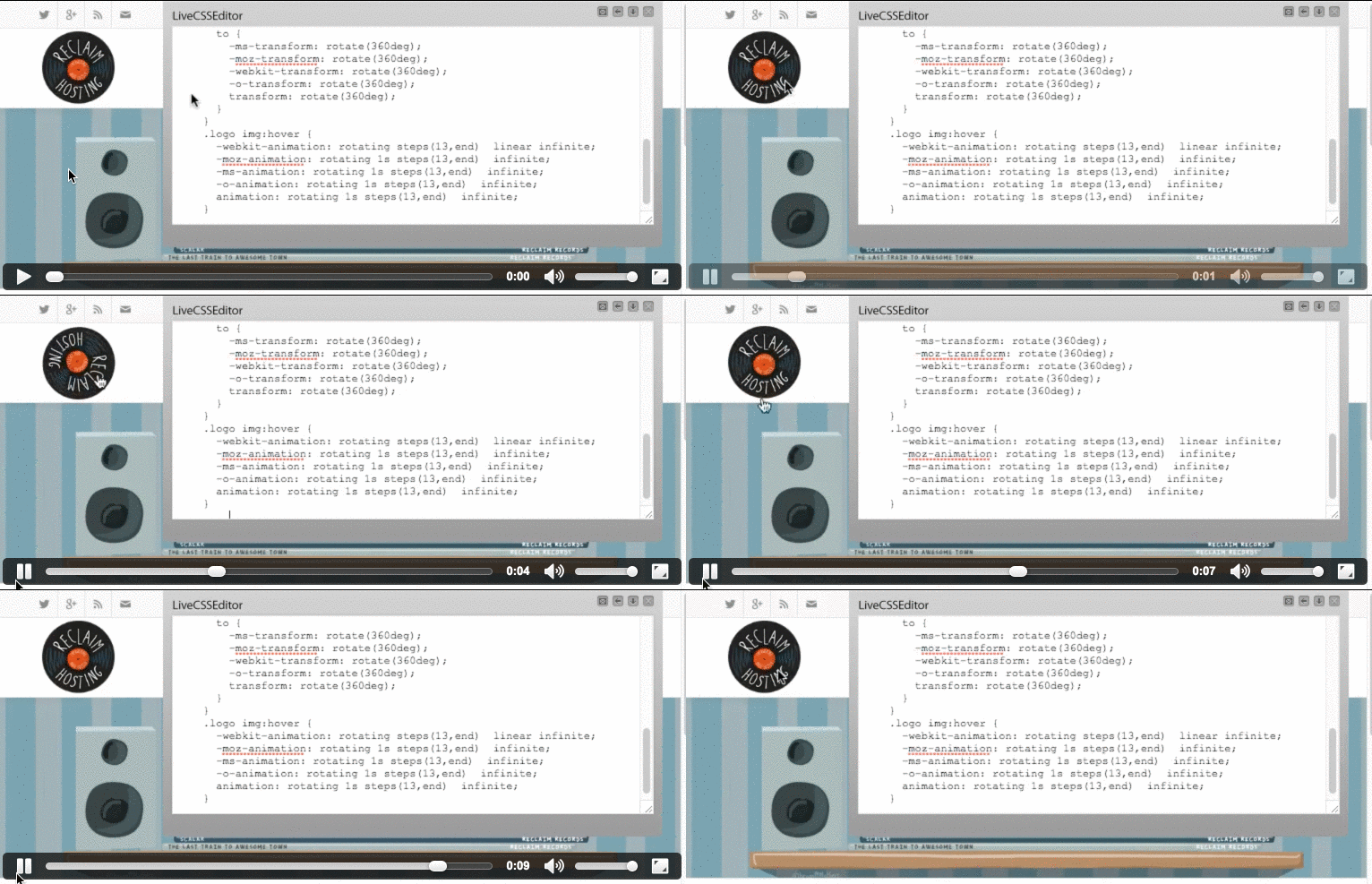
How about that, reading my mind! Or at least Tom Woodward’s blog. The Reclaim Hosting logo  animated as a revolving record whenever you mouse over it—I’m sold! Let’s see that again and again and again…LByMbD2uFy

Here is the CSS code John sent my way soon after:

@-webkit-keyframes rotating /* Safari and Chrome */ {
      from {
        -ms-transform: rotate(0deg);
        -moz-transform: rotate(0deg);
        -webkit-transform: rotate(0deg);
        -o-transform: rotate(0deg);
        transform: rotate(0deg);
      }
      to {
        -ms-transform: rotate(360deg);
        -moz-transform: rotate(360deg);
        -webkit-transform: rotate(360deg);
        -o-transform: rotate(360deg);
        transform: rotate(360deg);
      }
    }
    @keyframes rotating {
      from {
        -ms-transform: rotate(0deg);
        -moz-transform: rotate(0deg);
        -webkit-transform: rotate(0deg);
        -o-transform: rotate(0deg);
        transform: rotate(0deg);
      }
      to {
        -ms-transform: rotate(360deg);
        -moz-transform: rotate(360deg);
        -webkit-transform: rotate(360deg);
        -o-transform: rotate(360deg);
        transform: rotate(360deg);
      }
    }
    .logo img:hover {
      -webkit-animation: rotating steps(13,end)  linear infinite;
      -moz-animation: rotating 1s steps(13,end)  infinite;
      -ms-animation: rotating 1s steps(13,end)  infinite;
      -o-animation: rotating 1s steps(13,end)  infinite;
      animation: rotating 1s steps(13,end)  infinite;
    }

All I did was drop it into the stylesheet for the child theme we’re using for Reclaim Hosting’s site and it worked seamlessly. So, now it is time to take what I’ve learned here and animated the package icons for the shared hosting. You rule John Johnston!

Posted in design, reclaim | Tagged , , , , , | 2 Comments

Danny’s Wheels

overlookhotel

I am still playing with John Johnston’s cartoon script command line kung-fu using scenes from The Shining. You can see yesterday’s Punch and Judy show here. Today I wanted to try and play with some of the scenes of Danny on his Big Wheel. Seems like it would be fun, and I found this scene when searching that reinforces the idea in the movie that Wendy and Danny do all the work despite Jack’s dissertation to the contrary:

This 1 minute scene starts with the title “One Month Later,” then moves to an establishing shot of the Overlook Hotel, and then cuts to Wendy pushing a breakfast cart (which will be brought up to Jack who is still in bed sleeping). The scene then cuts to a parallel shot of Danny riding around the hotel’s hallways. Danny and Wendy are up and doing their respective jobs, whereas Jack has still got his lazy ass in bed. What’s cool about this scene upon watching it more closely is the way both Wendy and Danny move through the Overlook on wheels. It’s kind of cartoonish with the vast interiors of the set. Anyway, I liked it so I can it a whirl.

Posted in digital storytelling, film, movies, video | Tagged , , , , , , | 1 Comment

Gimme the Bat

I’m in a ds106 state of mind these days. In particular, I’ve been meaning to dig into all the amazing work John Johnston has been doing with command line tools over the last several years. I always looked on in wonder, but todayI decided to stop internet rubbernecking and get my A-game back on 🙂 As I was thinking about things I wanted to play with—his recent post about playing with ffmpeg and ImageMagick to create cartoon versions of famous movie scenes came immediately to mind.

gimmethebat

After some deliberation I decided on the “Gimme the Bat, Wendy” scene from The Shining.  The idea was to take this scene, which is reminiscent of a Punch and Judy puppet show, and make it cartoonish. There are several references to cartoons and fairytales in The Shining: Wile E. Coyote and the Road Runner (beep beep), Bugs Bunny, Hansel and Gretel, the Three Little Pigs, a bizarre ass rabbit, etc. So this might be a good place to start exploring the trope with some command line art.

Anyway, I spent far too long playing with this, but I am close to some understanding—well, at least of the basics. I followed John’s tutorial, and it was spot on. The only issue I ran into was a permissions problem with the cartoon script, and John bailed me out with a quick permissions fix in command line:

chmod +x cartoon

The other thing John does not cover in his post is installing ffmpeg and ImageMagick. I did this through MacPorts, and it makes installing system software like this really easy. As luck would have it, I just installed MacPorts a couple of weeks back to get my Mac to talk to the C128, so I was in like Flynn. I recommend this great guide for installing MacPorts if you have a Mac and are planning on exploring this stuff. Once you have MacPorts installed properly, spinning up ffmpeg and/or ImageMagick is a simple command.

For ffmpeg it is…

sudo port install ffmpeg

And for ImageMagick it’s…

sudo port install ImageMagick

John’s tutorial will take you the rest of the way home, and home is where the heart is as Jack Torrance constantly reminds us:

Posted in digital storytelling, film, movies, video | Tagged , , , , , | 2 Comments

8-Bit Realitaly

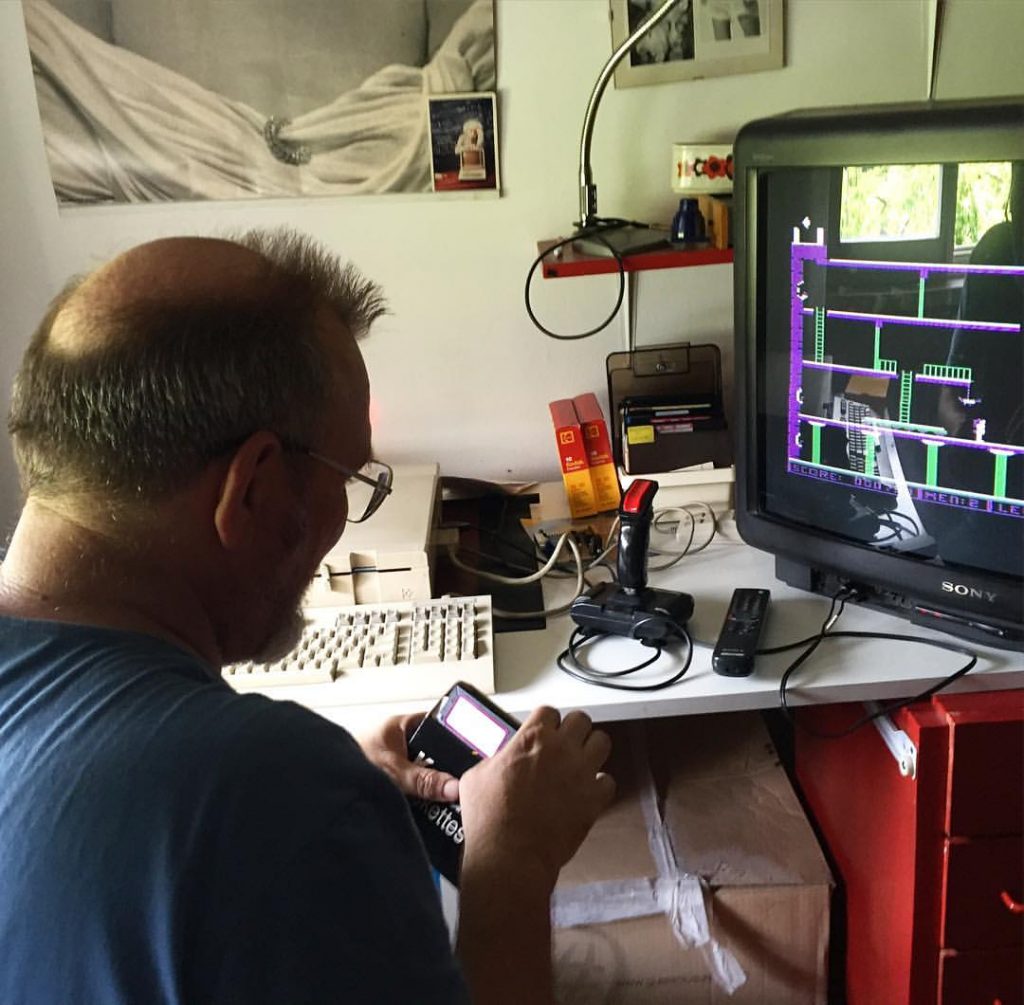
Yesterday’s Daily Create C64 Yourself was a treat. The idea, run a picture of yourself through the C64 image generator. This was particularly fun for me because I have been on a real life C64 bender. In fact, we recently had our good friends Jennie and Mikhail in town, and Mikhail caught me red-handed with the Conan: Hall of Volta diskette.

13584669_10153598856731231_6940955952906500876_o

Antonella’s mom gave me her old Commodore 128 to play with, and I have lost many an hour exploring this brave old world of computing. I’ve been in a bit of an alternative universe more generally since coming to Italy, 10 months ago I was worried this whole thing wasn’t going to work. Turns out I am living as well as I ever have. Our situation has been insane, and I know full well we are living far above our station thanks to Antonella’s friends and family. And while nothing gold can stay, I’ll take what may very well be the happiest time in my life for as long as it lasts.

2015-11-27 15.06.21 2016-05-03 11.50.57

2016-05-27 18.52.42

2016-07-11 11.31.55

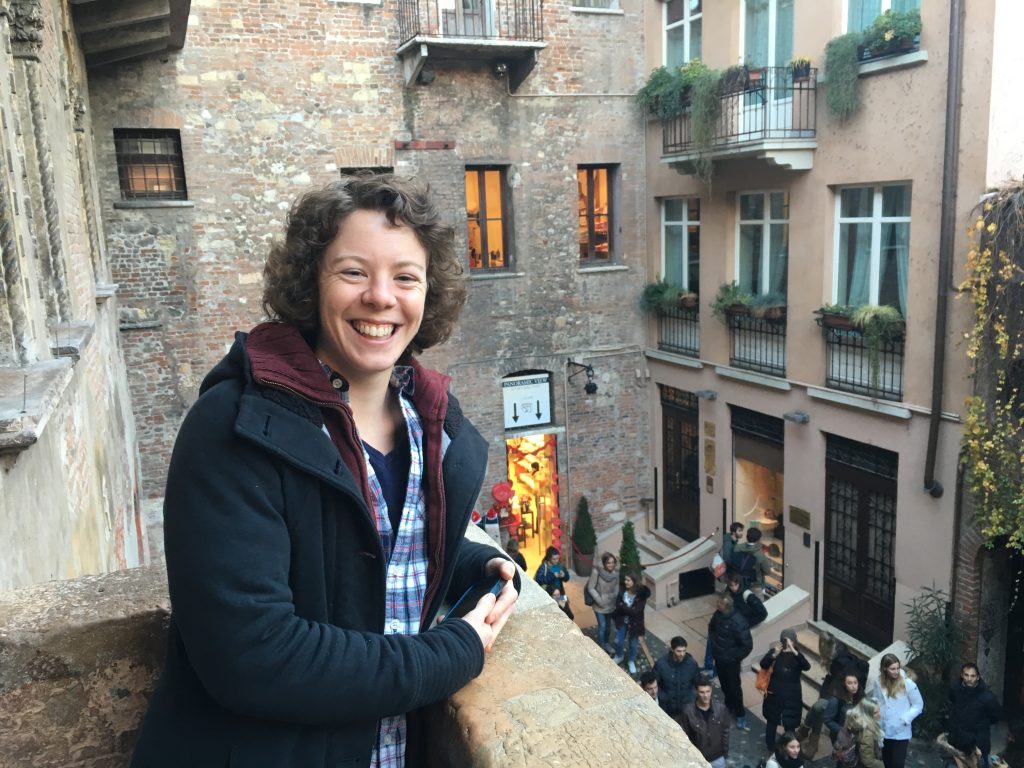
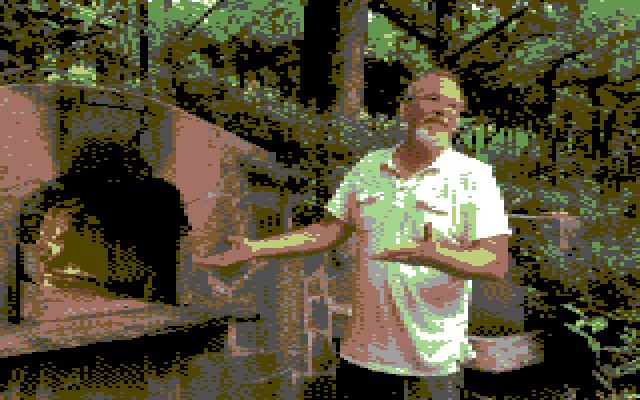
We’ve also been really fortunate to have good friends like Shannon Hauser, Brian Lamb, Mark Morvant and his awesome family, and Jennie & Mikhail come visit Bavilla—and we’ve actually had the time and space to entertain (something I’m beginning to really enjoy). To that end, the picture I chose for yesterday’s Daily Create was not the one Mikhail took featuring me in front of a C64, well technically a C128. Instead, I chose the image below that Jennie took of me in front of the fiery pizza oven in our backyard with the modest background of vineyards and mountains. It’s crazy this is starting to feel somewhat normal. We had a pizza party Sunday night, and our friends here in Italy (Andrea, Tania, Giorgio, Claudia,) came by to hang with our American friends. It was a good time, and the pizza was insanely delicious. Jennie took this picture as I was officially handing off the baton to Giorgio (who actually grew up in this house) who was taking over the pizza oven and would proceed to make anywhere from 15-20 pizzas over the next 2 hours.*

13668790_10154328145644269_5622142996116806599_o

But I love the picture because I think it captures the sense of my crazy 8-bit RealItaly. And nothing looks better in 8-bit than vineyards and brick ovens. AzU74CiOk6UrAAAAAElFTkSuQmCC And this simple exercise in re-framing the pixels of reality in some ways captures the way I feel about being in Italy and looking back at America through social media. It seems oddly surreal, or even hyper-real, as I peek out from a C64 reality into a retina-display nightmare of seemingly endless violence, stupidity, and abuse that comes through my various feeds. I know no place is immune to these things, but it resonates quite differently when that is no longer your context for living.


________________________________________

*I was simply employed to keep the fire burning for five hours before we started cooking.

Posted in Commodore 128, Reclaim Italy | Tagged , , , | 8 Comments

As Easy as Setting Up a Minecraft Server

Back in 2011 #ds106 had a Minecraft server my friend Zach Davis setup for us, the need for a sysadmin just 5 short years ago seemed far greater then

I was asked yesterday if we host Minecraft servers at Reclaim Hosting, to which I responded no. One of the great strengths of Reclaim has been it’s laser focus (provide awesome shared hosting environments) and managed growth (saying no, remaining lean, and keeping focused on the core mission).  That said, I’m not always working at Reclaim. I get five minutes off every hour, and in that precious time I like to play a bit on my own. So, I took 5 minutes this morning to try out this Digital Ocean recipe from 2012 to get a Minecraft server up and running. And while the tutorial is 4 years old now, it worked beautifully.* The only difference is you need to make sure you download the most recent version of the Minecraft server  software. That tutorial will get version 1.7.4, but you should install 1.10.2, below is the command you’ll need if you are playing along at home:

wget -O minecraft_server.jar https://s3.amazonaws.com/Minecraft.Download/versions/1.10.2/minecraft_server.1.10.2.jar

It literally took no time, and there is not much I can add to make it any easier (Digital Ocean’s documentation is pretty amazing as a rule). It was simply a series of following directions and copying and pasting commands into terminal. This doesn’t mean Reclaim will run Minecraft servers anytime soon because that’s not what we do, but I am continually impressed how easy it has become to get much of this stuff up and running on your own. I’m not even sure folks need Reclaim for this kinda stuff, and that may increasingly be the case in a future where infrastructure is a few clicks, some copying and pasting, and/or drag and drop. Servers are becoming simpler to manage and customize.

But, then again, I may be speaking from my own little web hosting bubble in the mountains of Italy given how much I’ve been playing with this stuff as of late, but it’s not like I’ve gotten any more technical in the last 10 months. Rather, the mystifying veil of how things work on the server side is being pulled back. A similar thing happened 10 years ago when I started hacking sidebar.php files in WordPress themes. I was by no means a PHP programmer (and that remains the case), but I could see just enough to get a sense of what the idea of programming even meant in a LAMP environment.

____________________________________

  • I would recommend running the $20 a month server with 2GB of RAM, seemed like the $10/mo option didn’t have enough resources.
Posted in fun, sysadmin | Tagged , , , | Leave a comment

An Archive of One

The great Alan Levine has unearthed and posted a version of a Second Life presentation Tom Woodward and I did back in 2008. It’s a personal favorite of mine because we managed to integrate elements of John Carpenter’s They Live! and The Thing seamlessly and subtly into the presentation, with a grand finale of setting everyone in the virtual world audience on fire. Those were the days!

I can happily report that my original post on this presentation now has video—the masses had been clamoring for it! But beyond the video, which I am fired up Alan has brought back from the dead, it’s untimely death is of interest. It was hosted on Blip.tv (as were a few of my currently missing EdTech Survivalist videos) and this video service did a webrexit. What’s more, the NMC had a site dedicated to the conference that is also living in oblivion now, although I was able to find PDFs of our presentation slides and the conference program on the nmc.org/files domain (I copied them to my web hosting account for posterity). But in terms of the page I linked to when I was able to keep track of my presentations on my CV site, it’s gone. 404 city. Dead link valley. I guess 2008 is no longer the domain of New Media 🙂

Screenshot 2016-07-06 13.27.16

But for me it seems good form that institutions and organizations should take some responsibility to archive and keep the links for various conferences they have run and presentations they recruited folks to present. I mean don’t you think an outfit that calls itself the New Media Consortium should be able to thoughtfully an intentionally archive and preserve that work? But I know the answer to my own rhetorical question. People come and go from organizations and institutions, priorities change, continuity is hard, memories fade, and links die. I guess we can chalk it up to the way of the world wide web, but if that’s the case Alan’s idea that that any cohesion we get from the web that was will be thanks to a few individuals who had the forethought and took the time to save stuff rings truer than ever. Luckily I have Alan in my community, and I can benefit from his  longterm vision of the web as a communal memory bank of experience, not a series of open, yet dead, resources. My money is on the dog in the zombie suit!

Posted in Archiving, presentations, second life | Tagged , , , , , , | 1 Comment