WordPress Education Mailing List

Matt Mullenweg linked to a new Automattic mailing list that is focused on using WordPress in Education. I signed up for it, making it the first mailing list I’ve joined willingly since the CUNY Grad Center list-serv many moons ago. It was funny to realize D’Arcy was on there as well (I don’t think I have met a more generous and prolific person who shares what they know so readily and freely), and we both simultaneously replied within what seemed like seconds to the first question that came up from someone who wanted to implement WordPress as a CMS in an elementary school. What I immediately realized is two things: 1) D’Arcy and I need help, and 2) the list might prove an excellent opportunity to start bridging the gap and sharing with folks from all kinds of educational settings all over the world. The blogs certainly do this, and I certainly don’t see the list as a substitute. Rather, I am wondering whether there will be a different kind of connection that might foster an even wider community. I really don’t know if this will be the case, but given that I understand my current mission as helping to bring the world of education into the digital age of publication so that learning institutions can become as flexible and open as the times demand, I figured this as one of the places I might be able to both help and learn. Not to mention I can now pick on D’Arcy through yet another, albeit a bit more conventional, web-based medium 🙂

Actually this makes me think of something Brad Efford wrote in response to a discussion we had about the the idea of e-mail being “outmoded.” His response to my assertion was extremely thoughtful, which he is is always guilty of, and I’m reproducing a part of it below:

I don’t think the e-mail is outmoded, necessarily, I just think its use is generally under-utilized & the extent to which an e-mail can be made more “moded” is not a field that is often explored. I tend to write long e-mails that drift in & out of tangents (with an incalculable amount of parentheses, of course) & describe daily stories & events, sometimes with verbatim dialogue. I think the average person, though, writes e-mails as a way of passing a note along at work or saying a quick hello. My point is that I think the e-mail has a lot more potential than people are willing to give it credit for, & as great as it is to receive a handwritten letter in a physical, curbside mailbox, the e-mail offers up all new territories for the writer & reader. A blog can be very useful in this regard as well, of course, & that’s why I like to keep this one semi-frequently updated, but sometimes you don’t want to write to everyone with a computer & their mother.

And while I don’t know how this will hold up for an email list on WordPress and Education, I’m interested to see how this community plays out given all the other means of sharing we currently have.

Posted in WordPress | Tagged , , | Leave a comment

Installing WPMu on cheap, external webhosting

James farmer has posted a great tutorial over at WPMu.org that takes you through the steps of setting up a WordPress Multi-User installation on a cheap, external webhosting service. He focuses on one webhosting service in particular for the demonstration, but most use CPanel and his instructions work pretty much across the board. That said, it is a good idea, no matter who you use, to find out whether they are cool with WPMu and dynamic subdomains–which I strongly recommend. Also, I would use this as a test space, running a full version for 7 bucks a month may be a bit sketchy–although we did it for six months 😉 Nonetheless, the video is an amazing resource that empowers folks who are interested in experimenting with this app to up and do it themselves. Imagine, you can create a dynamic publishing engine within minutes for pennies.

Posted in wordpress multi-user, wpmu | Tagged , | Leave a comment

UMW Blogs loves Akismet

nullAfter reading this post by D’Arcy about how easy and free it is to get Akismet up and running for WordPress Multi-User, I finally decided to take the plunge and replace the developmentally languishing Spam Karma 2 with Akismet–I’ll miss you SK2! The setup was easy, and putting the link in the footer (which guarantees us a free educational copy) was dead simple thanks to D’Arcy’s second WordPress plugin (did I ever mention how insanely elated I am to have this guy working in the WPMu realm?).  For the last 24 hours Akismet has been running as the only spam filtering system on UMW Blogs (which averages over 60,000 comment spams a month) without a glitch. I have yet to see spam in the sitewide feed for comments, and I have to say I am pretty fired up about this move. For unlike Spam Karma 2, Akismet requires no setup on the part of the user, it works for every blog on the system and just does it’s job quietly behind the scenes. The only thing I need to do now is find a script to go into the UMW Blogs database and delete all the SK2 tables (which are filled with old spam) that have amassed over the last year, anyone already figure this one out?

Either way, thanks for the push D’Arcy, that’s what this community is for.

Creative Commons License photo credit: david trattnig

Posted in Uncategorized | Tagged , , , , , , , , , | 5 Comments

The Revolution will be Syndicated

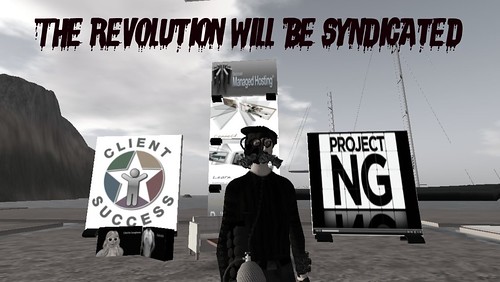
Tomorrow at 4:30 PST/7:30 EST Tom Woodward, Brian Lamb, and myself will be Syndicating the Revolution for NMC’s “Rock the Academy” conference in Second Life. Preparing for this presentation has been some of the most fun I’ve ever had collaborating, and while I can’t promise as much for the actual show—I do think it has the potential to be a gory, blasphemous, and entertaining experience all at once. We’ll be discussing the current Zombie state of institutional Web 2.0 fakery and the chains of expedient enslavement that bind us; exploring the means for surviving our current LMS malaise through imaginative resistance; as well as explaining how we can harness the radical possibilities of syndication through open source publishing frameworks and underground personal/professional alliances. ÂĄViva la revoluciòn!

Additionally, if you are planning on attending this session I would highly recommend an asbestos suit if at all possible.

Posted in presentations, rss, second life | Tagged , , , , , | 3 Comments

BlackBoard is such an open stud

This is classic, and it’s so bad it’s almost good, which is what scares me about it.  But the misinformation campaign being run here about openness is dangerous, and the portrayal of  Bb NG as “a hip stud” who gets all the hot girls because he is so Web 2.0 just tells you how much Bb mocks you, abuses you, and insults your intelligence. Looks like everything I remarked on in The Glass Bees post is playing itself out quite well, “BlackBoard Can Haz All Ur Web 2.0z!”

Download BlackBoard on openness

Thanks for the link Tom, now how exactly are we going to approach our video response, for we got your Web 2.0 right here 🙂

Posted in Uncategorized | Tagged , , , , , , | 38 Comments

Whither Fair Use?

“Fair Use” Photo by Lawgeek

I have been unable to get Henry Jenkins’s post “Why Universities Shouldn’t Create “Something like YouTube” (Part One)” out of my head for the last two weeks. I keep on returning to his candid and precise discussion about the “very timid and conservative legal approach” MIT’s Open Courseware takes towards Fair Use. And his argument is dead on, how can he “package” a course that deals with a precise, practical, and theoretical discussion of our mediated culture if he can’t share and re-contextualize the very media that is the basis for his course of study? And what Jenkins suggests about his own concerns with the Fair Use doctrine at MIT, must also be the case for a large number of professors around the world who need to “meaningfully quote and re-purpose existing [copyrighted] materials” in order to do their job effectively.

Yet, many have turned their attention to Creative Commons licensing, and there can be no question that this is a monumental victory in the increasingly war-like world of negotiating copyright. The fact that their have been so many images, texts, articles, and videos that have been produced under this license should be applauded roundly. At the same time, as Jenkins notes in Part 2 of this article, we still “need to be able to provide excerpts from other people’s media — especially corporate media,” resources that almost always would not be licensed for re-use with attribution, etc. And this is where the opportunity to buttress the power and impact of Fair Use has failed, we have focused so much energy on pushing folks to license their own work as Creative Commons, that the discussion surrounding Fair Use has waned to the point that sometimes I even forget it is still a viable option. So his Jenkins’s position as a “conscientious objector” to the Open Courseware project is important because it frames, at least for me, that K-12, Colleges, and Universities avoid the discussion around Fair Use at their own intellectual peril, and basically cede an amazing amount of control to the existing “intellectual property regime,” which just seems to continually get more and more powerful. Moreover, his position suggest that their is a fight to be taken up around Fair Use, yet it is one that most people have avoided because it’s too thorny, or the legal battles would be too expensive, or it’s just not “expedient at this juncture.” Well, I can’t think of a time when we need it more!

Do you remember the Library of Congress exemption “allowing film and media studies professors to create digital clips from legally-obtained DVDs housed in college and university libraries” as long as they are used in the classroom or on electronic courseware sites and “restricted to matriculators and measures are taken to thwart copying and downloading of the material.” And while all of this seems kind of quaint now that YouTube has exploded since 2005/2006 when this exemption was made, it still highlights the very real limitations upon Film and Media Studies faculty to quote the medium they inhabit and depend upon for discussion and analysis. Not to mention the fact that even when a faculty member takes clips from a DVD, for example, it is not entirely clear whether or not they are breaking the law given the uncertainty around the legality of breaking encryption in this instance. More importantly, how do you define a matriculated student in an open course? Does such an exemption have any relevance in the digital age of education? The whole thing is a copyright fueled legal nightmare, and has effectively made the critical analysis and discussion of our culture’s media that much more precarious and anxiety ridden. What we have is a direct competition between the Media Industry’s attempt to secure the largest percentage of profit and the academic mission to openly analyze, quote, and share media within a more nuanced argument or conceptualization of a given culture. And all of this doesn’t even speak to the numerous academic disciplines outside of Film and Media Studies that may depend on contemporary media to some large degree for examining our world.

But as I noted above, sites like YouTube kind of make this exemption seem dated, for video sharing sites provide an invaluable archive of contemporary (and not so contemporary) commercials, movies, TV shows, news, etc. And while the question of copyright is very much present there, it always seems like its someone else’s problem—it’s kinda like the masses have finally found a way to utilize the corporate strategy of creating a vanishing horizon of accountability. Almost by the simply unfathomable number of people, amount of redundancy, and pure voume of resources. All of this compounded by the anarchic ability for anyone to upload anything from anywhere goes a long way towards allowing people to depend upon a kind of transparent, but unspoken, “ungerground bazaar” for Media Studies resources (as well as every other academic discipline under the sun). And what’s more, the ability to re-contextualize clips with embed links exonerates professors and/or students from questions of copyright abuse while at the same time allowing them to frame clips within their own discursive space.

And while this doesn’t attend to the staggering limits in thinking about Fair Use in any kind of  progressive way at educational institutions throughout the US, I do think it bleeds into another point Jenkins made quite nicely when he was talking about the mistake of universities trying to build “something like YouTube.” He points out that universities are often focused on locking down and controlling content, whereas YouTube became hugely successful for the exact opposite approach –it is open to anyone, video can be embedded on other sites, and (thanks to Firefox extensions like Download Helper) the archive can be preserved despite the fact that it is ephemeral 🙂 So what would a system look like on campus that actually afforded the community the power to harness and share eductional resources on the open web? They would need the option to embed media from around the web on their own university space. They would need to be able to make their discussion and work public if they wanted to. Or, what’s more, be able to export their work to another service off-campus, and share it back from there. In other words, educational institutions need to manage the flow of digital ideas from where ever the comunity is working from rather than attempt to build and control such a space. And this ideas is at the heart of what Jenkins suggests most educational institutions have failed to recognize “university based sites are about disciplining the flow of knowledge rather than facilitating it.” And that is the problem, but there are some examples of alternatives, UMW Blogs is using WordPress Multi-User as an open, web-based publishing platform for its academic community and Bill Fitzgerald’s has modeled an impressive feed centered framework using Drupal. These spaces facilitate, rather than dictate, the incorporation of myriad resources on the web into a dynamic, syndicated environment which is premised on providing an open experience for the community as much in action as in theory and principle. It’s a space anyone on campus can add their outside feed, and have their work re-published into a course space, club space, discussion space, portfolio, etc. Point being, sometimes I think the idea of consortiums and study groups and inter-campus organizations for deciding the future of open education (not to mention building the repositories) is besides the point, and Scott Leslie’s work with Free Learning points the future out for us there, talk about sustainable! Just look at YouTube or Wikipedia or what was TextBook Torrents. Universities should be facilitating the sharing of open educational resources and fostering discussion and examination around them in a dynamic manner. I think openness (whether de jure or de facto) is already apparent on the web, and that is readily apparent for anyone familiar with sites like YouTube. The thing is we just can’t name it is such. However, if and when we start reclaiming Fair Use from the lawyers a bit more vigorously, perhaps we can start capturing dynamic interactions and streams of conversations and ideas rather than course skeletons, handouts, syllabi, and video lectures.

Posted in intellectual property, open education | Tagged , , , , , , , , , | 4 Comments

“I’m on my way”

I’ve been doing some digging around for great cinematic sermons, and during my relatively fruitless search I came across the scene below from Elmer Gantry (1960). This is a film I have yet to see, but after watching Burt Lancaster bust out in song like this I might have to get this film as soon as possible.

By the way, I’m trying to think of great cinematic sermons, and I am drawing a compete blank save for Orson Welles’s masterpiece in John Huston’s Moby Dick –any help out there?

Posted in movies | Tagged , | 13 Comments

Reflections on EDUCAUSE

I actually parachuted in and out of EDUCAUSE, and I was my usual strange self at conferences. I really can’t seem to bring it together when I go to these things, my head space gets a bit confused and I withdraw a bit. I’m going to have to work on this. The session Gardner and I co-presented on Educational Publishing Platforms went pretty well, and that was all Gardner’s doing, He was in his best impromptu mode and he carried me beautifully through the presentation, for I was admittedly not on my game at all. The highlight, however, was a recorded conversation Gardner and I had later on Wednesday with Gerry Bayne about EDUPUNK. It was kind of a last minute arrangement, and it turned about to be a raucous, free-wheeling conversation that covered a tremendous amount of ground over the course of an hour. It’s after discussions like that that you know you are talking with a great teacher and an extremely generous intellectual soul. I’ll be looking back fondly on that moment for a while hereafter.

There is one more highlight that I am almost scared to admit, I was completed transfixed by the vendor section. It was huge and salespeople were hawking their wears in some crazy ways. The first cat I saw when I walked in was an HP salesman with a bright yellow blazer who was performing his pitch like a circus act. I then headed right over to the BlackBoard booth to find out how “Web 2.0” NG would prove to be, and from what I saw it is just a little bit of ajaz with a single-sign on adapter that provides links to Sakai and Moodle courses—what a strange reason to proclaim your openness so boldly before the first day of the conference, again! Nonetheless, I couldn’t help myself. And once I was in the commercial Gulf Stream I couldn’t stop thinking about that scene in Coppola’s The Conversation (1974) wherein Harry Caul (Gene Hackman) is walking around the various booths at a Surveillance Convention talking to random people, while at the same time you can see he is all at once visibly estranged, paranoid, and fascinated by the space he is wandering through. In fact, it is that walk through the vendor exhibits at EDUCAUSE that may stick with me longer than anything else, it was like watching a room full of Gatsby’s throw their last party. So in the interest of exorcism, I’ll reproduce the scene from The Conversation in which Coppola frames Harry Caul’s wonderful discomfort with the commercialized bastardization of the quality of his profession so that a few scheming, idea-stealing businessmen and women can make a few bucks 🙂

Posted in Uncategorized | Tagged , , | 3 Comments

Happy Halloween

“And the haunting distribution of a million light particles from an edupunkin shall lead the way.”

Image Credit: Tom Woodward flexing his creaivity as usual with his wordpress edupunkin photo.

Posted in Uncategorized | Tagged | Leave a comment

What is an instructional technologist?

Yesterday I was asked by a good friend and mentor the following question: “What’s next?” And it made me stop and think, I guess since I don’t have a Ph.D. and I’m in “IT” I should be thinking about an administrative position, right? I mean you can’t be an instructional technologist forever, right? It’s just a position you take until you become a bonafide administrator or decide to head back into teaching, it’s a liminal identity that ultimately one must surrender to make more money or have more independence or have a bit more power, right?

Well, I answered quite frankly that I really don’t want to do anything else. I do not want to be an administrator, it would completely divorce me from where my particular strengths lie: getting people excited about what they do and helping them muster the courage to experiment wildly. I really, really like what I do a lot, and I think I’m pretty good at it. In fact, I’m better at it than I have been at anything else I have ever done, perhaps with the exception of watching movies. But, there’s no future in it, right?  I mean, come on Reverend, you’re an instructional technologist for Christ’s sake. I’d say 99.99999999999% percent of the population has no idea what that title means, and 99.9% of the instructional technologists aren’t too sure either. Well, that’s what I am, and the more I look around the world of educational technology the prouder I am of this fact. But thinking of how to articulate this idea was immediately daunting. I really don’t have the energy at the moment to write it all up or re-think why I need to say how this question has moved me to the point of reflection and deep consideration.

Well, luckily I don’t have to, because Matt Gold (a dear friend) did something special for me today. He pointed me to a post I wrote almost a year ago that addresses this question head-on. It’s a post I had all but forgotten about, yet he remembered it and commented upon it this very evening (when I needed it most) as if he were intentionally pushing me to re-read it–which his too kind comments actually did. So, taking my inspiration from Matt I am going to “radically re-use” my own thoughts from an old post to answer the question of what an instructional technologist is, at least in my feeble mind. (As an aside, I don’t think I have ever realized the full power of blogging my ideas regularly for the last three years until this evening, where my own ideas come back to lift my spirits in a existential moment of uncertainty and exhaustion, so thank you Matt from the bottom of my heart!)

_______________

What is an instructional technologist?

The difficulty of such a question is in many ways tied up with the larger problems with such a conference as EDUCAUSE, and actually framed quite clearly the heart of the presentation Gardner Campbell and I gave yesterday: it all depends on whether you want to focus on teaching and learning within a community or the ease and efficiency of administrating a system?

The answer to this question will ultimately decide whether or not one professor or ten professors or an entire campus is willing to use dynamic, loosely joined open source tools like WPMu, Drupal, MediaWiki, etc. If the focus is on administration and not teaching and learning than an enterprise, “turn-key” solution like BlackBoard will work perfectly. And you can spend all your time talking about the technical details of the proprietary system’s latest features or even its unbelievably bad “blog” and “wiki” building blocks, or how “open” it pretends to be, etc. I really can’t (or rather won’t) argue with anyone on this count, for the two ideas are conceptual forks in an approach to the digital landscape of education. But if and when one chooses the enterprise CMS more times than not that choice has more to do with administration than teaching and learning. And as a result of such a choice the role of the instructional technologist is effectively limited to routinized training that demonstrates the limited capabilities of any one system. All of which effectively makes the instructional technologist an administrative assistant providing technical help. It is the still birth of a profession that is still gestating. Little or no imagination goes into this process and the limits of possibility are always already defined by the technology mandated. A position that should be exploratory and imaginative is reduced to the administrative realm in the name of efficiency and doing the greatest good for the largest number.

Let me be entirely clear here, an instructional technologist should not, I repeat should not, be an administrator. To conflate the roll of an instructional technologist with administrative work is to sap it of its transformative vitality. Instructional technologists should do three things, and do them well: 1) work closely with faculty on imagining possibilities, 2) live within the latest technologies and 3) imagine and experiment with possibilities regularly. The less time an instructional technologists spends thinking about administering a system, the more time he or she can actually do these three things. This is, without question, the reason why WordPress Multi-user has been so appealing for UMW. The administrative onus is shifted to the teacher and the student. They have their own space that they control. It becomes their charge to think through the possibilities of the system, rather than being told how it works. They have to discover what works, how it works, and why it works. It is this transformative process that is all too often relegated to system managers rather than intelligent people who live in the interstitial spaces of ideas and imagination like students and instructors. It is in this liminal spaces of thinking through and imagining what such a tool can do (rather than being overly concerned with how to actually do it) that our work happens. This is when the possibilities are imagined and old conceptions and new directions coalesce and by extension morph.

In my current job I don’t administer UMW Blogs, I build community and interact with both professors and students on a regular basis. I’m not so much concerned with the technology (and if an instructional technologist isn’t—should students and faculty be?), rather I am an interested and engaged participant in the transparent intellectual life of the university. That is what an instructional technologist must do! There is no other definition that makes sense. The conversations about teaching and learning’s intersection with technology is the inspiration undergirding what has been taking place for the last several years at Mary Washington, and has in many ways fueled the transformation through a larger grass roots effort. The change starts with a conversation, not with a directive. The transformation is imagined, not administered.

Which leads me to my final musings on this topic after the presentation. The point at which I start administering systems or training folks on BlackBoard on a regular basis is the moment I walk away from this occupation. There really is no reason why anyone off the street who has read the respective CMS manual can’t do that as well as me. And I would gladly defer to them. To become an administrator and/or to fashion oneself as a leader means to often extract yourself from the actual relations that are the basis for re-imagining the space of teaching and learning. Why aren’t instructional technologists understood as something other than either one of these categories? You don’t need to be a leader to be a great instructional technologist who catalyzes change in an environment. Moreover, you really shouldn’t be administering anything because it would be taxing the invaluable time spent imagining and exploring the innumerable possibilities of these tools with faculty.

There is no question we are in an absolutely fascinating moment of flux in this field, and what becomes ever more apparent is that the role of the instructional technologist at campuses is understood as transitional at best. A job that will prepare you for a directorship, a higher degree, or some other administrative position in IT. Such a conception of this crucial role is in many ways defined by the hierarchical system of academia much like teaching and learning with technology is defined by learning management systems like BlackBoard: it’s limited in its structural imagination. While I was speaking with people at the conference about their own situations and the administrative route of academia I became evermore certain that budgets, meetings, and management more generally are important for numerous reasons, but in the end often compete with the time-intensive work of fostering conversation and inspiring imagination throughout the community more generally about teaching and learning with technology. And while the right management can foster the conditions for this conversation, the point is that what we are talking about is doing it, not constantly re-visiting the fact that technology and pedagogy “might” have a future on campus. For that is in many ways a given, it is the type of experience a professor or student imagines where a majority of the work still needs to be done. That is the invaluable role of an instructional technologist, and he or she may very well be one of the most crucial figures on college campuses today.

Yet, the position has been circumscribed and denigrated by IT directives and administrative exigencies to the point that this desperately needed space for freedom and experimentation on campuses around the world has become one of obedience, fear, and “service.” And I put service in quotes here because while my role is to serve the faculty and students, as well as to foster a community of openness, tolerance, and exploration (which I value dearly, and firmly believe is the role of everyone who works on a college campus–or in education more generally), an instructional technologist can only accomplish this in their particular field by being granted the freedom to follow their own imaginative and critical ideas about this constantly emergent space. Right now, this is seldom the case, and to be quite frank with you, I have seen the other possibilities out there, and they are meager at best. Mary Washington is one of very few models for what an instructional technology outfit should be doing on a college campus, and the UMW professors are arguably the best example of how faculty should be partnering with instructional technologists to explore the implications of the changing landscape of publishing, discourse, media, and socially created knowledge that everywhere surrounds us.

Instructional Technologists of the world unite; you have nothing to lose but your BlackBoard chains!

Posted in experimenting | Tagged , , , , , , , , , , | 26 Comments