Dave Lester did a fine job of compiling a long list of Universities that are using WPMu in one capacity or another. It’s a great list, and there are at least 40 institutions on there I had no idea about. Add to this list the work Mario Núñez-Molina did last year and add a few additions to his list and you may very well have over 100 institutions using this application. And as the recent comment on his post suggest from the University of Melbourne, there are probably a heck of a lot of international universities that are using this application that we have no idea about.
Yet another trend I’ve noticed with UMW Blogs is that courses and random groups are consciously publishing their articles with a far greater audience in mind than their specific class. Not only are many sites aimed at the UMW community, but also at the wide world beyond it. A great example is Uncle Lumpy’s Down-Home Art Blog and Pancake Emporium. This is a wild class experiment that has emerged on UMW Blogs wherein all the authors are blogging under personae (check out the very entertaining contributors page for a few examples). It’s a healthy mix of local art news, pancake recipes, and a Q & A column with Uncle Lumpy himself—which I think is awesome. I’m just patiently waiting for the actual arrival of the blabberized version of the Uncle Lumpy Q&A. What becomes immediately apparent is that the unknown souls behind this project are marking another trend, the conscious move of creating a news and entertainment space that moves well beyond the classroom and out to the community more generally. I love Uncle Lumpy!
One of the most interesting elements of UMW Blogs is the way in which things kinda happen on their own accord, and the publishing environment takes on a life of its own. For example, I track a lot of the posts and comments that go through the system, and what I have begun to recognize is that clubs and organizations at Mary Washington are using this space to get their announcements out by using this system to create quick and easy websites with built-in syndication.
So, why not aggregate all the announcements into one space and make things easy for the community to discover, view, and subscribe to? Well, thanks to the wonders of RSS and a WordPress spam plugin it’s a cinch. Check out the UMW Clubs and Organizations blog, which features the latest posts from contributing clubs and organizations at UMW, along with a list of the contributing groups. Additionally, if any club or organization wants to add their site (which can be hosted on UMW Blogs or any other service with a feed), it’s a simple form to fill out to get their announcements syndicated into this site.
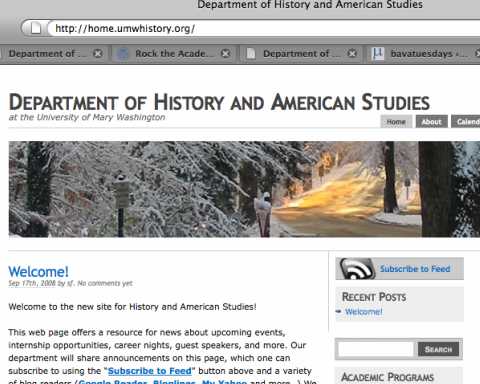
I have blogged regularly about mapping domains on WordPress Mulit-User for over a year now. And it is with great pleasure that I announce the first instance of a mapped domain on UMW Blogs (which is actually a mapped subdomain). UMW’s pioneering History department has decided to create a site on UMW Blogs to build an information/community site for their department which will provide the latest news, announcements, and events for current students, alumni, etc. They have a Bluehost account where they do a lot of their own departmental experimentation (http://umwhistory.org), and they—more specifically Sue Fernsebner and Jeff McClurken—wanted to know if we could map a domain to their UMW Blogs site in order to have a URL that is in line with the logic of this space and that doesn’t have that pesky word “blogs” in it. Well, if we will it, it is no dream!
In fact, we really didn’t want to map the entire domain umwhistory.org to UMW Blogs because that would throw off all the other sites they have on various subdirectories and subdomains already. So, what we did is created a subdomain ( http://home.umwhistory.org) and just mapped that, which left all the other subdomains and subdirectories on their Bluehost account unaffected. And voila, UMW Blogs can allow people to buy (or is it lease?) their own domains and map them to their own blog space.
For me, this realizes one of the most powerful elements of a publishing platform like UMW Blogs: it re-enforces that this space is the wide-open web, not some insular, monolithic campus CMS or LMS. This feature opens up the conception and perception of UMW Blogs as the open web to some great degree; it makes people feel like the space is truly their own and that they are out there framing their own work. On top of that, they can take advantage of all of UMW Blogs’s innumerable plugins and themes, while allowing them to capitalize on our first rate service 🙂 And all this without having to worry about doing their own upgrades or backups. And with their own domain name they can frame their own professional portfolio, website or blog on UMW Blogs, and should they ever need or want to export their site to another service (or even get their own web hosting account) the transition would prove that much more seamless. Mapping domains is the acknowledgment that the work people are doing in this community is their own, and the technological infrastructure should be flexible, robust, and easy enough to enable anyone who wants to control their online identities do it in the most effective and intelligent way possible. We are affording them one way to both build and preserve their personal archive of intellectual work, and we need to see the technology we choose as an extension of such an act of good faith!
OK, so how do you do it? It’s remarkably easy, first go download and install Donncha’s Domain Mapping plugin on your WPMu setup. (For server admins: to make it easy on yourself, change the documentroot line in httpd.conf to the directory where you have WPMu installed, that way any domain that points to your IP address will by default point to your WPMu installation, making the sign up process for your users seamless, and any work on your end minimal at best.) After that, I simply called up Bluehost and asked them to add a CNAME for the subdomain http://home.umwhistory.org and point it at the IP address for UMW Blogs. They had it done in less than a minute, the whole thing was really a cinch. (For more about this read the FAQ on Domain Mapping at WordPress.com.)
Well, I guess I gotta get going on my formative 10 because what has taken me almost eight months, has taken D’Arcy Norman all ofthreedays. I find it interesting how much a formative 10 can tell you about someone, for example given D’Arcy’s first three films it’s pretty obvious he’s a science nerd 🙂 Now me, kinda like Uli, I’m a nihilist, and it is, indeed, exhausting.
Escape from New York is a no-brainer for the formative 10, this movie may very well be the most perfectly conceived plot ever filmed, and it is without question my favorite film storyline of all time. Interestingly enough, John Carpenter is responsible for two of my formative ten, this one as well as the The Thing (which I recently blogged). Moreover, Assault on Precinct 13 would have been a shoe-in for the formative 15 and I blogged it as a kind of preview to this series many moons ago. It’s interesting that this exercise has brought into sharp focus just how important John Carpenter has been in my early years of film watching, and I’d just like to thank him for helping to make me such a huge fan of the form.
So, what now? I could talk about how cool Isaac Hayes was as the Duke of New York or how much I dug the terrorists that hijacked the Air Force 1 at the beginning of the film or how Harry Dean Stanton’s role as Brain remains one of his most memorable for me (“Unless you know exactly, precisely where it is…”) or even the crazy haired sidekick to the Duke of NY who hisses in a most peculiar way. I could do all this, and I haven’t even gotten to Snake Plissken yet. Or, I could show you a series of clips that capture the essence of this film. So, OK, dim the lights and get ready for some YouTube, roll ’em please:
The voice over (which is Jamie Lee Curits) at the beginning of the film sets up the situation brilliantly.
And here is the hissing maniac that shows off the President’s finger (love this guy!):
Scene wherein Hauk (played by the immortal Lee Van Cleef, the ultimate badass) recruits Snake for the mission to rescue the President from the prison that is Manhattan Island:
There’s the scene where the cannibalistic Mole People come out of the ground and grab Season Hubley, this was possibly the most memorable scene of the whole film for me at the time.
The Duke of NY (A#1) (played by the late Isaac Hayes) doing a little target practice with the President of the US (played by Donald Pleasance who is genius in this film, I might add).
Couldn’t find the scene of Brain (played by the legendary Harry Dean Stanton, perhaps my favorite actor of all time) on YouTube I wanted, so I will settle for when he stabs the crazy-haired hissing freak (the character is actually named Romero).
And there are many many more scenes in this film that make it simply amazing. In fact, I believe that it is still one of the best paced and consistently compelling action films ever made. Escape from New York, arguably Carpenter’s best, and maybe the last truly great American film ever made 🙂
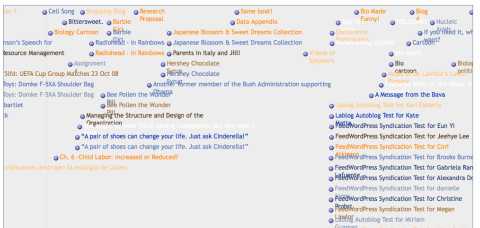
“Why?” you ask. Well Hondo, because these tools provide the means to visualize and connect the activity on UMW Blogs in new ways, check out the Timeline of UMW Blogs posts over the last two weeks here. Or look at how a tool like Exhibit provides interesting ways for creating a more comprehensive directory of users, tags, and posts (something WPMu just can’t do extensively). The alphabetized Bloggers Exhibit that has a weighted tag cloud for each letter of the alphabet which lists usernames, or take a peek at the Blogs Exhibit that does the same thing with Blog titles.
Moreover, we now have a way to collect all the images uploaded to UMW Blogs in one place, and a gallery of top ten lists for those blogs with the most images, audio files, or videos. What this means is we now have a series of alternative means for capturing and mnpulating dta for UMW Blogs that will allow us to search, discover, and make connections more easily than we could previously. We are at the beginnings of this experiment in some ways, yet in others we simply just have to style and re-theme the data accordingly and we are ready to unleash it on the UMW Blogs community to see how they use it and what value it brings to further build upon this already robust publishing platform. Is this what the trendy discussions about Web 3.0 is all about (besides the pervasive idea of cloud computing which is in many ways upon us)? Finding ways to marry the power, ease, and usability of Web 2.0 tools with the promise of discoverability, visualization, and deep connections that the Semantic Web has promised? I guess we’re about to find out here at UMW.
Update: D’Arcy informed me that “the flickr link was just crawled by google or technorati – no magic connection.” One can dream I guess 🙂
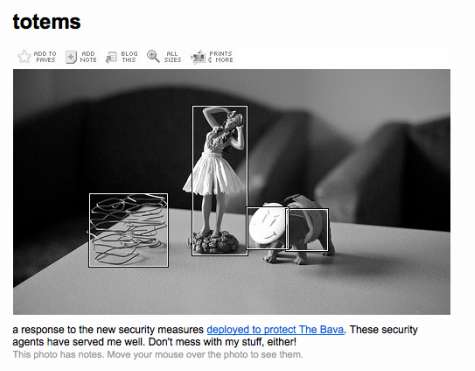
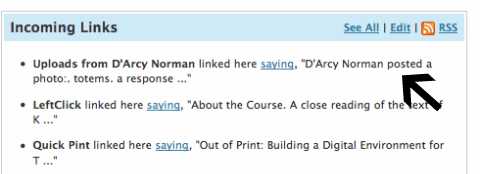
I just got a notification of an incoming link from a Flickr photo on my blog. I have to believe this is a new feature, am I right? Probably part of the overhaul they have been working on lately. I’ve never seen a pingback from a Flickr photo before, so when this photo (shown below) taken by D’Arcy Norman (which has a link to a post of mine in the description) showed up in the incoming links section of my blog, I was pretty excited. Think about it, we can now cite and reference blogs from within Flickr with links in descriptions to further connect these loosely joined resources online. Now, I wonder if it works in reverse as well—can you see a linkback from this blog in your Flickr account D’Arcy? That would be the kicker, wouldn’t it?
The image with the link to a post in the description:
The linkback notification on my blog:
And interesting development to say the least, Flickr just became a whole lot more powerful in my mind.
The presentation was an important one for me in retrospect, because of its pure and beautiful simplicity and self-evident knowledge 🙂 We proposed the creation of an Open Content educational resource/courseware/interactive space (or what have you) to enable both institutions and individuals alike to easily and effectively create their own dynamic educational publishing platform using freely available tools and services. This is what I have been working towards ever since the fateful and infamous Northern Voice 2007 festivities, and this presentation comes along the way in that journey, and captures for me a moment wherein D’Arcy, myself, and Brian Lamb (who is the only voice in an otherwise silent and seemingly uninterested audience to ask some questions and push the idea). As it always seems the case, Brian is the quiet and modest brain behind most of this stuff, and to hear him in the Q & A period frames why he is such an important part of my own process of working through this stuff, and I’m pretty sure the same is true for D’Arcy. I consider myself his student in many ways, and his keynote at this conference sealed it beyond a shadow of a doubt.
One of the ideas we talk about here that I am constantly coming back to is pushing the use of open source, easy-to-use applications like WordPress to publish interactive resources created by and for students. Which become far more powerful in this open environment given their ability to be shared freely online through search engines like Google (or re-published via RSS, etc.). The idea I talk about here is an online anthology created by and for an Early American literature course that frames an anthology of reading with critical intros and bibliographies written and peer-reviewed by the class. An exercise in creating and framing the very text of their class for the world at large. I love this idea, and I want to return to it soon. But a recent post by Bryan Alexander on the Nitle blog framed for me the fact that UMW’s Marie McCallister is in many ways already doing something like this with her Eighteenth Century Audio site. Thanks, Bryan!
So, all this long-windedness to say that this presentation is the beginnings of the idea of the educational publishing platform (well, at least for me it was). Something which was never only about WordPress per se (as D’Arcy reminds me 🙂 ), but always about the way we need to re-imagine publishing for our moment, and make it as much a part of the teaching and learning environment as possible.
Here are the URLs of the sites we talk about during the session: http://earlyamericas.wordpress.com/ and http://opencontentdiy.wordpress.com/
Back to the lost formative ten. John Carpenter’s The Thing (1982) has consistently been in my top three movies of all time since I first saw it. A masterpiece on many levels, and in fact there are two Carpenter films in my formative ten, and both of them center around his ability to create the most compelling situational horror/scifi/action films. Not only does he play with genres brilliantly, but what’s cooler than having Manhattan Island turned into a high security prison or a group of researchers in Antarctica discovering a shape-shifting alien? Such plot lines make his early films among the best of all time in my mind.
But, I’m gonna hold off on my reflections in this post, because Scott Leslie recently sent me a link to a documentary on John Carpenter’s career, John Carpenter: Fear is Just the Beginning…the Man and his Movies (freely available on Google Videos), that contains a ten minute clip which does an excellent job of framing the importance of this film and contextualizing its moment. The documentary focuses on a controversy surrounding The Thing that I was previously unaware of. In short, this film was Carpenter’s first big budget project and upon its theatrical release it was critically slammed, designating Carpenter as the “pornographer of graphic violence.” According to the documentary, such criticism scarred Carpenter so deeply that it changed the direction of his subsequent career (arguably for the worse if you look at his earlier work versus his later). Here is a link to the ten minute section of the documentary that talks specifically about the controversy surrounding The Thing. Fascinating stuff, I always found the difference between his first five films and all his subsequent work to represent a radical divide in vision and quality, and perhaps this might provide one theory as to why.
And, as an homage to Carpenter’s masterpiece (which is far better than the Howard Hawkes Hawkes’ original in my opinion), here is the classic scene where MacReady tries to distinguish the real people from the things as told by Legos. Enjoy!
is an ongoing conversation about media of all kinds ...
Testimonials:
Generations from now, they won't call it the Internet anymore. They'll just say, "I logged on to the Jim Groom this morning.
-Joe McMahon
Everything Jim Groom touches is gold. He's like King Midas, but with the Internet.
-Serena Epstein
My understanding is that an essential requirement of the internet is to do whatever Jim Groom asks of you while you're online.
-James D. Calder
@jimgroom is the Billy Martin of edtech.
-Luke Waltzer
My 3yr old son is VERY intrigued by @jimgroom's avatar. "Is he a superhero?" "Well, yes, son, to many he is."
-Clint Lalonde
Jim Groom is a fiery man.
-Antonella Dalla Torre
“Reverend” Jim “The Bava” Groom, alias “Snake Pliskin” is a charlatan and a fraud, a self-confessed “used car salesman” clawing his way into the glamour of the education technology keynote circuit via the efforts of his oppressed minions at the University of Mary Washington’s DTLT and beyond. The monster behind educational time-sink ds106 and still recovering from his bid for hipster stardom with “Edupunk”, Jim spends his days using his dwindling credibility to sell cheap webhosting to gullible undergraduates and getting banned from YouTube for gross piracy.

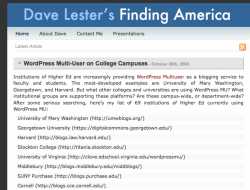 Dave Lester did a fine job of compiling a long list of Universities that are using WPMu in one capacity or another. It’s a great list, and there are at least 40 institutions on there I had no idea about. Add to this list the work Mario Núñez-Molina did last year and add a few additions to his list and you may very well have over 100 institutions using this application. And as the recent comment on his post suggest from the University of Melbourne, there are probably a heck of a lot of international universities that are using this application that we have no idea about.