Direct from the MooseCamp 2008 Wiki I give you WordPress Anonymous. Here is the working description of a proposed MooseCamp session titled “WordPress Anonymous”:
I would like to know if there is any interest in an intervention session titled WPA (WordPress Anonymous). The basic idea of this session is that WordPress users can come together, admit they are addicted, and seek help through the power of narratives. It will be a meeting premised on audience interaction and sharing about how they got hooked, how it has changed their ideas of self, affected their family life, and what they plan on doing to deal with these issues. We welcome the WordPress haterz as well, for they also need help and can learn a lot from those who admit they have a problem. Coffee and donuts will be served during the meeting. Please let me know if you are interested in helping and/or sharing below.
I know the session is geared to a “technology” and it may very well prove a non-starter. Nonetheless, it is one way to start thinking through alternative conference sessions that aren’t premised on the prevailing logic of conferences, yet rooted in a grand tradition of sharing and helping one another.
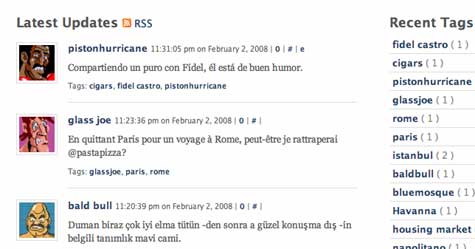
A strange thing happened to me today. I was playing around with the new Prologue theme for WordPress that acts in many ways like Twitter. I had already tested it on WordPress.com here, but I wanted to see if the GPL theme (freely available distributed here) would work on a hosted WordPress Multi-User installation. So, in an effort to keep the spirit of experimentation alive I tried it out. And it works well, but there are a couple of minor issues:
First, the author’s name doesn’t show up in the inviting sentence above the text box, rather you see the following: “Hi, . Whatcha up to?”. Nonetheless, the various author’s names do display the name properly in the page — so only the person writing the post will be perturbed.
Second, I am using Suleiman’s excellent WPMu Avatar Pack Release, but those avatars will not display as the theme is coded presently. However, GRavatars work well with this theme as it stands now. So if you are interested in trying this on your own WPMu installation, grab the GRavatar plugin for WPMu here.
Note:I am sure any “fix” (quotes here because the WP folks noted it would have to be tweaked) depends on a quick hack that I will hopefully figure out (but most likely find on the forums) soon. More importantly, however, is that when testing it on WPMu 1.3 there were no larger issues than these minor details.
But none of this is what was so odd, what was bizarre was that I tweeted the URL of the demo-site of Prologue for anyone who was interested in signing-up for an account. Logic being I culd get some feed back on how I set this site up so that anyone could quickly do it in two-steps: 1) sign-up for a username and 2) add their e-mail to sidebar of the Prologue log (an experiment to see if this could work for a larger number of people though allowing people to add themselves to the blog). I figured if all they needed to do was sign-up for an account and then add their e-mail address in the sidebar of the Prologue blog, I would find if there were any hitches while at the same time testing it out (for those interested, the ability to add authors to a blog via their e-mail is accomplished using the Sidebar Add Users plugin). Even though it’s two simple simple steps, people are busy and I really I didn’t expect anyone to jump on it anytime soon, if at all.
So, finally, what was really crazy was that when I checked back on the site tonight I found that at least six different users had posted at least twice in five different languages. Can you believe that?! Oddly enough, they all seem extremely familiar to me for some reason, and it’s as if they are picking up on a conversation they never really stopped. The internets can be very, very strange. If you don’t believe me, see for yourself.
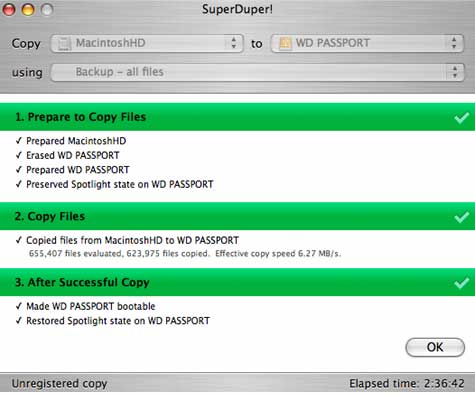
I have to give a shout-out to SuperDuper!, an application for creating a bootable backup of your Mac hard drive. Useful if your Mac goes south (and mine has three times in two years), and perfect for copying all my files from my MacBook Pro to 120 GB Western Digital external drive. So now when I get my new computer I can just use the migration assistant to import from the external drive and have everything as it was.
The best part about this application is that you can use the unregistered version for free and it does everything you will need for a simple backup/migration. It even walks you though the steps by prompting you if you need to re-format the external drive. Now I have to do the same for the Windows XP partition on my computer and I’m not sure what tools are out there, but I’d love to find something as simple as this. Any recommendations?
Having a little too much time on my hands this evening as I try and avoid wiping my computer clean and giving it back to UMW, I got sidetracked by my RSS Reader that featured some WordPress plugins that did some rather odd things. Some may even call these odd things superfluous, and they may be right. But if you open up that line of reasoning and push it too far, a whole bunch of things you might hold dear would crumble quicker than a Hollywood Mogul in front of HUAC. So be careful, Commie!
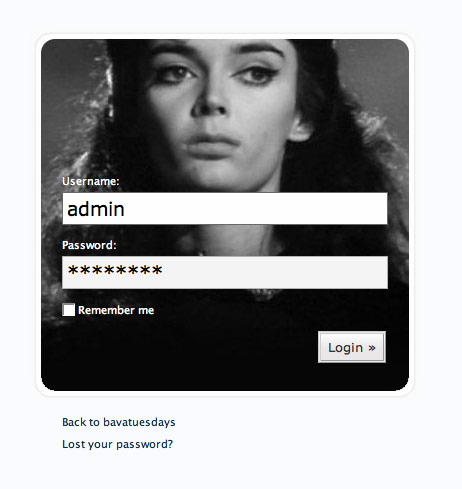
The BM Custom Login Plugin allows you to customize your login page with a design and image of your choice. I can’t stress strongly enough how utterly pointless this is for bavatuesdays given I am the only one who logs in, but nonetheless I had to do it. Poor Barbara Steele, I just can’t get over my obsession and leave her haunting visage alone.
Can you honestly tell me you’re not jealous right now?!
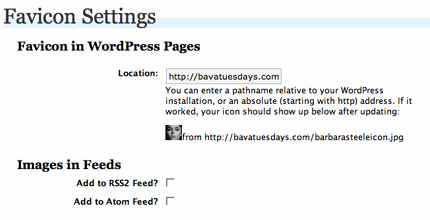
Even more ridiculous is the Favicon Manager WordPress Plugin that, you guessed it, manages your favicons. This makes it easier than ever (and it was already dead simple) to link to a 20px by 20px favicon that expresses the real you. Once again I chose the “scream queen of Italian gothic horror films” for my favicon, and for some reason I feel like I just added the finishing touches on the home I never owned.
Does anyone else use a plugin that is more useless than these two are for me? I highly doubt it.
The State of the Union Tag Cloud post by Jim Coe over at Bionic Teaching speaks for itself:
These terms (they bigger they are the more they were used) say a lot about the rhetorical tenor of our leaders and the fact that rabid nationalism, war-mongering, and unchecked aggression are still quite popular in Washington. Moreover, it also suggests the power of a cloud like this to distill keywords, concepts, or subjects to give folks who want various access points to a text (or texts) different ways at it. Though this may be a bad example, for I can’t see too many differing perspectives in this cloud.
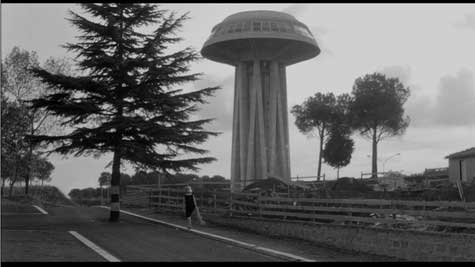
I had a pretty unbelievable experience the other night watching the late, great Michelangelo Antonioni’s L’eclisse (1962). I’m not sure how to explain this film, for the actual narrative itself is rather empty. Yet, it becomes immediately clear not five minutes into the film that this emptiness is very much at the core of its meaning.
The film begins with a painful break-up between Vittoria (Monica Vitti) and her distraught boyfriend Riccardo (Francisco Rabal). Yet, immediately after this breakup the film becomes a study of landscapes, the built environment, and things. Even before Vittoria leaves her ex-lover’s home, the world around her is visualized as an alien, hostile landscape. Immediately outside of the house is a huge tower shaped like and industrial fungus (phallus?), which looms large in several subsequent frames creating the atmosphere of another planet.
At that point I began to sense that this film was not going to be a dreadfully painful study in relationships like many of my least favorite European classics (such as François Truffaut’s The Soft Skin, for example). In fact, this film is a study about everything that surrounds relationships, quite literally focusing on all the things, surfaces, built structures that constitute the world that we live in, while pointedly de-emphasizing focus on actual interactions between and amongst people within these foreign landscapes. The cinematography is nothing short of stunning, and the shots themselves work together as a kind of study in the abstract relationship between things, not people.
Watching L’eclisse was particularly interesting for me this time around, because it frames a couple of ideas that I have been thinking about a lot lately. Namely, the power of deep attention to surfaces. The surface is often an idea that is easily dismissed, a space that represents something apparent that must be transformed to metaphor for value. Yet, what if the surfaces in L’eclisse don’t necessarily stand-in for anything in particular, but rather tolerate our connections as we attempt to archive and order the surface in an attempt to create relationships and search for any sense of meaning they refract back upon the characters.
The notion of an archive of surfaces that Michel Foucault discusses in the Archaeology of Knowledge is particularly poignant here because it traces the idea that the power of a text has everything to do with its position upon a surface, or placement within the mise-en-scene to remain more filmic. Celluloid film is in many ways the embodiment of our relationship to deep surfaces as they unroll in a long, thin sequential loop through the projector which shines out on a larger than life surface. On the other hand, the cropped surface of the internet opens up these deep connections (without any sequential march) which leads to a complex relationship within a variegated landscape of things that we can often interact with in a variety of ways.
Yet, there is no question in my mind that the power of surfaces and the limits of more traditional narratives is ever more apparent as we spend more and more time both consuming and creating our own surfaces within a peripatetic web of things. The difficulty of beginnings and endings, the crisis of influence and origins, and the rate at which relationships between texts are created and destroyed upon this new surface frames a unique narrative of things that we can’t ever know entirely. There is no way to tell the story fully, and these relationships between things exist both because of our own production, but also outside and in spite of it in some ways.
Take for example Scorsese’s discussion of L’eclisse in the following video that offers a very intelligent examination of innumerable experimentations in film happening in the early 1960s, as well as a more pointed discussion of Antonioni’s focus upon the detachment that characterizes the players, and the means through which the landscape of things in the movie in many ways emphasize their alienation. An excellent reading that I entirely agree with in many regards, and I highly recommend you take a few minutes to watch.
One thing Scorsese focuses on almost too much at the expense of some of the subtler issues, is the fact that the very things and surfaces that are supposed to embody and generalize this condition of detachment, also serve to make these characters’s disaffection seem irrelevant. The surfaces themselves become the focus of the film, and the liberation from the traditional “relationship narrative” comes as a welcome alternative. You can actually stare at the apartment buildings as if you have never seen one before. Or follow the faceless flow of people within the Stock Exchange, tracing large groups of people swarm and school together. The narrative of desire, relationships, and commodities will never compete with the deep attention Antonioni pays to the surface of things in this film. The one is purely a ploy to highlight the other.
One scene in particular that Scorsese doesn’t highlight, but for me is the most powerful example of this idea of surfaces is when Vittoria goes to visit heir friend Marta. Marta’s apartment is a fascinating example of exotic surfaces within this film. She is a white colonial from Kenya, and her apartment is filled with things from her home country. A table made of elephant feet, innumerable spears, jewelry, etc. Additionally, her walls are covered with pictures of her home Kenya, highlighting both the African “natives,” the wildlife (Marta not really distinguishing between the two), as well as the majestic landscape. Antonioni films the things in this apartment, reproducing a world that is as foreign to the one he has fashioned thus far, yet at the same time very much within it. Close-ups of the images on the walls create a textured landscape through surfaces, offering a tremendous amount of detail to a rather bland flat in an equally uninspired building.
Following the scanning of the surfaces of the apartment walls, one of the most troubling and vital scenes in the film unfolds. Monica Vitti puts on a record of African music and dresses up in blackface. She proceeds to dance around the apartment with African regalia and a spear. It is the only moment in the entire film where she is pictured in a state other than determined disaffection. Her animated eyes against her dyed skin marks the a highly charged surface of race, colonialism, and roots of these Western surfaces. Interestingly enough, this scene about Kenya foregrounds the post-colonial independent movements happening at that moment in Africa, a violent legacy that is still very much with us as I write this. The surface of Africa that emerges in this scene in relationship to the quotidian images that constitute the vision of the developed world and it’s fetishized surfaces makes this film something far more than an abstraction — it is a highly charged visual poem. So forgive my attempts to make sense of these surfaces in a very raw and incoherent fashion, and watch this film. You will not be disappointed.
(Aside: Excuse the appropriation and editing of Cat Power’s awesome album title — and awesome album for that matter!).
Over the last few days Twitter has been ablaze with updates from this year’s Educause Learning Initiative conference. The flood of tweets certainly augmented my already considerable yearning to be there, and Tom Woodward of the Bionic Teaching blog does a nice job of distilling a few gems from his twitter stream in this post.
I expected the Twitter stream to relent a bit today with folks getting ready to depart, and the energy level being all but exhausted given the amount of activity that was apparent from afar. Early on today that assumption proved true, at least until the final Keynote speaker gave his talk. Almost immediately my twitter stream was in full swing asking a series of interrogative questions about this speaker’s approach. From there it seemed to get more and more animated with just how infuriating this talk was for many of my twitter-friendly, first-hand witnesses.
What was interesting was that it was a quite different means of reporting an event. It isn’t uncommon for people to live-blog a conference session (often amounting to a summary of what was said — which has its serious limits in my opinion). The Twitter explosion this morning was the first time I had seen a distributed live-reporting of a conference session that was doing something extremely different than rephrasing or responding to a session, it was an out-and-out group reaction to what the speaker was saying.
From my vantage point, receiving all these reactions second-hand via twitter offered a fascinating look into something other than what was being said at the podium, or the vicarious experience of “being there.” What it suggested to me was how the community thinks about what is being said. To hear a large number of people (all of whom I respect and trust) in my network respond to ideas they neither agree with nor, at times, can tolerate was both unbelievably entertaining and fascinating all at once.
As Kieramc (a fellow twitter-ite who was not at the event) tweeted: “This may be my fave ELI session this year.” I couldn’t agree with her more! It was a blast from the bleachers, in part because I didn’t have to sit (or is it suffer) through this talk, but also because the experience suggests a real pulse within the network. This was a moment of cognitive crisis in our “collective intelligences” which had immediate reverberations in the network (or in this case twitter — sorry if I am using Network a bit loosely here). Didn’t Martin Heidegger say something about heightened being in the face of crisis? Was it at that moment when his notion of authentic being manifested? I forget, but “daseins” are on the wall -or is it the Twitter screen in this case?
I have been on Twitter for almost a year now and, oddly enough, I have yet to blog about it. And while some might poke fun that I am only doing so now because I finally found a way to push WordPress, I would say that they are only partially right 🙂
I use Twitter rather regularly, and in the beginning I had a similar reaction to just about everyone else who hears about Twitter for the first time: “Ya gotta be kidding me!” But I subscribe to Alan Levine’s theory of “Being There,” or to rephrase it using the NY Lotto slogan: “You gotta be in it to win it,” so I decided to try it out for a while before casting my final judgment. Needless to say it has become such an integral part of my network that after a year there is no question I would be far poorer without it.
I can’t really add anything profound to the discussions surrounding the value of Twitter, for folks like Alan Levine, D’Arcy Norman, Chris Lott (I wear my protection with pride, Chris!), and many others have done a far better job than I ever could.
What I would like to say is that I have always had a hard time thinking of Twitter as something I could approach faculty with in relationship to a more traditional classroom setting. The ever-eloquent Barbara Ganley once tweeted, “Blog to reflect, tweet to connect.” And I couldn’t agree with that sentiment more, it is the most succinct and accurate description of how these two publishing tools differ. But I still couldn’t see clearly how these connections might work in the classroom without seeming utterly trivial. Academhack has a good post that thinks through the possibilities in higher ed here, and today’s introduction of Prologue, a Twitter-inspired theme for WordPress.com (see a test run here) has me thinking about a couple of things — can I officially call WordPress my muse?
One of the things I like about twitter is the banter and the imaginative ways people use it. Brian Lamb had a stint where he traced his paranoia of being a hippie which made for an extremely funny series of twits over the course of a day, keeping several folks very much entertained. Such antics make up the very wonderful social fabric that is lost in the more LMS/CMS container-driven learning environments that still represent much of higher education online.
So, when I saw the Prologue theme something hit me. This is an invaluable space for totally online courses that entirely lose the banter of a physical/social experience in a classroom which is often not appropriate in a forum or blog. I have never met many of the folks on my “twitter roll,” but I have a very good sense of what a good number of them are up to. I also feel like I have the same level of acquaintance with these folks as I have had with many of my classmates over the years. Wouldn’t this inject a much needed social element to online learning that the blog is far too cumbersome for? For me, the most depressing part about totally online courses is the lack of a more informal way to connect immediately, something like the Prologue theme for WordPress might afford some of this.
Three half-baked ideas for using Prologue in a course:
For a totally online class here is how I see it: You have the Class Portal as a Prologue blog that people can post their updates to on a regular basis, they all have their individualized avatars and as soon as you go to the class portal you have an immediate sense of what everyone is doing. Moreover, you can hack this theme (which is GPL and available here) to include pages with course information, aggregated student blogs, syllabus, wiki, what ever you want. Highlight the social, playful element which ties the various members of any totally online class together right from the start on the course homepage (or portal or blog or whatever you want to call it).
Here’s another thought. Dr. Heidi Lorimor, a visiting Linguistics professor at UMW, has a really cool class blog called Unintended Novelties which she is using as a group publishing space where students can record and share certain linguistic “slips, stumbles, and misperceptions” that they come across in real life on a regular basis. A great idea, and a project we accommodated with UMW Blogs, but that would be so much better suited with something like Twitter, or even better a class-based twitter modification like Prologue.
Also, what if we hacked this theme for WPMu (it can obviously be done for it is running on WordPress.com) and created a blog using the Prologue theme that anyone within the community could sign-up for and post what they are doing? More than that, what if students had the options to select this theme and create their own “organic groups.” Perhaps a way to share files, study, or just update one another using a different tool. I don’t know, but the fact that something like UMW Blogs is already a very specifically defined community, helps me to see how such a tool could be used. Which is not to say it would be used, and I am well aware that there are many other tools that might very well do everything I listed above far better.
So there they are…some rough ideas outlining a few possibilities of such a publishing engine. I’m, sure there are many more, but I it’s just starting to click for me. Also, I certainly heed D’Arcy’s criticism that Prologue is far different from Twitter in that each individual can’t really define his/her own group in the way they might on that service. In many ways Prologue users are forced into a limited set provided by the class (or university) structure (I paraphrase D’Arcy’s more precise criticism here). I agree with D’Arcy, and I think that the “restrictions” of a given classroom or campus are exactly what has made Twitter seem so foreign to conventional ideas of teaching and learning. So, perhaps some more thought about a tool like Prologue might afford pre-structured groups (like a campus community) the ability to share and publish in different ways with the ease and immediacy of something like twitter, but as part of an already established framework like WPMu? It may very well have some value in such a setting. Then again, it might not!
I have blogged regularly about the problems with the CPU Quota Limit at Bluehost on and off for over year. I have to say that I am happy that Matt Heaton has reported that they have finally solved the issue. Kudos to him and his team for doing so.
My only issue is why did it take so long? And why have calls in to the tech support about these issues always resulted in blaming PHP applications like WordPress, Drupal, and MediWiki? I’m sure the good news will be generally welcome by the Bluehost faithful, but for me it comes a bit too late and with a certain amount of frustration that all those calls had more to do with their miscalculation than their customers’ gluttonous CPU usage.
is an ongoing conversation about media of all kinds ...
Testimonials:
Generations from now, they won't call it the Internet anymore. They'll just say, "I logged on to the Jim Groom this morning.
-Joe McMahon
Everything Jim Groom touches is gold. He's like King Midas, but with the Internet.
-Serena Epstein
My understanding is that an essential requirement of the internet is to do whatever Jim Groom asks of you while you're online.
-James D. Calder
@jimgroom is the Billy Martin of edtech.
-Luke Waltzer
My 3yr old son is VERY intrigued by @jimgroom's avatar. "Is he a superhero?" "Well, yes, son, to many he is."
-Clint Lalonde
Jim Groom is a fiery man.
-Antonella Dalla Torre
“Reverend” Jim “The Bava” Groom, alias “Snake Pliskin” is a charlatan and a fraud, a self-confessed “used car salesman” clawing his way into the glamour of the education technology keynote circuit via the efforts of his oppressed minions at the University of Mary Washington’s DTLT and beyond. The monster behind educational time-sink ds106 and still recovering from his bid for hipster stardom with “Edupunk”, Jim spends his days using his dwindling credibility to sell cheap webhosting to gullible undergraduates and getting banned from YouTube for gross piracy.

I would like to know if there is any interest in an intervention session titled WPA (WordPress Anonymous). The basic idea of this session is that WordPress users can come together, admit they are addicted, and seek help through the power of narratives. It will be a meeting premised on audience interaction and sharing about how they got hooked, how it has changed their ideas of self, affected their family life, and what they plan on doing to deal with these issues. We welcome the WordPress haterz as well, for they also need help and can learn a lot from those who admit they have a problem. Coffee and donuts will be served during the meeting. Please let me know if you are interested in helping and/or sharing below.
 First, the author’s name doesn’t show up in the inviting sentence above the text box, rather you see the following: “Hi, . Whatcha up to?”. Nonetheless, the various author’s names do display the name properly in the page — so only the person writing the post will be perturbed.