RSS Feed Generator for Academic Journals

Robert K. Nelson has created a very cool RSS Feed Generator for either articles or reviews for journals available through Project Muse and History Cooperative. His project takes its inspiration from William Turkel’s “How to: See the Field at a Glance” which uses a scraper to extract tables of contents and other useful data from online journals.

There is some some great stuff in these posts that outline some creative ways to re-image how to keep up with current scholarship in the field as well as thinking about searching the web in new and imaginative ways. I saw this resource a little while back and have been meaning to blog it because I think it is a superb example of just how valuable RSS is to academics who need to stay on top of what’s been published recently in their field.

I have subscribed to a few feeds in the field of Early American Literature, and interestingly enough I came across some scholarship being done by a professor here at UMW. How else would I know that Carter Hudgins recently published an article in the William & Mary Quarterly titled “Adaptation and Innovation: Archaeological and Architectural Perspectives on the Seventeenth-Century Chesapeake”? Immediate dividends!
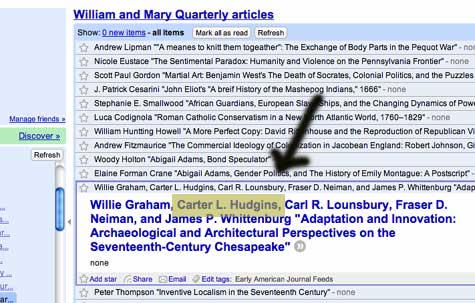
RSS Reader Hudgins

It should be noted that Robert’s Feed generator is designed primarily for journals dealings with US History and the Early Republic. Additionally, not all online journals can be scraped equally. Nonetheless, there is no reason why discipline specific instructional technologists couldn’t trace the resource Robert points to in order to see how many other journals fro a wider range of journals could be scraped and aggregated for their faculty. It would certainly make the conversation about the uses of RSS and Aggregation that much more compelling.

Posted in experimenting | Tagged , , , , , | 5 Comments

Carosello: An Italian TV Tradition

One of things I have noticed is that when hanging with a group of friends sooner or later the conversation turns to our mediated lives through television. Without fail, if the company is worth its salt, memories of Larry from Three’s Company, Rerun from What’s happening!!, or even Tootie from The Facts of Life will make there way into the conversation. I have also noticed that if we talk about anything other than Happy Days, the conversation quickly become inaccessible to Antonella, who was born and raised in Italia (woot).

I think this may have changed a bit recently with the advent of media imperialism and cable television, for many of my Italian friends have been recommending US TV shows that I have yet to see, most notably The Shield. I make no excuses for the current state of Italian television or film, for overall it is a god awful series of operatic melodramas. This wasn’t always the case however, and recently I have been introduced to a rich cultural resource that just about every Italian of the network age (translated as RAI) of television treasures: Carosello. Mark Tungate’s article “Are British ads still the best?” describes this Italian advertising tradition as follows:

Their [the Italians] advertising was permanently marked by something called Carosello – the carousel – which was a fixed ten- minute advertising slot screened every day at around 8.45pm from the late 1950s until the mid 1970s. Thanks to a government edict, it had to provide sponsored entertainment as opposed to a hard sell. And because kids loved watching Carosello just before bedtime, Italian advertising began to resemble kiddies’ TV.

The exact dates of the Carosello was from 1957-1977 and his brief overview highlights two fascinating points about this form of advertising:

  1. These ads seldom highlight the actual product they are pushing thanks to government intervention (further highlighting a point made in a comment on Abject Learning by Jon Beasley-Murray, namely that ads don’t work, or at least in this case Italian ads).
  2. These ads shaped the nightly routine and sleeping habits for at least two generations of Italian children. Antonella has talked to me about the Caroselli on many occasions, but having no access to this culture before YouTube I was very much in the dark.

Well, I have seen the light, and now you can too. Below are a few outlandish examples of how little these commercials have to do with the product they are selling. The first two are straightforward and need no explanation, the third (which is not subtitled Mojiti is no longer around) features the master comic Totò who is featured in his last role before his death as a cashier in a bank that is being robbed (this commercial is selling broth of all things!).

So, enjoy an Italian tradition that is not culinary.

Posted in Italy, pop culture, television, TV, Uncategorized, YouTube | Tagged , , , , , , , , , | 5 Comments

Mojiti is No Mo’

You can file this one under “Just Another Web 2.0 Service Cautionary Tale.”

I was planning on working on my Italian by sub-titling a short commercial for this post I plan on writing using Mojiti (an online service that allows you to annotate videos on YouTube and other services), when I discovered to my great dismay the following message:

Mojiti No Mo’

You’ve heard this story a million times before, but it’s actually the first time I had stuff on a service that I will miss a little bit. Fear 2.0 anyone?

Posted in Uncategorized, video, YouTube | Tagged , , | 4 Comments

Comprehensive List of US Network TV Schedules on Wikipedia

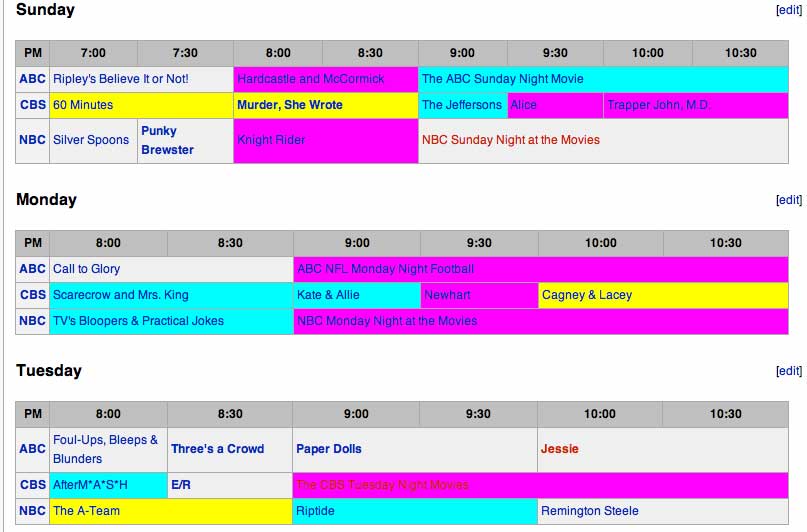
I was searching for information about 1980s sitcoms for another post I plan on writing when I came across a pretty phenomenal resource on Wikipedia for anyone interested in the history of U.S. television: a List of United States Network Television Schedules. An article which, by the way, is considered an orphan given the lack of other articles linking to it — what a shame! I imagine the subject has been the premise of several Media Studies/Communications research compendiums/directories that would aid countless scholars in their research (a quick search on Amazon produces at least one). And just think that this information is sitting quietly (even orphaned) on Wikipedia freely available for anyone to use and peruse. That’s open education if I’ve ever seen it!

Here’s an example of the layout (which conveniently links to the Wikipedia article about the TV Show) and a pop (culture) quiz:

US Network TV ExampleClick on image for larger version

What are your five favorite film adaptations of a Stephen King novel or story?

  • The Shining (1980) by Stanley Kubrick (15%, 34 Votes)
  • Shawshank Redemption (1994) by Frank Darabont (15%, 32 Votes)
  • Stand by Me (1986) by Rob Reiner (12%, 27 Votes)
  • Misery (1990) by Rob Reiner (11%, 25 Votes)
  • The Green Mile (1999) by Frank Darabont (9%, 19 Votes)
  • Carrie (1976) by Brian DePalma (8%, 17 Votes)
  • The Dead Zone (1983) by David Cronenberg (5%, 12 Votes)
  • Creepshow (1982) by George Romero (3%, 7 Votes)
  • Pet Cemetary (1989) by Mary Lambert (3%, 7 Votes)
  • The Mist (2007) by Frank Darabont (3%, 6 Votes)
  • Firestarter (1984) by Mark L. Lester (2%, 4 Votes)
  • The Running Man (1987) by Paul Michael Glaser (2%, 4 Votes)
  • Cujo (1983) by Lewis Teague (1%, 3 Votes)
  • Christine (1983) by John Carpenter (1%, 3 Votes)
  • Children of the Corn (1984) Fritz Kiersch (1%, 3 Votes)
  • Cat's Eye (1985) by Lewis Teague (1%, 2 Votes)
  • Dreamcatcher (2003) by Lawrence Kasdan (1%, 2 Votes)
  • Maximum Overdrive (1986) by Stephen King (1%, 2 Votes)
  • The Lawnmower Man (1992) by Brett Leonard (I imagine Stephen King would suggest this should not be on the list) (1%, 2 Votes)
  • Dolores Claibourne (1995) by Taylor Hackford (1%, 2 Votes)
  • The Dark Half (1993) by George Romero (1%, 2 Votes)
  • Apt Pupil (1998) by Bryan Singer (0%, 1 Votes)
  • Thinner (1996) by Tom Holland (0%, 1 Votes)
  • Needful Things (1993) by Fraser Clarke Heston (0%, 1 Votes)
  • Silver Bullet (1985) by Daniel Attias (0%, 1 Votes)
  • Sleepwalkers (1992) by Mick Garris (0%, 1 Votes)
  • The Mangler (1995) by Tobe Hooper (0%, 0 Votes)
  • Sometime's They Come Back (1991) by Tom McLoughlin (0%, 0 Votes)
  • Creepshow 2 (1987) by Michael Gornick (0%, 0 Votes)
  • Graveyard Shift (1990) by Ralph S. Singleton (0%, 0 Votes)

Total Voters: 150

Loading ... Loading ...

Posted in poll, pop culture, television, TV, Uncategorized | Tagged , , , , | Leave a comment

UMW (Blogs) Postscript

Image of tagging
Leave Your Tag courtesy of Alexleo10

Well, it had to happen sooner or later, and as I have been telling the folks at UMW for the last week or so: I am going out on top! This coming week will be my last at Mary Washington, and I can honestly say I have yet to have a job that has afforded me this much space to work creatively on a regular basis. I’m both grateful and indebted to my partners in crime at DTLT for making the environment constantly engaging, entertaining, and thoughtful.

Moreover, I have to thank the faculty at UMW for being unbelievably open and undeniably cool — you all make this kind of work worthwhile. The fact that in little over two years I have been able to work with faculty on well over eighty projects is a testament to their unbelievable tolerance (dare I say gluttony?) for punishment–they are a model for the school of the future and it has been an honor working with them.

Going will be a bit difficult for, as anyone who reads this blog regularly knows, I will be leaving behind a project that I have in many ways been married to over the last six months: UMW Blogs. I am extremely proud of the success of this project, but not so much because of the actual application, the design, or its conception. Rather, I am proud of the powerful virtual trace it has left of the amazing work that has been going on at UMW for the last several years. UMW Blogs will continue in the capable hands of DTLT, and by leaving now I am in the privileged position to take partial credit for its future success without any of the responsibility of its potential failure. This project has been a passion for me ever since Gardner and I had that fateful hallway conversation (almost a year ago to date) that led to a powerful “enterprise” publishing platform for the Mary Wash community.

Oddly enough, “divorcing” myself (to keep a metaphor rolling) from this project further reinforces the larger ideas that have come out of all this experimentation: UMW Blogs has far more to do with learning, communication, and community than with any single fascination with a technology. The fascination was simply an easy way to realize a framework. All of which makes the larger issues about educational publishing platforms that are open and community driven far more interesting to me than any isolated understanding of a blog or blogging software (more on this strain of thought soon).

So to the UMW faithful I say farewell, and to the good folks at the University of Richmond I say brace yourself, for I come further South with something to prove which makes me as dangerous as I am driven.

Posted in experimenting, UMW Blogs | Tagged | 14 Comments

Where’d That Silly Moose Go?

Moose

  • Plane Ticket: Check
  • Hotel room: Check (thanks to Alan)
  • NV 2008 Site Badge: Check
  • Insane Energy Reserve for the bacchanalian wonders: I hope so!

I got your Moose right here, baby!

Posted in nv2008 | Tagged , , | 9 Comments

Blogging Without a Spam Net

Spam Karma Stats

Shannon’s comment on my last post got moderated as spam (appropriately enough 🙂 ), and I mistakenly filed it as spam. All of which led me back to the Spam Karma admin tab to retrieve her magical comment.

When I got there I noticed that since my last Spam purge a few months ago, I have accumulated over 85,000 comments, 84,238 of which are spam. Of this number 651 were moderated, and only a handful actually got through (I would say two or three a week). Like the History Channel special “Life After People” Bryan Alexander linked to today, I started to wonder what the blogosphere would look like without spam filters. The internecine struggle reminds me of the classic story “Leiningen Versus the Ants,” except the man vs. nature theme doesn’t really work so well anymore.

In fact, it would be utterly impossible to host your own own WordPress blog if it weren’t for Dave’s brilliant Spam Karma plugin (or others like it). I would have to spend all my time fighting evil spammers, leaving little or no time for actually blogging. Having realized that I owe the ability to blog comfortably from my own server to Dave makes me want to actually do something for him in return. So, as I am trying to do more of these days, I am going to make a donation to him, it may be nominal given how much his plugin does for me on daily basis, but it certainly is a start.

Thanks Dave, for creating an excellent plugin that allows me to publish my inanities relatively free of spam, I couldn’t do it without you!

Posted in spam | Tagged , , | 8 Comments

Without Cigarettes There Would Be No Baseball Cards

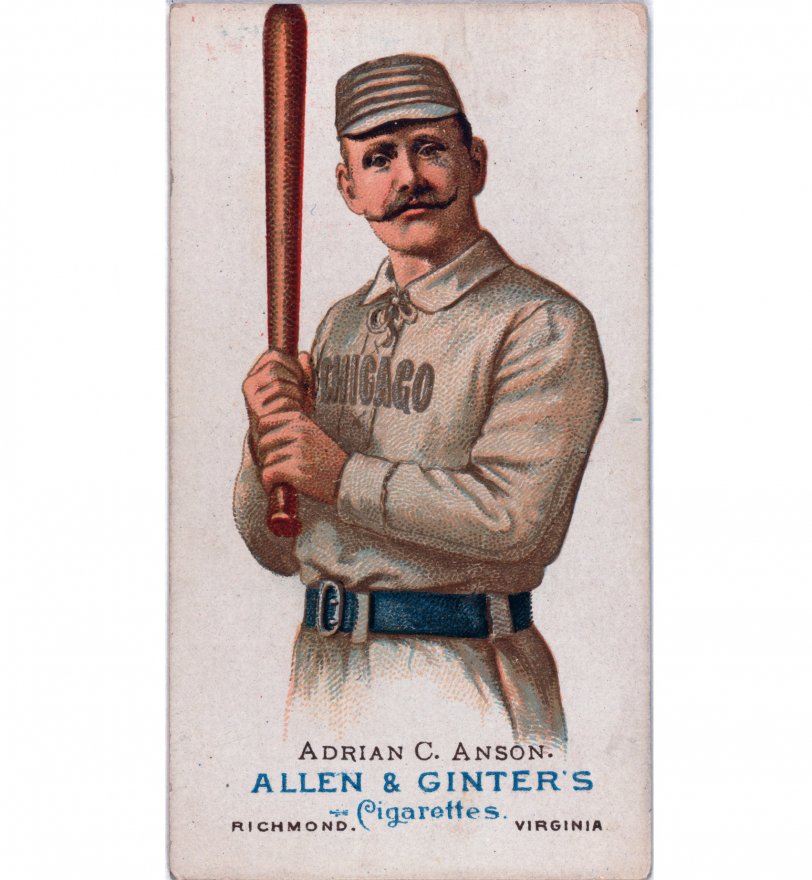
Image of a 19th century baseball cardWell, I’m not actually sure this blog title is entirely true, and that’s why I can freely publish it here. I found this 1887 baseball card on Shorpy’s Photo blog. It features the likeness of Chicago White Stockings first baseman Adrian C. Anson (also known as Cap Anson).

An early baseball card like this is in and of itself interesting to me, but it is far more amazing just how much history a seemingly inert object contains when coupled with a fascinating comment thread like the one following this image. You can find the comment thread here, and I will encapsulate what I learned from it below:

  • Cap Anson was “(common for the era, even in his native Iowa) a bigot. His racial attitudes were stronger than most, however, and he led efforts to exclude blacks from professional baseball.”
  • Which is followed by this fascinating bit: “Jackie Robinson was NOT the first black to play in the major leagues — both Fleet and Welday Walker played in 1884 before the color barrier limited baseball to the (ahem) melanin-impaired.”
  • Lewis Ginter (of the Allen & Ginter’s Cigarette’s company) was a New Yorker who went to Richmond when he was 18 and became an extremely wealthy and powerful industrialist. Here’s a look at his profile from a user’s comment:

    Ginter amassed a great fortune in the tobacco industry via new technology for rolling cigarettes. He used this massive fortune to act as a philanthropist and for the development of civic and business interests in Richmond. He developed the neighborhood Ginter Park and brought the Union Theological Seminary there. His niece Grace Arents continued his philanthropy, spurring the development of St. Andrew’s School, the Instructional Visiting Nurse Association and the Lewis Ginter Botanical Garden at her home Bloemendaal.

    Hired on to the John Allen & Co, he became a partner of the Allen and Ginter tobacco company that ushered in a number of innovations including cigarette cards and the use of local Virginia tobacco. In 1890 Ginter’s company joined forces with James B. Duke to form the American Tobacco Co..

  • Cap Anson was the first member of the 3,000 hits club, and is currently 7th on the all-time hits leaders. he ended his career broke and in vaudeville (Confession: I learned about his standing on the all-time hits list and his vaudeville career from wikipedia.) There was a controversy surrounding whether or not he should be considered part of the 3,000 hits club given over 400 of his hits were made in the National Association, which some believed could not be considered a major league (see the wikipedia article here for more on this).
  • Last, but certainly not least:

    I don’t know how commonly known this is, but this photo illustrates the fact that baseball cards were originally introduced in cigarette packs in order to keep the cigarettes from bending over. When they later started getting popular with kids they were packaged with bubble gum.

Now, I’m gonna have to have the bava-factcheckers go over this list to make sure all these points are 100% accurate and absolutely airtight, so until they give the thumbs-up I just wanted to reflect just how amazing it is to see a 120 year old baseball card take on so many rich social, material, biographical, and political inflections. The comment matrix of other people brings this cultural artifact to life. Informal learning at its best and, as usual, it is spurred on by curiosity, connections, and serendipity, not the desire to “get educated,” so to speak.

Posted in americana, images, pictures, richmond | Tagged , , , , , , , | 2 Comments

RSS Feed for Tags in YouTube

Here is a cool thing I discovered recently, and please forgive me if it is already common knowledge. There is a little hack for getting RSS feeds for tags on YouTube, and it goes like this:

http://youtube.com/rss/tag/randomtag.rss (where randomtag is the tag you want to aggregate)

Here are two examples of this tag-based feed. Andy Rush has put together some very cool screencasts for UMW Blogs which are appropriately tagged umwblogs. So, when you include http://youtube.com/rss/tag/umwblogs.rss in some kind of an RSS reader or aggregator you get the following:

Username as a Tag
What’s more, if you want to aggregate by a user on YouTube, you can just substitute their account username for a tag (seems that YouTube treats the username as a tag). For example, http://youtube.com/rss/tag/jimgroom.rss will bring the latest videos from my account.

Posted in tags, UMW Blogs, video, YouTube | Tagged , , , | 3 Comments

Propaganda Techniques

Educational film to teach viewers about the dynamics of propaganda…A teacher dissects the processes in which propaganda works to an eager student. In it are moments of classic hokum, but curiously it all rings true today. Link.

Posted in americana, experimenting, pop culture, video, YouTube | Tagged , , | 2 Comments