
[kml_flashembed movie=”http://bavatuesdays.com/wp-content/games/bowman2.swf” width=”475″ height=”400″ /]
Thanks to Free Game Dude for the heads up!
[kml_flashembed movie=”http://bavatuesdays.com/wp-content/games/bowman2.swf” width=”475″ height=”400″ /]
Thanks to Free Game Dude for the heads up!
Over the last month or so I have been scouring the Internet Archive for pubic domain films. Below are 31 of the 38 movies I bookmarked in del.icio.us that are currently available at Internet Archive (del.icio.us seems to be balking the feed after 31 entries for some reason). To see all 38 go here. The list includes some amazing films like Akira Kurosawa’s multi-perspective masterpiece Rashomon; D.O.A. -the classic Film Noir starring Edmund O’Brien; Fritz Lang’s German masterpiece M and his Hollywood Noir Scarlet Street; Charlie Chaplin’s first full-length feature The Kid; the depression era classic My Man Godfrey; classic exploitation films from the 1930s like Sex Madness and Reefer Madness; the unedited version of They Call Me Trinity -a Spaghetti Western starring Terence Hill and Bud Spencer; what many believe to be the first narrative film The Great Train Robbery; and the list goes on and on…
I will be building a number of these films into an idea I had that centers around a public domain film course. The logic is to organize several of these movies into a hands-on curriculum wherein students can have structured space to both analyze the history of film along the lines of genre, film form, stylistics, etc. as well as incorporating a lab element wherein they get their hands dirty by re-editing, re-mixing, and mashing up selected films as a way of using this unbelievable archive to give students a more immediate relationship to the art, craft, and beauty of film making. Moreover, we can really start to experiment with and think through the implications of writing papers for a course with the very films themselves. An exciting conflation of the creative and analytical process of producing coursework by editing the arguments filmically. This is all made possible by the abundance of open, mashable, and freely distributed resources we have at our fingertips -isn’t it about time we started to take advantage of it?
You can subscribe to the RSS feed for all the public domain movies I come across click here.
 I just came across “Liar, Liar Pants on Fire”, the first of a number of blog posts by Errol Morris for the New York Times. Apparently he will be blogging a series of articles, and his initial post deals with photography’s relationship to truth. Here is a brief excerpt:
It is also interesting how a photograph quickly changes when we learn more about what it depicts, when we provide a context, when we become familiar with an underlying story. And when we make claims about the photograph using language. For truth, properly considered, is about the relationship between language and the world, not about photographs and the world.
…
The idea that photographs hand us an objective piece of reality, that they by themselves provide us with the truth, is an idea that has been with us since the beginnings of photography. But photographs are neither true nor false in and of themselves. They are only true or false with respect to statements that we make about them or the questions that we might ask of them.
It is a really provocative and thoughtful post on the objective nature of photography that immediately inspired some thoughts of my own in regards to what seems to be a separating out and privileging of the relationship between “language and the world” over and above “photographs and the world.” It is not entirely clear to me why he makes such a distinction. I understand the idea that statements (or captions as he frames them here) open up a space where we can assert something is true or not linguistically. But aren’t textual statements, stripped of their context just as the example of the Lusitania he offers, neither true or false in and of themselves? I think images are as integral a part of the relationship between language and the world as texts are, rather than simply playing a supporting role as he seems to be suggesting here. Thinking through an image’s composition, framing, juxtaposition, and/or its relationship to a syntactical sequence of other images offers a linguistic system full of statements that could be construed or imagined as true or false, not unlike a caption or a line of text within a larger and richer context.
That said, how cool is it that Errol Morris is blogging all of this and that anyone can easily comment on or trackback to his thoughts and engage him in such a conversation, whether or not he ever gets around to reading it. Now, of course he is blogging under the auspices of the New York Times which makes this blog a bit more official and high-profile, possibly precluding a more intimate and pointed discussion through comments and trackkbacks. Yet, at the same time we have to recognize that he’s possibly one of the most important documentary filmmakers working today, and it remains important that a number of people can not only freely access his ideas immediately but also engage in distributed conversations with several folks around some of the concepts raised here -many of which are worthy of a more extended and detailed discussion. I, for one, know that Gardner Campbell is currently working through a number of them with his students, how cool for them to have the access to such a director, writer, and thinker like Morris in relative real time.I guess when someone has a blog, they just seem realer to me, so this may very well be one of the heights of Real School!

From the Wikipedia article:
The Fighting Whites were an intramural basketball team formed at the University of Northern Colorado in 2002. The reason that an intramural college team briefly attracted a storm of national attention is that, in order to make a satirical protest about stereotypes of Native Americans being used as sports mascots (such as the Florida State Seminoles or the NFL’s Washington Redskins), the team adopted the name “Fighting Whites”, with an accompanying logo of a stereotypical “white man” (styled after advertising art of the 1950s) as their team mascot. The original internet news article about the team mis-identified them as the “Fighting Whities”, inadvertently increasing the comic appeal of their name and logo. In response to customer demand, they eventually began selling t-shirts under each name. The team sold enough shirts that they were eventually able to endow a sizeable scholarship fund for Native American students at UNC. The team reportedly included players variously of Native American, white, and black ancestry.
I do love the Madison Avenue image of the 50s everyman -check out their store chuck full of the Fightin’ Whites buttons and t-shirts on cafepress.
Antonella and I have embarked on what we hope will be a fairly comprehensive retrospective of Italian Cinema in an attempt to answer one deceptively simple question, “What the hell went wrong?!” How did one of the most imaginative and inspired national cinemas of the 40s, 50s, 60s, and 70s become so vapid and uninteresting during the 80s, 90s and 00s? Was it the advent of video? Or the changing nature of Hollywood distribution? Perhaps it’s more closely related with the vicissitudes of Cinecittà? We don’t exactly know just yet, but we will find out!
 More than anything, it offers us an amazing opportunity to really explore and relish some of the masterpieces of Italian cinema. Recently we have been working through a number of Pier Paolo Pasolini’s films, and I really enjoy the elegiac poems the he manages to frame for the camera. We recently watched Mamma Roma (1962), Il Vangelo secondo Matteo (The Gospel According to St Matthew, 1964 -which was horribly dubbed in English making in unwatchable for Antonella, but made for a very interesting b-movie experience for yours truly), Comizi d’amore (The Assembly of Love, 1964), Uccellacci e uccellini (The Hawks and the Sparrows, 1966), and Teorema (1968). When I find a bit more time I’ll go into depth about our discussions of all these films, and their are some great interviews with Pasolini wherein he talks about the convergence of art, cinema, and politics as well as his own beautifully poetic notions about history, Marxism, and capitalism.
In the mean time, however, I wanted to talk briefly about Uccellacci e uccellini which features two of my favorite figures of Italian cinema: Pasolini and the brilliant comic actor Antonio de Curtis, whose stage name was Totò. Totò was a giant of cinematic comedy -his film persona has much in common with Charlie Chaplin’s Tramp, and in many ways he embodies a beautifully compassionate figure of an eroding patriarchy throughout the western world. He is a clown in the richest sense of that long tradition, representing a critical and subversive vision of post-war Italy. Antonella and I spent much of the time immediately before and after September 11th at the Brooklyn Academy of Music where we drank in the films from the “Totò Recall” retrospective like therapeutic medicine. In a moment of national crisis, Totò offered a compassionate and deeply hopeful means of coming to terms with the horrors that immediately surrounded us. He spoke to us from the war-torn landscape of a post-bellum Italy -working the ineffable magic of one of the last -if not the last– truly great humanistic comedic actors.
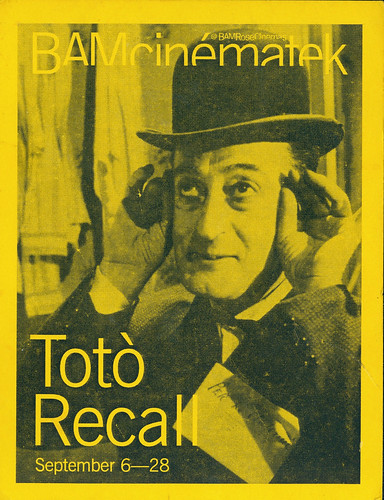
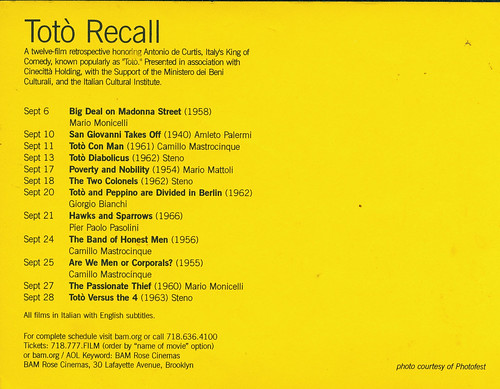
Totò is so important to me these days as a reminder of the deeply dark and painful impulse of great comedy, unlike current popular figures like Jon Stewart or Steven Colbert, his humor was driven by a deep-seated respect and love of his fellow travelers rather then guided by a logic of cynicism, contempt, and violent satire. Our comedy is a product of our moment, the beauty of film is that we can return to another moment and re-imagine the power to connect with one another in some real and meaningful ways like Totò connected with me during a moment of extreme terror and seemingly endless uncertainty. Totò deserves an entire blog unto himself (what do you think of Totòfridays?), but I will do my best to re-visit this really important retrospective of Totò’s work at the BAM that seemed almost divinely planned in terms of contemporary relevance.
But, I indulgently digress, Pasolini’s Uccellacci e uccellini is an elegiac poem about the state of Italian leftist politics in the mid -1960s. The film takes place in an exurban wasteland and features the peripatetic peregrinations of Totò and his son throughout the slums on the outskirts of Rome. The film features a talking crow who represents “the so called- left-wing intellectual of the kind of those living before Palmiro Togliatti’s death.” The crow tells the wanderers a tale of medieval times wherein two friars preach to the hawks and the sparrows. They were successful in preaching the commandment of love unto them separately, but were unable to get them to love each other (link). The hawks still feed on the sparrows, and the powerful continue to prey on the weak and disenfranchised. The film reads like a poetic history of the Italian left, towards the end incorporates footage from the funeral of the founder of Italy’s Communist party, Palmiro Togliatti, a stark break from the fable-like logic of the rest of the film. This is reported to be Pasolini’s favorite of the numerous films he made, yet critics and fans of Pasolini oscillate between extreme reactions of favor for Totò’s masterful dramatic performance and its aesthetic exploration of a “Pure Marxism,” or disfavor given the overt attention paid to Marxist ideology and the miscasting of Totò in a rather less than comedic role.
Be that as it may, my own favorite scene from the film is what I glibly refer to in the title as Pasolini’s Italian Dance party. The following sequence comes very early on in the film, and marks a moment that features some of my personal favorite film music from Ennio Morricone. I love the energy with which Pasolini consistently infuses the younger, working-class characters in his films. He films this raw talent with so much affection that the kinetic love of these images is burned on my consciousness.
[MEDIA=13]
We have been experimenting at some length with WordPress Multi-User at UMW as of late. Now I have focused almost exclusively on creating course spaces using a series of distributed feeds. In short, students feed out their posts by particular categories (or an entire blog they create specifically for that class) to a designated space that aggregates all their work. Their posts can be aggregated in a distinct blog, or even using a page within a blog with a host of different aggregators -I have talked about at some length here. (A problem with the Autoblog is the constant trackbacks -thanks Shannon-I’m working on fixing that.)
Now, let’s take a look at another possibility for framing a class using WPMu. Say a professor creates a blog for a class on UMW Blogs and want to have this as the primary space for students to post. You can approach this from a few angles, if the student doesn’t have a blog and doesn’t want one -he or she can create just a username and be easily associated with a class by adding the user’s email to a particular blog using the “User” tab in the backend.

As you can see above, you can also set the permissions. Relatively straightforward process to include any student who already has signed up on the WPMu install for a blog or just a username. Now if the student already ahs a blog and wants their posts on this particular class site to be reflected in their own blog space, they can do one of two things.
Why spend the time re-framing what might seem obvious to some here. Well, quite frankly, because not everyone is going to have or even want a blog, but they still should be able to participate in the class with little or no hassle. More than that, some folks may already have their own blog with services like Blogger, WordPress.com, etc. A class blog like the one I am outlining here allows for both of these possibilities and still makes it relatively easy for students who do not have a blog on a Multi-User space hosted by the university to participate with the class seamlessly.
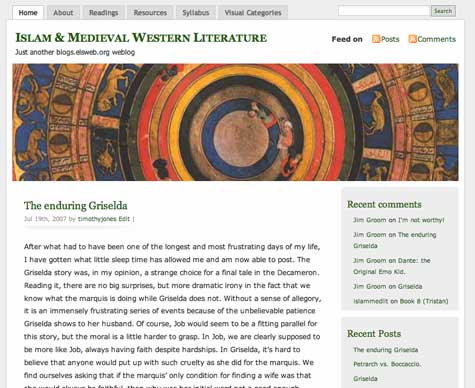
An excellent example of such a setup on ELS Blogs is Professor Terry Kennedy’s Islam & Medieval Western Literature class site/blog. There were a couple of reasons to do a centralized space for this class. Terry is experimenting with course tags, and a centralized course blog is still (for the moment) the easiest way to handle this through categories tags.
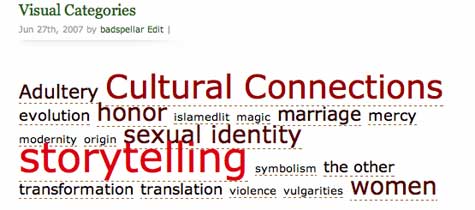
Moreover, the space acts as much as a hub for course documents, readings, announcements, commentary, etc. -keeping the integrity of a more stable and unified course site in tact. One of the plugins for this course blog/site I installed recently and I think goes a long way towards further making such a space work as simultaneously a communal and individualized space is the Posts by Author plugin which appends links to other recent posts by a particular student on this blog. Giving readers an alternative means to access the various work a student has produced on a blog over time.
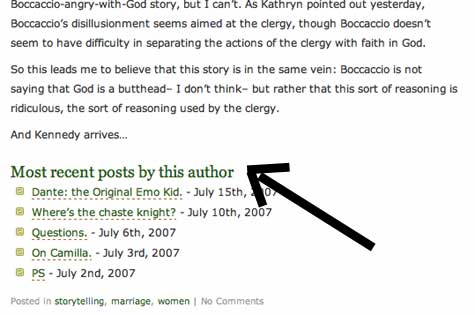
So, in short, Terry Kennedy’s experiment with her Islam & Medieval Literature course on the ELS Blogs site suggests that there is definitely more than one way to skin a course, and her class has done a bang up job on this one. This certainly speaks to the amazing versatility a web authoring platform like WPMu offers a university. What’s more, however, is that it speaks volumes about the unbelievable willingness of UMW’s finest faculty to experiment with new and unique possibilities for capturing and presenting the ideas, discussions , and resources that any class affords a larger community of learners. Bravo!

The folks over in Gardner Campbell’s New Media Studies class are having way too much fun. One student, humanisticmystic, is doing some research on the lolcatz phenomenon and submitted his own lolcat creation to I Can has Cheezburger with some pretty impressive results. He has a nice overview of this viral phenomenon and offers an extremely intelligent reading of its wide appeal here. Fun, fun, fun!
So if you have a WordPress.com blog, you can do some of your blogging from within Facebook with the new WordPress.com Facebook App designed by Joseph Scott.

In this app you’ll find the core blog features you’d expect: publishing posts, adding bookmarks and viewing stats. Beyond that we’ve taken advantage of the social network information that Facebook provides, with a Friends feature that shows you the most recent WordPress.com blog post from each of your Facebook friends that have added the app. Posts you make within the app show up on your WordPress blog here, and vice versa.
Hmmm, so any way to get this functionality for our independently hosted WordPress and WPMu installations?
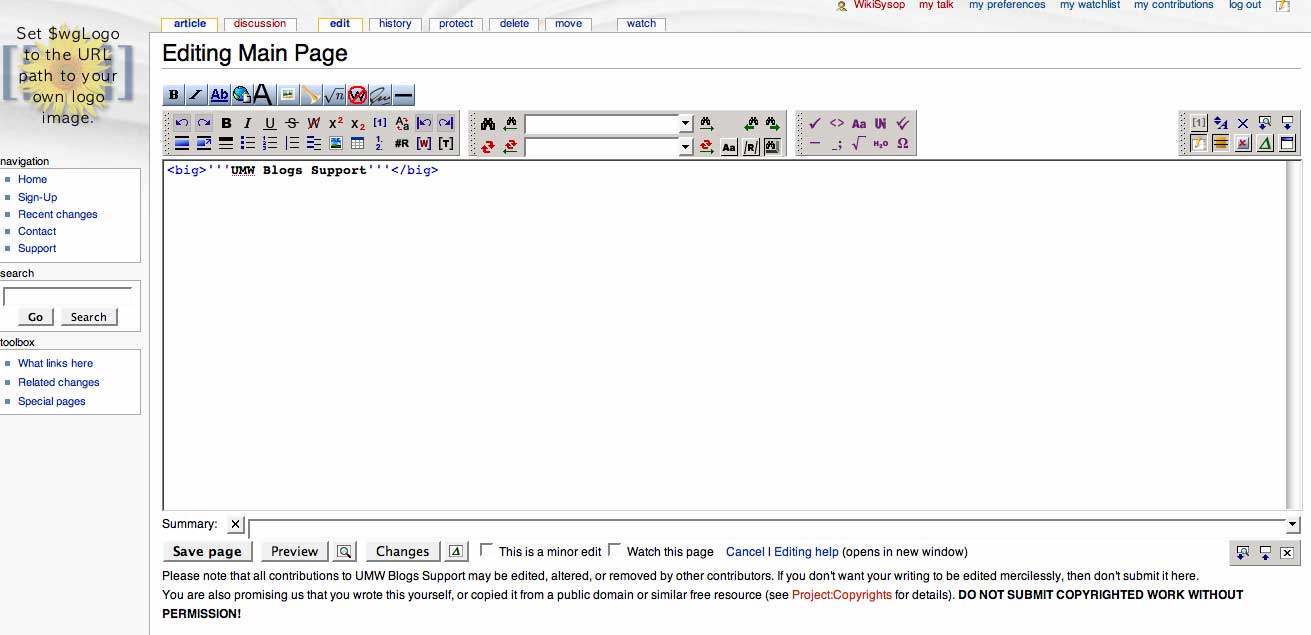
Update: Not exactly a full-featured visual text editor 🙂
Just found this little hack for MediaWiki that adds a more comprehensive visual text editor to the coolest wiki application going. How long have we been waiting for this? What’s more is that the features are pretty comprehensive. All you wiki purists be damned, I got mine baby! Thanks and praise go to El Guapo, whose del.icio.us bookmarks showed me the light. Scott Leslie rules the edtech school!
One of the things I love about my Flickr photostream are the intermittent gifts from my contacts. Fotoedge’s images regularly provide me with a beautifully textured and preserved Americana of the Mid-West. Whenever he uploads a new photo I am sure to spend some time thinking about the relationship between our state of mind and the built environment. Which will ultimately lead me to consider the horrifically unimaginative design of most recent development, and then a melancholic reflection upon the loss of so much beauty in the seemingly irrepressible push for more and newer developments that are rapidly convulsing the landscape we currently inhabit (not unlike Fyodor Dostoevsky’s description of the train tracks that cross and re-cross the landscape of Europe like a huge, tortuous scar in his novel The Idiot).
Another photostream that gives me untold delight is James Spadacinni’s Flickr project that occasionally features new images from the John Collier Jr. collection -which are an integral part of The American Image exhibit at the University of New Mexico. These photos are intermittent gems from the public archive that propel me into a kind of hypnotic re-imagining of the vast landscape of the US during the 1930s and 40s. I am continually struck by John Collier Jr’s uncanny ability to capture and preserve such a compellingly hopeful cross-section of the North American landscape and its people -often invoking the spirit of endurance and humanity I associate with the greatest novels of William Faulkner. The late photographer moves so seamlessly from Portuguese fisherman in New England to Hispanic Ranchers in New Mexico to Mennonite’s at a farm auction in Pennsylvania to the slums of West Virginia to white collar gentlemen on a train in the deep South. It is truly an amazing visual journey through time and space and I feel fortunate to get these gifts from Flickr with some regularity. It makes me feel connected to a national past held together by the sinews of difference that accentuate the variegated beauty of this space -feelings and emotions I am in sore need of during these dark days.
So, in the spirit of sharing, below are twelve of my recent favorites…
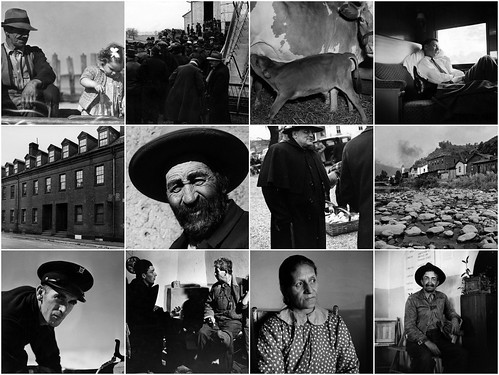
1. Portuguese dory fisherman and his grandaughter, 2. Farm auction, 3. Cow and calf on farm, 4. Whiling away the time through the Deep South, 5. Workers’ homes., 6. An Hispanic rancher, 7. Mennonite attending farm auction, 8. Slums, 9. Portuguese surf boat crew, 10. Father Cassidy and parishioner, 11. Hispanic woman, 12. A patient at the clinic

Find out more about me here.