To be clear, it was Taylor Jadin who upgraded my PeerTube instance running at bava.tv from PostgreSQL 10 to PostgreSQL 13. I did watch and learn as he worked through the process, so I’m some the wiser, but I’m still wrapping my head around both working in containers as well as trying to understand the particularities of PostgreSQL.
So in many ways this post is simply a redirect to Taylor’s post “Some notes on upgrading PostgreSQL in Docker” where he provides context and a step-by-step for upgrading PostgreSQL 10 to PostgreSQL 13, but it probably abstracts pretty well for upgrading a PostgreSQL container more generally.
At this point you might be thinking, “What’s up with you, Groom? Why are you making Taylor update your instance of PeerTube you lazy fascist!” Fair enough, I’m lazy and I do live in Italy, but there are reasons for this beyond those two things.
First off, working together on upgrades like this provides a low-stakes. collaborative opportunity to help us get more comfortable with supporting this awesome open source YouTube alternative.
Secondly, when we make time for projects like this that seem “low priority” it often pushes us to blog it, which is particularly important given there’s not so much help out there for folks tinkering with PeerTube.
So it’s directly related to our bigger push for honing our Reclaim Cloud support game, and Taylor is definitely our lead in that space. What’s more, watching him work not only helps me, but I think helps Reclaim more generally continue to push into the realm of containerized infrastructure. So that is my argument for having him upgrade my PeerTube PostgreSQL version and I am sticking to it!
I pretty much knew that my first post about Reclaim Open would be about scale. That was definitely one of the big takeaways from me over that re-invigorating, celebratory 3 day event. Keep in mind I helped organize the event, so I’m owning my bias out the gate. Even better is that Anne-Marie Scott—who travelled all the way from Scotland to join us in Fredericksburg, VA—already got the discussion rolling with her post “#ReclaimOpen – reclaiming human scale.” Anne-Marie is pretty awesome, and her thinking around open infrastructure and understanding scale in terms of augmentation and scaling people’s possibility rather than the metastasizing growth metric it has mutated into as a result of the consolidated social networks that continue to cannibalize any and all healthy cells left to make a buck. The hollowed out corpse was once a vibrant field of discourse. As Anne-Marie notes in the above referenced post:
The drive for scale seems to have become to scourge of our age. Mass education at the expense of meaningful relations and genuine community; AI operating at the scale of planetary effects. I have many more thoughts that I need to sit and digest properly.
The link between our unsustainable relationship with the planet and the ever increasing toxic climate on many of the predominant social networks is nothing new, but it really hit me in the gut at Reclaim Open. And again, as Anne-Marie notes this was a whole theme across sessions, from
But all that while a particulate haze from Canadian forest fires descended on the ‘burg, a kind of Raven for our time. Nevermore, nevermore! It was hard to look away, but it was also helpful to be reminded the stakes are far greater than textbooks and resources when it comes to the open web; we’re fighting for survival in some fundamental ways. Which is probably why things like Hopepunk and Solarpunk were invoked repeatedly (I think I am just re-writing Anne-Marie’s post, is that the ultimate compliment?), as the search for viable alternatives are starting to take on real resonance as the cultural/political lines are being drawn ever more deeply across the US and Europe.
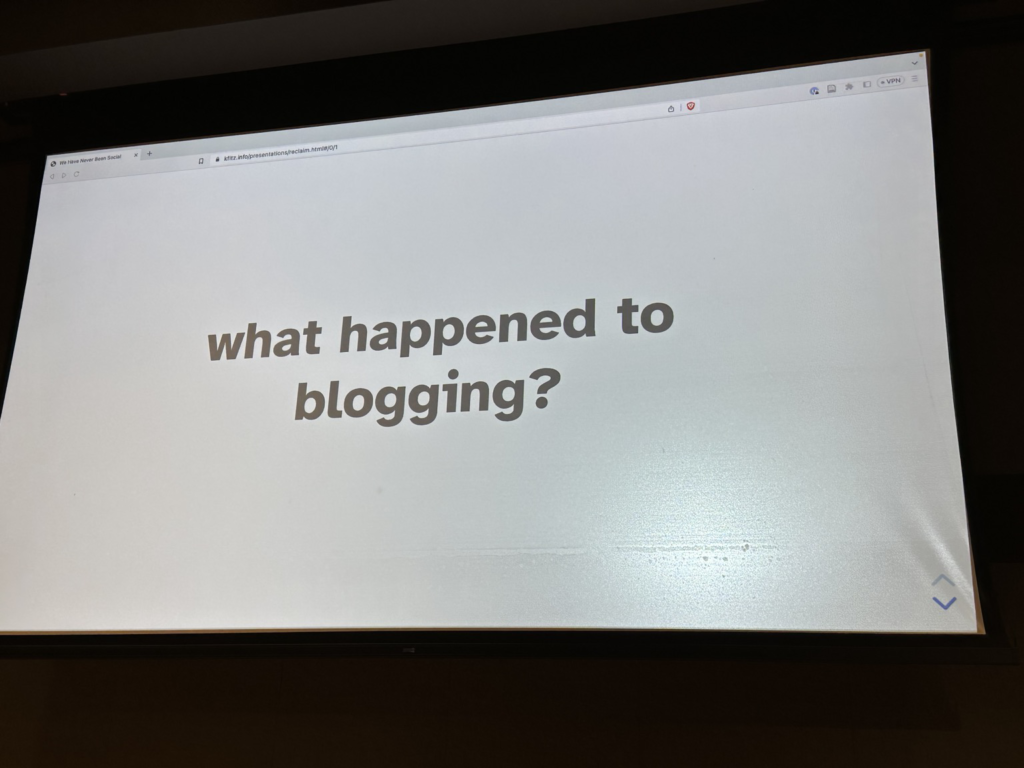
Slide from Kathleen Fitzpatrick’s the talk “The Web was Never Social”
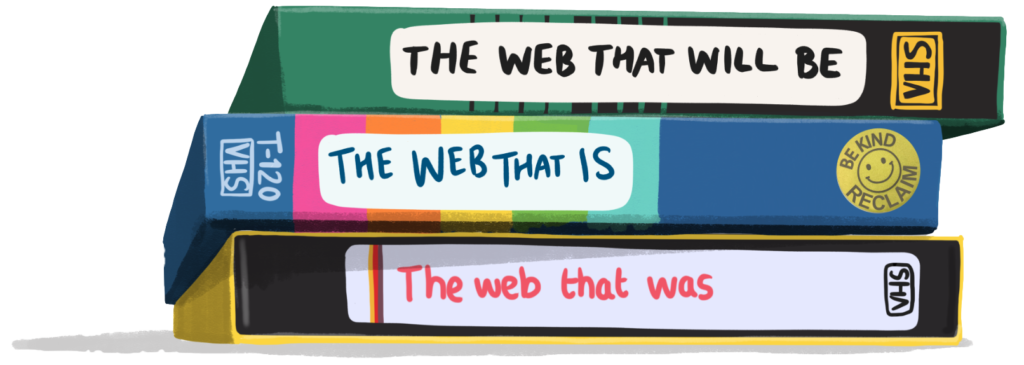
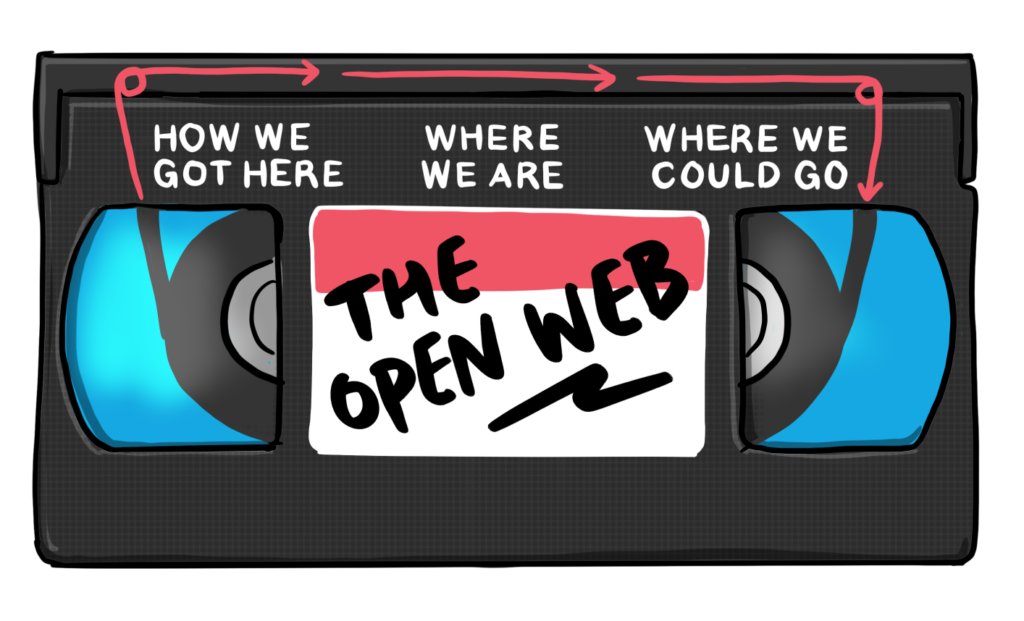
It’s a really brilliant meditation on the “web that was” that remains rooted in the “web that is” and can be with a call to a return to distributed, de-centralized networks. The coolest part of it all is Kathleen practices what she preaches by not only blogging, but helping stand-up one of higher ed’s most compelling Mastodon communities, namely hcommons.social. It’s just this kind of hopeful sense of working with generosity and a purpose that was a necessary adjacent reality to the waves of loss that pervades the social web as we knew it. This uplifting sense that the foundations are still there and the whole reason we got into this thing to begin with: to try to connect and create a sense of community, and that is not something any one platform can take away from us. This message helped balance the competing bouts of pessimism and optimism for what’s to come.
And that is just part of it, but let me stop there and start another post around Rajiv Jhangiani’s meditations on colonization and the open web as well as the UMW reunion session and many, many more. Like with OER23 there is no way I am going to get it all in one post, not need it be, and there are still so many posts I need to reference, so I might draw this out a bit, if even just to hold onto the magic just a bit longer….
I’m back from a trip to both Fredericksburg, Virginia for Reclaim Open and after that Long Island, New York for some extended family time. All of that coming off several days in Lisbon, Portugal, so I was feeling the effects of being on the road for a bit. I have a lot to say about Reclaim Open, and that will begin here shortly, but before that I need to ease back onto the blog, so I’ll highlight some of my recent work in the bavacade.
Turns out the arcade work can also do double-duty as a kind of re-entry therapy. My bipolar gets pretty acute when I’m on the road and away from the family for a while. If I’m not mindful my thoughts can begin to spiral. So for this re-entry—before blogging or jumping headlong back into work—I took some time to tinker on a few games. I usually lug a bunch of arcade parts, repaired boards, chassis, etc. back from the US, and this trip was no different.* On top of the random parts, I also retrieved a few game boards I had shipped during my last trip to the US in February (including Sidam’s Condor, Exidy’s Cheyenne, and Nichibutsu’s Moon Cresta). On top of that, I took a few with me from Italy, namely a Moon Patrol bootleg board with sound issues, a Bagman with sprite issues, and my back-up Yie-Ar Kung-fu board. So, in short, a lot of boards to be looked at, and below is the tale of the tape for board repairs:
The Sidam Condor board had a boot issue and missing star field caused by a bad 74LS32 chip. Mike ordered a MN6221AA melody chip and replaced that. The last problem was that the foreground was shifted to the left, cutting off the “F” in Fuel on the left hand side of the screen. This was fixed by replacing chip 74LS00 at location J4. Seems like pin 6 of that chip was stuck at a logic high and never moved.
Moon Patrol bootleg- dead sound cpu, replaced but still no sound. Traced sound all the way back to the amp. The problem was the folks who made this bootleg pcb switched the +/- speaker wires on the edge connector. Simply swapping the wires at the speaker fixes this.
Yie-Ar Kung-Fu – there was nothing wrong, no graphics problems, sound or control issues. This means power is the issue creating sprites, need to test this hypothesis once that cabinet is put back together, more on that custom project setup shortly
Bagman – the Z80 cpu was bad, but Mike did not report any sprites issues after it was fixed. I had recurring sprite issues and assumed it was a board/chip issue, but turns out it was power, as it always is. +5V DC needed to be raised a tad.
The issues with the Cheyenne board were linked to the 440 Multi-kit. Turns out the the sound portion of the Exidy kit was causing the no sound condition.The logic portion (the kit) had a problem coming from the GAL chip. Specifically, addresses 14 and 15 were missing and these addresses get generated by the GAL chip. The game boots and plays fine, but opted to remove the 440 Exidy kit and re-install original Cheyenne chips, now to fix that Hanterex Polo to get Cheyenne back up and running after nearly 10 months of that game being offline.
Moon Cresta was a strange issue, it was working fine until Zach and I tried swapping out the main CPU chip for a high-score save kit. Once we did that the game just threw garbage to the screen. Turns out the chip (and or high score save kit) needed to be soldered directly to board given the socket was not making contact with the chip’s legs— which seems odd. That said, the board is working again without the high score save kit, so might need to solder the HSS kit directly to board, we will see.
The non-working spare Dig Dug board was the final one Mike worked on, and that board had a bunch of missing chips, so that was a full blown salvage mission, but it works a treat.
That’s a fair amount of board work, but as of now there are no bad boards,. This will be a short-lived victory, but I’ll take it.
Next up is monitor chassis repairs. I have two G07 cap kits (Robotron and Condor) I need to do, as well as a K4600 capkit for the Centuri Challenger. After that, the final project is the Hanterx Polo, which has been drawn out way too long, so I’m trying to resolve that sooner than later.
The other work happening has just been some random testing of parts and boards I brought back, such as testing a 15-pin Williams power brick for Make Trax: it works fine. I’ve also been testing boards like Condor (looks and sounds amazing) Bagman (working again and power adjustment fixed the power-induced sprite issue), Dig Dug (works perfectly), and Zach reported back Moon Cresta is all systems go. So Cheyenne, Moon Patrol, and Yie-Ar Kung-fu are the last boards to test, but two out of the three will need to wait until the games are back online. That leaves Moon Patrol, and I’ll be testing that here soon.
This weekend I fell down a repair rabbit hole. I picked up a degaussing coil in the US, and brought it back to add the final touch to Exidy’s Venture (one of my absolute favs) which had a bit of discoloration on the CRT. The degaussing fixed the issue, but soon after the game was freezing and eventually it seemed the monitor was cutting out. When I adjusted voltage the screen came back, but this time with mono-chromatic colors and it was out of sync. Major bummer. I started troubleshooting which lasted deep into Sunday to finally learn the monitor’s fine, but one of the chips that controls the color and sync (chip 13C) needed to have the solder re-flowed. I did that and re-seated everything and the game started working again and looking better than ever. That was a small, but rewarding, win.
It all becomes pretty consuming for me (which is true of most everything I do), but I find that focused attention and tinkering to solve small, elusive problems can be just what the doctor ordered when trying to return to a much needed work/life rhythm. Arcade therapy! But not so much playing the games these days as fixing them which is a really pleasurable, if unexpected, consequence of getting into this hobby.
_______________________________
*I even found all my Dungeons & Dragons maps and guide books feared lost, but that is a post for another day.
I’m sitting in Zurich airport preparing to return to the motherland for Reclaim Open after celebrating 20 years of marriage to my special lady friend. Lisbon was amazing, and life continues to be a gift with Antonella, I’m a very lucky man. It was our first time visiting Lisbon, and that city’s attractions are like something out of an amazing Dungeons and Dragons map, I really loved it.
But that is just one of the many anniversaries—albeit by far the most important—that are happening this year. I celebrated 10 years off the sauce, WordPress turned 20 years old last month, the world wide web went open 30 years ago in April, and next month Reclaim Hosting gets its double-digit wings by turning 10 years old in July—which is insane. Next week we kick off the celebration with our bi-annual conference re-framed as Reclaim Open, which will find many of the original DTLT crew back at the University of Mary Washington.
Reclaim Open at UMW from June 5-7, 2023
I’m really excited for this event, especially given this conference is going to be fairly small and focused. We’ll be lucky if we get 50 people all told. And all those attending represent a community of folks that still believe in the possibilities of the open web for education, and I count myself a proud member of this shrinking club. In fact, that was the take-away for me from OER23 in April, that re-connecting and re-committing to the work open ed techs do is crucial. It’s work I love, work I believe in, and work that has never been more important. We’re a motley crew strewn across the globe here and there, but for a few days Reclaim Open will bring together a handful of those mutants for a celebratory meeting to help us remember what it is we do and why—especially in the wake of the pandemic.
What’s more, while we’ve tried to keep it on the down-low given Reclaim hates to over-promise and under-deliver, the the official event (everything but the un-confernece) will be accessible remotely. We’re using our watch site setup discussed in my last post about karaoke to play with a hybrid conference delivery setup, and we plan on streaming all sessions and managing the online conversations through Reclaim Hosting’s Discord server. We can even stream out the Tuesday night karaoke from Reclaim Arcade! So in many ways the conference will be an exploration of how we can deliver an effective hybrid event, and it will be freely accessibly during the conference as well as throughout the month of July when we transition the sessions from the in-person conference to a fully online, month long 10-year anniversary celebration.
So yeah, I am definitely getting fired up for Reclaim Open, and given it is accessible from anywhere you should be too!
It’s been a little while since I blogged, and that’s due to a combination of factors, including visitors, conference preparation, and a little bit of karaoke experimentation. The last of those will be the focus of this post, cause I’d rather just ….SING!
There have been a bunch of different iterations of karaoke over many years, dating back to the heady days of ds106 in 2011. It started with the idea of Karaoke Friday’s on ds106radio in March 2011, and Tim soon figured out how to bring the magic to ds106.tv. The push for online karaoke re-surfaced during the pandemic, in particular as OER20 was forced online and Reclaim wanted to help figure out how to do online karaoke. Tim’s awesome because he’s never satisfied with good enough, and in the following video he talks through the KaraOERke setup for the great OER online conference pivot of 2020.
That KaraOERke session for OER20 was really a lot of fun, and in many ways was the impetus for more karaoke experimentation, not to mention joining forces with ALT for OERxDomains21 (a high watermark of online fun) and ultimately the birth of the “Watch” platform Chahira and I are using for Reclaim Karaoke at the Rockaway Club. It’s a good reminder that all these little fun, seemingly throwaway experiments can lead to amazing things when you have the right people working together for a given time. And it’s always about the people working together, whether Tim, Lauren Hanks, Maren Deepwell, Michael Branson Smith (MBS), Tom Woodward, or Bryan Mathers, magic can happen when folks believe and time and focus allow.
Anyway, the experimenting with online karaoke continued in 2020 with ALT’s Summer Summit, in which I was seeing if I could substitute Jitsi for Zoom, but at the time Zoom proved more capable when it came to audio. In the Fall of 2020 we did a session on Streamyard for Digital Ocean’s Deploy conference, and that started us thinking through a pretty slick, fully online setup using Streamyard, YouTube, and Discord for OERxDomains21. That’s when we teamed up with ALT and brought in MBS, Tom Woodward, and Bryan Mathers to make the design, code, and art happen.
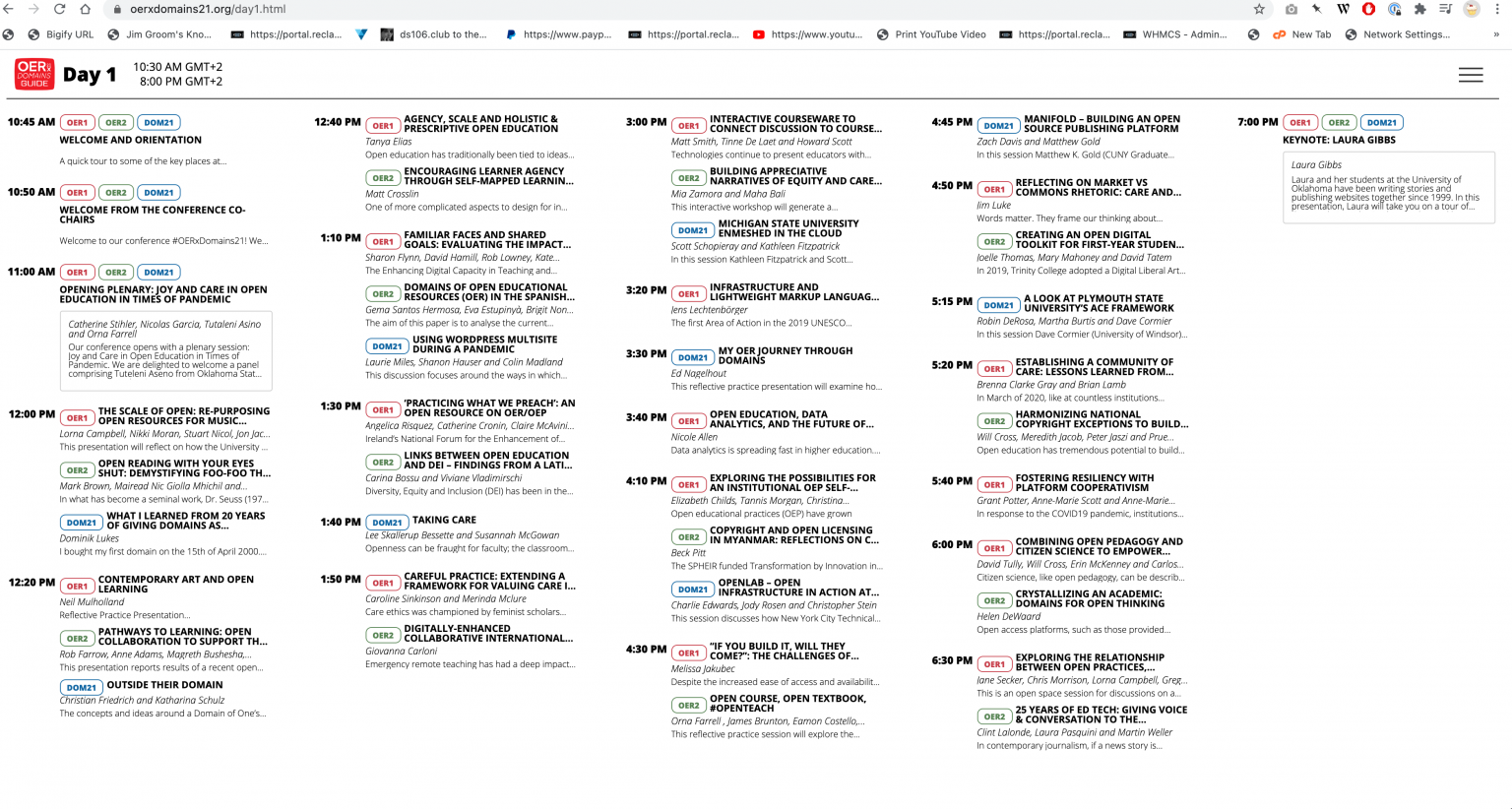
OERxDomains TV Guide
In my mind the success of that conference was directly linked to all the small, half-baked experiments and experiences that led up to it. In fact, the night before the conference officially started we had an OERxDomains21 karaoke session that keynote Rajiv Jhangiani joined, amongst others, and really set the tone for what would prove an amazing two days. It always goes back to the karaoke!
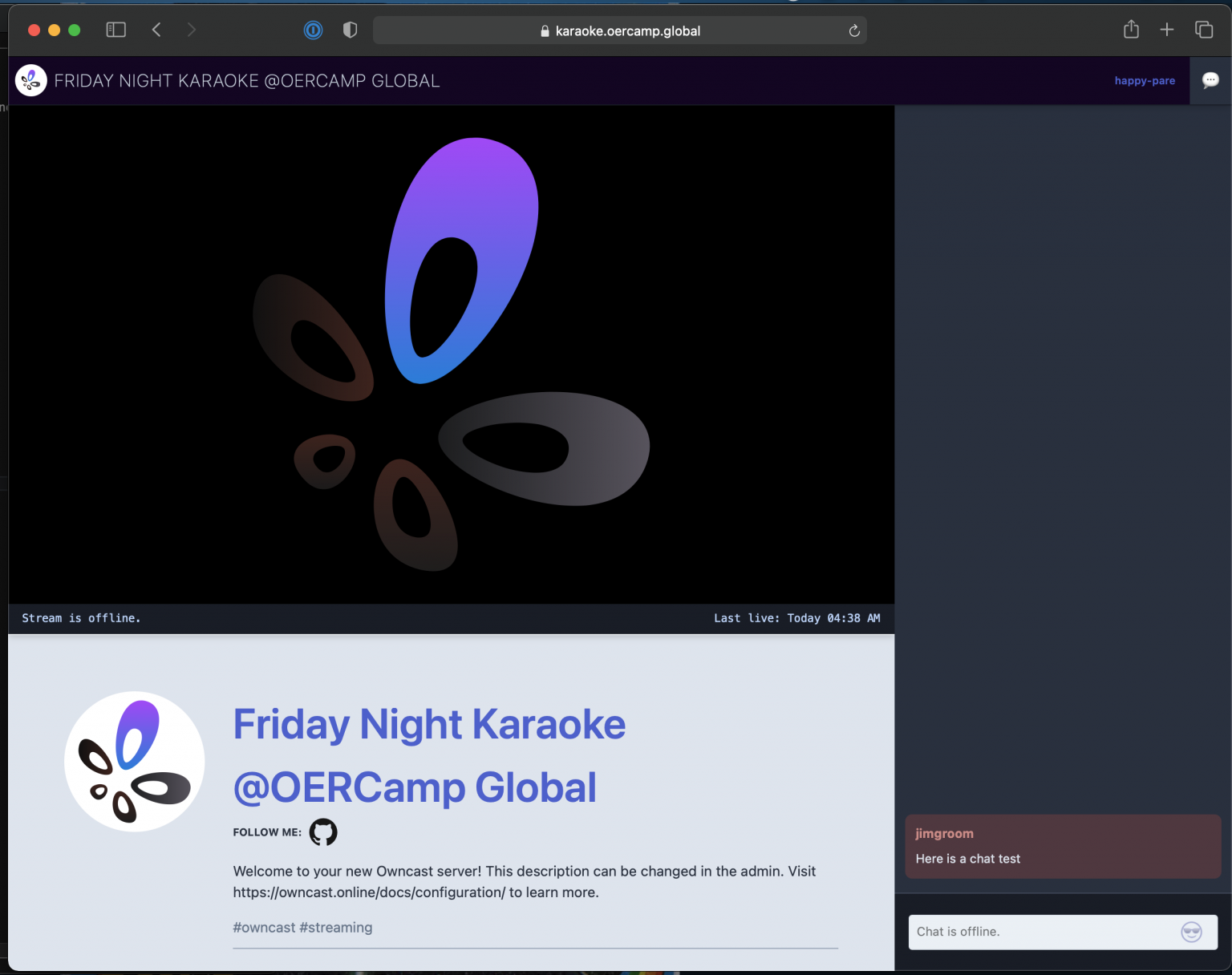
I got another shot at Friday Night Karaoke for the OEGlobal online event in December of 2021. For that setup I used a combination of Zoom and OBS to stream to Owncast, which was the the first non-ds106.tv based karaoke event.† This setup worked quite well given the chat and stream are combined for an integrated homepage. I had them map the URL karaoke.oercamp.global (now dead) to the container, which in retrospect was overkill, but at the same time I was excited by the possibilities of Owncast. In this iteration the goal was to minimize the window complications of Zoom in OBS, to that end singers joined Zoom and everyone else can watch and chat on Owncast. Having everyone in Zoom can create issues with feedback and open mic problems, but the biggest issue for me on the streaming side was how confusing windows in Zoom prove to be, making it hard to focus on just the singer and their shared karaoke video.
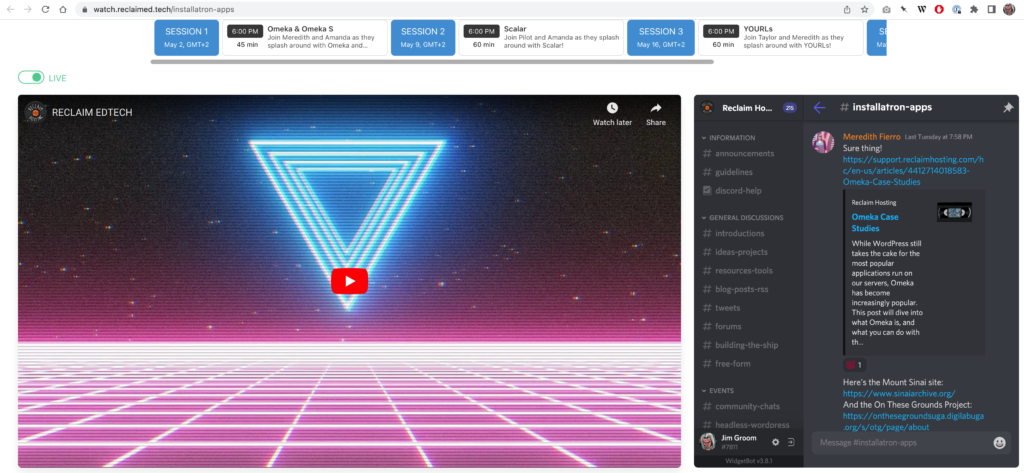
Reclaim Edtech watch site with Discord channel integration
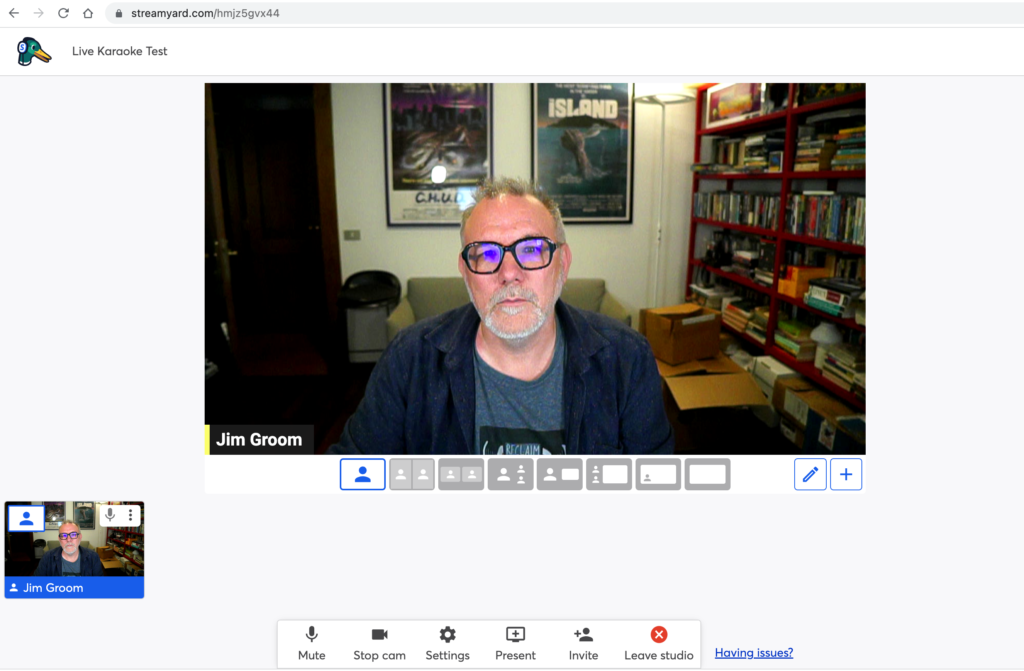
That pretty much gets us caught up to the latest (and greatest!) karaoke setup we’ve been playing with these days. Not surprisingly, the work we’ve done with the watch site for Reclaim EdTech, which was born of OERxDomains21, significantly informed this most recent setup. Chahira and I ran a final test using Zoom, but have since decided we are all-in on Streamyard given it handles the screen sharing with audio just as well. It also removes the need for OBS, which is huge. Another thing I love about Streamyard is when folks enter they’re immediately placed in a waiting room to prevent potential bad actors. And then there’s the way Streamyard uses video templates to make it easy to move between shots while still being able to participate in the fun.
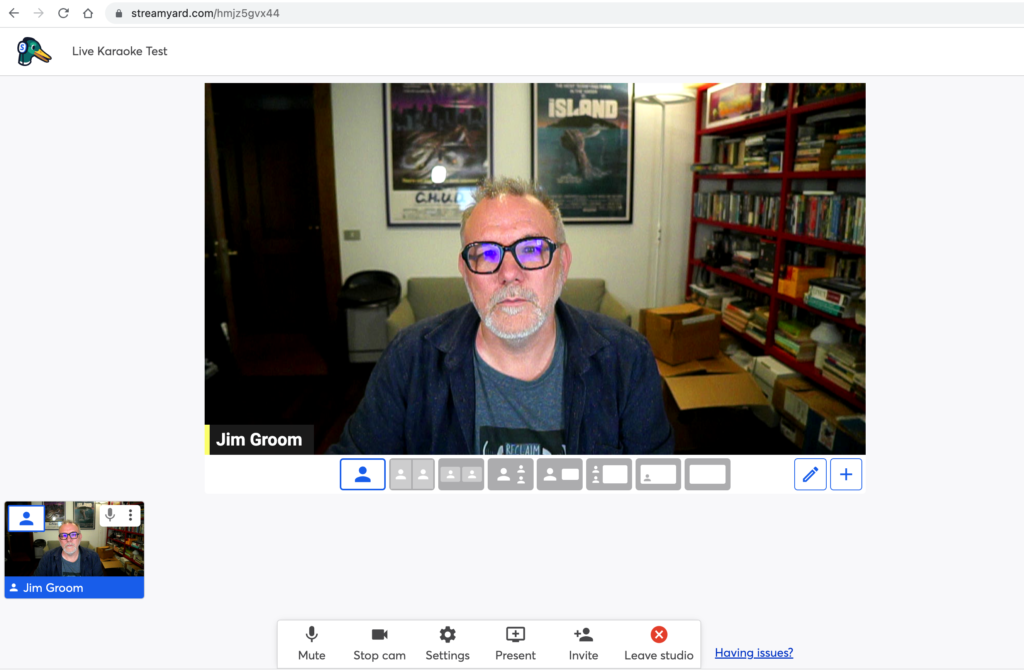
Streamyard interface with shot templates and participants list below the video
Different template layout for Streamyard with two participants and video sharing
With the Zoom and OBS setup I often felt like I needed an additional person just to help manage the video production and streaming—I could never have enough screens. With Streamyard it’s all in one browser tab, which also makes the audio setup simpler than with Zoom.* In short, Streamyard is the bomb.com because it does just enough of what both Zoom and OBS do, making it a more cohesive, streamlined solution.
Another shot layout in Streamyard that allows all additional participants to be placed around the central screen share
For the current setup we have been pushing the karaoke stream directly to YouTube live, which I’ll talk about more shortly. From there, the live YouTube URL is added to a headless WordPress instance that Tom Woodward created as part of OERxDomains21. We have used that same setup for subsequent online workshops like the Domains 101/201 workshop a year ago, as well as all of Reclaim EdTech’s flex courses thereafter. So Reclaim karaoke is yet another page on reclaimed.tech that the domains reclaimkaraoke.com and rockaway.club re-direct to. This also allows me to pull in the chat from the Reclaim EdTech Discord channel that is designated for the Rockaway Club (I decided on Rockaway so I could repurpose Bryan Mathers’ amazing Rockaway Hosting art).
The club metaphor obviously jives with this idea of going to an intentional space to experience something, whether music, film, some fun with friends, etc. This whole two or three year exploration around this setup has focused on “integrating” with tools like Discord, Streamyard, Youtube, or their open source counterparts like Mattermost, OBS, or PeerTube as a mashed-up prototype. The model can be reproduced in all kinds of ways, but I like the idea of trying to tie it all together with a headless WordPress backend that folks can use to quickly generate and schedule sessions that can stream seamlessly to and from a variety of tools. What’s more, we can further design out the TV Guide metaphor MBS already created, which is pure magic. I feel like the pieces are all there to move to some next attempt at integration, but in the interim I’ll karaoke!
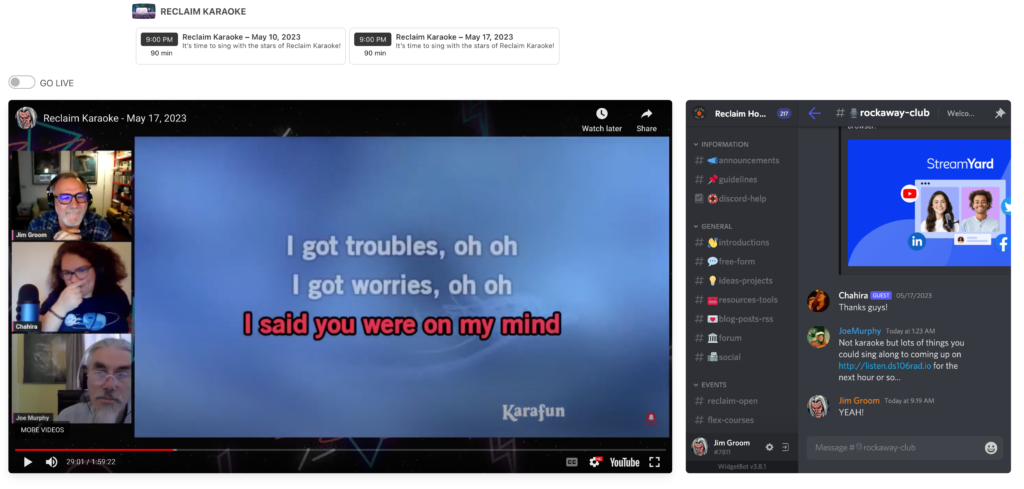
The karaoke setup at https://watch.reclaimed.tech/karaoke
As you can see in the Watch site above, the scheduled karaoke sessions are above the video embed, the Discord channel to the right, and the stream from Streamyard to the left, it is quite tight. When I add a new date with the appropriate YouTube link pre-scheduled, it will automatically go live when the stream starts in Streamyard, it is pretty cool, and live stream comments come through Discord. But this extends beyond karaoke because I was testing this setup out with Olia Lialina for her online keynote for the virtual conference in July, and we both agreed that this setup is good enough for the multimedia she’ll be sharing to discuss 30 years of the web. See, it’s never just playing, the fun matters.
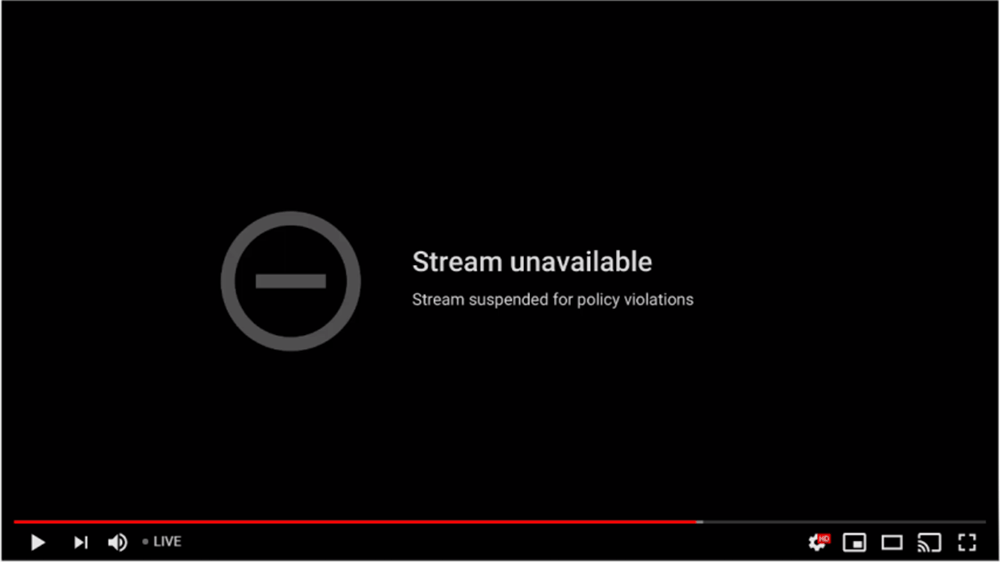
Stream suspended for copyright violations notice from YouTube live
The last piece to discuss here—and it’s pretty important—is the live streaming to YouTube. I’ve been down the slippery slope of copyright controls with video in the past, so I know how that ends. In fact, during our first and second sessions using YouTube live they interrupted the stream based on copyright claims. That means the stream goes off-air until the song is over, and if we were being serious about this for academic sessions where we may need to study culture, an alternative to mid-stream copyright claims is crucial. While right now Streamyard can stream just about anywhere, including PeerTube, the Watch site only embeds YouTube videos, so we would have to re-visit that because PeerTube is a solid substitute. In fact, my whole streaming setup for Antonio Vantagiatto’s The Girl Who Knew Too Much class session was run seamlessly through that platform.
That session worked in large part because of some variation of this setup to share clips, talk over them, and then stream the film for all to watch from OBS and PeerTube. No copyright-driven interruptions from Youtube. The hybrid piece of the class was difficult given I could not see them without cameras in the room, but if it was all setup right—it could be magic. My only regret is using Zoom, but we can fix (or rise above) that Blackboard of the 2020s. In that spirit, the first piece of development would be to get PeerTube to work in the current Watch site, and even abstract that out so any link/embed could work when you schedule something, but that’s another post that Taylor Jadin could write better than me.
Anyway, I guess this post was supposed to be about Reclaim Karaoke, but it turns out to really be about the possibility of integrating the Reclaim Watch site to work with various streaming and discussion platforms to make it less custom. But I’m happy to report that Karaoke (save some YouTube interruptions) works swimmingly with the current setup, but it would be even better with PeerTube for so many reasons.
______________________________
*Given Zoom is a different application you need to ensure audio is pulled into OBS for streaming, suffice to say it quickly gets complicated—but Streamyard simplifies so much of that.
Sorry for the oblique Jaws reference in the title, but I really couldn’t resist given I’m talking about Martin Weller‘s podcast about Metaphors in Edtech—captain Quint himself 🙂 In fact, one of the many joys of OER23 was not only seeing Martin, but that re-connection resulting in an invitation to discuss metaphors of edtech with him.
Martin and I immediately connected over our love of 80s horror films when the edtech blogosphere was still a thing, and I think of him as a kindred blog spirit in so many ways. His crisp, concise writing (that might be where we diverge), his understated wit (again, not a similarity), and his deep love of a good pop culture metaphor (bingo!) all resonate deeply with me. In fact, I think so many of those elements are what make a great teacher, and reading—and now listening to—Martin’s blog reinforces that connection in spades.
So, I figured talking with him about metaphors would be a lot of fun, and that proved true. It’s my inclination to ruin the punchline by over explaining the joke, so for the sake of Martin’s podcast stats I’m going to resist the urge to give a play-by-play and simply say if you like good edtech metaphors and have an inkling for 80s horror films, this might be right up your niche alley 🙂
So after digging in on the streaming for Reclaim Karaoke Tuesday night, I turned to preparing a discussion about Mario Bava’s seminal giallo film The Girl Who Knew Too Much (1963). That discussion happened last night, and it was streamed all the way from a basement in Trento, Italy to a classroom in San Juan, Puerto Rico—the internet still amazes me!Paul Bond and I have collaborated on a couple of sessions for Antonio Vantaggiato‘s Italian Cinema and Culture class back in May of 2020 and 2021. In May of 2020 the Pandemic was still relatively young, and I had just started experimenting with streaming in earnest, so doing that session with Paul for Antonio’s class was a bit of a trainwreck.
Discussion of Bava’s Evil Eye with Paul Bond back in May of 2020
Despite quite a few issues, I think we got our point across. In that session we discussed the U.S. cut of Mario Bava’s The Girl Who Knew Too Much titled Evil Eye, and you can read all about that session in both mine and Paul’s follow-up posts.
In 2021 we changed it up for the course visit and discussed Mario Bava’s adaptation of the comic Diabolik in his 1968 film Danger: Diabolik. Again, there’s a blog re-cap of that session, but the real break-through for me with that session was upping my streaming game from the previous year’s disaster.
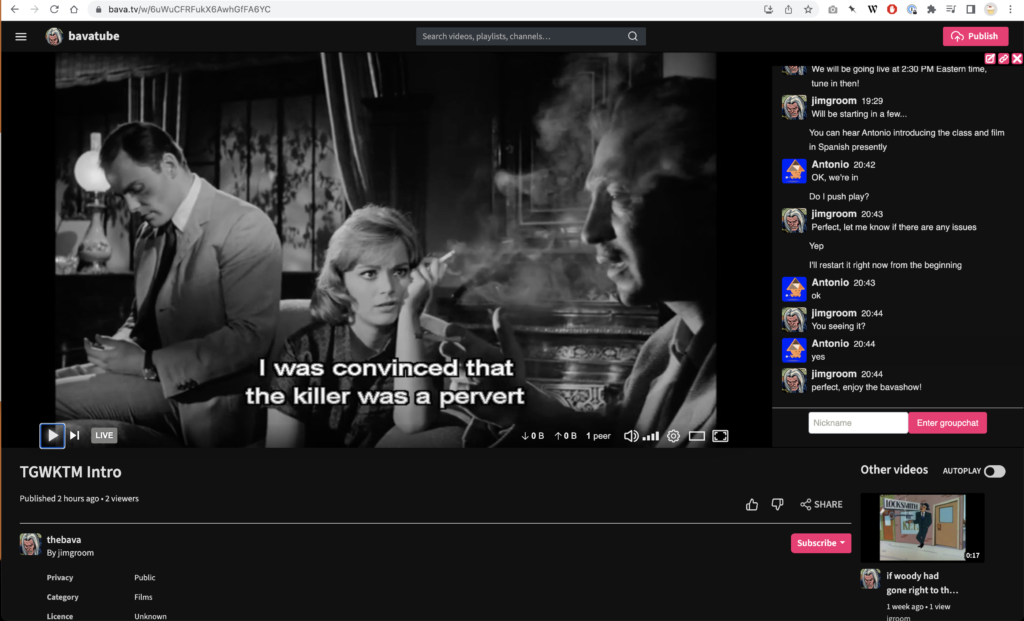
In fact, that’s a good segue into last night’s session because there were a few things different from 2021, most noticeably Paul Bond’s absence. That was entirely on me given I didn’t allow enough time to prepare given relatively short notice, but I’ll fix that next time as he was sorely missed. Another new element is that I used PeerTube to provide a livestream of the introduction, that immediately after the class ended became an instant archive for the talk. I was able to stream both my introduction as well as the entire film for the class in Puerto Rico from my Italian basement, it’s like they were really watching an Italian film from Italy 🙂 probably the best news was that the stream proved quite solid throughout, there was a glitch on the Puerto Rico side a few minutes before the end of the film, but they were able to wait until the stream ended and then published to go back and finish it, which is pretty awesome.
And finally, I think my ability to produce the stream on-the-fly was lightyears beyond my attempt in 2020. And while the 2021 iteration went pretty well overall—especially the addition of OBS Ninja to bring Paul in—I had yet to really play with OBS Studio’s features, which allows for previewing scenes before switching them, which made a huge difference. I really just have to dial-in my green screen and get the Streamdeck programmed in time and I’ll be off to the races given I could have removed myself from the video clips sooner than I did with my current setup, but again it all worked remarkably well considering who was running it!
It still blows my mind that I was simultaneously producing and live streaming an hour-long intro to Mario Bava’s The Girl Who Knew Too Much to a classroom halfway around the world, and then was able to stream the entire film for them seconds later. It was almost quicker than inserting a DVD. All of this made possible by a personal video platform, bava.tv (powered by PeerTube running on Reclaim Cloud). It’s pretty amazing how far all this tech has come, and I really love playing with it for something like this, so thank you Antonio for letting me experiment so wildly and being so cool year after year. You rule!
Film streaming on Peertube with live chat!
And while we did use Zoom to connect, in the end it was somewhat unnecessary given there was no camera on the students and there was no easy way to read the room or interact. The other part of this experience that would make it even better would ensuring the room had a camera on the audience with its own IP address that I could feed into something like OBS Ninja or an ATEM Mini or VLC in order to provide a real sense of interaction. In fact, from my point-of-view having people remotely join Zoom in previous years’ sessions was better than me talking to a room full of people I couldn’t see. That’s the real trick of doing a hybrid presentations/events like this, having a visual of the room and the attendees for remote presenters so there’s a mutual feeling of connection.
Some other streaming notes, I used VLC to create a playlist of clips to talk about during the introduction. I had to remember to pull the audio feed from VLC into OBS through Loopback. Once I resolved that it all worked a treat. I also had Zoom as a source in Loopback to pick up Antonio and the class for the stream. Having separate video and audio for Antonio and the students would have been the cherry on top.
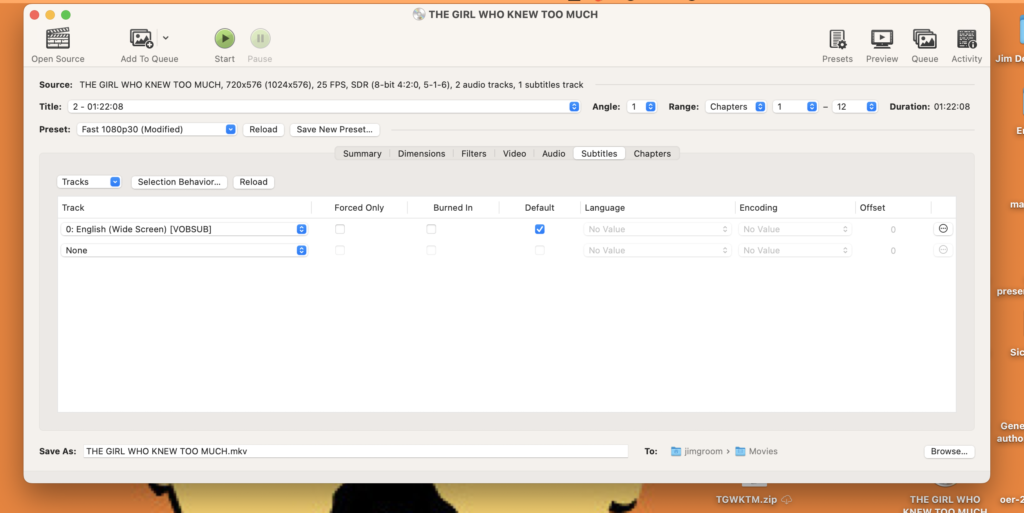
I did finally get Handbrake to make the english subtitles available on the ripped DVD, but it was unnecessarily frustrating. So to avoid future struggles, I’m going to record my solution. I found that selecting a .mkv formatted video with the subtitles track having only “Default” selected was the only combination that worked.
Subtitle interface in Handbrake
All in all I’m happy with how the production came together technically. There is still more to do, but this signaled progress for me. As for my introduction to the film, well that might be worth another blog post, but suffice to say I’m pretty good at getting excited about Mario Bava then parroting what others smarter than me have said to back some of those emotions up adequately 🙂 I mean this is a “b” blog after all.
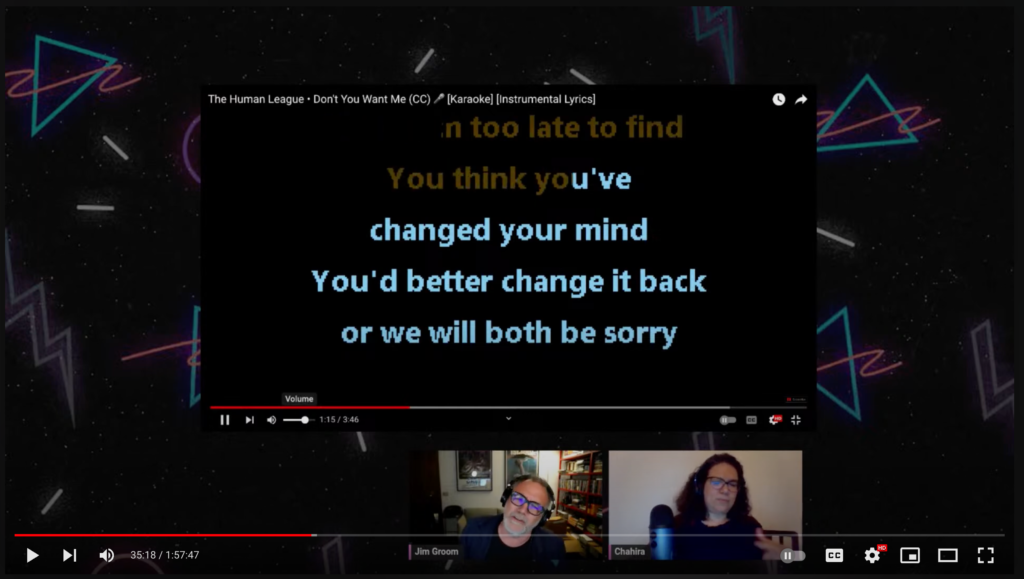
I’m starting to get back into the stream of things after a month of seemingly non-stop blogging. This week I returned to both Reclaim Karaoke and playing a docent on the internet. Doing karaoke on the internet is something I’ve been returning to on-and-off for over a decade now. When I find make some time to do it, it’s really a joy. Luckily Chahira Nouira shares that passion, and we also share a time zone, so she’s been a go-to for karaoke. What’s more, we have finally decided to try and make these sessions a bit more regularly on Wednesday night’s at 9:00 PM CET.
Jim Carey doing karaoke in film Cable Guy
We had our first test of things earlier this week, and as usual with me it was a bit of a mess. But hope springs eternal, and I believe we’re zeroing in on a workable solution. The issue this go around was that we did not have a paid Zoom account, so just as we started getting going around 30 minutes in we had to change gears. The upside of Zoom for Karaoke is they have audio options to turn-off any sound cancellation or automatic adjustments, which is a requirement for doing karaoke online. Once we got kicked out of Zoom for over-extending our 40 minute welcome, we tested karaoke in Whereby—which we do have subscription for. Unfortunately Whereby seems to automatically adjust for competing noises (the karaoke video shared from from YouTube and the singer’s voice), which makes for a less than ideal experience. Given I am doing the streaming I can bypass that compression through the video conferencing app, but anyone who joins to sing will not have that luxury.
So, what did I figure out? That Zoom is still the best bet and I may have to bite the bullet there, but before I do I want to re-visit trying Karaoke in both Streamyard and Jitsi one more time. We have a Streamyard subscription that we use extensively for Reclaim EdTech, and I love how that app manages pre-defined templates; offers a muted waiting area; integrates YouTube live streams; and provides behind-the-scenes chat. It really would be ideal if it could manage sound for musicians like Zoom. And after testing while mid blog post I can confirm it does work quite well! The YouTube videos come in strong, so you have to manage the audio there, but other than that there’s no automatic level adjustments!
Now the other test will be Jitsi, which I can spin up on Reclaim Cloud to test the latest version. When Jitsi works, it works well, but we’ve seen issues with it being a bit demanding for folks with under-powered computers, given it can be a resource hog—we’ll see.
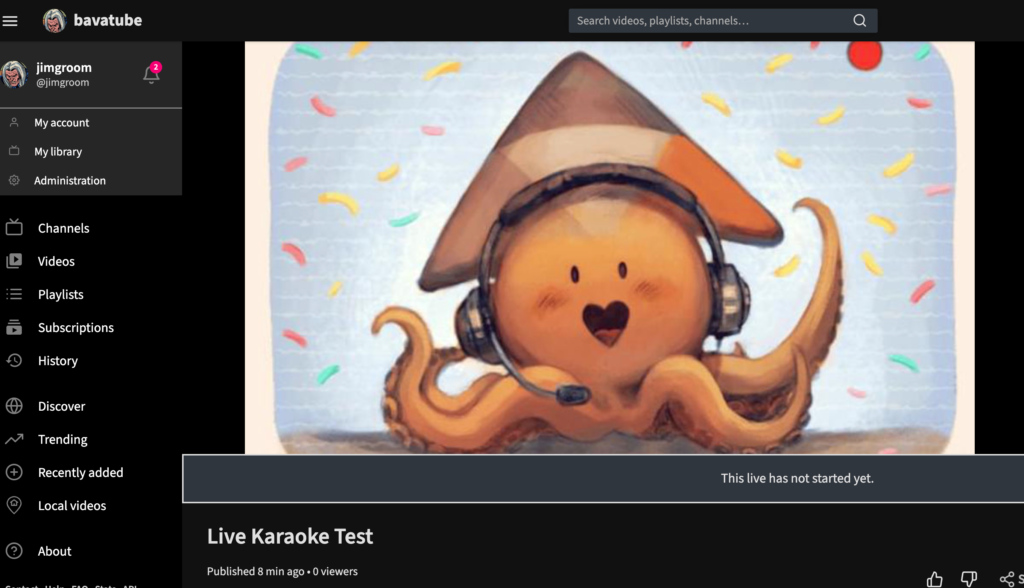
PeerTube Waiting for Live Screenshot
The other piece worth noting in the Karaoke saga is that streaming on PeerTube has been working seamlessly. I like this because I’m worried YouTube will ding us for streaming copyrighted music, even if the karaoke videos we use is from YouTube—they all always are. So knowing we have a more than viable alternative for streaming with PeerTube that offers a constant live URL, integrated chat, an instant archive, etc. is pretty exciting.
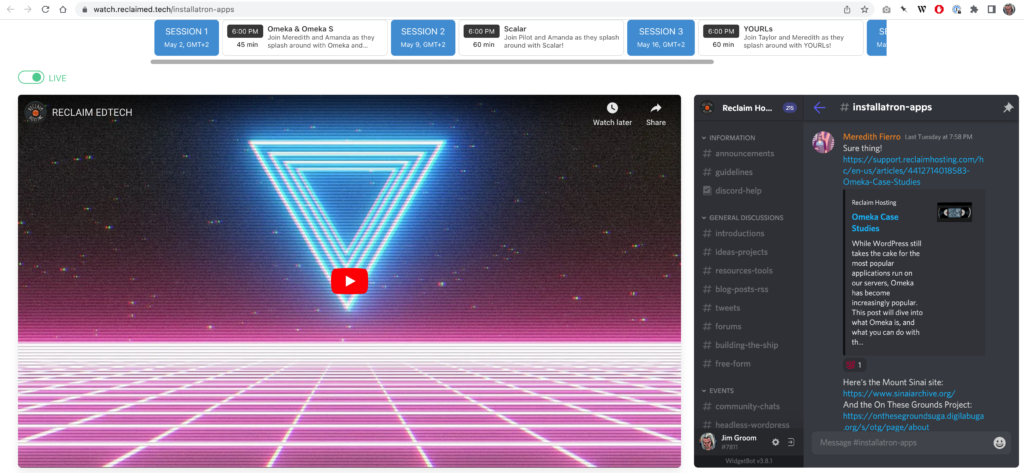
Reclaim Edtech Watch Site for live streams
I’m currently working out how to setup the Reclaim Karaoke PeerTube instance in relationship to the main domain. Leaning towards making the reclaimkaraoke.com a clone of the Reclaim EdTech watch site, which is itself a reprisal of the OERxDomains21 Discord/YouTube integration. I just need to see how/if we can embed a PeerTube live stream instead of YouTube live streams just as easily.
Streamyard dashboard in action
The other piece will be creating a Reclaim Karaoke channel in Reclaim Hosting’s Discord server where live chat for these sessions can happen. While I like that PeerTube and YouTube have chat built-in, a pre-vetted chat for a streaming karaoke session seems more sensible. What’s more, we can share the video conferencing link in that channel for folks to jump in and sing without the same concern of sharing it on other networks.
ds106radio stream of Reclaim Karaoke testing
Oh yeah, and by the way the entire Reclaim Karaoke testing session was also x-cast to ds106radio, and there were no interruptions by pesky apps that cut you off after 40 minutes. So the whole session was both streamed and archive in its entirety there.
This was a test performed on 5/2/2023 to see if Chahira and I could figure out how to get Reclaim karaoke to work seamlessly through Zoom and/or Whereby streaming into PeerTube. The PeerTube side was seamless, but we learned a bit about the limits of both Zoom and Whereby, and more recent tests of Streamyard have proved illuminating in regards to that being a solid alternative.
There are also videos capturing the exploits that I will include here for posterity by obscurity?
First test of Reclaim Karaoke in Zoom cut shortSecond test of Reclaim Karaoke in Whereby
This is the last OER23 blog post on my to-do list, there may be more, but this is the last one I’ve planned. Long live OER23 blogging!
The Industrial Reclaim Cloud Logo from Bryan Mathers
Lauren Hanks and I presented about Reclaim Cloud on the final day of the conference. This was in the afternoon after my “Web 2.0 and Web3 Walk into a Bar…” talk, and I think the two work together quite nicely. Whereas in the morning I discussed the loose federation of blogging that characterized early Web 2.0 and how much of that spirit was present in Web3 tools like Mastodon, this talk focused on how Reclaim Cloud enables folks to more easily install and host many of these next generation tools.
Retro-future art of a container by Bryan mathers
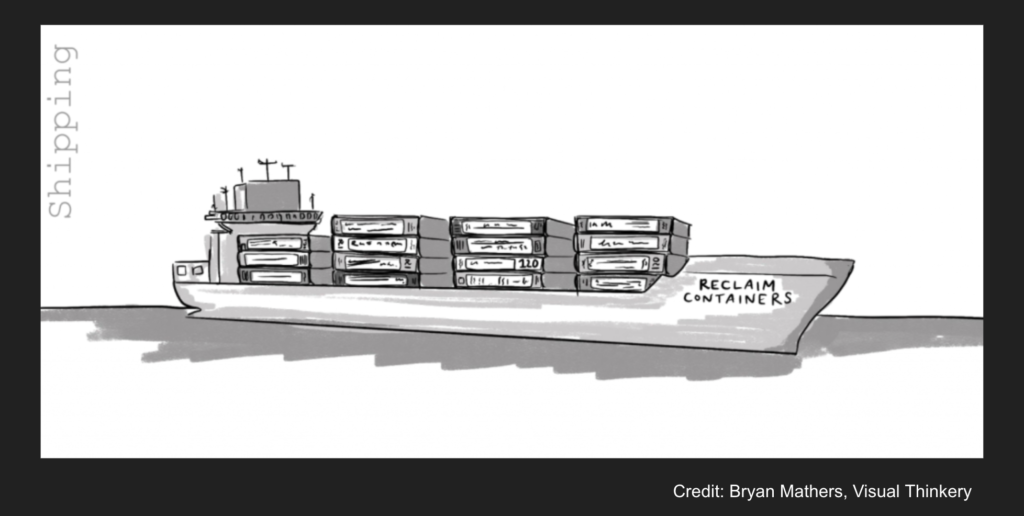
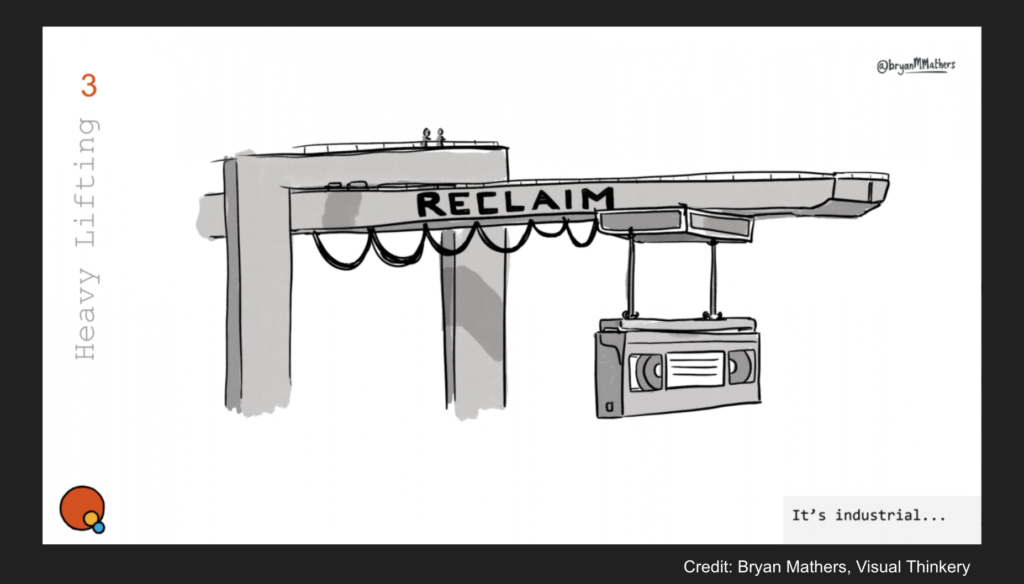
I’ll try and give a basic walk-through of the presentation in a bit, but it’s worth noting here that the break-through for us with this presentation were the following two sketches by Bryan Mathers: “Reclaim Containers” and “Reclaim Container Cranes.” These were images that were part of the original Reclaim Cloud concept artwork. We never did had these fully fleshed out and colored given we wanted to focus on the retro space-age vision inspired by the Jetsons. That said, when putting this presentation together Lauren and I realized that these visual/conceptual aides allowed us to describe clearly and concisely how containerization works.
“Reclaim Containers” by the ever amazing Bryan Mathers
With the ship you can think of that as analogous to the server that delivers a series of containers. In this example those containers are brilliantly visualized as VHS tapes, not only to remain on brand, but also to communicate each is its own product, such as WordPress, PeerTube, Mastodon, Ghost, etc. And I think that provides a visual metaphor you can wrap your head around quickly and easily, something Martin Weller and I discuss at length with the Milton-esque extended nautical simile that is Docker in a forthcoming episode of his indispensable edtech podcast series on metaphors.
“Reclaim Container Crane” by the indubitably wonderful Bryan Mathers
The illustrative power of the “Container Crane” image was not immediately clear to me until talking with Lauren when she noted that this is Reclaim’s role in helping folks understand and manage this new environment. So the cranes in the shipyard help manage and orchestrate these containers, becoming the metaphor for how Reclaim can help with the “heavy lifting” of the next generation of server infrastructure. It all starts to work, and this is something I’ve been banging my head on since 2015 or so. I’ve not been able to adequately communicate the brilliance of this metaphor. Lo and behold, it only took two images from Bryan Mathers for that breakthrough. If nothing else, folks listening to us might now have an apt visual metaphor to make sense of containerization and how it differs from more traditional web hosting. Long live Mathers art!
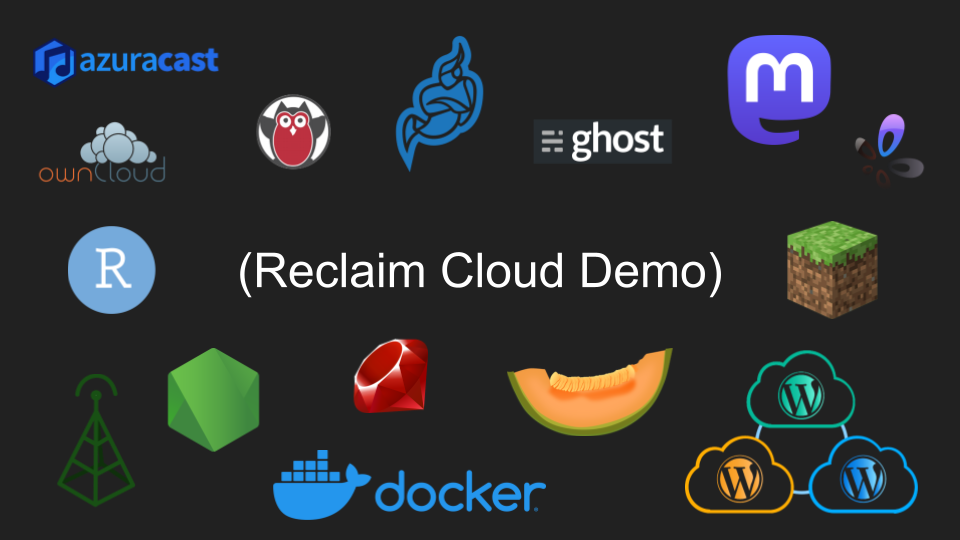
In terms of the presentation, we started with a Demo of the Reclaim Cloud interface and the one-click Marketplace installer.
Levine’s Law: Start with the Demo
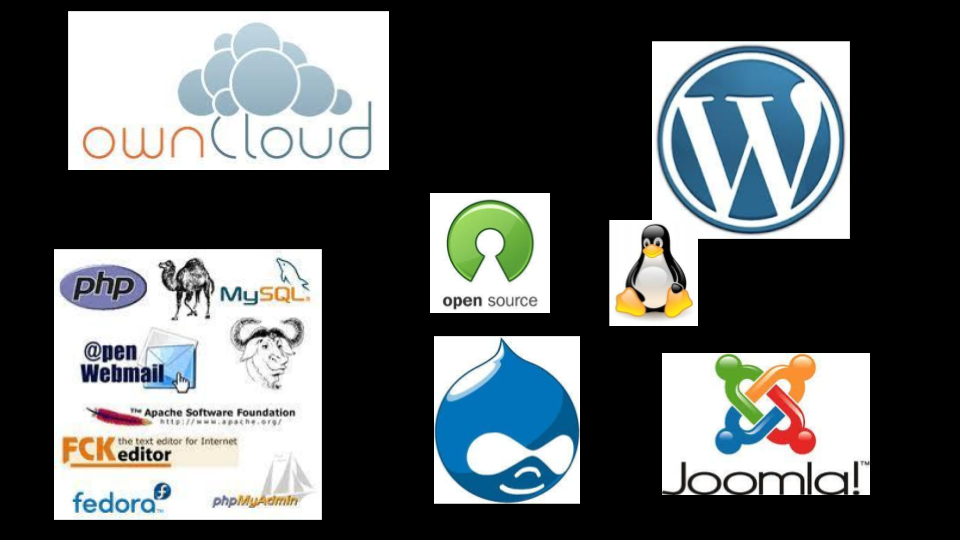
What’s interesting about the above image, is it’s really similar to the image Martha Burtis made for our presentation in 2006 when talking about Fantastico and one-click apps for cPanel hosting in Bluehost:
Derivative slide of the Bluehost experiment
This is not the exact slide from the Bluehost experiment talk, but it’s some derivative version of it that I continued to change and use for years afterwards, and funny how it makes the point, at least to me, that Reclaim Cloud is essentially the next iteration of what we started doing at UMW 18 years ago.
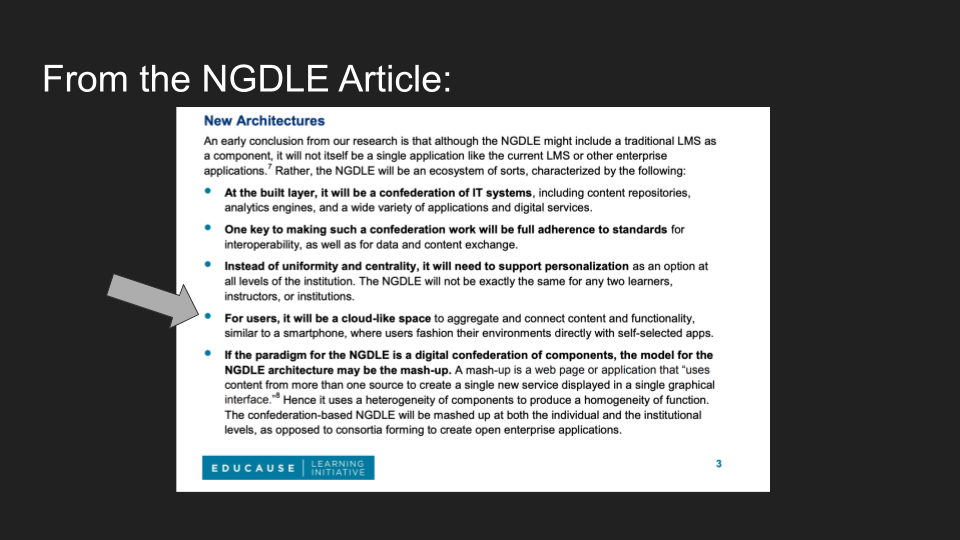
NGDLE: “For users, it will be cloud-like spaces”
Lauren then discussed the idea floated by EDUCAUSE back in 2015 called the Next Generation Digital Learning Environment (NGDLE). It was the promise of a Lego-like structure of applications and components that would be built around the LMS to provide more “personalized” learning and broader access to data, resources, and, most importantly, tool integration. It was also predicated on a cloud-like space for users that define the apps they use for learning. Obviously we felt Domain of One’s Own, just gaining some traction in 2015, was an excellent example of one instance of this vision—just without all the LMS nonsense 🙂
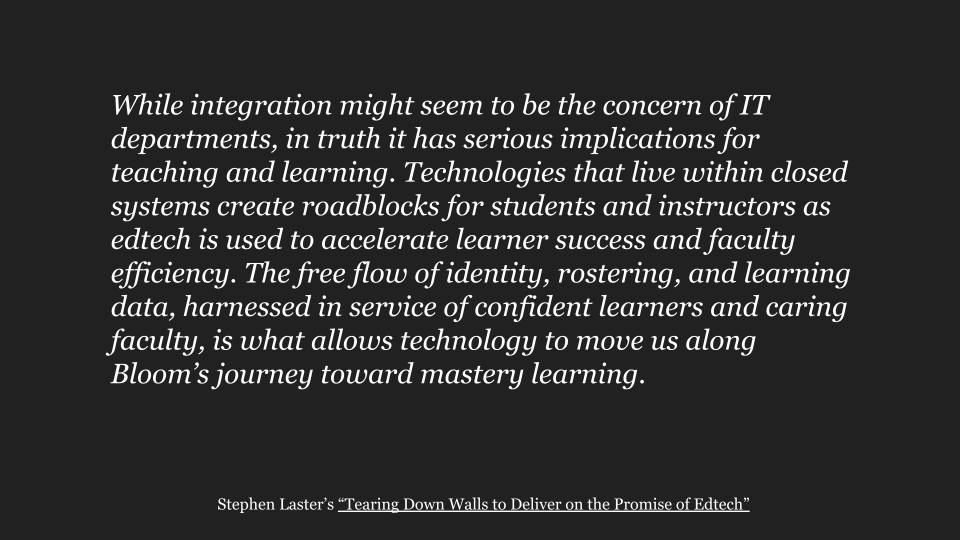
In this regard, the NGDLE white paper was appealing, but the follow-up essays in a special issue in 2017 were a bit more disconcerting. At first the calls for open standards and a general sense of the limitlessness of transparency seemed promising, but it was troubling when these words were written by then Chief Digital Officer for McGraw-Hill Publishing. Stephen Laster‘s call for radical openness when it comes to the “free flow of identity, rostering, and learning data,” which seems more like a free-for-all for student data collection than a thoughtful integration of open tools.
Quote from Stephen Laster’s “Tearing Down Walls to Deliver on the Promise of Edtech”
One of the travesties of the term open has been its seemingly uncontested goodness when it comes to edtech. I’ve certainly contributed to that problem, but when we’re talking about openness of identity and learning data in relationship to students within systems—this sounds more like a plan to make sure those various interested parties gain unbridled access to personal data within the NGDLE. That approach is very much the opposite of vision we have for Reclaim Cloud. While the NGDLE proved an acronym only a mother could love, the idea of collecting student data en masse and ensuring a more invasive and surveillance-ready series of tool integrations did come to bare. And I would argue none of these free-flowing efficiencies have resulted in anything resembling better experiences for students, not to say anything about that laughable metric of “success” in this context. Beware the wolf in open sheep’s clothing.
But despite all the scheming and posturing of companies large and small vying for student data, an open standard around containerization for the web was congealing and the vision of a cloud-based space for students to explore various applications was on the horizon. Docker was a huge piece of this shift. I talked a bit about the shipping metaphor at more length, this time using examples from Marc Levinson’s book The Box: How the Shipping Container Made the World Smaller and the World Economy Bigger.
Marc Levinson’s book The Box: How the Shipping Container Made the World Smaller and the World Economy Bigger.
I also re-used part of the script I wrote for my small piece in the “Understanding Containers” flex-course Taylor Jadin and I ran back in July, and I do think it holds up:
From there we pulled out the container ship images Bryan Mathers created and we could finally hear the “AHA” moment everyone was having 🙂
“Reclaim Containers” by the ever amazing Bryan Mathers
“Reclaim Container Crane” by the indubitably wonderful Bryan Mathers
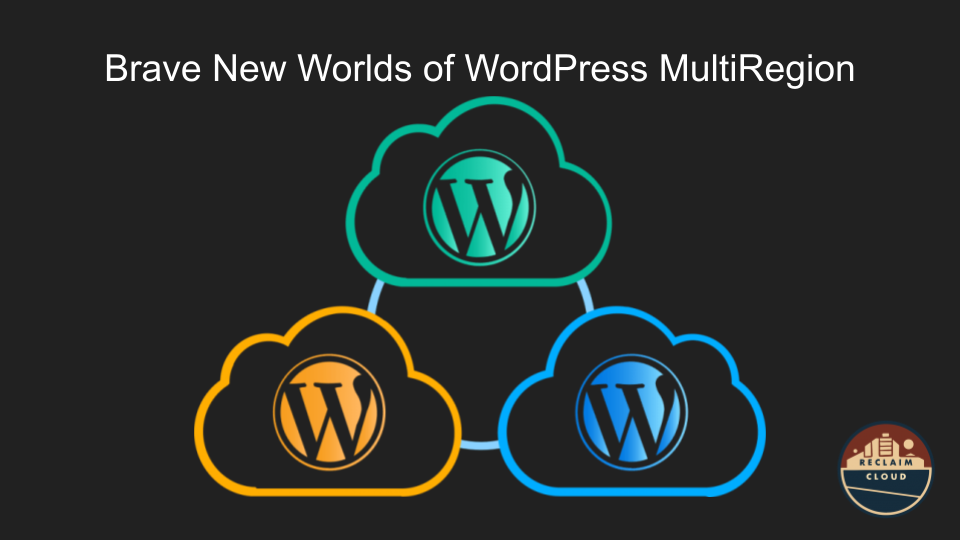
After that we returned to the Reclaim Cloud interface, and hit what I think is another huge point of this presentation. The difference, arguably, between what was happening with Web 2.0 software in 2006 and what is happening with containers in 2023 is that not only can it be a sandbox for edtechs to explore a wide-range of tools that were heretofore unimaginable to run without major infrastructure investments from IT. But, even crazier, any of those sandbox products that hit and gain traction can be seamlessly scaled to enterprise for a fraction of the costs. We used our recent WordPress Multiregion work in Reclaim Cloud to demonstrate this, and I believe this is the other piece of the evolution of this infrastructure over the last 20 years. You not only get a next generation sandbox, but that can seamlessly transition to an enterprise solution that fails over to multiple data centers across multiple regions with automated backups all with a few clicks in GUI interface.
Brave New Worlds of WordPress MultiRegion
I have much more to say about our forthcoming cloud-based WordPress hosting interface, which is quite exciting, but I think this same logic extends more broadly to cloud-based apps well beyond Reclaim Cloud. We’re in a brave new world of infrastructure that allows us to run our own federated social networks akin to Twitter or Facebook with the click of a button, there is some degree of magic to that—at least it would be for 2006 me trying to figure out how to keep WordPress up and running on shared hosting. AVANTI!
is an ongoing conversation about media of all kinds ...
Testimonials:
Generations from now, they won't call it the Internet anymore. They'll just say, "I logged on to the Jim Groom this morning.
-Joe McMahon
Everything Jim Groom touches is gold. He's like King Midas, but with the Internet.
-Serena Epstein
My understanding is that an essential requirement of the internet is to do whatever Jim Groom asks of you while you're online.
-James D. Calder
@jimgroom is the Billy Martin of edtech.
-Luke Waltzer
My 3yr old son is VERY intrigued by @jimgroom's avatar. "Is he a superhero?" "Well, yes, son, to many he is."
-Clint Lalonde
Jim Groom is a fiery man.
-Antonella Dalla Torre
“Reverend” Jim “The Bava” Groom, alias “Snake Pliskin” is a charlatan and a fraud, a self-confessed “used car salesman” clawing his way into the glamour of the education technology keynote circuit via the efforts of his oppressed minions at the University of Mary Washington’s DTLT and beyond. The monster behind educational time-sink ds106 and still recovering from his bid for hipster stardom with “Edupunk”, Jim spends his days using his dwindling credibility to sell cheap webhosting to gullible undergraduates and getting banned from YouTube for gross piracy.







 But despite all the scheming and posturing of companies large and small vying for student data, an open standard around containerization for the web was congealing and the vision of a cloud-based space for students to explore various applications was on the horizon. Docker was a huge piece of this shift. I talked a bit about the shipping metaphor at more length, this time using examples from Marc Levinson’s book The Box: How the Shipping Container Made the World Smaller and the World Economy Bigger.