WPMu Sitewide Comment Tracking

I have been mentioning DSader a lot lately on this blog, and that’s mainly because I have been deep into WordPress Multi-User mode for a couple of weeks now. And between the upgrade to 2.6 and the general overhaul of plugins, themes, etc., I find I’ve devoted no insignificant amount of time to plugin hunting –a truly enjoyable activity. For many of my most valuable WPMu plugins, I continually find I am utilizing DSader’s work. He wrote the following plugins that I can name off the top of my head: Userthemes (a must), Sitewide “Three-in-One” Multi Widget panel, Toggle Admin Menus Sitewide, and the indispensable More Privacy Options, to name a few.

So, there is no question DSader has been a veritable mensch when it comes to sharing with the WPMu community, and I’d like to say thanks. But before I even can he comes out with an updated version of his Sitewide Comment Tracking plugin for WPMu that reminds me just how deeply indebted I am to his work. If you haven’t tested it, I highly recommend it. It tracks the comments you have left on numerous blogs within the WPMu community. So, for example, If I leave comments on various blogs, I can track them from the Comments–>My Comments tab. It provides an awesome interface to quickly scan where you’ve commented and who has responded, an amazingly powerful feature for a controlled, yet deeply distributed architecture like WPMu.

Here’s what it looks like:

DSader's Sitewide Comment Tracking plugin for WPMu

DSader's My Recent Comments plugin for WPMu

Think about it, this is an amazing way to let faculty and students know how they can track response to their comments easily, something which isn’t all that easy in the regular blogosphere. So an engineered improvement to make the community potentially more manageable.  And so many of DSader’s plugins are just like that, it’s as if he were programming for UMW, he comes from an educational setting and it’s amazing how many of our needs and desires are met and satisfied by his work

Update: While writing this I received an email from him telling me the Sitewide 3-in-1 Widget panel has been updated, with a bug or two fixed, Is DSader sick or what? What can I say, it’s people like him that make this whole thing so much funner and cooler. Thank you, thank you, thank you!!!

Posted in Uncategorized, widgets, wordpress multi-user, wpmu | Tagged , , , , , , , | Leave a comment

Speech, YouTube, and WordPress

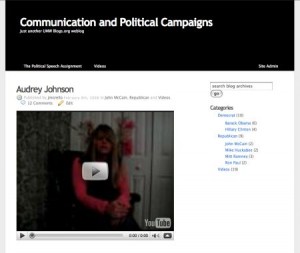
Last semester, Professor John Morello’s “Communication and Political Campaigns” class did something interesting with UMW Blogs. Rather than thinking of the class blog as a semester long activity for writing and reflecting (which is always good), he used it for one specific assignment. The blog provided a space where students could upload, categorize, and receive feedback on their own recorded “surrogate speeches” that support one of the various candidates for the then upcoming Virginia Primary.

John Morello's Speech 311 Video Site

John Morello's Speech 311 Video Site

Keeping in line with the small pieces loosely joined philosophy, all the speeches were uploaded to YouTube, and then embedded in a post on the class site. What you have is not so much a blog as it is a broadcasting engine where students can easily post media and receive feedback from the class.

I want to stress the fact that John is not at all seduced by the shininess of the tool or sermons about technology as the future of education, being UMW’s debate coach for many a year he could easily dismantle anything resembling an argument I tried to throw his way. Rather, I think he uses it because it’s straightforward, handles embedded video seamlessly, and provides an easy way for students to aggregate, organize, and comment on videos without completely relying on a decentralized tool like YouTube. UMW Blogs is just the publishing framework it all fits into.

Posted in experimenting, YouTube | Tagged , , , , | Leave a comment

Virgil, Blabberize, and 50 Ways to Applaud CogDog

This Summer I had the good fortune of working with professor Angela Gosetti-MurrayJohn and the students of her “The Classical Tradition” course. I would like to say I came up with some original and elaborate EdTech scheme to change the world through mediated mean, but I didn’t. However, Angela did by pushing her class to explore a variety of digital tools for relating their work. And I just happily obliged by pretending to be a dog, and barking about 50 ways you could present a digital story with free Web 2.0 tools.

During the session where I talked to the class about these tools, I channeled Alan Levine’s presentation on the 50 Ways resource that he gave at Northern Voice 2008—which was a gem. I found myself laughing hysterically when he went to the Blabberize homepage and showed the Llama speaking with a thick, comical Indian accent. It stuck with me, so I tried it out on this group and lo and behold everyone was laughing hysterically and I felt good. Nonetheless, I still wrote Blabberize off as a pretty useless tool, and went on to my own personal favorites once I had their attention like YouTube, VoiceThread, VuVox, FlickrSlidr, etc.

So when I saw a group from the class that was working on the theme “War in the Aeneid“ and had incorporated Blabberize effectively into their web-based, thematic readings of The Aeneid and war, I was intrigued.  Here it is below, featuring none other than Vergil himself:

Now, that is an entertaining and intelligent use of this seemingly silly technology to set the stage for a dynamic, media-rich site dedicated to The Aeneid. What’s more, this group utilized a number of embeddable resources from YouTube and Comiqs to highlight and contextualize their presentation while at the same time enriching their own readings. Alan’s 50 Ways is the resource that keeps on giving and, as an added bonus, just about every tool that has embed code available works with UMW Blogs, making it the Web 2.0 Digital Storytelling publishing platform par excellence 🙂

Posted in digital storytelling, experimenting, UMW Blogs | Tagged , , , , , , | 1 Comment

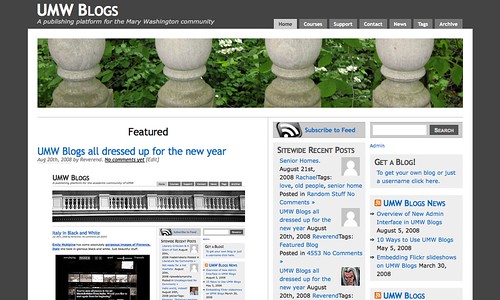
New digs for UMW Blogs, or the anatomy of a redesign

UMW Blogs has got a brand new bag, with no small assistance from Andy “EDU” Rush nation who turned me on to the beautiful theme PrimePress (Andy’s the go to theme guy without question), along with Serena Epstein an Jerry Slezak who provided the gorgeous header images featuring the UMW campus. The redesign took a couple of days with some on and off work, and before I get into the details of that, I wanted to take a quick poll. PrimePress offers you two different looks, and I wanted to know which one people preferred.

Here is UMW Blogs with the gray background:

UMW Blogs with Gray Background

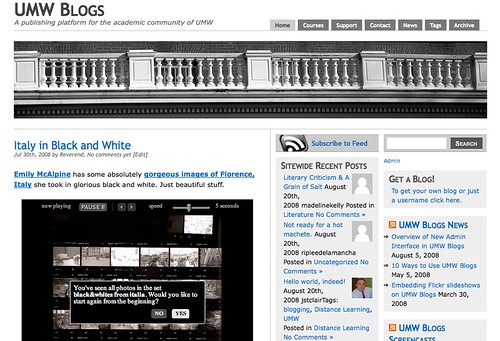
And here it is with the white background:

UMW Blogs with white background

Which of the above background colors do you prefer for UMW Blogs: gray or white?

View Results

Loading ... Loading ...

Now for the anatomy of the redesign of UMW Blogs. I have to say that a year ago this time I had spent many a long hour trying to get everything working on the front page of UMW Blogs. I blogged the process for creating the front page here, and talked extensively about the elaborate hack to get sitewide tags and a sitwewide archive working here.

This time around, my life was significantly easier, and I think that’s a testament to how far the WPMu community has come over the last year. It never ceases to amaze me how folks like Donncha, D Sader, andrea_r, Andre Malan, and Enej Bajgoric (amongst many, many others), have made the creation of a state of the art publishing platform for Mary Washington elegant, simple, and powerful as hell. These are people that have little or no affiliation with UMW, but have nonetheless enabled truly cutting edge publishing possibilities for little money and even less programming know how. I love the whole thing.

The Home Page

The homepage for the redesign really captures just how much easier things have become, and also points to some necessary re-aligning of plugins, resources, and syndication. For example, the previous version of UMW Blogs front page was almost entirely driven by the BDP RSS plugin for aggregation, in this iteration it has all but disappeared. I am keenly aware that the developer for this awesome plugin hasn’t updated it in over a year, and while it still works swimmingly in version 2.6 (a testament to the solid coding), I’m not sure how much longer it can hold out. So I’m afraid it’s high time to try and move on. That’s where two plugins I have already blogged about recently have allowed me to transition away from BDP RSS with little or no separation anxiety: Donncha’s Sitewide Tags plugin and D Sader’s “3-in-1” widget.

Between these two plugins I can have the 10 most recent sitwewide posts, a sitewide tag cloud, and a sitewide archive all on the front page sidebar. These features would have been impossible for me last year, and now it is as simple as two plugins and a customizable widget. Moreover, Donncha’s Sitewide Tag goodness single-handedly powers the Recent Posts, Tags, and Archives pages of UMW Blogs that I will get to in more detail below.

As I mentioned already, PrimePress is the theme, and the header images are homegrown. The login is a little bit of PHP code Patrick Murray-John whipped up, and you can download it here and drop it into your sidebar should you need it.

Finally, the blog that powers the UMW Blogs homepage will be the site we use for the feature articles that chronicle and share the activity, cool blogs, and course projects that are happening throughout the UMW community.

Courses, Support, and Contact Pages

The Courses page is pretty straightforward, and it is going to be a directory of courses being hosted on UMW Blogs that will be up and running by Monday. I have some idea of how I am going to feed this stuff in, but for the most part it will be relatively traditional directory of courses being taught around campus using this publishing platform, but I have some more thinking to do here–any recommendations?

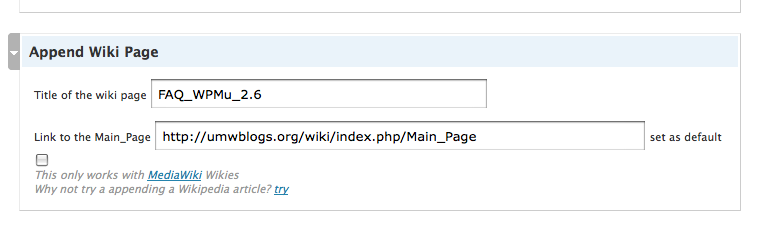
The Support pages are awesome, and this marks for me one of the most significant leaps forward over the last year. Namely, the Bliki has arrived people! And that is thanks to the awesome work of Brian Lamb’s UBC rat pack of developers like Andre Malan and Enej Bajgoric. They are working on integrating MediaWiki and WPMu as a kind of symbiotic distributed publishing framework, which Brian talked about in his screencast here. The fruit of this syndication rich framework has made my life a million times easier thank to Enej’s plugin Wiki Inc, which basically takes an article from a MediaWIki installation and republishes it seamlessly on a WordPress page. So, all the documentation for UMW Blogs done in MediaWiki can now be effortlessly pulled into a page on the home blog for UMW Blogs. So support pages like the FAQ, WordPress Guide, and “10 Ideas for Using UMW Blogs” are all MediaWiki articles posing as blog pages—bliki bling bling!

Wiki Inc Plugin for WordPress

Wiki Inc Plugin for WordPress

And then there is the Embed MediaWiki Sections plugin that allows you to copy and paste a section of a wiki article into a blog post or page, kinda like YouTube embedding for MediaWiki content. I played with this one a bit earlier in the Summer, but haven’t got back to it yet. Not sure if all the bugs are out, but I’m convinced this will make things insanely interesting for the holy grail of the Bliki.  All of which is just another name for a distributed publishing framework that can be collaborative, simple, and polished all at the same time. Disco!

The Contact page is the Dagon Design Secure Form Mailer plugin inserted in a page, simple, secure, and customizable.

News, Sitewide Tags, and Archives

The News tab on the Front page links to the UMW News Blog, which is actually a separate blog from the home blog (http://news.umwblogs.org) which gives it a separate feed, and a simple way to pull in the RSS feed for News into the home page sidebar without it interfering with Feature articles. The trick to making it integrate seamlessly is just dressing it up in the same theme with the same widgets.  And once you hack the navigation menu to match that on the homepage of UMW Blogs, it’s done. Pretty simple.

The Sitewide Tags tab also links out to another blog, which is actually the blog that is automatically created through Donncha’s Sitewide Feeds plugin, I already mentioned earlier. This blog/plugin also changes the game in my mind, and it provides everything from sitewide posts, tags, categories, and archives in one fell swoop. It rules, and I simply dressed this site up in the same theme as the home page, and hacked the navigation menu accordingly. Moreover, if you go to the front page of the tags.umwblogs.org blog you’ll see the most recent post, which on the front page has been substituted with featured blogs. The Tags tab is just a page on the tags.umwblogs.org blog that has a Simple Tags tag cloud running, which will by default collect all the tags from around UMW Blogs, as well as provide a working feed for each tag (major possibilities here!).

The Sitewide Archives tab does much of the same thing, but this is just using a hacked version of the archive template for PrimePress that will allow people to search all of UMW Blogs, see posts archived by month (or day or year), as well as the last 100 posts that have come through the system.

And voila! That’s it! All the hacking and kludging I had to do last year has been replaced by clean and elegant solutions that make this years model a step up indeed.  We couldn’t have done it without the community, so a big thanks to all of you making WPMu about as bitchin a publishing engine as I’ve seen.

Now, the semester is poised to start, and it’s time to make this baby sing with 1500 new blogs.  Let’s get ’em!

Posted in UMW Blogs, widgets, wordpress multi-user, wpmu | Tagged , , , , , , , , , , , | 19 Comments

WPMu “3-in-1” Widget: Tags, Recent Posts, and Archives

I already mentioned that Donncha’s Sitewide Tags plugin was going to make a whole lot of things much, much easier.  Well, DSader wrapped all the awesomeness into one bitchin’ plugin for WPMu: Sitewide “three-in-one” Multi Widget Panel. I discovered it through James Farmer’s WPMU.org (already proving an invaluable resource) and I just had to test it out. Lo and behold, it works like a charm as long as you remember to install Donncha’s Sitewide Tags plugin.

What’s more, DSader notes that this plugin can also be edited to…

pull from multiple blogs by editing one line of code ("clones" the widget output while applying the same widget control options to each clone):

`$featured_blogs = array($options['blog_id']); // Clone multiple panel outputs such as ...
// $featured_blogs = array($options['blog_id'],3,354);`
(inspired by http://dailytestimony.net/plugins/)

In other words, there may be a way to select a specific number of blogs from a WPMu installation that can be fed into a specific tag cloud. Now this would be an awesome plugin in and of itself, for it could provide a way to aggregate tags for a series of distributed student blogs for a course, which could then be presented back on the mother blog as the course tag cloud. Something similar to what I was imagining way back when in this post.

Anyway, awesome work fromDSader and if you're itching to see the plugin in action, I have it running on UMW Blogs already 🙂

Posted in wordpress multi-user, wpmu | Tagged , , , , , , , , , | 5 Comments

WPMu Subdomain Mapping

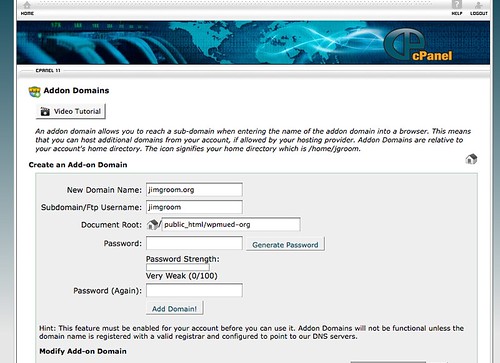
As a follow up to my last post, I also tested out mapping subdomains with CPanel on a WPMu installation using Donncha’s Domain Mapping plugin. And surprise, surprise, just about the same method works for mapping just a subdomain to a blog on WPMu. To clarify, when I say mapping just a subdomain I mean mapping just one part of a domain, rather than the entire domain. For example, I don’t want the domain jimgroom.org to only host one WordPress blog because I plan on using this domain name for other things like a MediaWIki or even a Drupal installation 🙂  So, all I do is create a subdomain such as blog.jimgroom.org and map that to a blog on my WPMu installation.

Assuming the domain is already pointed to your host and you are using CPanel like me, just create the subdomain and point the document root to your WPMu installation. In the following example I added a subdomain blog to jimgroom.org and then pointed it to my WPMu installation using the Document Root field (which is at public_html/wpmued-org for my personal installation).

After you do this, you can map subdomains for all your favorite domain names to one WPMu installation and save yourself the headache of updating numerous blogs on numerous domains that need numoerous updates and themes and plugins and whatnot. One installation to rule them all!

Posted in wordpress multi-user, wpmu | Tagged , , , , , | 2 Comments

WPMu Domain Mapping Plugin on CPanel

Well, I have written a bunch about domain mapping on WPMu over the last year or so. Up and until tonight I have been using Richard Bui’s tutorial here along with David Dean’s Multi-Site Manager Plugin. The combination of the two have worked great for me thus far, and I liked that with this combination each mapped domain could act like its own, stand-alone WPMu install—with each domain have the possibility of unlimited dynamic subdomains—a feature I’m not so sure is available with this plugin. That said, you did have to be brave enough to muck around in the database.

Well, that was then, this is now. Donncha just released a plugin that brings domain mapping for WPMu to the masses in the form of a simple, easy-to-use plugin. Is Donncha on a roll or what? Last month it was the Sitwewide Tags Plugin (though it’s much more than the name suggests) which kicks major ass. This week it is the Domain Mapping Plugin, which is for many the Holy Grail for WPMu admins.

So, I just got around to testing it out on a WPMu install that uses [[CPanel], and it is actually pretty painless, though not entirely automated. Keep in mind this will only work for installation that have sub-domains setup, no love for sub-directories just yet.

Here is how I got it to work with CPanel:

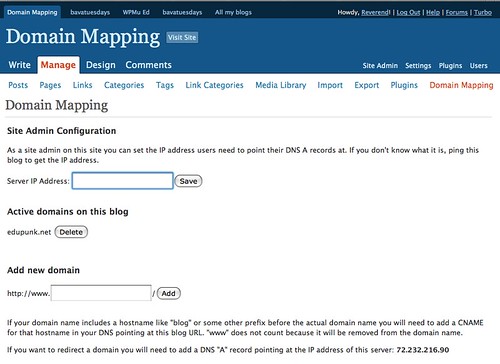
After you install the plugin you will find the Domain Mapping subtab under the Manage tab. Once you go there you will see the following:

Image of Domain Mapping Tab

Domain Mapping Subtab

The logic here is simple, each WPMu blog will have access to this subtab once the plugin is installed. If someone has a blog on your system and they have a domain they want to map, they would need to do two things:

1) From where ever they purchased their domain, they would need to point their domain to the nameservers of the WPMu install. For example, if your WPMu install was hosted on Bluehost, they would need to point them to NS1.BLUEHOST.COM AND NS2.BLUEHOST.COM.

2) After that, they will need to go tot the Manage–>Domain Mapping tab and specify the IP address of the WPMu site and have them put in their domain. (You can decide how you want to share the IP address with them.)

That’s it on their end, pretty simple. But on the admin end there is one more step if you are using CPanel.

You need to create an addon domain for the mapped domain and point it to the directory with the WPMu installation. For me it looked like this:

Add Domain Trick in Cpanel

Add Domain Trick in Cpanel

You can see that the domain is added normally, but the document root is changed to point to the actual directory with the WPMu installation. After that, it works like a charm. Now, this was simple and awesome, and for folks who aren’t using CPanel it will probably work automatically once someone points their domain to the correct IP address. But with CPanel there is one extra step, and while a relatively easy one, it does rule out strict automation of the mapped domains. But, th upside is that at the end of the day even I can map domains with out hacking Apache settings or putting our WPMu install in imminent danger. Disco!

So, can UMW Blogs map domains now? Well, I gues we can now, can’t we 🙂

Posted in plugins, wordpress multi-user, wpmu | Tagged , , , , , , , | 12 Comments

The New Bava Beverly

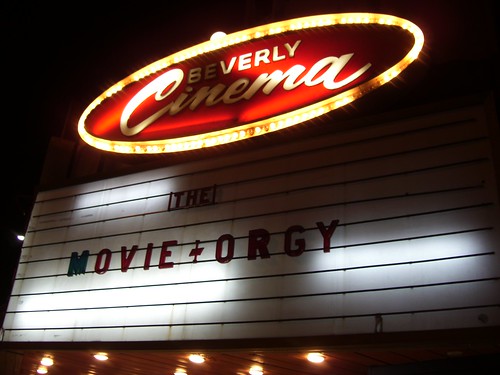
The Movie Orgy at New Beveryly
Image courtesy of Robjtak

Los Angeles is a fine town. I lived in its tepid embrace for over seven years, and I have to say it was probably seven of the best film years of my life. I think I saw as many movies in that time span as the occasional film viewer sees in a lifetime, it was a non-stop love affair. I met a ton of great people who were extremely knowledgeable about film, truly loved the medium, and enjoyed talking, and eventually arguing, about movies. That’s my kind of town. And while I often compared LA to New York while I was there—let’s face it NYC owns LA when it comes to Pizza and baseball—when it comes to film there is no comparison: LA kicks New York City’s ass up and down Hollywood Blvd. Enough said.

The theaters in LA are probably the best in the world, and the fact that there are still so many pristine single screen film houses standing is one of the great rewards of being the center of the movie industry for almost a century. Just thinking about Mann’s Village Theater or Mann’s Bruin Theater, or my personal favorite in Westwood Mann’s National Theater makes me long for yesteryear. There was also the Majestic Crest Theater in Westwood that was independently owned and had a full blown constellation on the ceiling you could watch shine before the feature started (it even had shooting stars that raced across the artificial sky).

And then there’s the Cineramadome in Hollywood that captured the magnificence of 70mm films like no other theater can. Of course you can’t forget Mann’s Chinese (where I saw the re-release of the original Star Wars trilogy with the unnecessary effects) and El Capitan theaters in Hollywood amongst many others. It is a veritable moviegoers mecca. What does NYC have in comparison? The Angelika? Please, that may be the single worst theater in the US, not only does it signify the downfall of that great city to shallow cafe culture and style, but it’s screens are tiny and the subway rumbles through the entire film like a bad bass line. The Film Forum is a little better, but not much. The only place to see a movie in NYC is the BAM in Brooklyn, and while I love that movie house to no end, it has nothing on even the lesser theaters in LA in terms of ambiance and single house heaven, but it does have the most innovative and exciting film programming I have ever seen in either NY or LA (and it’s film programming that this never ending post is really going to be about). But, when I really think about it, I’d have to say my all time favorite theater in LA is the Nuart, it is by no means the best theater in LA but it just reminds me so much of the Century’s Baldwin theater up the block from my house while growing up. The two don’t necessarily look alike, but they had the same candy (Dots!) and popcorn, and when I would sit down in a seat before a movie at the Nuart I felt strangely like I was home again at the Baldwin, even though Thomas Wolfe assures us we can’t ever go back there again—and I believe him because boy did he ever try and get back in his novels.
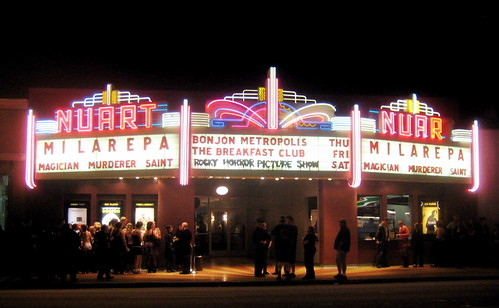
Image of the Nuart Movie Theater in LA
Image courtesy of MV Jantzen

Ok, but that is a long-winded way to introduce this post which has been brewing in my mind ever since I read this post at Joe Valdez’s The Distracted Globe (he watches and writes about a ton of great films) in which he was partaking in the 12 Movie Meme started by Piper at The Lazy Eye Theatre (a very fun movie blog). The logic is pretty simple, yet it struck me as quite brilliant: if you were asked to choose a sequence of 12 different double features at the New Beverly Cinema in Los Angeles what would they be? This is an extra special find for me, because I lived about three blocks from this theater for almost two years and saw many a great double feature there. And while the seats were some of the most uncomfortable in movie house history, the programming was both intelligent and very fun. Always an argument in the way the films were paired. You can subscribe to the RSS feed of their film calendar to get a clearer sense of what I mean, sometimes it was fun just to think about the relationship the two movies being linked had in common, at times it was clear and beautiful like with Aguirre Wrath of the Gods and Fitzcarroldo or Planet of the Apes and Beneath the Planet of the Apes. But others were less clear to me at the time like Body Heat and the original The Postman Always Rings Twice or Rosemary’s Baby and The Brood (a double feature I actually saw at UCLA’s Melnitz theater–another favorite of mine in LA–under the bill of Maternal Nightmares, but let me pretend here in my blog, will ya)?

After obsessively thinking about my program for the last 24 hours—because you know I had to do one—I came up with a bit of a theme. For as we know, every good film program, just like every good syllabus or amusement park, has to have a theme. Mine was Bava…Mario Bava. The reasons for Bava are as follows: a) I dig his films and b) he experimented with so many different sub-genres that it makes this particular program not only fun but wide-ranging in its potential appeal. More than that, the influences between Bava and other “great” films and filmmakers would ultimately make the program far more diverse than if I focused on my 12 favorite movies (possibly the worst approach). The restriction of sticking with Bava actually gave me a grand theme as well as a series of sub-themes to explore and experiment with through genres, directors, and actors.

So, here are the twenty films (I couldn’t stop at 12) I would choose for a month of programming at the now “New Bava Beverly.” Below are my picks with a brief rationale, or at least I think it will be brief, I mean I want it to be brief, I swear.
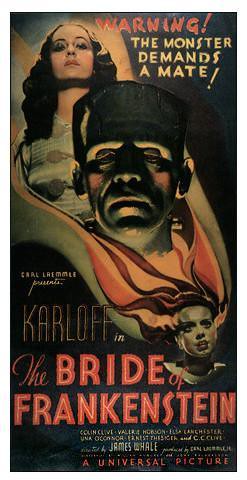
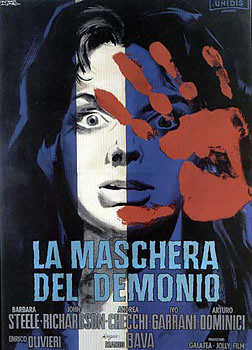
Bride of FrankensteinBlack Sunday

The first double bill would have to start with both James Whale and Mario Bava’s masterpieces respectively: The Bride of Frankenstein (1935) and Black Sunday (1960). Bava’s Black Sunday is an homage to the beautiful black and white Gothic horror film classics of the 1930s. The Bride of Frankenstein is not only one of the most beautiful made by Universal Studios during this period, filled with the transcendent sets and ghastly graveyard scenes, but in many ways as wild and ludicrous as Black Sunday. The two seem a perfect fit, and frame two directors at the very height of their genius.

View the trailer for The Bride of Frankenstein here and for Black Sunday here.
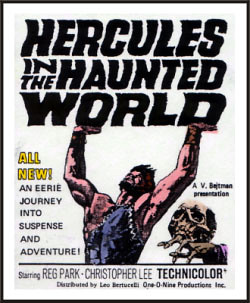
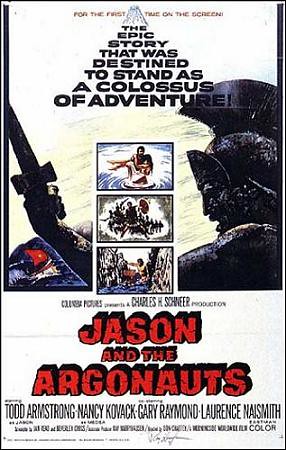
Hercules in the Haunted WorldJason and the Argonauts

Bava wasn’t afraid to dabble in sword and sandal movies, and Hercules in the Haunted World (1961) is one of the cult favorites of this genre. While not necessary his greatest film, It remains one of the most popular and appreciated films of a relatively poor lot. Bava’s trippy settings and haunting atmosphere sets the film apart from the usual cheap standards. That is, of course, until you start dealing with Ray Harryhausen’s animation in Jason and the Argonauts (1963), another sword and sandal film that may very well be the most famous and best simply because of the genius animation by Harryhausen, featuring the Skeleton fighting sequence, perhaps some of the greatest special effects ever to be filmed.

View the tailer for Hercules in the Haunted World here and for Jason and the Argonauts here.
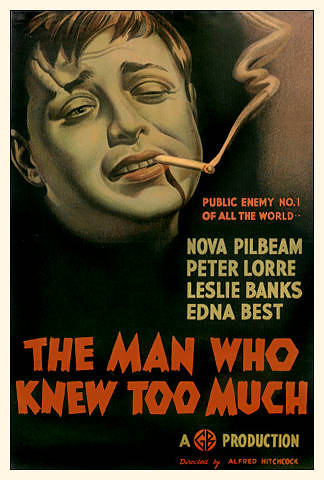
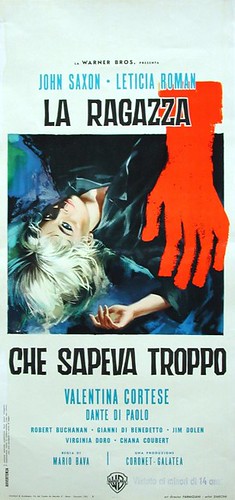
The Man Who Knew Too Much (1934) The Girl Who Knew Too Much

I chose Alfred Hitchcock’s first version of  The Man Who Knew Too Much (1934) because it has Peter Lorre in it, which is his first film role since leaving Nazi Germany (suggesting Hitchcock’s genius that much more given he was the first to cast him). And interesting fact here is that Lorre doesn’t yet know English so he is speaking all his lines phonetically. It’s wonderful to watch. Also, I must admit, I’m not a  Jimmy Stewart or a Doris Day fan—who star in the 1950s version—and would much prefer to watch Lorre in just about anything any day of the week than suffer through another gosh, golly or shucks by Stewart. There….I finally said it on this blog.

As for Bava’s The Girl Who Knew Too Much (1963) I think it is one of his most beautiful films, perhaps his most beautiful after Black Sunday, and the header image of this blog is proudly taken from this gem. What’s more, it is commonly thought of as the first filmed Giallo, which is an Italian term that literally means yellow. And due to the yellow covers of these pulp novels, the term was used to describe an entire genre of novels and films in Italy during the 50s and 60s. The novels consisted of sensational fiction that often brought together the thriller, horror, and sexploitation genres. This is Bava’s last movie filmed in glorious Black and White, a medium he excelled in and wouldn’t ever come close to surpassing in color except, perhaps, in Planet of the Vampires (more on that soon).

Trailer for The Girl Who Knew Too Much here.
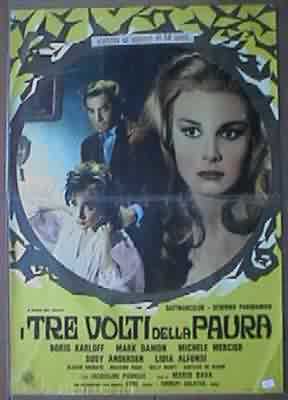
Black Sabbath (or Three Tales of Terror)Trilogy of Terror (1975)

Pulling out all stops, I went for the episode films. I would love to do some research on episodic films like the two featured here: Black Sabbath (1963) and Trilogy of Terror (1975). I was toying with the idea of including Cat’s Eye or Creepshow, but I think Trilogy of Terror as a series of three shorts really comes closest to the vision of Bava’s Black Sabbath, and as an added bonus it has the psychotic African Fetish Doll–which will be a major draw, believe you me 🙂 I’m fascinated by the idea of several short films within a film, and the relationship their order and organizations plays to plot and theme, just like with a good book of short stories. The American version of Black Sabbath was expurgated and reorganized, basically removing the Lesbian relationship from the Telephone episode, toning down the violence, and re-ordering the sequence of the films. Which, for many, kills the effect of the three films. I haven’t seen the Italian version yet, so until I do I’ll stick with the US version. I think these episodic films are a fun genre that isn’t played with nearly enough, so The New Bava Beverly will bring you six short films at the price of two long ones.

Trailers for Black Sabbath here and Trilogy of Terror here (not a trailer but beautiful clip from this classic).


Planet of the Vampires Alien

Thanks to Bava, we can even feature one of the greatest science fiction films, Alien (1980).  And while Planet of the Vampires (1965) may be of for those of a particular taste (the beginning scene is ten of the most bizarre moments you will ever spend), I still hold that it is one of the most beautiful films shot in color.  Absolutely stupendous effects and lighting, not to mention the coolest space suits ever worn by any astronaut of any age. Genius. A few critics actually link the atmospheric landscape, lighting, and mood in Planet of the Vampires to Ridely Scott’s Alien (1980).  And while I don’t think there has been an acknowledged inheritance on the part of Scott, watching the two films side-by-side would offer an interesting opportunity to see what these very differently paced and imagined Alien films have in common.

Trailers for Planet of the Vampires here and for Alien here.
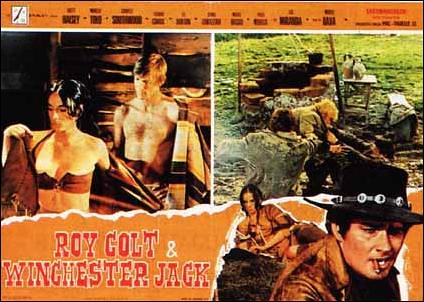
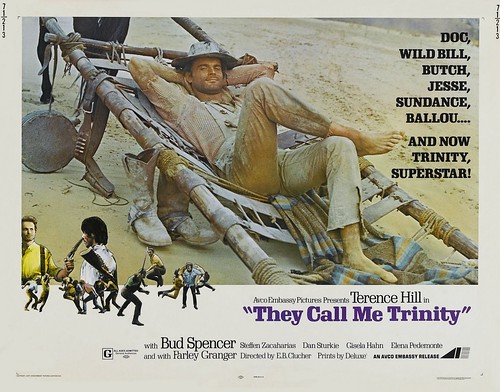
Roy Colt and Jack Winchester They Call Me Trinity

Roy Colt and Jack Winchester (1970) is Bava’s only foray into the Spaghetti Western. And by no means one of his better films, it is a spoof on the genre and pushes it to its most insane limits. There is a fight scene between the two main characters named in the film’s title (played by Charles Southwood and Brett Halsey) that last for well over five minutes. It’s drawn out to the point of absolute absurdity. More than that, there are a few cinematic gems as Bava turns his eye to the Western landscapes of the film. The film is spoofing the by then well-established Spaghetti Western genre, and lead characters are quite similar to the acting team of Terence Hill and Bud Spencer, both of whom became internationally recognized with the film that re-inspired the moribund Spaghetti Western during the 70s: They call Me Trinity (available on Google Video its entirety given it is in the public domain—haven’t seen the high quality version on the Internet Archive yet—but I strongly encourage you to watch the opening sequence of this film, it’s a blast).

No trailer available for Roy Colt and Jack Winchester. Trailer for They Call me Trinity is here.
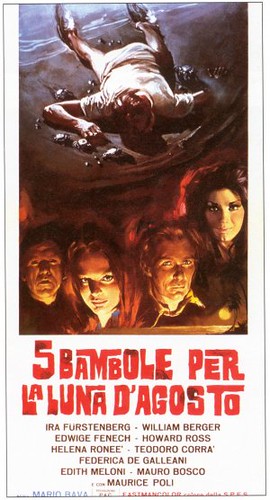
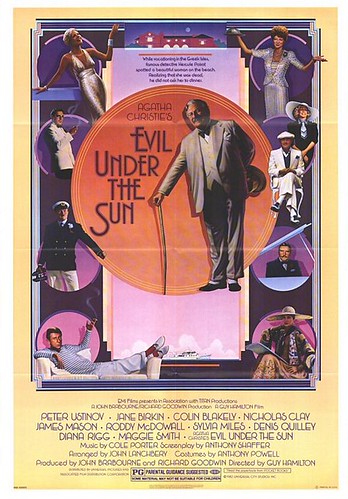
Five Dolls for an August Moon Evil Under the Sun

Pushing the obscure genre boundary angle even further, Bava did a film titled Five Dolls for an August Moon (1970) which provides a kind of Agatha Christie setting and plot without the wise and savvy detective, and far more gruesome murders. The plot of Five Dolls focuses around “a group of people who have gathered on a remote island for fun and relaxation. One of the guests is a chemist who has created a revolutionary new chemical process, and several of the attending industrialists are eager to buy it from him.”

A plot line which reminded to me to some degree of a favorite of mine when I was a kid, Evil Under the Sun (1982), which also features a group of wealthy people who steal away to an exotic island and find one amongst themselves dead. And while Evil Under the Sun concerns itself with culture, deductive reasoning and smart detective work, Five Dolls just kills off the decadent industrialists, which has its benefits.

No trailer available 🙁
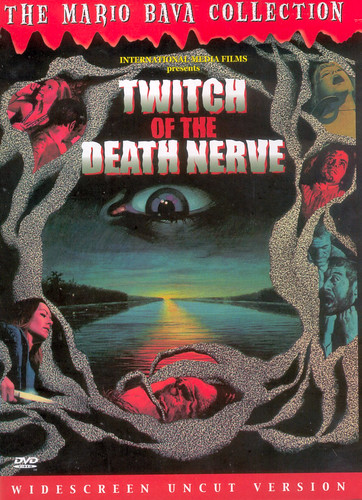
Twitch of the Death NerveFriday the Thirteenth

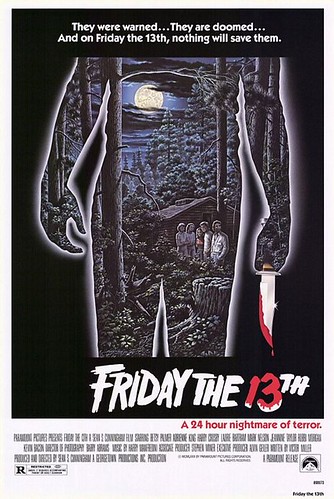
Bava invented the Slasher film! What else can I say here?  Twitch of the Death Nerve (1971) is the proto-type for the Slasher films of the late 70s and 80s (and the more I started thinking about this today the more I thought so must The Texas Chainsaw Massacre be then too). Friday the 13th was the film it most reminded me of given the similarities in camp settings, and the fact that both film’s have a somewhat unexpected and deeply disturbing ending.

Trailers for Twitch of the Death Nerve here and for Friday the 13th here.

RashomonFour Times That Night

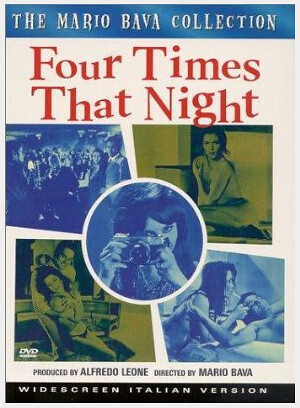
Akira Kurosawa‘s Rashomon (1950) is the classic film told from varying viewpoints that beautifully demonstrated all the complex theoretical beauty of the hermeneutic problems undergirding testimony, perspective, and narrative more generally. So, why not pair this classic with an Italian Sex Comedy done from four different perspecitves that retraces a date that has conceivably gone wrong from four different perspectives.  Four Times That Night (1973) is a monument of 70s style and expression. The film centers around an apartment, and the shag rugs, turntables, and generally awesome furniture and colors is not to be under emphasized.  The space of the bachelor pad and consumerism looms large in this film (as it does in the sex comedies of the 50s with Rock Hudson). Yet, at the same time, Four Times That Night flirts with a disturbing vision of how the night might have gone wrong, channeling some of Rashomon‘s darker moments.

Trailer for Rashomon here and a trailer for Four Times That Night is not readily available.
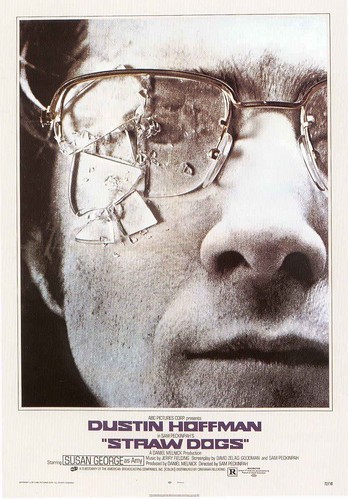
Straw DogsRabid Dogs
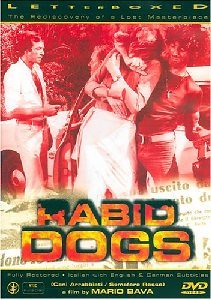
Finally, as a grand finale I’m pairing Sam Peckinpah’s Straw Dogs (1971) with Bava’s Rabid Dogs (1974). Both of these films might be seen as prime examples of the increasing escalation of violence in cinema that characterized the early 70s. The graphic and realistically filmed rape scenes in both films makes them both highly controversial and extremely hard to watch. Both are characterized by an acute claustrophobic aesthetic, and mark the dark visions of masculinity gone animal. Rabid Dogs marks an interesting moment in Bava’s films, wherein he firmly moves outside of the fantastic/gore/absurd sub-genre pieces to a stark, realistic film about violence. It marks a bitter, dark ending to his career—it’s actually his penultimate film—which in many ways reflects how he felt about his work’s reception over the years. It’s his final masterpiece, and a difficult one to manage given how terrible its ultimate vision of the world becomes when stripped down to the raw free of fantastic effects and far out visuals.

Trailers for Straw Dogs here and for Rabid Dogs here.

OK, that’s it. I did it, and I’m all fired up about it!

Posted in film, films, fun, movies | Tagged , , , , , , , , , , , , , , , , , , , , , , , , , , , , , , , , , , , , , , , , , , , | 7 Comments

I ain’t no preacher no more

Image of Grapes of Wrath movie posterI watched John Ford’s Grapes of Wrath (1940) last night and I have to say it is a masterpiece of the highest order. The film both blew my mind and deeply touched me on so many levels I just can’t sort them all out right now. I’m confused. So, until then, here are a few highlights from a film that must have been as relevant and deeply human back in 1940 as it was last night.

The scene at the beginning of the movie when Tom Joad (played brilliantly by Henry Fonda) encounters the ex-preacher Jim Casey (John Carradine) for the first time frames the entire film. The scene is wonderfully rich and complex in its existential humor, setting up the overarching logic of the film: honest doubt and life’s dire uncertainties are not anathema to hope and possibility. Not understanding our condition is a crucial element to being within it, to embracing it. To decide to go on while not understanding is the greatest act of faith. Similar to Estragon’s claim in Beckett’s Waiting for Godot: “I can’t go on, I’ll go on.” More than that, the preacher’s lost spirit haunts me like a second skin these days.

And there’s Muley (an Oklahoma sharecropper like the Joads) being told he needs to get off his land. This scene beautifully captures the ever receding logic of responsibility and individual accountability under capital. What makes the land “our’n”?

The scene between Tom Joad and Ma Joad (played flawlessly by Jane Darwell) was an almost impossible one for me to watch. The moment captures the parting between mother and son, a strange apotheosis of Tom Joad into the canon of freedom fighters for social justice which is sealed by his “I’ll be there” speech. Yet, despite these moments of poetry, there is still no clear understanding on the part of either son or mother, and the anguish at the separation remains terribly real for both of them. This scene painfully reminded me of just how much I miss my mother, and how deeply I long to look into her eyes once again and talk to her about the world I see.

Ma Joad delivers the final thoughts of the film. A brilliant ending to the preceding dark and disturbing vision of the world. The final lines about “the people” made me realize how Ford takes the film version of the novel to another level. It is his ability to marry stock characters with profound philosophical vision that drives the engine of hope that is the Joad family throughout the film.

That final scene reminds me of something Mrs. Jorgensen said in The Searchers (1956), another Ford classic:

It just so happens we be Texicans. Texican is nothin’ but a human man way out on a limb, this year and next. Maybe for a hundred more. But I don’t think it’ll be forever. Some day, this country’s gonna be a fine good place to be. Maybe it needs our bones in the ground before that time can come.

Posted in film, movies | Tagged , , , , , , | 11 Comments

Anyone else have problems upgrading WPMu 2.6 with subdirectories?

I’ve been upgrading a number of different WPMu installations. And while the upgrades I did for WPMu 2.6 installations that ran on dynamic subdomains went smoothly, two installations I upgraded that run on subdirectories (a result of them being hosted on shared hosting that would do dynamic subdomains) ran into problems. The upgrade seemed to go fine, but when I tried to login into a blog other than the main blog (or even login as another user) it simply remains on the login screen that redirects to itself for all blogs except main.

I did a quick search and found this forum thread which suggests I’m not alone with this issue. I deleted all my plugins and mu-plugins,  cleared the cache and threw out the cookies. I even spent some time in the wp-config file, and double checked my .htaccess settings, all to no avail.  I’m sure a fix is forthcoming, or at least a hack, but until then I would perhap hold off on upgrading to WPMu 2.6 if you are using subdirectorties. I make this post because after the pollyanna screencast about upgrading to WPMu 2.6 I posted previously, I want to make clear that the upgrade was only tested with dynamic subdomains, not subdirectories.

Update: I found a fix for these issues as they were occurring for me, I’m not sure they will work for everyone, but they worked for my two installs with subdirectories.

What I did was create a new blank database and deleted the wp-config and .htaccess files.  Then loaded WPMu 2.6 as if it were a new install and once I was done, I simply pointed the wp-config file to the pre-exiting database with all my tables and whatnot in it. This worked like a charm for me.

I’m going to go out on a limb here a say it was the creation of a new .htaccess file and wp-config file for 2.6 that did the magic, but I’m not certain of this, all I know is that it worked.

Posted in WordPress, wordpress multi-user, wpmu | Tagged , , | 13 Comments