



Watch the bava blog trailer!
about
is an ongoing conversation about media of all kinds ...
Testimonials:
Generations from now, they won't call it the Internet anymore. They'll just say, "I logged on to the Jim Groom this morning.
-Joe McMahon
Everything Jim Groom touches is gold. He's like King Midas, but with the Internet.
-Serena Epstein
My understanding is that an essential requirement of the internet is to do whatever Jim Groom asks of you while you're online.
-James D. Calder
@jimgroom is the Billy Martin of edtech.
-Luke Waltzer
My 3yr old son is VERY intrigued by @jimgroom's avatar. "Is he a superhero?" "Well, yes, son, to many he is."
-Clint Lalonde
Jim Groom is a fiery man.
-Antonella Dalla Torre
“Reverend” Jim “The Bava” Groom, alias “Snake Pliskin” is a charlatan and a fraud, a self-confessed “used car salesman” clawing his way into the glamour of the education technology keynote circuit via the efforts of his oppressed minions at the University of Mary Washington’s DTLT and beyond. The monster behind educational time-sink ds106 and still recovering from his bid for hipster stardom with “Edupunk”, Jim spends his days using his dwindling credibility to sell cheap webhosting to gullible undergraduates and getting banned from YouTube for gross piracy.
I am Jim Groom

Find out more about me here.
Recent comments
- Reverend on Punk’s Not Dead
- Reverend on Punk’s Not Dead
- Martin Weller on Punk’s Not Dead
- Maren Deepwell on Punk’s Not Dead
- Jim Groom on Punk’s Not Dead
- Jim Groom on Punk’s Not Dead
- Scott Leslie on Punk’s Not Dead
- Alan Levine on Punk’s Not Dead
- Jim Groom on You’re definitely Dr Detroit …
- Jim Groom on Atari 2600 Game Cartridge Display Stand
- Jim Groom on Conference, Camera, ILTA!
- Jim Groom on Conference, Camera, ILTA!
- Tom on Conference, Camera, ILTA!
- Zach Davis on Atari 2600 Game Cartridge Display Stand
- GNA Garcia on You’re definitely Dr Detroit …
-
Recent Posts
- Punk’s Not Dead
- Unscripted Futures
- Conference, Camera, ILTA!
- You’re definitely Dr Detroit …
- The Reclaim Student Showcase Returns for 2026
- Domain of One’s Own Version 2
- Heigh Ho, Heigh Ho, It’s Off to ILTA’s EdTech 26 We Go
- Atari 2600 Game Cartridge Display Stand
- Building a Blog You Can Walk Into
- Deferred Maintenance: Upgrading Mastodon and PeerTube
browse the bavarchive
Contributors
some favorites
- Alan Levine
- Andy Rush
- Audrey Watters
- bava.social
- Bonnie Stewart
- Brian Lamb
- Bryan Alexander
- Chris Lott
- Clint LaLonde
- Cole Camplese
- Darcy Norman
- David Kernohan
- David Wiley
- Gardner Campbell
- GNA Garcia
- Grant Potter
- Jeffrey Keefer
- Jon Beasley-Murray
- Jon Udell
- Kate Bowles
- Kin Lane
- Laura Blankenship
- Leslie Madsen-Brooks
- Lisa M Lane
- Martha Burtis
- Martin Hawksey
- Martin Weller
- Mike Caulfield
- Mikhail Gershovich
- Mountebank
- Paul Bond
- Scott Leslie
- Serena Epstein
- Shannon Hauser
- Stephen Downes
- The OLDaily
- Tim Owens
- Tom Woodward
- Tony Hirst
Mildred Pierce Double Feature
Bad Boys (1983)
 I liked Sean Penn in Fast Times a Ridgemont High, Jeff Spicoli was possibly one of the single most beloved and influential film characters of the 80s. But it wasn’t until seeing him in Bad Boys that I became a huge fan of the early Penn. Now he ain’t much of a director, and his latest film Into the Wild (2007) confirms that without question (was it simply a bad Eddie Vedder music video that forced Hal Holbrook to run up a mountain?). So, in tribute to my favorite Sean Penn role as the Chi-town badass Irishman Jimmy O’Brien, here’s a hard hitting clip from Bad Boys.
And now a word from our sponsors…
Produced in 1973 [by Richard Serra and Carlota Ray Schoolman], “Television Delivers People” is a seminal work in the now well-established critique of popular media as an instrument of social control that asserts itself subtly on the populace through “entertainments,” for the benefit of those in power-the corporations that maintain and profit from the status quo. Television emerges as little more than a insidious sponsor for the corporate engines of the world.
A historical lesson for the potential futures of the internets?
Thank you Nessman for making my day!
Tale of the FeedWordPress Tape

Image courtesy of Looking for Fish tacos at ELI 2006, aka CogDog.
Well, I have finally gotten a free minute to get this all down, and get it down I will in hopes that I can drum up some help and support in working through a couple of the issues we’re having with FeedWordPress. So, here goes my state of the union address for FeedWordPress syndicating student work to class blogs on UMW Blogs….
First, FeedWordPress is the real deal, it is a solid interface, not too complicated, works out-of-the-box without cron plugins, and makes syndication a breeze. (D’Arcy overviews it beautifully here). Combine this simple syndication with all the tag and category feeds made available by Donncha’s Sitewide Tags plugin and you got the goods, EDUGLU-o-rama! As the great Mara Scanlon said after we demonstrated the power of FeedWordPress for her Ethics and Literature course today, “This is getting so much easier!” And that it is, she suffered through the days of BDP RSS and the untold issues with WP-Autoblog last year with character and fortitude, and her recognizing this afternoon that the syndication angle is coming together was a morale boost, for she doesn’t compliment ed tech stuff often or lightly.
So, I’m really excited. I can see some real potential and power here, we have over 15 classes using some version of FeedWordPress syndication, and for the most part it works seamlessly, enter one feed for a class tag, and the course blog populates itself, aggregating the student blog posts tagged accordingly. All is good….well, almost good.
Here are some of the issues we have run up against in the last week, in order of gravity:
1) For a few classes we are actually feeding the posts in with comments turned off and the permalink sending the reader back to the original blog. This works well when the feed is first syndicated in FeedWordPress. However, after that the subsequent posts that are pulled in link within the course blog, the permalink no longer send the reader back to the original post on the student’s blog. This sucks! This was a way to allow posts to aggregate in one place, but lead the rest of the class back to the student’s space, particularly useful if the class is subscribing to the course blog feed, for all the feeds will immediately take the reader to the student’s blog, a way to aggregate feeds from a variety of sites off one feed (a kind of tag specific OPML feed for class sites). So, this one is major, and it ain’t working as of now 🙁
2) This may be related to number one, but for several feeds that I click on that have been aggregated via FeedWordPress I get the following error:
Fatal error: Call to undefined function wp_insert_category() in /home/umwblogs/public_html/wp-content/mu-plugins/sitewide-tags.php on line 120
Making me think there may be a correlation between the FeedWordpress issues and the Sitewide Tags plugin. Anyone experience anything similar to this?
3) After FeedWordPress is activated and up and running, if you try and create a Link (just a plain old link in the Write–>Link tab) it actually creates a new, malformed feed in FeedWordPress. Bizarre. This doesn’t necessarily hurt anything that I know of, and I stress that I know of.
4) FeedWordPress doesn’t pull in tags from syndicated posts. Not a huge deal for us right now, but it would be useful.
5) The creation of categories from syndicated posts doesn’t work out-of-the-box. You have to actually update the rss-functions.php and rss.php files using the two they provide in the MagpieRSS Upgrade folder that comes with the FeedWordPres plugin (thanks for pointing this out, D’Arcy).
Ok, that’s it. I’m gonna post a modified version of this on the WPMu forums as well to see if anyone knows anything. The plugin author, Charles Johnson, seems to have been busy with other things and hasn’t upgraded his plugin for WP/Mu 2.6+, and frankly the guys built it out and supported it brilliantly. And once your plugin becomes popular, it must seem like as much as a burden as a service to constantly update and maintain it, I’ve seen it happen with a number of good syndication plugins which makes me nervous. We need to support these folks, and help them develop it out, or contribute accordingly.
So, there it is. FeedWordPress is about as close as we’ve come to realizing the syndication bus in major way, mad props to Andre Malan for turning me onto it again at Norther Voice this past February, and if anyone has any ideas for making it work a bit more consistently don’t be shy.
Oh yeah, one more thing.
The BDP RSS widget Andre Malan created for allowing people to add their feeds to a site via BDP RSS would make even more sense these days for FeedWordPress.
I <3 Consumerism

Well, I have been sucked into the UMW Blogs vortex. The first week or so just thrills me to no end, people start coming out of the woodwork, and I have fun commenting, reading, and getting a sense of what’s in store. it also makes me marvel just how much cool stuff is happening all around campus, and the syndication framework really bring that into sharp focus (but more on this in technical detail in my next post).
So, I have met with almost twenty faculty during the first week of classes alone about UMW Blogs, and this project seems to really be generating some serious interest and excitement. The utility and imaginative power of such a framework is becoming more and more apparent, or at least I think it is (but don’t trust me). I spoke with five different classes about the system this week, and had four workshops on UMW Blogs for faculty—all of which had very healthy attendance.
So, this post is not so much about the consumerism behind RSS feeds and UMW Blogs, but rather one particular class I talked with this week. American Studies professor Krystyn Moon is teaching a course on Consumerism this semester, and she had a brilliant idea for using blogs for their studies: have the students collaborate on a shopping blog, not unlike Gizmodo or Cool Hunting or Uncrate, wherein they can examine and inhabit a contemporary form like blogs for mediating consumption. So, I gave them an overview of UMW Blogs on Wednesday, but started the discussion talking about the Internet Archive, and all the amazing resources that lay in wait for them. As I tried to navigate to archive.org to give them a quick sampling, the network began to choke on campus (and choked it did for most of the first week). So, I thought my moment to get them hooked came and went.
But, but, but, but, this weekend I figured why do I need to be there to show them what’s there? They all have blogs now, and they all feed into professor Moon’s class blog, so why not just post the quick possibilities of the Internet Archive on the course blog? That would be easy enough, and it provides me the possibility of sharing resources centrally for any specific class without being their necessarily. Blogging for classes as a form of support/presentation? I love that!
Anyway, here is my post to the class on Industrial films dealing with Consumerism at the Internet Archive’s Prelinger Archive:
As I mentioned on Wednesday, the Internet Archive’s Prelinger Archive may prove a really rich source for you over the semester.
Check out the videos under the consumerism tag on the Prelinger Archive tag cloud.
Note: The videos may take a minute or so to load.
There is “In the Suburbs,” a 1957 advertising sales promo film extolling 1950s suburbanites as citizens and consumers.
Download In the Suburbs
Here is a reel of classic 50s and 60s television commercials.
Download Television Commercials 1950s-1960s
Or the two part series “Consumers Want to Know” from 1960.
Download Consumers Want to Know, Part 1
Or even the strangely bizarre and gendered “Consuming Women” (1967).
Download Consuming Women
Or this 1955 gem “A Word to the Wives” about two women who trick their husbands into buying a new kitchen.
Download A Word to the Wives
Anyway, enjoy the Archive.
Jim
How much to you love it that the Prelinger Archive has a tag cloud now?
UMW Blogs: A Forest of Feeds!
Today it really hit me that UMW Blogs is back and roaring. I rolled through the jungle filled with RSS and picked lovingly from the fruit of connected people thinking about wild stuff. And I knew it for sure when I read Jesse Kopp’s first blog post of the semester:
From the makers of last summer’s smash hit “The Stove That Ate Sylvia Plath” comes “When Dishwashers Attack”–so blood spillingly, bone chillingly thrilling that you may never feel safe with kitchen appliances again. Anne Scaldwell (Sigourney Weaver) and Peter Boilsworthy (Matt Damon) are excited about renovating the kitchen in their newly purchased and well-isolated beach house, but soon after moving in, they discover their old Kenmore dishwasher has very different plans… Coming to a theater near you this September.
Jesse is an amazing thinker and blogger, and his work with Carole Garmon last year in her Video Art class was awesome. In fact, she had some wonderful folks pushing the boundaries, currently missing the Roblog, but loving the rise of a whole new year with new discoveries. Shannon is back at it and will be discussing William Faulkner an Toni Morrison for literature and Grapes of Wrath in her US Film History course with the great Jeff McClurken (who is all about honor). And Serena proves her literary acumen by caricaturing the mighty Reverend, and her sharp and exacting voice makes me marvel at her ability, and feel a bit self-conscious about my WordPress habits 🙂
And professor Sue Fernsebner pushes the boundaries with a full blown FeedWordPress site for her Historical Methods course. And already the students are taking their research sites and the ideas to the next level, check out how Nick Ford’s imagines his own vision of history and teaching which is punctuated by a punishing quote from Orwell’s 1984:
“He who controls the present, controls the past. He who controls the past, controls the future.”
That’s right, school is back in session, and everyone’s getting ready to imagine. And that is what Gardner Campbell nails in his presentation at the UCEA pre-conference; it’s a masterpiece of the first order, and in it he notes beautifully that on top of and between every open course resource is not only content, but the mindface of the people you think with. The pushing of ideas and the experience of learning that makes it intoxicating. He noted the openness as not opposed to or at odds with the resources, but an integral part of the design of education and a faith that puts us one step closer to a manifestation of a kind of real school. He’s on to something. The interstices of experience, the moment that happens between structures and beyond localized routines of learning. A commitment to the life of the mind and a sense of comunity, not to some abstracted notion of excellence. I makiing my committment, I’m gonna read Faulkner’s The Wild Palms (maybe my favorite of his, maybe), watch some John Ford, re-visit Toni Morrison’s Paradise, and promise myself I will get at Marx’s Capital sooner or later. The year’s begun, and just like every Fall of my life til now, I’m excited to learn.
Claudia Emerson: Poet Laureate of Virginia
 It’s been hectic on the Mary Washington campus these last few days, and in all the hustle and bustle of classes starting up a pretty honor for one of our faculty was announced. Professor Claudia Emerson was named the poet laureate of Virginia by Governor Kaine on Tuesday, August 26th, 2008.
I couldn’t be more excited for both Claudia and the University of Mary Washington. She is an awesome teacher, brilliant poet, and a downright cool person. Her tireless work ethic captures what I find so inspiring about UMW’s faculty in general, despite a tremendous load of work she refused to stop innovating and imagining beyond the pale.
And should you ever be lucky enough to find yourself near Claudia’s gravitational pull, she’ll most certainly reel you in and start talking about words, figures, and etymologies. She’ll throw out wild ideas and make you re-think your assumptions with an offhanded comment that opens up the complex problems and possibilities of our shared language. I often come away from a conversation re-thinking the encrusted words I have enshrined and come to lean too much upon for meaning.
What’s more, to hear her talk about her hometown Chatham, Virginia is really like something out of a Faulkner novel. She represents what I had always imagined was unique about an artist, a relentless openness married to an unforgiving return to what matters most. And to be honored the poet laureate of her home state must be an amazing honor for her, and I would just like to add to that the following: Rock on, Claudia!
In the Meantime…
…this is how I’m feeling right about now:
And kinda like this:
 |
Yo La Tengo – Deeper Into Movies |  |
 |
||
 |
Found at skreemr.com |  |
And even a little like this:
|
The Roots – Double Trouble | |
| |
||
|
Found at skreemr.com | |
Oh yeah, and this:
| Unwound – We Invent You (Extended) | |
| |
||
| Found at skreemr.com | |
All amped up!
Course blogs, Sitewide Tags, and FeedWordPress
OK, I’m officially in full blown UMW Blogs blogging mode, I will most likely prove insufferable for the next month or so, and that’s just the way it is, suckas!

Steve Harris Stalinism Blog (Oh what a header)
Today I actually gave my first advanced training session on WordPress to a group of five faculty. And I have to say it was a ball. Professors Steve Harris (History), Michael Killian (Biology), Betsy Lewis (Spanish), Andrew Dolby (Biology), and Zach Whalen (English/New Media Studies) were nice enough to remain polite through a kind of abstract session on UMW Blogs as syndicated publishing platform. Because all of these faculty were to some degree familiar with UMW Blogs, and could navigate the application rather well, we went through a few quick questions about uploading and the new interface and then proceeded to focus on how the syndicated logic of a course blog works. Exactly how does WPMu re-publish students work form their own space into a course blog? What kind of setup allows the student to compose and publish their work on their own blog/academic portfolio space yet feed it out easily?.
These are the questions we wrestled with, and I figured I’d blog the details of this setup for other mavericks WordPress users like Professors Sue Fernsebner and Jeff McClurken who will likely be adopting a similar method. So what follows is a tutorial for creating a syndication rich course blog using sitewide tags and FeedWordPress.
Here it is (is that The Roots I hear on the headphones or is it Yo La Tengo?):
For a while now we have been using BDP RSS at UMW Blogs for aggregated course blogs, but with that plugin out of development for a while now, it is time to explore some other aggregating options. The heirs to the spam aggregating plugin WP-Autoblog (long defunct) are WP-O-Matic and FeedWordPress. Given the elegance and simplicity of FeedWordPress it is the republishing aggregator of choice at UMW Blogs these days. What does it do? Well, quite simply it republishes a post (or several posts) from one blog into another, and provides a series of option to customize the republishing of a feed.
So, take this plugin (which I will go into more detail on below) and marry it with Donncha’s new Sitewide Tags Page plugin, which generates feeds for sitweide tags from a WPMu install. In other words, every time a person uses a shared tag on a post in their own blog, it automatically becomes part of a larger feed for that tag. So, if students for History 101 tag all their posts for this class hist101 in their own blogs, a sitewide feed on that tag will be generated, and it will look like this:
http://tags.umwblogs.org/tag/hist101/feed
So, that url above contain the posts from every student blog tagged with hist101, groovy, right?
OK, so the tag needs to be unique and students need to remember to use, but if those things happen, then this is one single feed for an entire distributed class that could consist of as many as 30 blogs. And this is where the details of FeedWordPress come in handy. So, we have the feed for all the student blog posts relevant to History 101, all we need to do now is activate the plugin FeedWordPress and do the following:
- Go to the Syndication tab in your WordPress stall that is created once you activate the plugin and add your sitewide tag feed, and click syndicate.
- If the feeds work swell, no errors, then click the syndication button.
- After that, go to the Syndication–>Options Subtab and customize the options for your feed (make sure it updates automatically and you consider if you want the permalink to take people back to the student blog, etc.
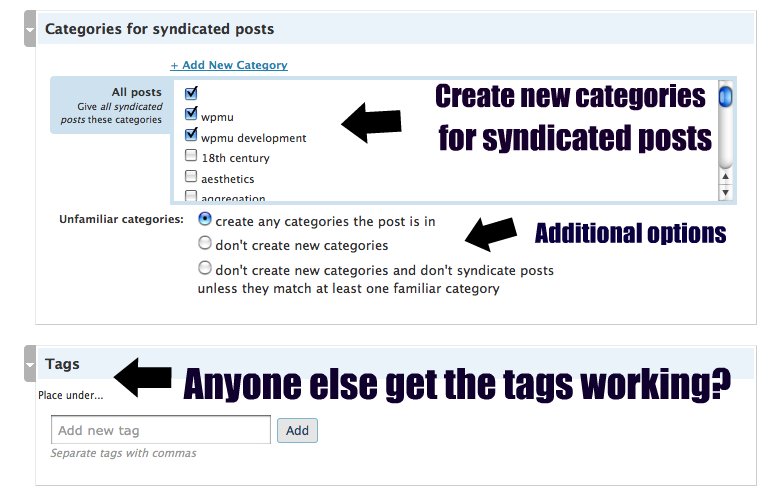
- Categories for syndicated posts do work (attention WPMu über admins: I learned this thanks to the ever wise D’Arcy Norman, you just have to do the Magpie RSS Upgrade included with the plugin). You can have the feed you are syndicated come into its own category or even include the categories the students use in their posts. I still can’t get this plugin to include tags fro the original post, however.
- Click on image for larger view
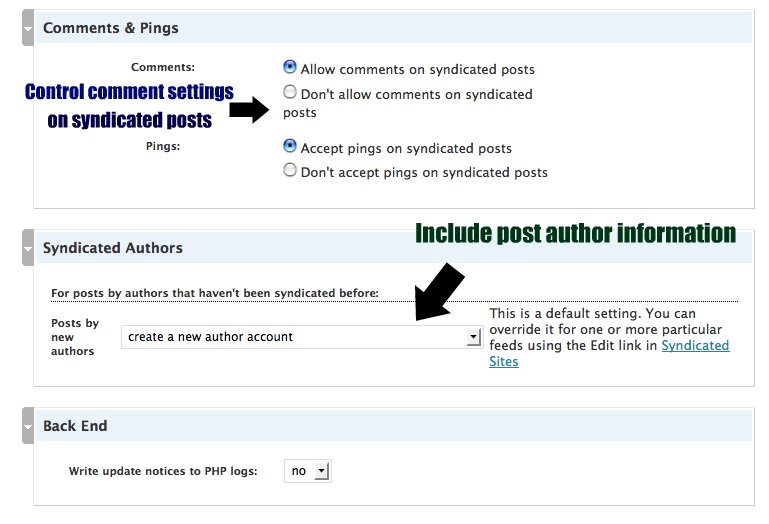
- Comments and ping can be enabled or disabled (you may want to disable them if you want people to comment on the student’s own blog (this is where changing the permalink option to original post might be useful). You all can choose the author settings here.
- After it is customized to your liking, you can then return to the main syndication tab, and check the radio box aligned with this link and click the “Upgrade checked links” button. And the posts will start a feeding 😉
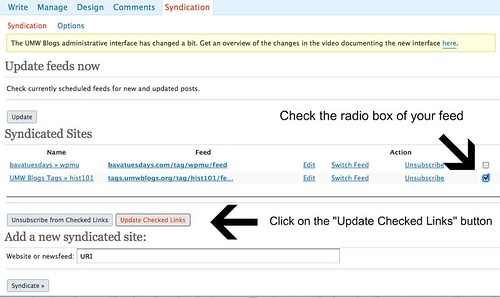
Click on image for larger view

Click on image for larger view

Click on image for larger view

Click on image for larger view
If you would like to get a sense of what a course blog like this might look like, take a look at the master course blog wrangler Gardner Campbell’s phenomenal Milton Seminar taught this summer. I love his design, and he has the permalink going back to the student’s blog, while aggregating all the distributed comments for all the students blogs in the sidebar (using the BDP RSS aggregator) . Gardner used FeedWordPress to great effect, and while this blog isn’t feeding off of one sitewide tag feed (there were few enough students so that Gardner could add the students’ feeds manually) it does demonstrate the wonderful power and elegance of the FeedWordPress plugin.
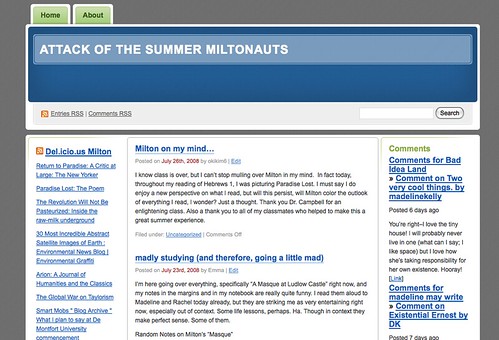
Gardner Campbell's Attack of the Summer Miltonauts course blog
Now, imagine the sitewide tag feed for Gardner’s blog as just one less step to do, and one giant step towards complete automation. We are getting there people!!! Die BlackBoard die 🙂
P4P: Universities as techno-corporate thinktanks?
I’m a fan of TorrentFreak, it’s one of those rare blogs that streams interesting news on a very specific subject and openly acknowledges its biases while providing the reader with a ton of information to fend for themselves. In fact, I have come to think of TorrentFreak as one of the outposts in a war over our culture and piracy that goes generally unacknowledged in the educational sphere. We talk a lot about licensing and open resources in educational technology, but I think the 5000 pound elephant in the room that is the internecine battle over cultural distribution for the 21st century is being waged silently on the margins.
Interestingly enough, Ben Jones has recently completed Part 2 of a TorrentFreak exclusive on “Tackling College Piracy” (see Part 1 here). In it he touches on the College Opportunity and Affordability Act of 2008 which recently passed. The article examines how it is being enforced at one particular campus, highlighting what colleges and universities will be dealing with in regards to deterring filesharing (which isn’t always illicit!). Here is the wording of the act as it specifically pertains to illegal filesharing on campus:
Section 495
Includes among the duties of the Advisory Committee on Student Financial Assistance, monitoring the adequacy of total need-based aid available to low- and moderate-income students. Authorizes the Committee through FY2011.
(Sec. 495A) Requires IHEs to: (1) make information available to their students and employees regarding the illegal downloading and distribution of copyrighted materials (campus-based digital theft); and (2) develop plans to provide alternatives to, and deter, such illegal downloading.
Authorizes the Secretary to award competitive grants to IHEs for the implementation of programs to prevent the illegal downloading and distribution of intellectual property.
Authorizes appropriations for such grant program for FY2009-FY2013.
Interestingly enough, deterring illegal downloading of files in Section 495 has become the responsibility of universities and colleges. They need to “develop plans to provide alternative to, and deter” illegal filesharing. And while the repercussions of what happens if they refuse to comply are still unclear, the Electronic Frontier points out there is still some MPAA pirate lobbyists that believe that the withholding of federal funding to schools that don’t comply is totally appropriate. A thought more disturbing given the gross inaccuracy of the MPAA takedown notices as they stand now with bitTorrent clients, how do they know? And, moreover, why is it the universities and colleges’ responsibility to police this activity for the MPAA and RIAA? (It’s their market, and they have profited tremendously off of it.) Such deterrents for universities and colleges will ultimately lead to industry standard traffic shapers that cost a fortune and will most likely fail to accomplish their intended goal. Why the hell was this written into a federal educational act that could potentially cut aid to schools and students wrongly accused of illegal downloading?
Well, maybe not so much silently as surreptitiously (to refer back to the first paragraph after that long digression), for ambiguous, fear-inspired verbiage like that found in the College Opportunity and Affordability Act just further puts the entertainment industries in a position of malevolent power that will ultimately prove technically futile, but tax many a college and college student in the mean time. Yet, I firmly believe that that is exactly the point of this legislation, it is a temporary stay during this particular moment of uncertainty for content distribution mechanisms. These industries are depending on fear and terror while they feerishly work with ISPs, economists, programmers, and network engineers to develop the new economy/currency through which they can conquer and control the distribution of the culture they package. And this brings me to the point of this post 🙂
I read for the first time today about a new technology known as P4P, or also known as Proactive network Provider Participation for P2P. To quote Wikipedia:
P4P, or Proactive network Provider Participation for P2P, is a method for internet service providers (ISPs) and peer-to-peer (P2P) software to optimize peer-to-peer connections. P4P is being touted as a method that can save an ISP significant costs – the current P2P model may have a peer sending data across the world while a nearby peer is receiving data from across the world – when theoretically they could be transmitting the data locally. Beyond saving an ISP money, P4P proponents argue that using local connections also speeds up download times for P2P downloaders by between 2 and 4 times.
The P4P working group has participants from the ISP, Movie/Content, & P2P industries. It is focused on helping ISPs handle the demands of large media files and enabling legal distribution – they are building what they believe will be a more effective model of transmitting movies and other large files to customers. The working group is not endorsing or opposing the illegal download of copyright material, commonly associated with P2P networks.
This working group is basically coming up with a method that will supposedly relieve the strain on the poor ISPs (a theme we will revisit), while enabling “legal distribution.” Interesting how the next line is sure to point out the working group “is not endorsing or opposing the illegal download of copyright material.” If that was really the case, why stress “legal downloads” immediately before this disclaimer? Why not just say downloads?
Anyway, this new technology sounds in some ways to Harvard’s Tribler P2P experiment. The article in TorrentFreak that introduced me to P4P, and its potential underbelly, led me to this recent press release from the University of Washington about their active involvement, along with Yale University, helping the P4P working group come up with a solution that seems like it will ultimately empower the media and content distributors.
Here is a bit from the newsletter at UW which you can find in its entirety here:
Peer-to-peer networking, or P2P, has become the method of choice for sharing music and videos. While initially used to share pirated material, the system is now used by NBC, BBC and others to deliver legal video content and by Hollywood studios to distribute movies online. Experts estimate that peer-to-peer systems generate 50 to 80 percent of all Internet traffic. Most predict that number will keep going up.
Tensions remain, however, between users of bandwidth-hungry peer-to-peer systems and struggling Internet service providers.
To ease this tension, researchers at the University of Washington and Yale University propose a neighborly approach to file swapping, sharing preferentially with nearby computers. This would allow peer-to-peer traffic to continue growing without clogging up the Internet’s major arteries, and could provide a basis for the future of peer-to-peer systems. A paper on the new system, known as P4P, will be presented this week at the Association for Computing Machinery’s Special Interest Group on Data Communications meeting in Seattle.
“Initial tests have shown that network load could be reduced by a factor of five or more without compromising network performance,” said co-author Arvind Krishnamurthy, a UW research assistant professor of computer science and engineering. “At the same time, speeds are increased by about 20 percent.”
“We think we have one of the most extensible, rigorous architectures for making these applications run more efficiently,” said co-author Richard Yang, an associate professor of computer science at Yale.
The project has attracted interest from companies. A working group formed last year to explore P4P and now includes more than 80 members, including representatives from all the major U.S. Internet service providers and many companies that supply content.
Notice the “struggling Internet Service Providers” sentiment again, compared to the greedy and voracious P2P user—what an objective image of the situation. And then we have the University of Waahington and Yale University providing this working group of Media Lobbyists and ISPs with a potential mean for controlling filesharing and endangering Net Neutrality. This is the real warzone in technology at the moment, the earch for the means by which to monetize and commodify bandwidth and media distribution. David Wiley mentioned the New York Times opinion piece that frames bandwidth providers as OPEC 2.0. Stating that “Americans today spend almost as much on bandwidth — the capacity to move information — as we do on energy.” Yet, these are the very same, poor struggling folks whose profit are being drained by those greedy P2Pers. So, what do they do? They team up with the MPAA, RIAA, and other content providers, put together a working group and employ the intellectual talent from the very same universities around the country that they obsessively target for illegal downloading activity. Insane!
It reminds be of the emergence of American Studies departments in the US during the 1950s, they were enclaves for Cold War rhetoric and nationalism, a space for defining the essential and unique qualities of the US that make it special, unique, superior, and somehow immune to the commun ist disease. Well, let’s face it, these companies are using universities and colleges as the battle/testing grounds for both shaping minds and inspiring fear in the rising adults while at the same time depending on these institutions’ intellectual firepower to help them re-imagine a new means to control and commodify the distribution systems they ignored for decades while the future moved forward. I find it all very disheartening, and while P4P may end up being a bust (it probably will be), the long, drawn out siege upon universities and colleges by ISPs, the entertainment industry, and now government legislation continues.
Well, it’s 1:26 am on August 25th, officially the first day of classes for the new school year at UMW, and this is how I’m starting it. I’m tired of this bullshit, and I’m gonna blog them as much as I can because the fist is getting tighter and we need to become more and more like sand.