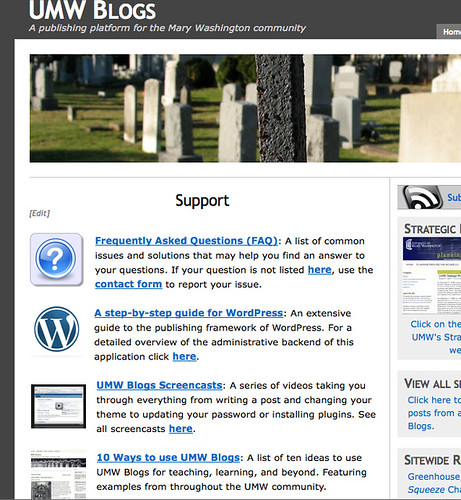
When people ask me how much time I spend supporting UMW Blogs, I say it’s about an hour of my week, which is true. Now, to be clear, I think of support along the lines of “I lost by password” or “How do I change my theme?” and questions like that. More along the lines of basic, functional questions rather than the conceptual re-imagining for teaching and learning, which is where I spend most of my time—and rightly so. The support DTLT has had to give for the day-to-day user operations of UMW Blogs has been absolutely scalable, particularly given we now have more than 2300 users on the system…boooyah!
So, how do we do it? Well, I’m really not certain, maybe WordPress is just that easy, or maybe 2200 of the 2300 users set up a blog and then say this is far too hard and go admin a Drupal site—who knows? However, if the stats for the UMW Blogs Support pages tell a story, I think that story is that a whole lot of people are using them.
Here are the support page stats for the first full year of UMW Blogs (2007/2008):
Frequently Asked Questions (for WP 2.5x) 29,309 views
WordPress Guide (for WP 2.5x) 3,144 views
Now, check out the stats for UMW Blogs updated support pages for 2008/2009 (which is a whole new set of tutorials given the changes in the user interface from 2.5x —> 2.6x)
Frequently Asked Questions (for WP 2.6x) 82,341 views
WordPress Guide (for WP 2.6x) 1,539 views
Crazy, right? More than 82,000 hits for the FAQ this academic year alone! I am on record saying that I enjoyed writing this documentation, but never in my wildest imagination would I have guessed it would be viewed so widely and extensively. Now I know for a fact a number of other schools are using it extensively, and that’s awesome because it was part of the plan. But I also have to believe that a good number of people here at UMW are actually using the FAQs, which saves us a ton of time and energy on the straightforward support issues.
And to add to the support page love, last April Shannon Hauser and Joe McMahon (where am I linking to you now, Joe? You’re all over the place!—you need a stable domain, a domain of your own) added “10 Ways to Use UMW Blogs,” over the course of a year that has gotten 4,448 views.
Additionally, Andy Rush and I created a screencast blog with a whole series of screencasts about using UMW Blogs, and that site has gotten 5,802 views.
So, to re-cap, something as unsexy as documentation has gotten 126,583 views as of 11:06 this evening! I guess it doesn’t feel so boring and painful to write when you know so many people are using it, and you better believe that when we upgrade to WPMu 2.7 this Summer I will spare no expense to pimp the documentation out like it’s nobody’s business, for the people have spoken 🙂






Achilles’ Heel of the Syndication Bus
Thing is when you use a tool like FeedWordPress to syndicate posts, what you cannot syndicate is comments, and while the permalink points back to the original post where the comments should be seen, there is no way to indicate on the syndicated post just how many comments there are, or reflect the recent ones in the sidebar somehow.
Steven says this in his comment on the issue:
What I would like is the ability for the comments to be reflected in both spaces, so that the permalink can point to the post on the course aggregation blog, for example, but once someone leave a comment there, that same comment is automatically re-published on the original post. Now this, for me, would make the whole thing perfect.
But at this point I would even settle for a little number on each post in the aggregation blog that would dynamically reflect how many comments are on the original post. Yet, this wouldn’t answer the questions of how to show recent comments in the sidebar of the aggregation blog. I’m using a workaround for this currently on UMW Blogs which basically takes all the comment feeds for the individual student blogs for a course and creates one aggregated feed of them in the sidebar (I do this BDP RSS). But this is not only laborious, but it is also far from perfect because if a student uses their blog for a variety of different classes or reasons, then comments that are not relevant to course will show up.
So, anyway, I was just recognizing a weakness in this model and wondering if there is a better way to deal with the aggregation of comments for a syndication bus like the one we are thinking through.
Image credit: Otbayley’s “Left Leg: Broken Heel Bone and Detached Achilles’ Tendon”