Finding Steve Wheeler’s presentation on EDUPUNK for a F-ALT fringe meeting today was a nice reminder for me that so many of the associations this idea took on over the course of a couple of months really do still resonate deeply with me. I believe Steve’s idea of “unleashing the anarchy of the web” is a perfect way to think about what makes this moment of DIY teaching and learning in relationship to the more traditional institutional framework of course delivery rather radical.
Stephen Downes and George Siemens Connectivism course marks a rather important moment in this regard, and with the web as your classroom, and your blog (or your tool of choice) as your notebook, who the hell is stopping you from thinking and learning what you want?! And then taking the next logical step and sharing it freely far and wide. Therein lies the real danger and threat of such an approach.
So thanks Steve for the reminder that EDUPUNK was a wee bit more than a meme gone awry, although it was that too.
Coney Island’s Astroland has officially closed this past Sunday, September 7th, 2008, after 46 years of operation. Seems it has been bought up by a developer for $30 million, and the times they are a changing in Coney Island. Read more about the details on the Gothamist here. It’s a sad occasion for a great city whose best attractions and spaces have been devoured by developers. At least the Atlantic Yards development scam was slowed and may be in some doubt as to its future.
I’ll miss you Astroland, the world just won’t be the same without Dante’s Inferno.
In stark contrast to the Uncle John Scruggs video, check out this video of Jack Johnson’s Jazz band performing “Tiger Rag” on December 21, 1929 in the great city of New York, NY.
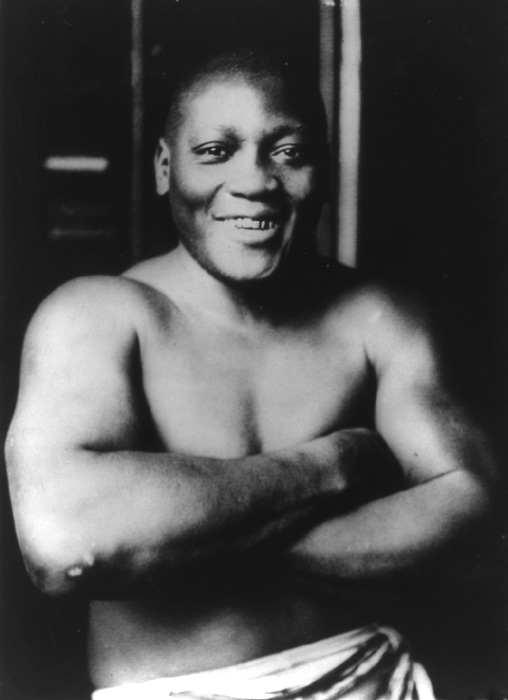
Now, I’m not sure how much you know about Jack Johnson, but if you are new to this phenomenal figure of the early twentieth century, I strongly urge you to read more about him on Wikipedia here. I first learned about Johnson from a Christmas Present I got back in 1999, the book published by ESPN titled “Sports Century,” which was also a series of documentaries on the network. The first chapter of this book is dedicated to Johnson, and after I read it I was amazed by this monumental figure, who may very well be one of the great characters of the last century. His story inspires nothing short of awe, and while he was by no means a saint, his accomplishments in the face of wide spread racism accompanied by his staunch refusal to accept the status quo are remarkable to say the least. He is probably best known as boxing’s first black Heavyweight Champion of the World from 1908 to 1915. And for good reason, for such this title was deeply segregated:
His efforts to win the full title were thwarted as world heavyweight champion James J. Jeffries refused to face him. Blacks could box whites in other arenas, but the world heavyweight championship was such a respected and coveted position in America that blacks were not deemed worthy to compete for it. Johnson was, however, able to fight former champion Bob Fitzsimmons in July 1907, and knocked him out in two rounds.
He eventually did win the title by defeating Canadian Heavyweight champion Tommy Burns in Sydney, Australia in 1908. To quote his Wikipedia article again:
After Johnson’s victory over Burns, racial animosity among whites ran so deep that even a socialist like Jack London called out for a “Great White Hope” to take the title away from Johnson — who was crudely caricatured as a subhuman “ape” — and return it to where it supposedly belonged, with the “superior” white race. As title holder, Johnson thus had to face a series of fighters billed by boxing promoters as “great white hopes.”
He did get to face Jeffries after all in on July 4th, 1910 in what is termed “the Fight of the Century”:
James J. Jeffries came out of retirement and said, “I am going into this fight for the sole purpose of proving that a white man is better than a Negro.” Jeffries had not fought in six years and had to lose around 100 pounds to try to get back to his championship fighting weight.
At the fight, which took place on July 4, 1910 in front of 22,000 people, at a ring built just for the occasion in downtown Reno, Nevada, the ringside band played, “All coons look alike to me”. The fight had become a hotbed of racial tension, and the promoters incited the all-white crowd to chant “kill the nigger”. Johnson, however, proved stronger and more nimble than Jeffries. In the 15th round, after Jeffries had been knocked down twice for the first time in his career, his people called it quits to prevent Johnson from knocking him out.
The “Fight of the Century” earned Johnson $225,000 and silenced the critics, who had belittled Johnson’s previous victory over Tommy Burns as “empty,” claiming that Burns was a false champion since Jeffries had retired undefeated.
So with all of this sports background to contextualize the “Galveston Giant’s” career, it is wild for me to see Jack Johnson in the video above conducting a Jazz band at a club in Harlem, New York in 1929. In fact, Johnson owned and operated his own club in Harlem for three years from 1920-1923 until he sold it to Owen “the Killer” Madden in 1923, and soon after it became the legendary Cotton Club). He was also known for his involvement with white women throughout his public career, one of the greatest race taboos which was in many ways responsible for his arrest and imprisonment for “transporting women across state lines for immoral purposes.” It is always interesting for me to think about a figure like Johnson as the Heavyweight Champion of the World in 1915, the same year D.W. Griffith’s Birth of a Nation redefines film narrative, with the controversial theme being very much the horror of inter-racial sexual relationships.
So, to hear Johnson referring to his boxing career, as well as to watch him conduct and shadow box to the music is quite an experience, particualrly since this man embodies an era and so many of the most complex issues of the US throughout the 20th century and into the 21st.
Uncle John Scruggs was born a slave, [and] is a good example of white-influenced black music as it probably sounded at the end of the 19th century. He is performing the folk ballad “Little Log Cabin Round the Lane” in a minstrel style.
Whereas, according to the “for old times sake” blog, “[Scruggs’] music is an example of an Afro-American banjo playing tradition than predates that of white settlers in the Appalachians.”
Elijah Wald’s Escaping the Delta has some interesting things to say about Uncle John Scruggs, particularly the tradition of black banjo playing and the significance of the “Uncle” in front of this performers name at the time. He also has some interesting things to say about minstrelsy and its enduring popularity amongst black and white audiences through the 1950s.
This video clip not only captures some amazing music, but the setting itself (with the children dancing and chickens feeding) seems like an almost archetypal vision for how our culture has come to think about the post-bellum conditions for black share croppers in the South, and all of this right here in our own Virgineyeyeah.
Here is a wild moment in film/TV history via the ever entertaining Classic Television Showbiz blog. The two video clips below are from a 1977 episode of “The Mike Douglas Show,” featuring interviews with Star Wars cast members Carrie Fisher, Mark Hamill, and Harrison Ford. The film is still in theaters at the time of the interviews, and you can kind of tell by the conversations that it is already gaining a sacred, wondrous space in the popular imagination.
One take away for me is how cool Mark Hamill seems, and what a blowhard Harrison Ford is. To be honest, I have held a deep grudge against Ford ever since Charles Bronson died back in 2003. Why? Well, because I read in the New York Post that when asked about his feelings about the passing of a fellow action star legend and thoughts on Bronson’s career, Ford was quoted as responding with something like the following, “Well, I was never much of an action film fan myself, so I can’t comment too much on his career.” What?! Is that your eulogy for the great Charlie Bronson? Pathetic. Now he may have been misquoted, it was the New York Post mind you, but how can I live with such a paltry, pompous ass quote as a remembrance of the great Charlie Bronson? I’m scarred for life.
I do enjoy working at a university, for on a regular basis new cultural gems come my way. I’ve been working with Gary Stanton on his “Memory and Culture in American Vernacular Music,” and through this course I came upon Jimmie Rodgers, also known as “the father of country.” A quick search on YouTube delivered a short film featuring Rodgers titled The Singing Brakeman (1929). Since I starting watching The Singing Brakeman early yesterday morning, I’ve been transfixed by this guy’s style.
I’m sure those folks who know something about the history of music are yawning by now, but this musician and film wer a wild discovery for me. Watching him perform “The Blue Yodel” (also known as “T is for Texas”) immediately made me think how much his style embodied the best of both Robert Johnson and Hank Williams –not a light combination of 20th century musical legends. More than that, he yodels. The guy yodels like there is no tomorrow and it’s beautifully tortured. In this short nine minute film he sits sheepishly in front of the camera with his guitar, throwing in some brilliantly subtle riffs, and making just about everything else on the screen disappear but his sound.
The film features three tunes, “Waitin’ for a Train,” “Daddy and Home,” and “Blue Yodel.” They’re all good, but “The Blue Yodel” is an absolutely amazing tune. I have to republish the lyrics below because it reads like a blues song of the highest order, and the yodels and his guitar licks bring it to the next level in my mind —not to mention his pronunciation of Georgia as “Georgie.” Here’s the video of “Blue Yodel”:
What I particularly like about this nine minute film is the way it depicts Jimmie Rodgers as a railroad worker stopping in for a cup of coffee and belting out three amazing songs while waiting for his train. Rodgers came from a family of railroad workers, and was one himself before contracting tuberculosis. What’s more, he’s one of the earlier popular music stars (although he had a rather short career) during a historical moment when mass media was exploding; distribution of his music could be mediated more widely than ever before given the popularity of film, the emergence of radio, and high quality recordings. The film kind of captures this transitional space, a Mississippi country boy waiting for his coffee framed for an entire nation in a short film that is staged, but not all that unreal. He’s not a celebrity in the sense we might understand it now, but rather a local musician reaching the world at large. Makes me think (hope?) that in our moment the opposite trend might be at work. As celebrity fades the re-emergence of the local musicians occurs, especially given the means of capturing and distributing media have changed so radically that the role of the musician as global pop star is finally seen as more of a manipulated marketing product of the artificial forces of capital than the capturing and fostering of a talent.
Lyrcis for “The Blue Yodel, No. 1”
You’ll notice these lyrics are different than the those he sings in the video, and there were several different versions of this tune, suggesting a kind of constantly riffing and improvisation. A fluid, arbitrary process of interpretation.
I said T for Texas
T for Tennessee
Oh, yeah, I said T for Texas
T for Tennessee
Said, T for old Thelma
The gal who made a wreck out of me
Well, if you don’t want me momma
You sure don’t have to start
Ah, if you don’t want me momma
You sure don’t have to start
‘Cause I can get more women
Than a passenger train car
Yeah, I said T for Texas
T for Tennessee
Whoa, T for Texas
T for Tennessee
I said, T for old Thelma
The gal who made a wreck out of me
I’m gonna buy me a pistol
Just as long as I am tall
I’m going to buy me a pistol
Just as long as I am tall
I’m gonna shoot down old mean Thelma
Just to watch her jump and fall
I said T for Texas
T for Tennessee
I said T for Texas
T for Tennessee
T for old Thelma
The gal who made a wreck out of me
Gonna buy me a shotgun
With a great long shiny barrel, oh yeah
I’m gonna buy me a shotgun
With a great long shiny barrel
Gonna shoot down that rounder
That stole away my girl
I’m going where the water
Tastes like cherry wine
Yeah, I’m going where the water
Tastes like cherry wine
‘Cause the water down here in Georgia
Tastes like turpentine
I said T for Texas
T for Tennessee
Oh I said, T for Texas
T for Tennessee
I said T for old Thelma
The gal who made a wreck out of me
Oh yeah, women make a fool out of me
Update: it seems this issue is only happening on Firefox 3 with Mac Intels. Anarchy Media player is apparently working fine on Firefox 3 for PCs. Go figure 🙂
When putting a series of videos in a post or page with Anarchy Media Player, I get the following bug when viewed in Firefox 3:
Anarchy Media Player, Firefox 3 bug
Seems like one or two videos will show up, then the subsequent videos show just a part of the play button, and no sign of the video anywhere. Are others having a similar issue? I tested it on more than one WPMu install, and the same issue occurs in both. Seems like it is triggered when there are several videos in one post.
I also tested it on Safari, where the videos show up fine. Any ideas?
Update: There’s a great article on this very retrospective by Benjamin Strong on the Moving Image Source titled “Morning in America.” He positions this retrospective as genre readings of the Reagan 80s, yes, that’s it!
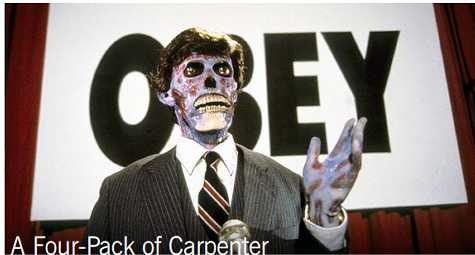
As if you need any more proof that the BAM’s film programming is far and away the best out there, check out the just finished Four-Pack of Carpenter series. These folks are good…very, very good! What I would have given to have been in the BAM for eight hours consuming all of this 35 mm magnificence. It’s probably better that Matt “old gold” Gold didn’t tell me until after the fact, cause I would have just been depressed for four days straight.
4-Pack of Carpenter at the BAM
The four films by John Carpenter they showed are Big Trouble in Little China (1986), The Thing (1981), They Live (1988), and Escape from New York (1982). Now, I just got done praising the programmers, and I stand by that, but I for one think Big Trouble in Little China and They Live are kinda weak spots in the line-up. Big Trouble in Little China is one of those beloved Carpenter films (for many a favorite) that I never really cared for or understood why so many people liked it so much. I mean let’s be honest, if you are going to have a small retrospective of Carpenter, the four films would have to be Assault on Precinct 13, Halloween, Escape from New York, and The Thing —am I right? Of course I am, Halloween, while not my favorite (that would be an even tie between The Thing and Escape from NY), has to be Carpenter’s most perfect film. It framed the aesthetic, pacing, and camera angles for a whole decade of horror films, and it features unbelievable performances by both Jamie Lee Curtis and Donald Pleasence. In fact, I watched it yet again recently and remain amazed just how well it stands up in every way, it’s the Carpenter film.
Now, I know They Live is going through a renaissance of sorts as of late and I’m all for it, fun film and a great plot concept with the consumer/message zombie/monster thing. Yet, it pales in comparison to the pure philosophical genius of The Thing, or the brilliant plot frame and post-apocalyptic setting of Escape from NY. In fact, I think Big Trouble in Little China and They Live are lesser Carpenter because they move into the intentionally corny, a facet of his film making that by the time we come to a film like Escape from LA renders it unwatchable. Carpenter’s films were always a bit comic book and hokie, it’s one of the things I love about all the movies in my 4-pack. It just seems by the time he got to Big Trouble in Little China the move from horror/sci-fi master to mediocre b-comedy was complete, and the latter didn’t really wear to well on him (with In the Mouth of Madness (1995) being the one exception).
OK, I’ll admit it. This is really just hair splitting, I understand that, I would have gladly gone to all four films with butter-drenched popcorn, Coke, and Dots in hand, greedily stuffing myself while consuming the true beauty of 35 mm Carpenter. This caddy response may be a result of my intense dejection that I wasn’t at the BAM to witness all this first hand. At the same time, we have to maintain a standard for our b-movies, or else everything just becomes artistic schlock 🙂 And as an unintentional side effect, this post has helped me figure out a perfect life for myself: I would run UMW Blogs on the side, and attend and blog every film being shown at the BAM on a regular basis for the rest of my natural life. That, my friends, would be heaven. Sometimes I miss Brooklyn, but I always miss the BAM Cinematèk (looks like the got ride of the whole Cinematèk thing, and are just going with BAM Cinema now–glad they dropped the elitist European name with accent, this is America damn it! We invented film!!!).
Two weeks into the semester and UMW Blogs is a non-stop post party.
Blog Activityon UMW Blogs as of 9-6-08
And while I get excited about the activity and the overall usage, it’s often the tidbits that get me going. Like Fumanchu’s random video post about the Triadic Ballet from the 80s.
UMW Blogs is about a different kind of teaching and learning resource, it’s the interstitial space of sharing that happens between people, and that’s why it’s unique in its beautiful chaos. It’s not about collecting institutional data, or some staged brochure for the world at large. It’s a complex series of intersecting roads that have no routinized map for learning. Rather, an online community driven by the engines of inquiry which randomly seeks out inspiration in the most unsuspecting spaces. Together we have built a highway leading to nowhere and, to misquote Gus Haynes from the final episode of the fifth season of The Wire, “we just want to see something new everyday.”
is an ongoing conversation about media of all kinds ...
Testimonials:
Generations from now, they won't call it the Internet anymore. They'll just say, "I logged on to the Jim Groom this morning.
-Joe McMahon
Everything Jim Groom touches is gold. He's like King Midas, but with the Internet.
-Serena Epstein
My understanding is that an essential requirement of the internet is to do whatever Jim Groom asks of you while you're online.
-James D. Calder
@jimgroom is the Billy Martin of edtech.
-Luke Waltzer
My 3yr old son is VERY intrigued by @jimgroom's avatar. "Is he a superhero?" "Well, yes, son, to many he is."
-Clint Lalonde
Jim Groom is a fiery man.
-Antonella Dalla Torre
“Reverend” Jim “The Bava” Groom, alias “Snake Pliskin” is a charlatan and a fraud, a self-confessed “used car salesman” clawing his way into the glamour of the education technology keynote circuit via the efforts of his oppressed minions at the University of Mary Washington’s DTLT and beyond. The monster behind educational time-sink ds106 and still recovering from his bid for hipster stardom with “Edupunk”, Jim spends his days using his dwindling credibility to sell cheap webhosting to gullible undergraduates and getting banned from YouTube for gross piracy.




 James J. Jeffries came out of retirement and said, “I am going into this fight for the sole purpose of proving that a white man is better than a Negro.” Jeffries had not fought in six years and had to lose around 100 pounds to try to get back to his championship fighting weight.
 I do enjoy working at a university, for on a regular basis new cultural gems come my way. I’ve been working with Gary Stanton on his “Memory and Culture in American Vernacular Music,” and through this course I came upon