I’m a ridiculous man

From the opening passage of Fyodor Dostoyevsky’s “The Dream of a Ridiculous Man”:

I’m a ridiculous man. Now they call me a madman. That would be a promotion if I weren’t as ridiculous as before in their eyes. But it no longer makes me angry. I find them all nice now, even when they laugh at me–indeed, if they do they’re somehow particularly dear to me. Id even laugh with them—not really at myself but out of sheer love for them—if looking at them didn’t make me so sad. Sad, because they don’t know the truth, while I do. Ah, it’s hard to be the only one who know the truth! But they don’t understand it. No, they won’t.

And yet, looking ridiculous used to upset me very much. In fact, I didn’t just look ridiculous—I was ridiculous. I’ve always been ridiculous, and I think I’ve known it from the day of my birth. Perhaps I became fully aware of it at the age of seven. I studied at school, then at the university, and the more I studied, the more I realized that I was ridiculous. For me, in the final analysis, higher learning amounted to explaining and proving my ridiculousness. And in life it was the same as in my studies: every year I became more conscious that I looked ridiculous in every respect.

I’m really not sure how you top an opening passage like this, even in translation. Dostoyevsky is out of his mind in the best of all possible ways. I’m going to spend some time this semester reading Dostoyevsky, Nietzsche, and D.H. Lawrence as part of a course I will be auditing, and it couldn’t come at a better time for me.  The frame of the class is built upon E.M Forester’s  discussion of the “the prophetic voice” in his work Aspects of the Novel:

With prophecy in the narrow sense of foretelling the future we have no concern, and we have not much concern with it as an appeal for righteousness. What will interest us today — what we must respond to, for interest now becomes an inappropriate word — is an accent in the novelist’s voice, an accent for which the flutes and saxophones of fantasy may have prepared us. His theme is the universe; he proposes to sing, and the strangeness of song arising in the halls of fiction is bound to give us a shock. How will song combine with the furniture of common sense? we shall ask ourselves, and shall have to answer “not too well”: the singer does not always have room for his gestures, the tables and chairs get broken, and the novel through which bardic influence has passed often has a wrecked air, like a drawing-room after an earthquake or a children’s party. Readers of DH Lawrence will understand what I mean.

Prophecy — in our sense — is a tone of voice. It may imply any of the faiths that have haunted humanity — Christianity, Buddhism, dualism, Satanism, or the mere raising of human love and hatred to such a power that their normal receptacles no longer contain them: but what particular view of the universe is recommended — with that we are not directly concerned. It is the implication that signifies and will filter into the turns of the novelist’s phrase, and in this lecture, which promises to be so vague and grandiose, we may come nearer than elsewhere to the minutiae of style.

I’m fascinated by this idea of prophecy as song, as opposed to preaching which might be understood as a kind of compulsory approach to communicating, and with compulsion, to quote D.H. Lawrence, “the recoil kills the advance.” Such a literary conceptualization of prophecy is far more interesting to me than prediction, because it’s a tone and a voice not premised on an arbitrary science of being right, but an art form of communing. And it is best soulfully sung with tortured faith, rather than preached with a fear and trembling that imposes the “dread insomnia of compulsion” (to quote Lawrence again) that fuels the Zombie nation we inhabit.

Dostoyevsky’s “The Dream of a Ridiculous Man,” as with much of his work, is premised upon a tortured faith in the face of uncertainty, dread, and despair. And while the latter often overshadows the search for faith in his work, it is that meager clinging to faith that makes the existential horror of his novel so compelling. Take for example one of the most disturbing and macabre scenes I have ever read, in which the ridiculous man dreams he has shot himself in the heart and remains somehow conscious after his death:

Then they buried me. They left, and I was all alone.  I didn’t stir. Previously, when I imagined how they’d bury me in my grave, I had always associated sensations of cold and damp with it. Now, indeed, I had an acute sensation of cold, especially in the tips of my toes. Bit that was all I felt.

I lay there, strangely enough, waiting for nothing, accepting as a matter of fact that a dead man has nothing for which to wait. But it was damp, I don’t know how much time went by—an hour, a few days, or many days, but suddenly a drop of moisture that had seeped through the lid of my coffin fell on my left eye. The, a minute later, a second drop fell, then, after another minute, a third and so on and so on…

A scene which quickly moves to one of the most unexpected scenes I’ve ever read in a Dostoyevsky story or novel, a creature (presumably an angel) takes the ridiculous man from the grave and flies him through space (is this a 19th century Russian scifi or what?) to an alternate earth where the inhabitants have not fallen, they live in harmony and peace. Yet, the ridiculous man soon introduces deceit to this world, and the fall is precipitated and the history of humanity since the fall on this parallel world is quickly recounted, which is unbelievably efficient and powerful in it’s own regard.  All of which leads the ridiculous man to the conclusion from his dream that there can, indeed, be a paradise on earth, and that he must proselytize this reveltion far and wide:

I don’t know how to organize a paradise on earth, because I cannot convey it in words. After my dream I lost that words that could convey it. At least, the most important, indispensable ones. But never mind, I’ll go out and speak tirelessly, for I’ve seen it with my own eyes, although I’m unable to tell what it is I’ve seen.

But here’s something those who laugh at me cannot see. They say, “So he had a dream, a hallucination.” Well, is that really such a wise objection? Why are they so proud of it? A dream. What’s a dream? And what’s our life if it isn’t a dream? And I may say, moreover, “All right, suppose it never happens, let’s say paradise will never come about! I know myself it won’t—yet I’ll still go on preaching.”

Much like Samuel Beckett’s Estragon notes, “I can’t go on, I’ll go on.”  The heart of our absurd drama is not so much a sermon as a psalm, not so much a lecture as a song. And that is what the story is, it isn’t a lecture or a moral imperative, but a song sung by a madman who wants to believe in something, just about anything.

Posted in Uncategorized | Tagged , , , , , , | 4 Comments

I like crazy

Re-posted from UBUWEB’s Outsiders thanks to the Assorted Street Posters archive.

Posted in art | Tagged , , , | 1 Comment

Textbook Torrent searches on the rise

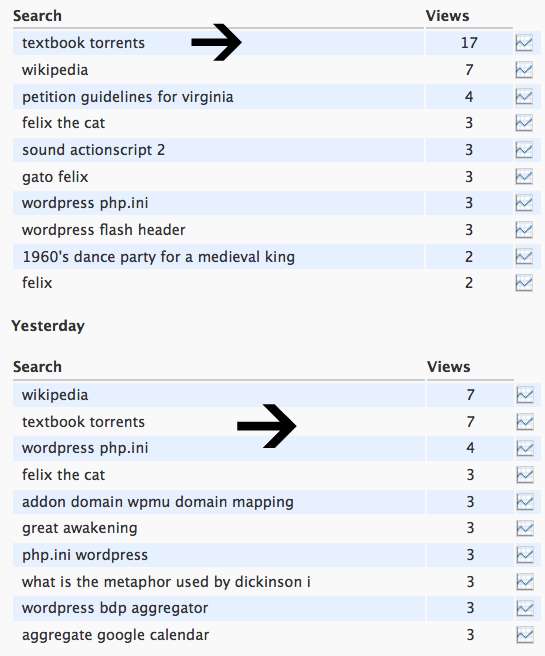
According to a recent study (involving the WordPress Stats plugin for bavatuesdays), students searching for textbook torrents has seen a dramatic rise as of late. In little over 24 hours Google searches for the term “Textbook Torrents” on the bava have  increased almost 150%. During these tough times it seems that students are looking for alternative methods of securing their textbooks, and avoiding those lofty (or is it inflated?) sticker prices.  Take a look for yourself:

Today

textbook_torrent_search

What does this all mean? Well, a few things:

  1. Students are returning to their colleges and universities and have a good idea of what books they will need for this coming semester;
  2. they don’t want to pay the exorbitant prices they are being asked;
  3. textbook publishers may soon be following in the footsteps of the RIAA, and engaging in higher profile “crack downs” on students, which means this is all just getting fun.
Posted in bitTorrent, campus, copyright | Tagged , , , , | 2 Comments

EDUCAUSE’s Top 5 Teaching and Learning Challenges

EDUCAUSE has created a list of top 5 teaching and learning challenges for 2009. This list caught my eye because I think all of these issues have been dealt with rather intelligently at UMW, so I’m gonna annotate this list and suggest how Mary Washington is kicking ass on a point-by-point basis. With my overall thesis being if Woody would have gone right to UMW, none of this would have ever happened 😉

Creating learning environments that promote active learning, critical thinking, collaborative learning, and knowledge creation.

We have a little learning environment called UMW Blogs (powered by WordPress Multi-User) here at Mary Washington which powers an academic community of over 2,000 users and 1800+ blogs (the student population is roughly 4000+). It’s a space that puts the power of publishing, archiving, and showcasing work squarely in the hands of faculty and students. Moreover, it’s relationship to the web is symbiotic, it allows users to easily integrate resources from all over the web into the academic environment, while at the same time giving the administrator (which in this case is not an IT person but the faculty member or student) the option to protect what need be, and share what should be.

But the technology only frames such an environment, the active learning, critical thinking, collaborative learning, and knowledge creation can only be a feature of the willingness on the part of both students and faculty to engage these tools and experiment with them, and this is where UMW has truly seen some unbelievable examples.

Developing 21st-century literacies among students and faculty (information, digital, and visual).

Jeff McClurken’s Digital History course positions students to critically consider and engage the implications involved in choosing a particular technology to accomplish their project’s goals. The groups all published their own research using a variety of tools and media that they both experimented with and learned more fully as they were tasked with being information architects of the scholarly resources the created for the community at large.

Reaching and engaging today’s learner.

Claudia Emerson’s Literary Journals course (which is three years in the running this Spring) will dovetail with her new role as Poet Laureate of Virginia. The class will not only create a series of literary journals from scratch, they will also record interviews with poets from around the state and publish them on the course website. A collaborative process that create a unique resource for all Virginians, and well beyond given it will be openly published on UMW Blogs (although the domain we just got may suggest otherwise: http://virginiaisforpoetry.org). And despite the intense workload of this course, it remains one of the department’s most popular because it engages “today’s learner” by providing them the means to both analyze, collaborate, and create simultaneously.

But, don’t take my word for it, listen to the always cool Claudia Emerson speak about it in a recent promotional video I just discovered last week.

Download Claudia Emerson on the “Practices in Professional Publishing” course

Encouraging faculty adoption and innovation in teaching and learning with IT.

Professor Marie McAllister’s Eighteenth Century Audio site was a conception for podcasting. But given the possibilities available through UMW Blogs it became much more. The students both collected and aggregated audio of eighteenth-century poetry readings from around the web, as well as recorded their own interpretations and published them online in the public domain. Their work remains an frequently visited online resource, and has even inspired a group at LibriVox to create an anthology of 18th Century poetry, which is currently well under way.

Advancing innovation in teaching and learning (with technology) in an era of budget cuts.

What does all this innovation cost? Well, the price tag for a dynamic publishing platform and an array of powerful web-based tools is next to nothing. The cost resides in the investment in people. Technology represents a key development in this moment of education, let there be no question about that, but it does not by extension lead to good teaching and learning. The faculty listed above are consummate professionals and would do projects like this where ever they taught. The difference at UMW is, however, that they teach at a school that has invested in a staff of instructional technologists who are encouraged to innovate and proselytize these technologies to the community. All of these projects, and many more, were born from real relationships and conversations between people premised as much on ideas, bad jokes, and re-conceptualizations, as they were on new technologies and possibilities. And while these projects could have happened here in isolation, they didn’t. And they didn’t because they worked in collaboration with a group that both collects and promotes the work happening all over campus, a veritable propaganda machine that features what’s happening in a wide variety of classes in an attempt to make the great stuff happening all over campus both more visible and more imposing 🙂 The tools we promote also allow us to promote good teaching and learning across the disciplines, and frame a community of innovation. Technology is key to this in many ways, but it is in the thinking it together—not the further isolation of another un-inspired LMS ruled over by a zombie-like IT schlep—that makes UMW so god damned badass.

So, in short, if schools are serious about taking on the challenges outlined above over the next year, they should invest in (which means pay, damn it!) people who are creative, innovative, and ready to engage professors around ideas as well as technologies, for it is through the idea imagined, then quickly and effectively executed, that these challenges are met. And at this moment in the emergence of technology in higher ed, the difference between a good instructional technology staff and a bad one, is, well, the difference between a UMW Blogs, or not.

So, can you tell it’s game time? The semester has officially started (it’s currently  2:50 am, on January 15th) and I’m ready to bring BlackBoard to its knees for yet another semester.  And how do we do that, pray tell? Well, by engaging the rich imaginations all around us, and then amplifying them with new fangled publishing tools that are so cheap and so good.

Posted in Uncategorized | 5 Comments

This time of year….

….I’m feeling stretched like Jennifer Jason Leigh in The Hitcher (1986).

I watched The Hitcher for the first time in over 20 years the other night, a film which I loved back in the day. I was a bit scared to return to it, fearing it wouldn’t hold up all that well and I would have to cross yet another film off my list of 80s classics. Yet, I was pleasantly surprised to find that Rutger Hauer’s menacing, demon-like character was just as powerful as it once was, even if C. Thomas Howell was a bit lamer than I remember. Plus, this remains one of those great situation horrors that does an amazing job of using the barren landscape and isolated atmosphere to great advantage. Moreover, it’s wild to watch how so much of the suspense and horror has to do with Howell’s character being cut off from the world. I found myself thinking how much this film is as much a mediation on communication and identity (aren’t all horrors?), as it is an over-the-top exploitation film that forever scared me away from picking up strangers. Also, It’s kind of like No Country for Old Men without the hang over, for it doesn’t take itself half as seriously nor resort to glib nihilism.

One of the things I had forgotten entirely was that Jennifer Jason Leigh was in this one—she remains for me one of the icons of 80s film, and a truly great character actor in every sense of that word. So, seeing her made me feel all the more sure this film deserved the place I had reserved for it in my memory, too bad she had to pay for Howell’s sins.

Posted in movies | Tagged , , , , , , , | 2 Comments

Hey Buddy(Press), lovin’ those plugins

If you are playing with BuddyPress, you may want to check out the Buddy Press Dev site. It’s a community site for BuddyPress provides developers to add plugins they have developed, and leeches like me to download them and ask annoying questions in the forums—it’s awesome, at least for me 🙂 This week there have been some cool additions to the available plugins for BuddyPress. For example, adding your latest Flickr photos to your Profile page (developed by Nicola Greco).

bpdev_flickr

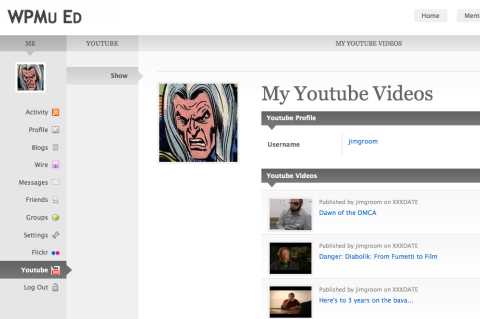
Or adding your latest YouTube videos to your profile page (developed by Nicola Greco).

bpdev_youtube

And there’s the SimplePie plugin for BuddyPress that makes these other two go (developed by Nicola Greco).

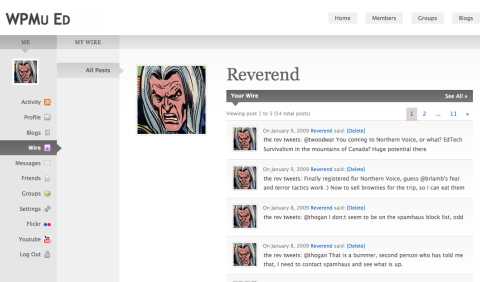
Oh yeah, and there is the Twitter to Wire, that allows you to include all your tweets to your BuddyPress Wire (developed by David Aubin). Keep in mind that you need the Twitter Tools plugin isntalled and activated for this one to work, which you do in your blog on the BuddyPress site.

twitter_wire

There is also a BuddyPress Dev Site Admin plugin, which allows you to see the latest plugins on the BuddyPress site in the Site Admin area of your blog (developed by Nicola Greco)

I also tried the Community Blogs plugin by Burtadsit, which allows users to add themselves as authors to a community blog, similar to Andre Malan’s plugin Add Users, just integrated into the BuddyPress navigation bar. I like the idea of this plugin, but I haven’t been able to get the add user function to work in the navbar.

And there are more, I just haven’t tested them.  I’m impressed by how quickly integration with three major social networking services was accomplished in BuddyPress, and I also like that my various sites (and I am a Flickr, YouTube, and Twitter guy) can so easily show up on you profile page in BuddyPress. What I’m thinking is that they need a plugin for RSS feeds for the profile page from, say, another blog on some other service. They also need a way that you can widgetize and customize your profile page so that you can easily control the order of what people see and how that can explore your various identities online.

Posted in BuddyPress, plugins, wordpress multi-user, wpmu | Tagged , , , , , , , | 12 Comments

We Edit Life

The other day I came across a video by People like Us (a.k.a. Vicki Bennett) on Ubuweb, specifically the collage video she put together from found footage at the Prelinger Archive called Remote Controller (2003). It comes highly recommended, and the description at Ubuweb frames it succinctly:

This work explores the subject of experimentation in human body and machine interfaces in the 20th century. The film edits together the different ways we have controlled our environment – through technology, magic and theatrical devices. As the world of communications brings people together, power still exists by pushing a button and pulling the puppet strings.

The film got me excited, so I went searching for more. I found out the she has a weekly radio show on WFMU (why am I not surprised by this?)  called Do or DIY. And with just a bit more searching I found another gem by People Like Us called “We Edit Life” (2002). This film is an excellent model for video collage in my mind (much like Donald O’Finn’s work) that is almost entirely dependent upon the audio. It’s abstracted by a series of inter-connected themes like creation, visual design, technology, communication, manipulation, destruction, and death that are weaved in and out by and amazing soundtrack that might be understood as a series of crazy dialogues and songs, but yet have none of the predictability or organization premised by these traditional narrative cues. Rather it provides a kind of mood noise that undulates in an uncomfortable struggle for meaning. My favorite part of the film comes at about six minutes in when you see the golden-bodied robot (which the designers created earlier in the film) singing a far out song for which the lyrics move from “never to die” to “we will all die…die, die…” It was a powerful shift for me, and it was all in the audio—the voice of the robot was derived from a kind of MacInTalk Fred which adds brilliantly to the effect. Trippy and powerful stuff that just makes me want to return to the Internet Archive daily and search for crazy stuff and create one found footage mashup a week—which actually sounds a lot more appealing to me than a picture a day.

And speaking of MacInTalk Fred, for more craziness that is very much in line with the experimentation by People Like Us, check out the song “Within One Universe there are Millions” by Man or Astro-man? that features MacInTalk Fred on the vocals, in fact their entire live performance at the BBC studios in November of 2001 is available on the Internet Archive here.

Download Man or Astro-man? “Within One Universe there are Millions”

Posted in music, Uncategorized, video, YouTube | Tagged , , , , , , , , , , , | 4 Comments

Get a real job, hippies!


Image credit: Hippies de Valdivia (Chile) by leo.prie.to

Tired of singing the same old song about teaching, learning, and technology to an apathetic audience?  Want to liberate yourself from those degrading improv gigs in the campus commons to anyone who will listen?  I bet you are, and I know you do. So why aren’t you applying for Director of the UMW Center for Advancing Teaching and Learning position? I mean, come on, Mary Washington provides a unique experience for anyone who is deeply passionate about teaching and learning, especially if you think these practices in relationship to emerging technologies. We don’t only have an absolutely amazing faculty committed to exploring and experimenting with their pedagogy out in the open, but we also have a crack crew of instructional technology folks (if I must say so myself) which is just an added bonus.

So, this is my shameless plea to anyone out there (or anyone out there who knows someone else out there) who might be interested in getting on board with a bunch of punks who won’t deign to beg for beer money, but rather just go out there and snatch it. Real innovation, real fast, and a faculty to back you up, that’s what we got—and we are serious about what we do. So, think about it, but make it quick because applications are being accepted until 5:00 p.m., January 30, 2009.

In the event you’re finally ready to give up your hippie ways, you can find more details about the position here [Update: link long dead].

Posted in Uncategorized | Tagged , , , , | 12 Comments

I like my Cultra Rare

Update on 12/14/09: Unfortunately Cultra Rare is gone, for nothing gold can last.

cultra_rareI have been exploring the Cultra Rare site I found by way of this post by Kliph Nesteroff over at WFMU’s Beware of the Blog (I’m finding Kliph to be a veritable goldmine of resources). What I love about Cultra Rare is how much it makes me feel like I’m eleven years old browsing the shelves of our local mom and pop video store circa 1982. The look and feel of the site adds to this bit of nostalgia given the old school web design and no-nonsense approach, the tag line says it all: “NO POLITICS, NO NEWS, JUST PURE ENTERTAINMENT!!”

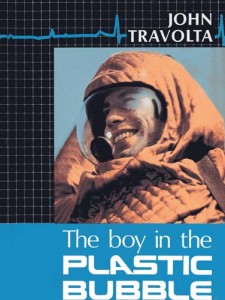
plasticbubble2The site offers downloads to a wild collection of hard to find films from the 1960s, 1970s, 1980s, and early 1990s, that haven’t been commercially released on DVD. It’s kind of a b-movie lover’s dream archive, filled with everything from the Dean Martin’s last film (which is still banned from video distribution in the US–anyone know why?) Mr. Ricco (1975) to The Boy in the Plastic Bubble (1976) to Sasquatch (1977) to American Hot Wax (1978) to Treasure of the Four Crowns (1983) and a ton in between. I’m excited by the possibilities here, but just like in the video stores of yore, browsing the titles and the crazy poster/cover art is a large part of the titillation of the movie watching experience.
Another bonus is the file that includes an insane number of trailers from a host of crazy movies. Until last night, I have never watched two hours worth of horror movie trailers in one sitting, and I have to say that the experience is pretty wild. It’s in some ways more enjoyable than sitting though any one of these films for the same time period, which may have something to do with the way I’m consuming video online these days. Nonetheless, watching so many trailers in one sitting impressed me with just how many ways you can approach a trailer.

Take, for example, Hitchcock’s trailer for Psycho (1960), wherein he tours the scene of the crime for six minutes (all the while to an oddly upbeat music score) obliquely narrating the details of the grisly murders, until he nails the lulled audience at the end with the shower murder scene. Brilliant stuff.

And the unreleased trailer for William Friedkin’s The Exorist (1973) is like surrealist experiment in expressionism, a truly haunting and impressive trailer that seems to bun the possessed image of Linda Blair on your psyche.

Or another masterpiece is Kubrick’s original trailer for The Shining (1980), which is brilliant in its austere approach to introducing the film.

And then, in stark contrast to Kubrick’s subtlety, you have the in-your-face, sensational narration for The Corpse Grinder (1972) trailer, which is a lot fun in it’s innovative use of editing the machinations of this diabolical machine, creating some very mild gore.

And then there are the unrated trailers that seem to push the limits for certain audiences, for example the Italian horror film Mangiati vivi! (1980) (or Eaten Alive!) lays on the gore.

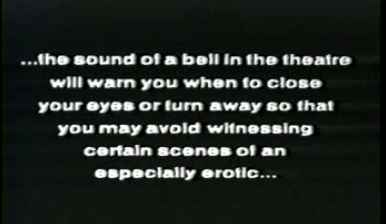
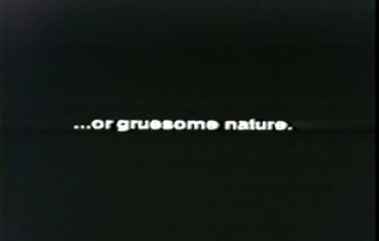
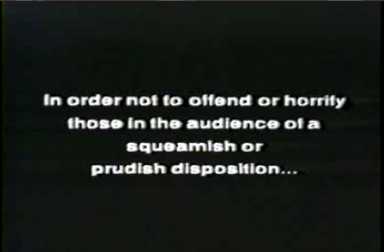
And then there are those trailers with the warning gimmicks for the audience, which I love. How come we don’t do this any more? Take for example the trailer for Cannibal Girls (1973) which let’s the audience know that a bell will ring when a particularly erotic or gruesome scene is about to occur in order to protect “the prudish and squeamish”:

Here is the trailer where the narrator talks about this:

And here are the screen shots from an alternative trailer where the message is both read and written on inter-titles:
cannibal_girls_1
cannibal_girls_2
cannibal_girls_3

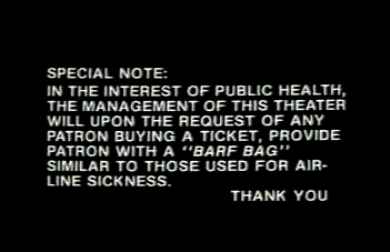
Or the warning at the end of the trailer for Lucio Fulci’s classic Zombie, which adds this special note:

In the interest of public health, the management of this theater will upon request of any patron buying a ticket provide patron with a “barf bag” similar to those used for airline sickness.
Thanks You.

Barf Bag Zombie

And here’s the actual trailer, which makes me wish I was playing Left 4 Dead right now:

And then you have the more erotic than horror trailer for a film like Lady Frankenstein (1971) (a personal favorite). There can be no question this is a European production given the nudity in the trailer, but I’m wondering whether an R-rated trailer like this actually make it into US theaters in the early 70s—my impulse is to say no, but I’m not certain.

And then there is even more overt trailes for the Italian soft-porn horror genre. Take, for example, Alfredo Rizzo’s 1975 film the The Bloodsucker Leads the Dance, which I’ll let you find on YouTube on your own, with a little help, if you are so inclined 🙂

All this to say, there is much to be learned from movie trailers, and while my bag is the horror/gore trailer, I think this form has much to teach us in a moment when two to three minutes of video is about all we make time to watch. How much can you say in such a short period of time? I think a course of movie trailers and posters has never been more relevant.

Posted in movies | Tagged , , , , , , , , , , , , | 3 Comments

Friday the 13th, part 3 with laugh track

This is awesome, and illustrates beautifully that canned laughter can make some really bad movies rather enjoyable.

Posted in fun | Tagged , , , | 2 Comments