“A Little Fable” by Franz Kafka

‘Alas,’ said the mouse, ‘the whole world is growing smaller every day. At the beginning it was so big that I was afraid, I kept running and running, and I was glad when I saw walls far away to the right and left, but these long walls have narrowed so quickly that I am in the last chamber already, and there in the corner stands the trap that I must run into.’ ‘You only need to change your direction,’ said the cat, and ate it up.

Posted in Uncategorized | Tagged , , , | Leave a comment

A 21st century teaching conceit

Last month TorrentFreak had an article about Professor John Stinchcombe of the University of Toronto explaining how he uses the concept behind bitTorrent to explain DNA sequencing. You can see the slide below (which even includes an image the Pirate Bay logo 🙂 ) where he draws the comparison.

Image of bitorrent dna slide

What’s so cool about this to me is not just that prof Stinchcombe is using new, relevant technologies to explain biological concepts like DNA sequencing, but more broadly how this exemplifies how important it is for all of us to explore and imagine the contemporary conceits that surround us with this new technological moment.

Language is how we will make sense of this stuff, it’s how we will both question and directly challenge the determinism that is often concomitant with new technologies. The poetry of the 21st century will be written, filmed, or designed through these new, de-centered technologies that connect a new world, while at the same time control and expose it like never before. It’s a multi-headed hydra (to push a metaphor) that we need to play with both conceptually and linguistically just as much as we dictate its uses and abuses pragmatically.

Posted in art, bitTorrent | Tagged , , , , , , , , | 4 Comments

A Calendar Year

About a month ago I discovered a ton of UMW-related Google calendars, and thanks to Tony Hirst’s post here, I realized that Google Calendar actually allows you to aggregate public calendars into one overarching calendar. So, I finally sat down today and brought 26 public calendars related to UMW events into an aggregated, embeddable calendar, the fruits of which you can see below or here (I stopped at 26 because when I tried to add a 27th the embed code threw an error, which is curious).

I think the folks I work with at UMW might find this as remarkable as I do, for one of the biggest issues we have is actually knowing what the hell is going on (which I imagine is the case at most institutions that have thousands of people). By looking briefly at this calendar I know more about what’s going on around campus in one quick scan than I have for the last three years. Moreover, it simply adds several more events and deadlines to a pre-existing calendar that I found on the UMW site here in early December.

Now, this is all fine and good, and I’m excited by the idea that departments, offices, and clubs around UMW can create and manage their own public calendars in Google, which, in turn, anyone can aggregate and embed where ever they want. But the question will soon arise, how would we allow anyone to add their own events from a range of different applications such as Apple’s iCalendar, MS Outlook, a WordPress Calendar plugin, a Drupal Calendar module, or an online events service such as Eventful? Well, I wouldn’t really have a clue if I didn’t subscribe to Jon Udell’s blog. He’s been talking about his most recent social project elmcity.info somewhat regularly for the past six months, and he’s been working through this very issue. Elmcity.info is several things, but I think the backbone of it—or at least what Jon has spent most of his conceptual time on—is centered around an open, distributed events calendar for the goings-on in and around his hometown of Keene, New Hampshire. You can get a nice conceptual introduction to aggregating calendar feeds (a.k.a. ICS) on his blog here, as well as a series of posts about his development of this calendar aggregator here. And just a couple of days ago he introduced his plan for vetting trusted feeds for a public calendar by using delicious as a transparent, online database through which you can tag new or trusted links accordingly, which will provide a feed for monitoring new additions. But, the real take away might be this:

Del.icio.us (and any del.icio.us-like service) is a database! You can use it, without doing any programming, to maintain lists of arbitrary sets of resources that can be queried and edited, with equal ease, by humans and by programs.

Using a pre-existing, easy-to-use tool like delicious to vet, manage, and monitor new events and users for a public calendar is wild, yet another conceptual nuance that Jon is king at, and a further realization that the small pieces loosely joined makes so much sense. Albeit, Jon is prototyping the actual ingestion of those delicious feeds into the calendar aggregator he’s developing in the cloud (using Microsoft’s Azure).

So all this has me excited, and a while back when I was talking to Jon about a recommendation for a grant, he started talking to me about what he’s doing in Keene, NH with elmcity.info, and now I know why he’s the real reverend, because in less than fifteen minutes he sold me on doing something similar for Fredericksburg. I was immediately drawn to it because it’s not about monetizing the software or selling a product, but rather hitting the pavement and engaging the “city” I live in around issues of how organizations, small businesses, sports clubs, libraries, schools, etc, can easily manage, share and aggregate their public information for the larger community without depending upon a proprietary solution or corporate go-between. So, rather than having everyone’s calendar of events siloed on their own website, or managed by the local newspaper, like the one here in Fredericksburg (none of which can be shared on other people’s sites, or is managed by the individual contributor), each organization or individual manages and updates their own calendar, but shares it freely once they have established a level of trust. It truly becomes a community calendar, all of which makes me think that I am finally going to finally take a small step in the recent direction of Barbara Ganley, who has chosen to leave academia and roll up her sleeves up for a good, old fashioned neighborhood digital street fight, or what she calls Centers for Community Digital Exploration 🙂 I like her style, and for me 2009 will be about getting out there in my physical community and talking to people about how some rather simple ideas like syndication and aggregation can help people easily share what’s going around town.

At the same time, I hope to discuss certain ways of thinking about these new technologies that might help shape the way any given community shares information with its members and provides open access to what’s going on. While at the same time gives individuals control over their respective information and allowing anyone to participate by becoming a contributor. Obviously, this shouldn’t stop at the calendar, for the same logic applies to local blogs, images, videos, etc. Yet, perhaps the calendar might frame an important, yet elusive, piece to bringing together a group of geographically bound neighbors in search of what the hell is going on. For, more often than not, the prevailing logic of the web is often still, at least on local levels, a proprietary strategy of making people come to your site for information. A reality which is quickly becoming less and less a viable option for getting the word out. We need to focus on how we get the information out there and encourage it’s reproduction in as many places as possible as often as possible.

So, I guess I’m gonna try and explore my own backyard when it comes to imagining these technologies as a way to shape community and build relationships. Something I enjoy tremendously in my work at UMW, I’m just thinking about it as a hobby on a bit broader scale. At the same time, it will hopefully give me the opportunity to think more specifically about what the term “community” really means in this day and age, for it is thrown around alot, but I’m still not entirely comfortable with it. So, anyway, I imagine there will be a few blog posts over the course of this year about my explorations in the local, that is if i don’t get sent packing directly as a carpet bagging, pushy New Yorker. I guess only time will tell.

Posted in Around Fred | Tagged , , , , , , , , , , , | 9 Comments

The Pirates of Oz

I just put on a DVD for my kids, a Warner Brothers film we paid cold, hard cash for, yet are still forced to sit through a barrage of commercials and previews that range from insipid to insulting. On the far end of the insulting side of this spectrum was a fear mongering anti-piracy clip that has me reeling. Warner Brothers re-cast The Wizard of Oz so that Dorothy, the Tin Man, the Lion, and the Scarecrow are to be understood as pirates, and the Wizard is to be seen as something along the lines of an MPAA goon. Take a look for yourself at the 50 second spot below:

What’s crazy is how brazenly Warner Brothers is targeting attacking the young and the meek “Dorothys” of the world with their scare tactics. Despite the fact that we paid more money than we should have for the video, our kids are, nonetheless, forced by Warner Brothers to sit through this cautionary commercial if they want to get to the feature. When did a company’s preying upon their young and meek audience, while simultaneously ruining an all-time classic, become not only tolerable, but the norm?

But re-framing always cuts both ways, that’s the beauty of media, interpretation, and context. Anyone who has seen the film knows that the Wizard is a fraud who builds an elaborate front with smoke and mirrors to hide the sobering reality that he’s a homunculus whose only power is in false bravado, subterfuge, and double-talk. And therein lies the “man-behind-the-curtain” of pirating cautionary tales spawned by media interests to prey on the unassuming. A despicable tactic that has no other aim than to instill fear and terror in the hearts and minds of the young and the meek. Yet, it is the meek that shall inherit the internet, and the deceptive interests that espouse fear and terror must be exposed as soon as possible so that we can bring them and their cultural heritage into the 21st century. If you don’t feel the need to stand up against the MPAA and the RIAA because they are eroding your rights to share, copy, and interact with the culture you have been thrown into, then, for the love of God, do it for the children!!! 🙂

Posted in copyright | Tagged , , , , , , , , , | 10 Comments

A John Hughes New Year

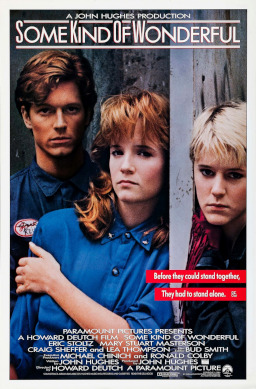
Image of Some Kind of Wonderful movie poster

Well, when the clock strikes midnight the New Year will be upon us, and it’s a particular one for me because 20 years ago this year I will have graduated high school. I really don’t have too many high school horror stories. I had my fair share of fun and disappointment in that prison, while managing to watch a ton of movies all the while. In fact, I think my high school years made sense to me because of all those 80s movies I watched on the family VCR.  And when in comes to dealing with high school and the concomitant friends, romantic relationships, sexuality, and identity crises, I think a good amount of teenagers during the 80s in the U.S. did much like me–they turned to John Hughes’s big five: Sixteen Candles, Pretty in Pink, Some Kind of Wonderful, The Breakfast Club, and Ferris Bueller’s Day Off.

In fact, I blame John Hughes for making me a hopeless romantic during those years, for innumerable fashion disasters, and for an unhealthy desire to see my high school start a Saturday detention.  Yet, I’d be remiss if I didn’t acknowledge how important films like Some Kind of Wonderful (my all time favorite high school film, and introduction to Elias Koteas) and Pretty in Pink were for me in the way they articulated and traced the implications of class and wealth in US high schools in ways few other directors have paid such close attention to before or since. But, the fact that these films were so popular brings up some larger questions about the hyper-individuality often associated with the 80s. If so many of us took our cues from the same, limited, mass-mediated cultural pool, how do we even begin to understand the idea of individuality?  I think this might be why music (particularly the splintering and redefining of the punk movement along with the explosion of rap) remains the most important cultural phenomenon of this decade alongside, and as an integral part of, the film industry.

So, as part of an on-going, half-assed commitment on the part of the bava to re-visit the impact of the VCR on 80s culture and directly address the intolerable injustice that haunts the middle class hallways throughout this entrenched nation,  I will take a close look at the history of high school films over this next year, using Hughes’s big 5 of the 80s as a starting point, but then working out from there in an arbitrary, whimsical manner and until September 12th, 2009—or the day of my 20 year high school reunion. I’ll be thinking through high school films as a very specific argument about issues surrounding education, class, gender, music, style and race—which is an absent presence throughout all Hughes’s high school films—during the 1980s. At the same time I’ll be wondering what life might look like as the future of education promises to change dramatically in the 21st century, so half nostalgia, half Nostradamus 🙂

As a primer, here is some required viewing I found on the internets:

A pretty amazing montage of scenes from the big five high films titled “Through the Eyes of John Hughes”:

A great, class-inspired moment of triumph as the poor kids overcome the rich in Some Kind of Wonderful, which may be read as an allegory for the mainstream media versus the bava

And I’ll throw in “Some Kind of Wonderful in a Nutshell” because the music in this one rocks 80s style:

Posted in movies | Tagged , , , , , , , , , , , , , | 2 Comments

“If they don’t learn, kill ’em”

Martin Weller has been making the parallel between movie stars and edubloggers, and while some folks have commented with the usual concerns about thinking through blogging in terms of stardom and fame—more of the self-effacing edtech pandering that drives me crazy—I love this exercise. My only issue is that Martin does himself a great disservice by likening himself to that hack Ben Affleck, he’s more a Sean Penn in my mind. So, while I’d like to think of myself as a character actor along the lines of the inimitable Harry Dean Stanton, I think the bava comes much closer to the late, great Robert Mitchum. Now, some of you may not know (or remember) how crazy and unlikable Mitchum was, so before rolling over on this one, try warming up to the comparison after watching the following clip from an interview in which he responds to the question “Should we pull out of Viet Nam?”

That’s right baby, the bava is back from New York and in full effect. Kill ’em all!!

Posted in fun | Tagged , , , , , , , , | 7 Comments

A Very Bava Xmas

A day late and a dollar short, I know, but I’ve been so busy stocking up on meatball heroes, pizza, and bagels up here in New York that I haven’t had time to return promptly to the bava (which is one of my rules). But I’m not one to let an opportunity for an 80s b-movie posting pass me by, so here’s a special clip from Silent Night, Deadly Night (1984), a Xmas slasher that is representative of the beautiful titles you could discover at mom and pop video stores on Long Island back in the day.

Posted in movies | Tagged , , , , , , , , | 2 Comments

RIAA: Three strikes and you’re without

I’ve been following the RIAA’s recent announcements that it will no longer be suing individuals, but rather working with Internet Service Providers (ISPs) to enforce a “three strikes your without” campaign. As David Kravets notes on here:
The RIAA has sued more than 30,000 individuals the past few years, and has settled most of the cases out of court for a few thousand dollars. Under the RIAA’s new strategy, internet service providers will notify (.pdf) alleged copyright infringers detected by the RIAA that they need to cease their alleged infringement of the industry’s music. Three-time offenders face losing internet access.

I think this new approach has far greater and even more frightening implications for just about everybody on the internet. And while the RIAA has been targeting high school and college students as part of their recent strategy, this new approach basically goes to the source of connectivity and threatens everyone’s internet access through an attempt to circumnavigate the courts by framing a friendly, fascist arrangement between ISPs and media interests groups.

Let’s think about the implications of this for a second, as quoted above, “alleged copyright infringers detected by the RIAA that they need to cease their alleged infringement.” One of the key things to think about here is that the detection for files is anything but a science, as the study “Tracking the Trackers” at the University of Washington found earlier this year when examining the take down notices sent to students who were “allegedly” sharing files via bitTorrent. Little is known about the actual methods these anti-piracy companies are using for detecting alleged violations. According to the University of Washington study, “practically any internet user an be framed for copyright infringement today.”  So, as the RIAA changes their strategy to directly work with ISPs, the issue of their methodology and ability to establish what may confirm an “infringement” will become even more pressing given they are threatening to take away your internet after the third offense. Are they going to be transparent about this in their new assault approach.

In fact, I think the RIAA may be savvy in their new approach because, let’s face it, by targeting students they weren’t really winning any popularity contests. Add to that the fact that they were forcing already strapped educational institutions to be the go-between, which sometimes (though not often enough) resulted in a certain amount of collective awareness about students rights and their recourse through the law. Well, seems like any hope, however meager, to fight the continued attacks of these through some kind of collective action against media interest groups (which, by the way, don’t understand the internet) will soon be gone. This is no longer a negotiation between university IT organizations and students (which in many regards is a good thing for their relationship), but rather the more isolated and alienating struggle between an individual and their internet provider.

Needles to say, the individual who is up against a wealthy and powerful collection of interests is at a greater disadvantage then when this process was mediated through a university. And chances are that most people won’t know their rights or ask the the basic questions: How do you know I’m sharing files? How can you prove it was me? And what happened to the basic levels of privacy a service provider should offer its customers?

Moreover, does this mean a university or college will have to still mediate these same issues through their ISP rather than directly through the RIAA. Will the university lose it’s internet after three offenses when this new approach goes into effect 😉

I don’t know, a part of me is glad to see it moved away from the institutional mediation of copyright infringement at universities and the like, but another part of me is even more frightened  at the new strategy which will potentially place huge, bureaucratic corporations against individuals, threatening them with their internet lifeline over allegations that none of us really know how they are technically establishing. What it all moves towards is not simply the fear of sharing copyrighted files via the internet, but more broadly the fear of sharing on the internet period for fear of losing this “corporate sponsored right.” This is not necessarily an attack on copyright infringement, but rather a war against the mentality of sharing more generally on the internet when it comes to media. It’s this core value of US corporate capitalism against sharing (which is premised on accumulation and greed) that has fucked our economy up so thoroughly these days. It’s nice to see that tradition continued though powerful interest groups like the RIAA, who shamelessly place all of us under their gilded boot by going to the root of connectivity. Why don’t they just ask for a bailout and be done with the whole thing? Better yet, given our recent move towards socialism, isn’t it time we socialized the ISPs?

Posted in copyright, piracy | Tagged , , , , , , , , , | 1 Comment

Integrating WPMu, BuddyPress, and bbPress

This is a tutorial documenting the steps I’ve been working through over the past week to integrate WPMu, BuddyPress, and bbPress. All of the applications versions I am currently using are either in beta, alpha, or taken from the trunk. So, needless to say, this tutorial will have to be updated regularly as the versions stabilize. Knowing this, I wrote this tutorial in a wiki, which I plan to update regularly as the version of each application changes. And once it’s all solid, I plan on moving it to any WordPress codex that will take it 🙂

Just about everything I document here comes from either the bbPress or BuddyPress forums. I just tried to organize the resources and instructions to help out anyone who is coming at this fresh, and needs pointers to the relevant resources such as forum threads, further tutorials, screencasts, etc. To see this insanely long tutorial, make the jump after the following link.

Integrating WPMu, BuddyPress, and bbPress tutorial

Posted in wordpress multi-user, wpmu | Tagged , , , , , , , | 57 Comments

Lady Frankenstein

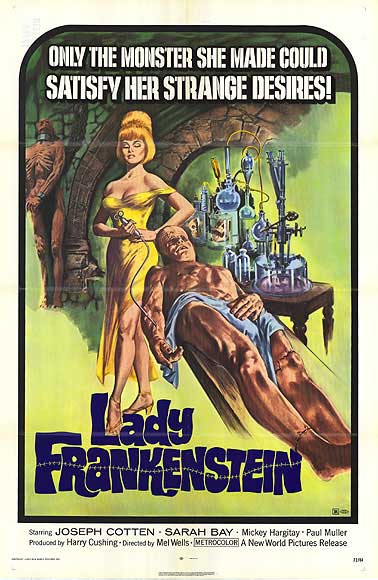
I have this movie poster hanging in my living room, it’s one of my all time favorite posters—though admittedly not such a great film. I particularly like the tag line as it relates to the artistic detail in the poster.

ladyfrankenstein

So, pray tell, after a closer examination of this movie poster, what might Lady Frankenstein’s “strange desires” be? 🙂

Has anyone seen a crazier film poster?

Posted in images, movies | Tagged , , , , , | 6 Comments