Wonder Twins activate, form of “Write To Reply”

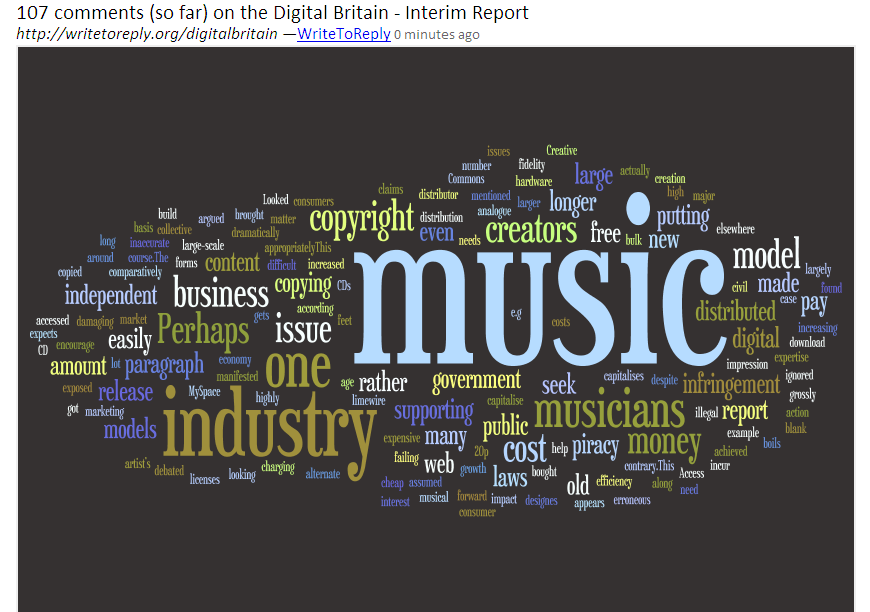
Image of Wordle CLoud on

I just wanted to applaud Tony Hirst and Joss Winn for the amazing work they are doing with Write to Reply. These two British cats did nothing short of re-imagine the possibilities for an open, accessible discourse around documents that are made available for public review. What they have effectively done is create a site for re-publishing these public documents—which at the moment are Digital Britain’s Interim Report and the recently released Open Source, Open Standards and Re–Use: Government Action Plan (which Ars technica just reported on today)—that allows a line-by-line commentary by anyone who has something to say about the direction of these initiatives.

They also have a twitter account, a blog, Wiki, etc. It’s a remarkable example using free and (mostly) open tools like WordPress Multi-User, MediaWiki, and the like to quickly implement a space whereby people can publicly discuss, debate, and become informed about the ideas and decisions the British government is framing about their shared future. This is a model for fast, cheap, and loosely-joined civic engagement, and it wasn’t done by committee or through the organizations and leaders that be. It was done by a couple of British edtech edupunks who just wanna rock out! So, what have you done lately, honcho?

Posted in edupunk | Tagged , , , , , , , , , , | 6 Comments

EDUPUNK Battle Royale, Part 2

EDUPUNK Battle Royale, Part 2

Thanks to Gerry Bayne for turning this around so quick —I think the next three videos will be coming out sooner than later. I just saw this for the first time minutes ago, and I have to say that this is where Gardner and I really start to dig deep into questions that we have been talking about for years, namely the idea of leadership in institutions.

Posted in edupunk | Tagged , , , | 19 Comments

Another State of Mind

Another State of Mind, part 6 Note: the sound on the video is out of sync, which is annoying, so all the more reason to get the whole thing and just watch it.

As a follow-up to the Heavy Metal Parking Lot post, here’s my favorite punk documentary of the 80s, Another State of Mind (1984). It follows Youth Brigade and Social Distortion on a national tour in 1982, and it has some of the best talking heads and vignettes of the punk scene I have yet to see. Check out the kid talk about his idea of punk at 2:36 seconds of the above video clip, and don’t miss the Circle JerksKeith Morris talking about religion either.

Another gem of this video is watching Mike Ness compose the song from which the video takes its name. it really endeared me to him back in the day, although I was never a big Social Distortion fan. Also, the first 2:30 of this video is absolutely priceless in regards to religion, punk, and the larger questions of family values and the idea of punk as an embodied reaction to the family values agenda and moral order of the Reagan 80s. In my opinion, no sequence captures the complex social relations and realities such a scene evolved out of and into better than this one.

Posted in edupunk | Tagged , , , , , | 2 Comments

Heavey Metal Parking Lot

I just came across the above video featuring a scene from Heavy Metal Parking Lot (1986), which is a cult classic documentary about Heavy Metal in the 80s that I had never heard of. How in God’s name did I miss this? I may have to rent this on Netflix along with Decline of Western Civilization Part II: The Metal Years (1988)—which I also haven’t seen—for a special double-feature at the bavahouse, or maybe part of the bavacon movie marathon?

Thanks for this goodness go to my new favorite blogger, Renè Garcia, Jr. on I Love this World.

Posted in movies | Tagged , , , | 11 Comments

Horror of the 80s: Step-Parents

Now let me be clear about this before I get started, the horror of step-parents is by no means particular to the 1980s. If one thinks about it for a bit, other examples throughout the Western canon of literature and film come to mind, like Hamlet‘s King Claudius or Cinderella’s wicked step-mother or even my favorite reverend Robert Mitchum in Night of the Hunter. That said, the 80s provides an interesting cultural moment for the murderous step-parent that is particularly special to me, because the film The Stepfather (1987) was an important one in my life. Let me explain a little bit as to why.

My parents were divorced in 1984 (I was 12 or 13), but it wasn’t so bad because I had six brothers and sisters to lean on, and quite frankly my mom deserved a break—we all knew that. In fact, we were all prepared for it, and one of the best traits of my family—despite being clinically nuts—was that we had the great fortune of being able to joke about emotional turmoil, a trait which buoys us and keeps us close still. By 1986 my mother was re-married, and I entered the world of step-parents. Divorce and step-parents was nothing new to me, most of my close friends from high school came from divorced families, and it was as much the norm as not.

It wasn’t something we ever really talked about, it just was. I have no real horror stories of my own, just more life, but I give you this background to set the stage for why The Stepfather’s appearance on my local video store’s shelf in 1987 was so significant. It was the first time I watched a film wherein I realized how it was intentionally playing on (some may argue exploiting) a social phenomenon that so many people with a given culture were experiencing. The idea of the broken family as somehow horrible, and the nucleus of moral values, “the family unit,” being invaded by outsiders, who might even potentially be homicidal strangers. The heart of the 80s family values cultural tripe might be read into this film, yet at the same time it was comical. It was a film that made my friends and I laugh, we loved Jerry Blake and his constant stammering “Who am I here? Ahhhh, Jerry…Jerry Blake.” This was vintage humor for us, and the very idea that we were together reading this film as a piece of exploitation, of thinly veiled and cheaply packaged cultural commentary that we both acknowledged and reveled in at the same time was a watershed moment for me in retrospect. I was 14 or 15, the world on film was trying to comment on my living room, and I realized there are millions just like it. A narrative ill-equipped to deal with the issues of the day is just as informative, and at times more enjoyable, than those that pretend to be, or even are. The apotheosis of the b-movie in my mind, and the beginning of a love affair with bad films.  Yep, that’s right, The Stepfather was the first in that regard. No, not the first b-movie by a long shot, but the first one that gave me a glimpse of perspective on why I liked them so much. It was a moment that very much informs much of my writing on this blog, and my own fascination and great respect for cultural media studies.

Who am I here? Ahh , Jerry…Jerry Blake.

Here’s the trailer

And here’s the classic opening scene

Posted in movies | Tagged , , , , , , , | 5 Comments

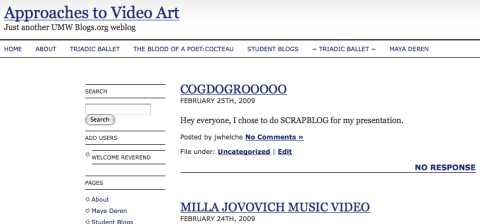
Cogdogroo is in the UMW Blogs House

cogdogrooooo

While scanning UMW Blogs this morning, I came across the above blog post which I have to believe is referencing CogDogRoo’s Story Tools.  And while we push the Dog’s “50 Ways to Tell a Digital Story” like crack around UMW, what’s remarkable to me is that none of us here in DTLT talked with the folks in this particular course about Alan’ awesome resource, it just appeared, like magic—and the title says it all. The long tail of the CogDog is wagging it’s way all over the place, and here’s just another little bit of proof.

Posted in UMW Blogs | Tagged , , , | 3 Comments

The EDUPUNK Battle Royale, Part 1

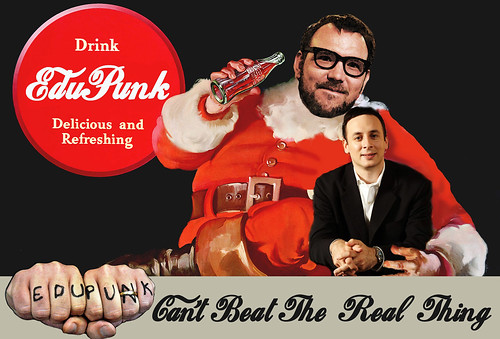
Image credit: Tom Woodward’s “Michael Chasen sits on edupunk Santa’s lap and hopes not to suck so much this Xmas”

At the EDUCAUSE main conference in Orlando this past October, Gerry Bayne asked Gardner and I if we would be interested in sitting down to discuss the finer points of EDUPUNK. I was thrilled about the idea because there are few things in this world as stimulating as a sit-down, drag-out conversation with Dr. Glu, so I jumped at the chance. What followed was one of the better conversations I’ve ever had….period. It was a free-ranging—at times heated, yet always respectful—discussion about ideas we both hold near and dear. We don’t always agree on a number of issues surrounding organizations and leadership, and it is in those moments when our relationship becomes all the more important to me.

The first part here is an introduction and six or seven minute flail on my part to dodge defining EDUPUNK, after that Gardner kicks in and gets the ball rolling. The next four episodes should be released periodically over the next few weeks, which is awesome for me cause it means at least four more posts 🙂 Special thanks to Gerry Bayne for being an awesome interlocutor and production artist, as well as for making this happen above and beyond the mass of work he was already faced with at EDUCAUSE. And also a big shout out to Catherine (Pumkiny) Yang for quietly working behind the scenes to see that this is reproduced in its entirety, sans editorial (it’s funny Cathy is everywhere doing cool stuff for EDUCAUSE but she does it all so gracefully and without pomp and circumstance, unlike some—namely me 🙂 ).

And now, bring it on Campbell, you finally met your Clubber Lang!

The EDUPUNK Battle Royale, part 1

Posted in edupunk | Tagged , | 30 Comments

Rod Serling on time travel

Rod_Serling_photo_portrait_1959I just got through watching a sixteen part “YouTube series” featuring clips of Rod Serling teaching a course at Ithaca College during the late 60s or early 70s. Gardner mentioned this to me during my first week at UMW more than three years ago, and I finally got around to watching it in its entirety.  There are a ton of gems to be had, and it’s not too long given no one section is more than five minutes—and most are far shorter. If you’re interested, here’s part 1, and you can find the other fifteen easily with YouTube’s related videos feature.

I particularly fell in love with the following minute long section, “On time travel,” wherein Serling talks about time travel as a story device, but also, and more importantly, his own particular obsession to become young again, to return home again—despite what Thomas Wolfe admonishes. He acknowledges his own work is in many ways driven by the creative wellspring and slough of nostalgia. And, as Gardner always points out to me when we start down The Twilight Zone path, the single best episode of the single greatest TV show ever created might be one of the most powerful and painful indulgences of nostalgia ever captured on camera: “Walking Distance” (1959).

“On time travel.”

Beyond that, there is Serling’s discussion of feeling the horror of any given moment deeply while at the same time placing those emotions within the flesh, rather than on a soapbox. Simply great advice, characteristically phrased, from the master himself.

“Does espousing a cause lose character credibility?”

This last clip is a kind of challenge Serling puts forth that seems ever more resonant these days. He wonders why people refuse to push themselves to actualize an idea when it comes to the creative process. Inspirational stuff for anyone who thinks creativity may still have some life in its moribund carcass yet.

“I wish more good writers would put themselves to the test.”

Posted in pop culture, television | Tagged , , , , | 9 Comments

What the internet doesn’t need…

…is another businessman, CIO, CEO, coordinator, customer service agent, designer, developer, director, e-commerce engineer, entrepreneur, instructional technologist, information architect, IT admin, programmer, project manager, quality assurance engineer, security analyst, blog, Web 2.0 app, spam filter, sign sign-on, identity management tool, encyclopedia, learning management system, social network, open source community, email application, digital media tool, video site, social bookmarking service, wiki, cloud, or search engine.

What the internet needs is a….

Poet

Posted in Uncategorized | 19 Comments

Intimate Alienation

Image of a barcode
Image credit: Tom Loth‘s Barcode

I was reading through UMW Blogs this morning, and I came across a post on Mara’s Blog titled “Toys and Intimate Alienation.” The title intrigued me immediately, and the post offers a quick summary of a section of Anne Allison’s Millenial Monsters—a critical study of toys in post-war Japan. [openbook booknumber=”0520245652″ ] The book sounds fascinating, and I’m particularly drawn to this idea of “intimate alienation” that is discussed:

…“intimate alienation,” a term which she [Anne Allison] references a 1999 article by James A. Fujii,…is when you are doing something alone and disconnected from others but simultaneously you are in a place that is “shared” by others.

This concept seems ever more relevant these days, and it reminds me of something Alan Levine (Cogdog) said, via this tweet by Brian Lamb yesterday, during his presentation at Northern Voice yesterday:

@cogdog said his online life felt more real than physical one, people laughed. But that’s not crazy. ‘Real’ life is often mediated bullshit.

The idea that Cogdog’s online life is in many ways more real than the physical world might seem somewhat insane to some, but it hits home in so many ways for me, which also seems the case for Brian. So, when I came across this idea of “intimate alienation” this morning, something clicked in regards to how a number of people understand the mediated, virtual space of the internet as their real life. The very term alienation carries with it a whole series of Marxist connotations around capitalism’s logic of fragmenting any attempts at an emerging class consciousness. It’s often framed by an intimacy not between people but, as Georg Lukács suggests, and intimacy mediated by things that obfuscate real, meaningful social relations. A condition wherein interaction between people is mediated by consumer goods, making the very possibility of relationships outside of these very things extremely difficult, if not impossible.

This idea of alienation might be understood as increasingly more relevant during our moment based on the growing number of people who seem cut-off from the “real world” given the massive amounts of time spent physically alone in public while communing through a computer. A reality that has been woven into just about every facet of modern life from work and education to even more intimate relationships like family, friends, and one’s love life. They are all increasingly mediated by devices, i.e. a computer, the internet, mobile phones, applications, websites, social networks, etc., and what we have emerging is a kind of invisible, multi-layered constellation of things that bring people into real and intimate relationships, but are at the same time premised upon an irrepressible faith in objects: their perfection, increased performance, speed, mobility, ubiquity, etc. It might be understood as an almost religious Positivism wherein social relations are premised on the cumulative logic of a product—in this case computers or the internet (is the internet a product?)—while at the same time the product itself is somehow objective or neutral in the resulting relationships such a platform provides.

This is where this idea of “intimate alienation” seems to capture the real difficulty of our moment, because we are sharing our alienation, we have congregated around that fact in mass numbers. And while many still hail the Googles, Apples, and Microsofts of the world, there is also a growing movement of organized alienation which challenges some of our assumptions about distributed intimacy and the necessary logic of capitalism as alienating. Might have capitalism produced a product that undoes itself? Might the internet be just such an example? Think about the way it explodes the industrial logic (and by extension the model for profit) of distributing information, media, culture, and education, but even more profoundly interpersonal relationships, intimacy, and a kind of re-imagined sense of both the self and the real. The idea of “intimate alienation” captures this strange, unmapped, and unevenly developed space beautifully in my imagination, albeit I am most definitely far afield from the original concept by this point. Nonetheless, I can’t help but think we, as an internet-connected culture, are simultaneously more alienated and connected than ever before, which is at once terrifying and amazing, and I don’t really know how to conceptualize it, no less make any sense of it. It is my life, and it scares me.

Posted in Uncategorized | 10 Comments