YuleTube

Looking for classic Christmas television? Kliph Nesteroff’s Classic Showbiz Television blog may be the best online filters for television on the web. He seems to tirelessly comb social video sites for archival classics that suggest an insane—almost encyclopedic knowledge—of the history of television. And he has been working overtime this holiday season, linking out to all kinds of classic TV Christmas specials. Here are a few of my favorite episodes (taken from a seemingly endless archive spanning three decades) dealing with this joyous season: The Twilight Zone, The Brady Bunch, The Jeffersons, I Love Lucy, All in the Family, Happy Days, Taxi, Sanford and Son, and WKRP in Cincinnati.

And, as an added bonus, here’s the first part of the WKRP in Cincinnati Xmas episode from 1979, the first two minutes feature some classic Dr. Johnny Fever:

And while Kliph Nesteroff was smart enough to avoid this one, I’ll follow the lead of The B-Movie Catechism blog and link out to one of the worst Xmas specials ever made, The Star Wars Holiday Special (1978). I blocked this out as a child because it was such a traumatic experience to watch this while still imbued with limitless sense of wonder instilled by the film proper. Nonetheless, I was recently reminded of this insanely bad moment in Star Wars history —the sitcom logic of which foreshadows the film episodes 1, 2, and 3 in many ways. So here’s you pre-1999 Star Wars medicine.

And, if it’s a film your looking for this Xmas, then look no further.

Posted in Uncategorized, video | Tagged , , , , , , , , , , , , , , , , | 2 Comments

WPMu Theme Editor Easter Egg

Update: Fail! I’m wrong yet again, damn it. Donncha replied to this post on my UMW Blogs here, basically saying he had nothing to do with it:

Not my doing. That’s just the normal WP easter egg. Dunno how that plugin managed to trigger it!

Tom Woodward discovered an Easter Egg in WPMu 2.6 which occurs when you install D Sader’s wonderful Userthemes Re-visited, but fail to include the proper code in the theme-editor.php file. You can see the Easter Egg he saw below:

The analysis below is a WPMu addict geeking out on a few things about this particular Easter Egg that may seem entirely nonsensical, but I find it particularly playful because there’s a history to it. If you follow Donncha O Caoimh (who is the developer of WPMu) you may have noticed he recently discovered the Easter Egg in WordPress 2.6. Getting a kick out of it, seems he made his own version for WPMu 2.6.5. Yet, this Easter Egg isn’t arbitrarily placed at all, it’s linked to an ongoing pet peeve of Donncha’s.  You see, he’s not a fan of allowing theme editing in WPMu because it wasn’t intended to do this (at least according to him) and it opens up security risks if mishandled.

In fact, about a year ago Donncha pulled the theme-editor.php file out of the WPMu trunk all together (which slipped back in recently–purely a merge error he assures us), and I was pretty puzzled by its absence back in January when updating to WPMu 1.3.3. I tracked down the reasoning through a trac ticket which had a brief discussion between Donncha and RavanH and posted about it here. So, when Tom told me when and where the Easter Egg showed up, I was sure Donncha was taking a shot at all us blaspheming WPMu theme editors, and it made me laugh.

After learning about this, I have to admit I’m deathly afraid to upgrade the Multi-Site Manager plugin because I’m petrified it will explode my blog for real. Reason being, if there is one thing Donncha hates more than theme editing capabilities in WPMu, it may very well be creating Multiple WPMu sites within one install –which I for the life of me can’t  figure out because it is such a damn powerful plugin and model.

Anyway, I thought this Easter Egg was awesome touch, particularly because it has a rich, contextualized history behind it if you are a WPMu geek. Here’s to you Donncha, quite a nice touch—you do fine work!

Posted in Uncategorized, wordpress multi-user, wpmu | Tagged , , , , | 5 Comments

WPMu 2.7 before its time

I have upgraded the bava (and my several other sites running on this installation) to the trunk version of WordPress Multi-User 2.7 well before its natural time. I know the risks involved, but everything is neatly backed up and I have been feeling generally restless these days. Not to mention I really, really want to get the 1.0 alpha 4 version of bbPress integrated with WPMu in order to experiment with the BuddyPress group forums. So, I took the leap a bit earlier than recommended, and here’s WPMu as seen through the lens of version 2.7!

Image of WPMu 2.7 interface

Click on image for larger version

On another note, as I learned this morning from Andrea’s WPMU Tutorials log, it looks like the folks at Automattic have released their code for a video solution framework for WPMu—wow! This could get interesting quick, could we soon see a bavatube? What’s your take on this Andy?

Posted in Uncategorized | Tagged , , , | 7 Comments

Going into deep experimental mode

The bava may be in and out over the next day or two as I upgrade my own WPMu version to the 2.7 trunk (pre-beta!) and integrate it with BuddyPress and bbPress (the last piece of which has consistently proven a major pain in the ass when it comes to cookies). Nonetheless, I am getting really close—you can see the beginnings of the integration between WPMu and BuddyPress here. I am still bothering with bbPress because it has been integrated with BuddyPress groups providing instant, integrated forums on the fly, which I like in theory a lot.

So, anyway, great pâté, but I got motor if I’m gonna make this funeral.

Posted in Uncategorized | Tagged , , , | 2 Comments

Dawn of the DMCA

Well, this is a favorite failure of mine. I was working on ideas with Tom Woodard on a Zombie-themed video for copyright, and I insisted on doing my favorite scene from George Romero’s Dawn of the Dead (you can see the original version of this clip here about 55 seconds in). Well, I got in over my head, despite another fine performance by Andy Rush. Unfortunately, I have since let this footage sit around and collect dust, and I’ve been oddly unmotivated to do anything in terms of editing and framing out the zombie footage.

So, this is an effort to get it up in its raw, unedited state so I don’t have to think about it anymore, and perhaps the fact that it’s so half-assed will irk me enough that I’ll re-visit it sooner rather than later—although, truth be told, I do enjoy half-assed stuff. Either way, at least it will no longer be something I have to think about finishing on a regular basis—this stuff gnaws at me—for I want to end this year strong and unencumbered by half-eaten zombies.

dawn of the dmca from Jim Groom on Vimeo.

Posted in fun, video | Tagged , , , , , , , , , , , , | 1 Comment

The RIAA Hates Education! (Which means they hate you and your whole family)

If you haven’t heard, the RIAA recently accused Joel Tenenbaum, a graduate student at Boston University, of downloading seven copyrighted songs when he was a teenager. Such extortion notices aren’t necessarily novel, but what is unique is that Tenenbaum decided to fight back and is represented by professor Charles Nesson and the students in his “CyberOne: Law in the Court of Public Opinion” course at Harvard University.

Not bad representation, especially since Nesson founded the Berkman Center for Internet & Society and has been an outspoken critic of the insidious threat RIAA’s preying upon universities and colleges poses to the mission of sharing that is at the core of educational institutions. Nesson had this to say in an op-ed titled “Protect Harvard from the RIAA” published in the Crimson Tide on May 1, 2007:

Yet “new deterrence and education initiatives” from the Recording Industry Association of America (RIAA) threaten access to this vibrant resource [the internet]. The RIAA has already requested that universities serve as conduits for more than 1,200 “pre-litigation letters.” Seeking to outsource its enforcement costs, the RIAA asks universities to point fingers at their students, to filter their Internet access, and to pass along notices of claimed copyright infringement.

But these responses distort the University’s educational mission. They impose financial and non-monetary costs, including compromised student privacy, limited access to genuine educational resources, and restricted opportunities for new creative expression.

Amen! That’s exactly what the RIAA is doing, using higher education as its unpaid muscle to scare this freshly minted population of adults, essentially putting the responsibility for playing the bad cop on universities (and more specifically IT departments) which breeds an ever-greater culture of criminality and fear when it comes to the internet as tool for sharing and re-imagining the possibilities for teaching and learning in the 21st century. So, the RIAA is not only attacking their customers, but is one of the greatest enemies of education in the US and abroad. Their tactics deter, if not outright prevent, institutions from innovating with online publishing for fear of questions and uncertainties surrounding the legality of sharing resources online—and the moribund state of educational fair use as a concept, no less a strategy for fighting back. The RIAA are a lobbying band of capitalist vampires that are sucking the lifeblood from web-based educational culture, and the logic of controlling access and preventing sharing that fear breeds keeps outdated and irrelevant learning software like BlackBoard on-campus, which costs universities an exorbitant amount and is basically useless in our moment…yet, I digress.

So, Joel Tenenbaum’s case has been shaping up since October 2008, and I just got the following news release suggesting that the RIAA is targeting Joel’s parents now:

HARVARD PROFESSOR & STUDENTS FIGHT THE RIAA:

COME TO RHODE ISLAND FEDERAL COURT

TO PROTECT DEFENDANT’S FAMILY

Now it’s his parents. Who’s next?

Cambridge, MA (December 2008) – At a Dec. 15 hearing in Rhode Island federal court, Harvard Law School Professor Charles Nesson and his team of students will defend Rhode Island residents Arthur and Judie Tenenbaum from the full might of the U.S. recording industry’s combined lobbying and litigating power.  The Tenenbaums face legal pressure from the industry’s lawsuit against their son, Joel, a graduate student at Boston University accused of sharing music files online.

Nesson and his team allege that the Recording Industry Association of America and a coalition of record companies are abusing the federal court system with their litigation tactics, which attempt to make an example out of Joel and his family in the name of “deterrence.”  Joel faces possible damages of more than $1 million for allegedly sharing seven songs on the Kazaa file-sharing network.

The Dec. 15 hearing will address the recording industry’s motion to force Arthur and Judie to produce their home computer so that it can be inspected for evidence of copyright infringement. The computer is not the device on which the alleged downloading took place, and Arthur and Judie did not own the computer when Joel lived with them.

“The basic rules of evidence suggest that this invasion of privacy is both unnecessary and absurd,” said Matt Sanchez, one of Nesson’s students working on the case.  “This hearing isn’t only about Joel’s parents.  It’s also about finally putting up a fight against the recording industry’s intimidation practices.”

The hearing is scheduled for December 15 at 10:00 AM at the Federal Building and Courthouse, One Exchange Terrace, Providence, RI 02903 in Courtroom A, before Magistrate Judge Lincoln D. Almond.  Interviews will be available with Charles Nesson and his students immediately following the hearing.

For more information, please visit: http://blogs.law.harvard.edu/cyberone/riaa/.

Looks like the battle has begun, and while I think their defense is interesting, I would actually modify one thing: they are not simply “abusing the federal court system with their litigation tactics”–they’re abusing and denaturing the mission of higher education as well.

And another thing, why the hell is there only one professor and his students going this alone? Where are all the other institutions that have everything to gain from them winning this case? Who else is lending a hand? The role of colleges and universities as RIAA’s pitbull is in the balance, don’t they want to free of their abusive corporate owners?

Posted in civil rights, piracy | Tagged , , , , , , , , , , , , | 3 Comments

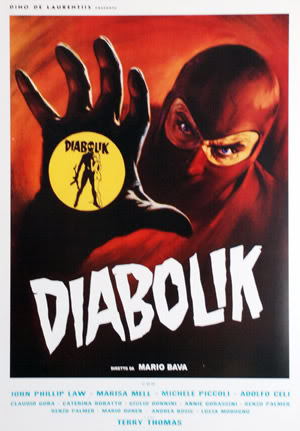
Mario Bava’s “Danger: Diabolik”

Diabolik-posterAfter an unbounded discussion with Bryan Alexander a week ago over dinner in Washington DC, I was reminded of one of Mario Bava’s most acclaimed movies I had yet to see: Danger: Diabolik. And after finally watching it last night, I understand why it has recently become the most popular of Bava’s films. It’s right up there with Black Sunday and Planet of the Vampires when it comes to brilliant camera work, stunningly cheap special effects, far-out costumes and beautfiul set designs (all of which are the keys to a great Bava film). And there may be one other thing it has over these other two films: possibly Ennio Morricone’s wildest soundtrack. Morricone has at least four unforgettable gems in this film: Under Wah-Wah, Deep, Deep Down, Money Orgy, and Driving Decoys (the last of which now rivals my other favorite Morricone song from Pasolini’s Uccellacci e uccellini available at the bottom of this post).

One of the most pleasant surprises of the DVD was actually the short documentary about the film titled Danger: Diabolik: From Fumetti to Film, which featured brief interviews with Ennio Morricone, the great Dino DeLaurentis, and MCA of the Beastie Boys—who happened to be annoyingly inarticulate. The majority of the documentary’s commentary was framed by comics artist and publisher Stephen R. Bissette, who was absolutely awesome to listen to. His discussion of Bava’s aesthetic is one of the best I have heard, he perfectly defines the power of Bava’s film making as primarily sensual, which is driven by an aesthetic and ambient experience rather than a complex narrative or character driven logic. The only thing better than that was his discussion of the comic Diabolik as a moment in pop culture history, which provides a wonderfully contextualized discussion of the cultural history of comics in post-WW II Europe. Bissette offers a fascinating explanation of why the tradition of super criminals (or anti-heroes) took hold in Europe, as opposed to the US tradition of super heroes. If you have two-minutes to spare, I highly recommend you listen to him contextualize the cultural history of comics in post-WW II popular culture, it’s this kind of intelligent discussion and the ability to relate what might appear to many a cheesy b-movie to a broader shift in thinking as a result of historical events like WW II and the counter-culture movement of the 60s that makes me fall in love with film and film criticism again and again. It just seems like he is having so much fun make these connections, and framing his interpretation–not to mention he’s quite smart.

Posted in movies | Tagged , , , , , , , , , , , , , , | 6 Comments

Here’s to 3 years on the bava…

…and all the irreparable harm its has caused me. (Watch the HD version here.)

Exactly three years ago today the madness began, here’s to at least three more.

Film Credits:

  • Andy Rush as an impeccable “Floyd” the bartender who absolutely makes this video.
  • Shannon Hauser for crewing and being, as usual, too generous with her support and time.

Thanks, you maniacs!

Update 11/15/12: My YouTube account was deleted this year, so this now lives on Andy Rush’s YouTube here: http://www.youtube.com/watch?v=mVM7cMYL7NQ

Posted in fun, Uncategorized | Tagged , , , , , , , , | 12 Comments

An inventory of preliminary effects

Wow, I sat down for a good two hours this afternoon while the chilluns were asleep and made my way through the first part of Marshall McLuhan’s The Medium is the Massage, and I have to say that just about everything folks have been saying about the changing nature of the web and its impact on every facet of or life is touches upon within the first 70 pages of that text.  It’s kind of wild to hear it ll, so I’ll use this post to get down some of them and then swing back around the try and make some more sense of McLuhan’s unbelievable handle on our particular moment.

The lead in quote by A.N. Whitehead is just the first of so many gems:

The major advances in civilization are processes that all but wreck the societies in which they occur. (6-7)

Or, how about this for an opening paragraph:

The medium, or process, of our time–electric technology–is reshaping and restructuring patterns of social interdependence and every aspect of our personal life. it is forcing us to reconsider and re-evaluate practically every thought, every action, and every institution formerly taken for granted. Everything is changing–you, your family, your neighborhood, your government, your education, your job,cyour relation to “the others.” And they’re changing dramatically. (8)

Or this one :

It is impossible to understand social and cultural changes without a knowledge of the workings of media. (8)

Or this:

The older training of observation has become quite irrelevant in this new time, because it is based on psychological responses and concepts conditioned to former technology–mechanization. (8)

McLuhan on the “Age of Anxiety”:

Innumerable confusions and a profound feeling of despair invariably emerge in periods of great technological and cultural transitions. Our “Age of Anxiety” is, in great part, the result of trying to do today’s job with yesterday’s tools–with yesterday’s concepts. (8-9)

Another quote by Whitehead that I think really puts into sharp relief the place of emotion in understanding a shifting moment like the one we are in:

“In the study of ideas, it is necessary to remember that insistence on hard-headed clarity issues from sentimental feeling, as it were a mist, cloaking the perplexities of fact. Insistence on clarity at all costs is based on sheer superstition as to the mode which human intelligence functions Our reasonings grasp at straws for premises and float on gossamers for deductions.” (10)

And McLuhan on learning and the educational process, maybe my favorite quote yet:

Learning, the educational process, has long been associated only with the glum. We speak of the “serious” student. Our time presents a unique opportunity for learning by means of humor–a perceptive or incisive joke can be more meaningful than platitudes lying between two covers. (10)

I think this quote exonerates much of the antics I pull on the bava regularly, for I see humor and fun as the  key ways of thinking through the ideas and concepts we are all facing in this shifting moment. Not only to is protect you from taking your self too seriously, but it might also force you to re-invent how you say something which might prevent you from the dessicated approach of the essay without the “I” or the dreaded white paper. Blog it, bitch!

Once again on “your education”:

There is a world of difference between the modern home environments of integrated electric information and the classroom. Today’s television child is attuned to up-to-the-minute “adult” news–inflation, rioting, war, taxes, crime, bathing beauties–and is bewildered when he enters the nineteenth-century environment that still  characterizes the educational establishment where information is scarce but ordered and structured by fragmented, classified patterns, subjects, and schedules. It is naturally an environment much like any factory set-up with its inventories and assembly lines.

The child was an invention of the seventeenth century; he did not exist in, say, Shakespeare’s day. He had, up until that time, been merged in the adult world and there was nothing that could be called childhood in our sense.

Today’s child is growing up absurd, because he lives in two worlds, and neither of them inclines him to grow up. Growing up–that is our new work, and it is total. Mere instruction will not suffice. (18)

McLuhan on “your job”:

Under conditions of electric circuitry, all the fragmented job patterns tend to blend once more into to involving and demanding forms of works that more and more resemble teaching, learning, and “human” service, in the older sense of dedicated loyalty. (20)

That quote above is about the best description I have yet to read about how I feel about what I am doing as an instructional technologist.  This idea of human service and dedicated loyalty frames my relationship to my job as an individual, not necessarily as a part of an institution–although that still remains a key element of it.

The Renaissance Legacy.
The Vanishing Point = Self-Effacement
The Detached Observer.
No Involvement!

The instantaneous world of electric informational media involves all of us, all at once.  No frame or detachment is possible. (33)

And that’s just a peek.  What truly blows me away after reading this book is how much of what he was talking in the first 60 pages of this book (which was at the time pointed at TV and other mass media of the moment) was intuiting the potentia for so many of these forms that were never really realize in terms of particpation and re-framing the institutions. Yet so much of what he is saying is what we have all been hearing so many others repeat again and again over the last several years—including myself.  And this in many ways is kind of the optimists companion to the far more pessimistic perspective on technology in Ernst Jünger’s The Glass Bees. Which sees nostalgia as a salvo to the rather invasive and controlling presence of technology, which becomes more akin to an extension of corporate dominance and military power than an individual/societal return to the Global Village that McLuhan suggests.  And this may be where I part ways with McLuhan on some kind of return to another “primitive” way of seing, knowing, and communicating. Yet, I still need to read more and figure this out, but what I do know thus far is that so much of what McLuhan says in 1967 is as relevant for the world I find myself in at this moment than anything I have read in the last 10 or 20 years, perhaps only Dostoevsky speaks more eloquently of the implications of a complete and utter conceptual shift within a culture.
Posted in books | Tagged , , , , , , , , , , , , , | 4 Comments

The Shining Polka

This is an impressively insane homage to Kubrick’s The Shinging. I love how it is entertaining, freaky and downright disturbing all at once.

Posted in fun | Tagged , , , , | 4 Comments