
Playing with BuddyPress

For the last 12 hours or so I have been playing pretty heavily with BuddyPress, which is basically a series of powerful plugins developed by Andy Peatling that creates a social networking layer for WordPress Multi-User. I had played with BuddyPress about six months ago on the recommendations of Andre Malan, and while it wasn’t there at that time, I’m sure it’s just about there now. In fact, I’m blown away by this project, for it really turns WPMu into a powerful open source social networking tool while at the same time preserving all the functionality and brilliance of WPMu as a blog-based publishing platform.

I really think this project will propel this application into all kinds of new and exciting directions for communities, and particularly educational communities. I regularly get between 10 and 20 emails a month from other universities and colleges all over the world expressing interest in UMW Blogs, and asking for more information about what we are doing with WPMu. Now that a social layer can be seamlessly added to this publishing framework I think the interest in WPMu will become far greater. In fact, I think it has the possibility of absolutely exploding in the education sector given EduBlogs has introduced ad content links in free blogs, Elgg is far less powerful and elegant, Ning is…well…Ning, and Facebook’s ploy for world domination will ultimately prove to be its demise. Why do I make such a prediction? Shouldn’t I leave this to the master of such things? Probably, but after signing up for an account on the BuddyPress test site last night, I got really, really excited.

And in large part because of something rather simple, like this:
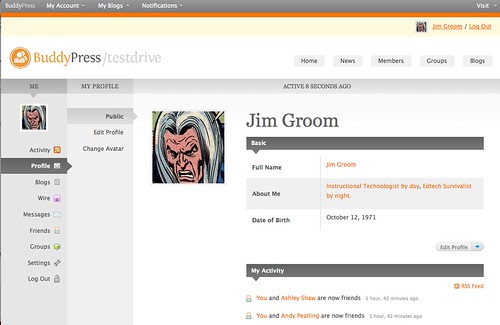
Image of my profile page on testbp.org

Click the image for a link to my profile page

What BuddyPress does is build a space for an individual profile that has a series of feeds across an entire WPMu installation that is an aggregation of their activity throughout the community, including posts, comments, status updates, groups joined, images uploaded, etc. Moreover, you can also subscribe to the activity of your friends’ feeds (oh yeah did I mention you can have friends), see a directory of all your blogs, create and join groups, send both direct and group messages to community members, have a “wire” attached to a group or image or some other object that allows for an ongoing discussion. And if that doesn’t get you excited, then how about directories that are centered around either blogs, an individual community member, or groups. Or maybe the fact that it will integrate with bbPress forums does it for you? I don’t know, what will it take? Huh?

Exploring BuddyPress this time around, I finally see all the social pieces we needed to allow others to find other people’s work within a WPMu community that was so much harder before. They are enabled through widgets so that you can customize the frontpage, and integrated for every user through a top-level menubar that is specific to them (much like what WordPress.com offers its users for administering their spaces). In fact, it seems that the menubar affords the ability to integrate the BuddyPress features with WPMu in a far less intrusive way than trying to build it within a blog admin space. The member profile becomes the new locus for activity and aggregation, and it just further re-inforces the privileging of the individual within WPMu community—and builds upon that fact beautifully. I think BuddyPress may prove another key element to “The year of the Digital Campus” at UMW next year for it really does re-cast the idea of an individual’s digital identity within an academic community. All this gushing, and I have ony just begun to play with BuddyPress in earnest. I think the next month or so is going to be dedicated to getting this seamlessly integrated into UMW Blogs. Moreover I think it would be perfect for another EDUPUNK project I have been thinking about for a while—but more on that anon.
Posted in BuddyPress | Tagged , , , , , , , , , , , , , , , , , , , , , | 2 Comments

30 Seconds on Community (American and Queen’s English verisions)

Cole Camplese posted a call for 30 second video responses defining community. He actually didn’t specify which language he wanted it in (i.e., American English or the Queen’s English), so I covered all bases, for reading text is one thing–but actually listening to someone talk is something else all together.

American English version

The Queen’s English version

The “inspiration” for this train wreck comes from EduRush Nation.

Posted in Uncategorized | Tagged , , | 5 Comments

In-Universe Perspective

I was reading up on one of my favorite movies, The Terminator ([beginning of insanely long tangent] which I love that Stephen Downes references when re-framing what might otherwise be bulldozed as an unquestionable firing offense of a teacher in this post:

Connecticut Teacher Fired Over Myspace Page – his teacher was fire for having a MySpace page that had “among other things, pictures of naked men with ‘inappropriate comments’ underneath them.” We are not told what the comments were, nor told what the pictures were (perhaps they were of the governor of California in his first shot in Terminator 2). Again, this is a firing for perfectly legal behaviour under the heading of ‘nappropriate’.

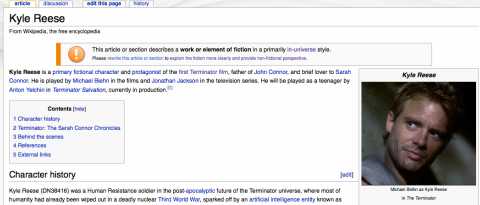
Having been a English teacher at Clara Barton High School in Brooklyn for a year and a half while that jackass Bloomberg was revitalizing New York City while trying to gut the Union (and he is re-writing the rules to run again–I hate that rich bastard!), his point is very well taken [end long tangent]) I was fascinated that the character Kyle Reese had his own full-blown Wikipedia page. I was even more intrigued when I saw the warning at top of the entry suggesting the article describes a work of fiction “in a primarily in-universe style.” What? What the hell does that mean?

Well, I followed the link, and here is the definition of the in-universe style and the accompanying problems:

The problem with in-universe perspective
An in-universe perspective describes the narrative from the perspective of characters within the fictional universe, treating it as if it were real and ignoring real-world context and sourced analysis. The threshold of what constitutes in-universe writing is making any effort to re-create or uphold the illusion of the original fiction by omitting real-world info.

Many fan wikis and fan websites (see below) take this approach, but it should not be used for Wikipedia articles. An in-universe perspective is inaccurate and misleading, gives undue weight to unimportant information and invites unverifiable original research. Most importantly, in-universe perspective defies community consensus as to what we do not want Wikipedia to be or become.

In fact, it is this in-universe style that really attracts me to Wikipedia. The fact that people frame these works of fiction (as well as objects, events, places, people, etc.) with a kinda of personalized relationship to the subject often makes it that much more powerful. Moreover, the ability to decipher numerous voices within one article is fascinating as well, and kind of suggests a kind of arrival of the multivocal non-fiction (as opposed to Bahktin’s focus on fiction) that makes the encyclopedic style a kind of creative non-fiction.

Posted in Uncategorized | Tagged , , , , , , , | 3 Comments

Skitching

We had our first very, very light snow here in Fredericksburg on Saturday, and it was refreshing given last year we got nothing to speak of all Winter. It also made me think of one of my favorite childhood Winter sports: Skitching  (it even has its own Wikipedia article)

Skitching (i.e. “ski-hitching” or “skate-hitching”) is the act of hitching a ride on the rear bumper of a car when there is ice or slick snow on the roads. It is also sometimes commonly referred to as Bumper Hitching. This can also be done with a skateboard or roller skates in urban areas where there is no ice or snow. In addition, skitching can be performed on a bicycle.[1]

So, as I often do, I went to YouTube to find some telling examples of this underground sport, only to find that the majority of them were rehearsed examples with rope, skis, snowboards and the like. That’s not skitching! Using a car to pull you around the snow is a blast, without question, but so is sledding and the like. The thrill of skitching is that it is booth dangerous and illegal. And when I say dangerous I don’t necessarily mean you can get hurt skitching (although you certainly can), but rather the person driving the car could get out and in a fit of rage come after you, not to mention cops on the prowl. We skitched relentlessly after every big snowstorm in my neighborhood—and we had some formidable numbers, a regular pack of kids. Cars were often going slow enough so that we could catch rides all night, and when they discovered us they yelled, got out, and threatened. And a few times they actually got out, left their car and chased us all over our neighborhood, but we always had the upper-hand in that regard. However, it didn;t always end well for us, their were a few unlucky victims who got their fingers caught in the bumpers (when they still had bumpers).

Anyway, i think the following video on YouTube captures the true spirit of skitching better than any of those rehearsed “we’re skitching” nonsense videos. Skitching is all about transgressive transportation, and if that element is missing, than it can be called a lot of things, but it ain’t skitching!

Posted in Uncategorized | 6 Comments

The Horror of Women’s Studies

Image of women's Studeis Poster by WOMEN’S STUDIES is about a graduate student in the titular subject who, along with three friends, winds up on the campus of a girls-only academy with an empowering feminist doctrine. The longer they stay, however, the more they discover about the school’s dark and violent side. The filmmaker’s wife, Cindy Marie Martin, co-produced and stars alongside Tara Garwood, Melisa Breiner, Laura Bloechl, James Radack, Kelley Slagle and NIGHT OF THE LIVING DEAD’s Judith O’Dea.

So, why is an “empowering feminist doctrine” always accompanied by a “dark and violent side” in popular culture?

Via Fangoriaonline.

Posted in movies | Tagged , , , , | 3 Comments

Death of Hollywood: the re-installment plan

Hollywood continues down the road of cannibalizing its own archive, this time with a brand new Friday the 13th and My Bloody Valentine —both due out in early 2009. I won’t lie, I desperately want to see both films. Knowing full well that they’ll most likely be terrible, and I’ll be further disgruntled, and have more ammunition for my ongoing attack of the moribund industry that is tinsel town. Yet, the re-emergence of early 80s slasher films for our horrific moment is an interesting fact in and of itself that might be worth thinking through in great detail. Until then, here are the new movie posters and trailers, enjoy!

Image of Friday the 13th movie poster

Image of My Bloody Valentine remake movie poster

Posted in movies | Tagged , , , , , , , | 3 Comments

Social media is a channel optimised for the insignificant

James Gardner of the Bankervision blog (nod to Tony for pointing me to this one) beautifully describes the presiding logic of insignificance in social media in this post. Below is the excerpt that hit my like a diamond in the forehead:

Over the past few days, I’ve been conducting an experiment: using my Facebook status, I’ve been trying to see just how ridiculously uninteresting I can get before people dump me.

On the first day, I told everyone that I was still breathing.

On the second, that my heart was beating, and I was counting how many times it did it.

For the third, I said that I’d blinked, but that as it was a normal bodily function, no one should be surprised.

And today, I have uploaded a photo of the specific piece of gravel on which I stand waiting for my morning train.

Here is what I’ve found out so far: the less useful the content is, the more people engage with it. You’d not believe the string of emails I’ve been getting.

Now, although this is not an especially scientific experiment, it suggests to me you can build engagement with social media on things that are unimportant and irrelevant. But when you say things which, theoretically, would be interesting and useful, paradoxically, no one cares. Social media is a channel optimised for the insignificant.

While some might think this is a slam on social media, I actually think it is a really perceptive and beautifully articulated description of the presiding logic of these social spaces. If you enter these spaces with pedantic recommendations, overly wrought theories, extreme beliefs, or a product to sell, chances are people will turn you off immediately. Yet, if you don’t have much to say, an axe to grind, or a specific idea to push, chances are others will not only engage you, but also listen. In many ways this seems counter-productive to the idea of thinking of these spaces as “learning” spaces, but I think that has everything to do with how we have traditionally framed learning spaces. Here there is a give and take that isn’t pre-figured as the authoritative domain of any one party—as a classroom always already is no matter how much we try and re-structure that spatial/personal relationship with all our hippie theories— but rather a conversation that we all have to disarm ourselves to some degree to enter with any kind of success and honesty.

Posted in Uncategorized | Tagged , , | 21 Comments

What was May Place

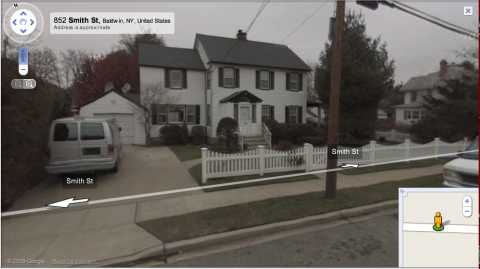
Inspired by Luke Waltzer’s screencast using Google’s Street View to experiment with digital storytelling, I decided to take a look at the neighborhood where I grew up in Baldwin, NY. This process was really trippy for me, and the possibilities for nostalgia in Google’s Street View is virtually limitless. And while Luke’s narrative is tight, reflective, and thoughtful, mine is overly long, distracted and self-indulgent. I have no problems with nostalgia, on the contrary I think it’s the basis for some of the most creative and generative work ever produced—William Faulkner being my cultural yardstick here. In fact, nostalgia has its roots in a Greek word which literally means homesickness. How appropriate, nostalgia as the almost perpetual sense of homesickness imposed by the passing of time that we all carry around with us to some degree. My work in this blog for almost three years has consistently been about searching for some kind of return to a symbolic home.

So here’s a series of reflections, stories, and musings on the neighborhood I grew up in, and as an added bonus you can hear about all the times I got beat up as well as gawk the boyhood home of BlackBoard’s co-founder Matthew Pittinsky—whom I mistakenly call Scott in the video—who actually grew up around the corner from me 🙂

Posted in Uncategorized | Tagged , , , , , , | 9 Comments

The Last American Pirate

Image of Pirate Flag
Image Credit: “It be a Pirate Flag” by Nick Humphries

Update: Turns out this site was a hoax, there is no student, but rather a cadre of students who set about creating a fake student, who wrote a fake blog, and did fake research. For more information see this post by Mills Kelly, who engineered the hoax for the benefit of humanity more generally 😉

Thanks to a tweet by Dave Lester and push to read it by Patrick Murray-John I found not only a really cool example of the power of these tools for an individual to track and frame their own educational experience, but some absolutely exciting research about a 19th century Pirate (possibly the last US pirate of his kind) no one’s ever heard of: Edward Owens. This undergraduate took her research to the next level by framing the experience on her blog, full with images and details from her Library of Congress research, video interviews with scholars and her visit to Owens house, her bibliography, along with a link to the Wikipedia page she created for this little known local pirate.

What’s even cooler is the fact that she not only framed a digital space for her research by getting her own domain and setting up a blog there, but she understood that she could also protect her identity at the same time by keeping certain information private. It is such a perfect example of the importance of framing your identity as a student/scholar online, and it really buttresses beautifully with the ideas we’ve been thinking about recently in regards to digital identity at UMW. More than that though, is the fact that this project was hers and she was fired up about what she had accomplished, and she could actually share that fact with others through her blog.

This project has been a journey for me, not only as a student but as a historian. This may sound a little lame, but I am really proud of the work that I’ve done and how far I’ve come. I’ve learned a lot, not only about Edward Owens, but about the Chesapeake Bay during the late 1800’s, the shipping industry, the U.S. Navy, etc. ( I could go on forever, but I’ll spare you). I’ve also developed my researching skills. (Grad School here I come!)

Posted in digital identity | Tagged , , , , , , , , , | 18 Comments

Katabasis and “Choose Your Own Adventure” narratives

Image by paral lax
Image Credit: “Odysseus” by paral_lax

It’s funny how things work online, soon after reading Alec Couros’s post “‘Choose You Own Adventure’ comes to YouTube” (which is such a brilliant use of YouTube annotations for digital storytelling), I got a message from a Professor Angela Gosetti which pointed me to a “Chosse You Own Adventure” website one of her seminar students created for her final project, interactive project for freshman seminar dealing with Katabasis in Myth and Film (not sure what Katbasis is?…I wasn’t either until I looked it up on Wikipedia).

The student’s project is a lot of fun, but you can read her words about the interactive site she created here. I’ll quote part of it below, because I think it is very telling:

Hello people of my freshman seminar class and those who wandered here randomly. This is a choose-your-own-adventure type game that leads you through the entirety of the ancient Greek/Roman underworld seen through the minds of various old writers, but primarily Virgil and Homer. Why are we journeying through the underworld you ask? Well, your best friend without a name has gone and got himself killed again and rather than put up with his eternal whining when your time on Earth has ended, you might as well try and rescue him. I mean, you are an ancient Greek/Roman warrior on an epic quest to save a dear friend from a premature life in the netherworld. Being the hero of this tale, you’ll obviously make it through in the end, right? It didn’t work for that Orpheus character, but you’re better than him, so you’ll win this game anyways!

The tone and narrative of this “paper” is so fun, and I love the idea that she is both engaging her classmates along with the random “wanderer” on the web. The fact that she is conscious that her project will reach far beyond the confines of her seminar is really cool, and frames one of the marked differences between the end-of-the-term paper that rarely sees another reader outside the grader, and a project that is framed openly as an experience that one expects others to find and interact with. Also, the fact that she did this interactive project on a website publishing service (http://webs.com) other than UMW Blogs re-enforces what we already know, people will use the tools they are comfortable with whether or not they are inferior 🙂 And I now have another tool to look into to see how it deal with exporting work and thinking through how students might be able to manage all these different spaces they create over time.

Image of Katabasis siteAlso, I’d be remiss if I didn’t note that Angela’s course blog has been one of the most fun, active and engaged spaces on UMW Blogs I have ever seen. With almost 200 posts and 250+ comments—many of which are far longer than the original post—it has been an absolutely astounding success for generating a group-based discussion for a freshman seminar course, while at the same time providing a publishing platform for web resources and sharing final projects–unbelievable conceptualization and work on Angela’s part! It also makes me re-think the syndication vs. group blog dynamic for course blogs I talk about so much on this blog. She obviously liked the group blog structure, and it worked remarkably well. What would allow a faculty member to use a group blog, but also allow his/her students to get their work out easily would be a feed for each of the authors in a group blog so that their work could be fed out into their own space for archiving (and ideally along with the comments). As far as I know their are no author feeds for WordPress, but it just needs to happen so that the divide between group blogs vs. syndicated course blogs isn’t as stark as it seems currently. We’re still learning and experimenting with all this stuff, but it is certain there is no one right way, just ensure we can republish whatever it is easily.

Posted in UMW Blogs | Tagged , , , , , , , , | 2 Comments