
Innovation Lost

Paradise_Lost_12

Yet from those flames
No light, but rather darkness visible.

I’ve been writing a bit about early internet and web history based on the Internet Course I am embroiled in currently. Some of the early deomgraphics of the web are really interesting to me, and I imagine are somewhat surprising to the students.
4-year_campuses

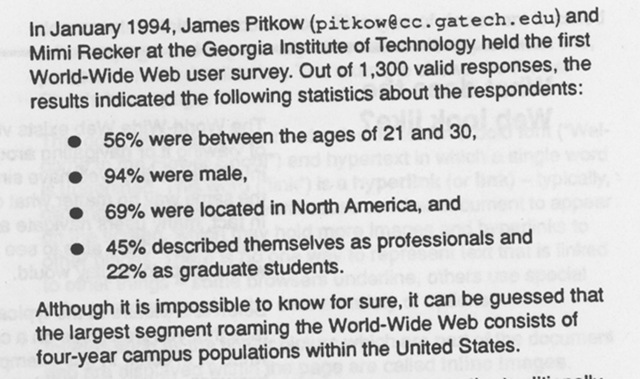
Kevin Hughes’ 1994 guide  “Entering the World-Wide Web: A Guide To Cyberspace,” citing a survey of 1300 World-Wide Web users conducted by Georgia Tech professors James Pitkow and Mimi Recker in January 1994, shares the following demographic information:

  • 56% were between the ages of 21 and 30
  • 94% were male
  • 69% were located in North America, and
  • 45% described themeselves as professionals and 22% as graduate students

The early web was a relatively young, male-dominated, and North American phenomemon. Additionally, according to Hughes, the survey suggests the “largest segment roaming the World-Wide Web consists of four-year campus populations within the United States.” The early web was composed of people just like Alan Levine, even back then 🙂 More seriosuly, four-year campuses were the epicenter of early web culture which is a powerful and compelling narrative of higher ed as a laboratory for the future—even if it’s humble beginning were demographically skewed.

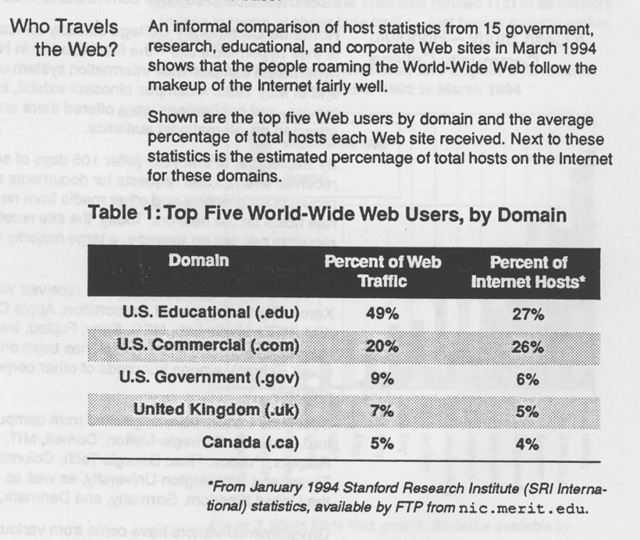
In his guide, Hughes also provides a breakdown of who surfs the web based on “an informal comparison of host statistics from 15 government, educational, and corproate Web sites in March 1994.”
top_five_www_users

Once again, a vast majority of the web traffic, and the largest percentage of “internet hosts” (computers connected to the network) were located at educational institutions. It may be hard for those who didn’t live through this history to imagine it, but at a moment in time universities were actually relevant when it came to the web. Hell, they weren’t only relevant, they built out the entire internet infrastructure it emerged from.

Oh, how far we have fallen! Just two decades later the LMS, not the web, has become where universities do most of their web-related work with students. University websites are little more than glorified admissions brochures. In a depressing twist of fate, higher ed has outsourced the most astounding innovation in communications history that was born on its campuses. Through a process that started in earnest during the late 1990s—roughly at the same time the dot.com market boom—universities moved to a  market-driven corproate IT logic. Digital communications were understood as services, and the open web got lumped with email, intranets, and the LMS as a business application. Somewhere during this time the internet was confused with efficiency and the web was mistaken for an interactive fact sheet.

That reality has pretty much continued unabated since. Web 2.0 was often integrated into the campus brand, but broad, culture-shifting experimentation along these lines can be counted on one hand. IT organizations have dictated what’s possible, often defaulting to closed and “no” when it comes to anything but enterprise. Ironically, they’ve been more than happy to outsource their own bread and butter (email, document storage, web space, the LMS, etc.)  in hopes of the cloud making their own work redundant. Where is the innovation happening right now when it comes to IT in higher ed? This is an honest question because I can’t see it.

Back to history, as the internet transitioned from a NSF-sponsored backbone to a commercial-friendly environment in the late-1980s and early 90s, the ground was prepared  for the web to become an increasingly corporate dominated venture. In some ways this all made sense, the popularity of the world wide web and the resulting demographic explosion from the mid-90s through the early 00s—thanks to relatively cheap and easy access— brought millions and millions of households online.

What doesn’t make sense is how the education sector essentially denatured itself from the innovation it had cultivated for almost three decades. It’s hard to believe, given where we are now, that universities were behind a majority of the major networking protocols established from the early 1970s through the early 90s (such as Telnet, FTP, TCP/IP,  Gopher, etc.), as well as a majority of the early social networks such as Bitnet and Usenet.

The invasion of a corporate mindset of IT has had its deep effects on higher ed’s inability to innovate for the last fifteen years. We stopped at BlackBoard, and everything else we refer to as innovation is a service we have bought from the corporate sector: Google Apps, Microsoft Live, Apple everything, Abobe anything, BlackBoard, Facebook, YouTube, and on and on and on. And when students do try and innovate despite the university’s risk-averse infrastructure, they’re shutdown quicker than a strip bar in Times Square 😉

Universities are the last place you’d look for innovation in education, even though it’s still happening there. Take, for example, the Massive Open Online Course (MOOCs) which over the last two or three years has become the posterchild of innovation in highered. This approach was started by two Canadians, George Siemens and Stephen Downes, at the University of Manitoba in 2008. A professor and government researcher, Siemens and Downes decided to put into practice the educational theories and philosophies of connectivism and connected learning they’d been writing about and experimenting with for years. Their early MOOC provided a brilliant example of praxis. What’s more it’s telling it took a collaborative effort between a university professor and a government researcher (much like the beginnings of the internet) to demonstrate the deep, powerful implications for universities more generally. [When the specifications for the internet were distributed as a bid for building this network in 1969, most corporations laughed at the idea proclaiming it as impossible—a reality that lasted for almost decade.]

MOOCs, as Siemens and Downes imagined them, are one of the few sources of true innovation you can point to in educational technology in recent history, and it was born from a higher ed/government relationship. Yet, within a couple of years the MOOC movement had become increasingly denatured and over-run by corporate boosterism that was redirecting the logic of experimentation and possibility to a rhetoric of how broken higher education is, and how Silicon Valley (poaching superstar faculty from Stanford with the allure of millions of dollars) has come to its rescue. What was remarkable to me as I watched the MOOC experiment transform into a corproate takeover was how quickly and completely the alien pods took over the experimentation before it could breath. before it could even develop it was already a fully formed disruptive solution to a moribund instituion. Innovation lost.

As a case study, MOOCs provide an excellent example of how quickly innovation happening at universities is co-opted and re-branded by venture capital-funded startups. The craziest part of it all is that University adminsitrators and IT professionals have no idea where the innovation started. It’s akin to Mike Caulfield’s recent documentation of the amnesia universities suffer when it comes to their own history with online learning. Elite universities all over the world have been buying back the innovation from Coursera that their very ideals and missions were established to make possible with the mindset of, “hey, it might get big, let’s get in on the bottom floor.” It was as if edtech shops and central IT at all these universities were approaching MOOCs (as fashioned by Coursera and their ilk) as if it were a Google IPO, “who knows, it could break big.”  Or it could break bad, and they’ll look like a bunch of jackasses for not doing the job educational institutions were meant to: bring in smart people to experiment with what’s possible. Stop outsourcing innovation, it has gotten us no where in the end.

I would say more, and I will shortly, but I think I’ll stop here. This post is very much inspired by Brian Lamb and the brilliant work he is doing right now on this topic. We’re co-authoring an article and they only way I can write any more is to sitdown and blog my ideas first. Some parts of this post may re-emerge later in a more digested article, or they may not given how bad they will seem to me (and Brian) tomorrow 😉
Posted in Instructional Technology, The Internet Course | Tagged , , , , , | 27 Comments

Some Raro Poliziottesco

Since my trip to Italy I’ve been thinking a lot about the Poliziottesco genre of Italian b-movies. I’ve also been watching my fair share. Raro Video, a publishing house located in Minneapolis, has been brilliant enough to re-release a lot of these films on DVD and BLU-RAY. I worked my way through Fernando Di Leo’s Crime Collection (volume 1), and I’m working on volume 2 currently. What’s more, I got my hands on a copy of Young, Violent, Dangerous (1976) while in Italy—which I plan on watching this weekend.

Raro Video tweeted out a clip from Young, Violent, and Dangerous today that’s got me excited. When I watch it I feel like I’m back in the VHS rental stores of my youth scanning the b-movie section.

They also tweeted out a link to the DVD menu for the upcoming release of Umberto Lenzi’s Gang War in Milan (1973).

Raro Video was recently written up by J. Hoberman in the New York Times about their work “Reissuing the Italian Renaissance.” I love the title of this article, though its larger point is not fully articulated in the piece. The genre b-movies coming out of Italy from the 1960s through the 1980s were a low-budget renaissance of their own that the Italians still refuse to acknowledge. For far too many Italian cinema ends with Pasolini, Fellini, and Antonioni. While I can’t (and won’t) deny these directors’ genius,  there’s another, equally influential, strain of genius in Italian cinema that begins with Mario Bava 😉

Posted in movies, video, YouTube | Tagged , , , | 2 Comments

UMW Domains-Now with More Community!

Screen Shot 2014-02-27 at 12.43.26 PM

Domain of One’s Own has been an unqualified success, and Martha’s post on this project provides a nice summary of where we are at six months in. We’re on track to have more than 700 folks in the UMW community with their own domain and web hosting this academic year, and for 2014/15 we’re shooting to double that number with an additional 1500 domains. Just think of it, 2200 people with their own domain by year two. That’s almost half our campus community—that’s absolutely awesome. Unparalled in the known world—we’re the god damned Magellans of edtech!

But like any age of exploration, we have to start mapping this brave new worlds for beauteous mankind, and that’s just what Martha Burtis and Tim Owens  have been doing. Since the beginning of the semester they’ve been building a community hub for all of the distributed working happening on UMW Domains. Tim wrote about creating this space in some detail already, and it’s amazing how the longstanding dream for many of us in edtech of “eduglu” (a syndication hub that could seamlessly pull feeds and tags from a variety of applications) has become a reality for us at UMW once we abstracted beyond dependence on one particular application. The Community site for UMW Domains is the best approximation of a syndication hub for a distributed community we’ve yet to build, very much inspired by our earlier work with UMW Blogs and ds106.

One would think with the early syndication work with UMW Blogs we’d be able to crack the syndication nut. The fact we were locked into WordPress Multi-Site for everything with UMW Blogs, which on first thought should make things easier for this sort of thing, proved to be just the opposite. Everything was dependent on this one application (a similar issue we’ve always had with the LMS in edtech) which meant we’d become a bit  myopic in our approach. With ds106 we started to understand community through a single WordPress install that simply acted as the syndication hub—it was just the place we added the feeds. And while the the UMW Domains Community uses WordPress and FeedWordPress for the syndication, we are getting at the

UMW Domain Community Frontpage

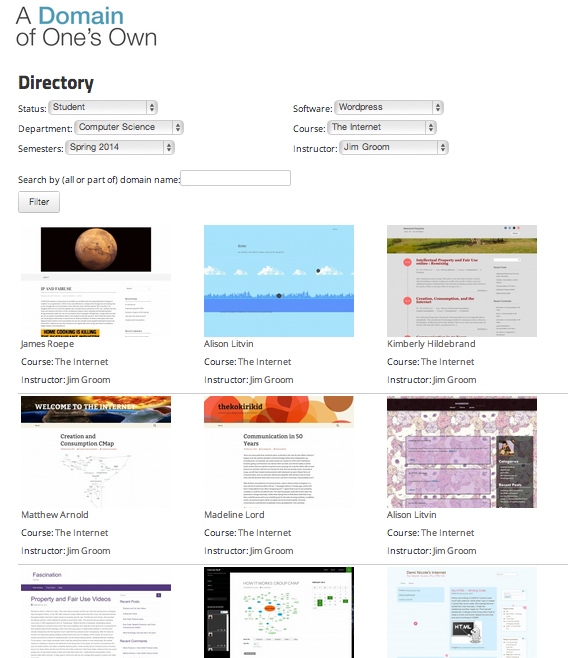
While the UMW Domains Community site still uses WordPress and FeedWordPress for the syndication hub,  with the web hosting and domain setup we’ve been able abstract out a level and start hooking into the application installer Installatron through API calls to enable us to add additional metadata when anyone installs an application. For example, when faculty and students install a WordPress site in their web hosting account they can assocaite it with a course, a specific instructor, topic, etc at the point of install. The results have been astounding, we now have a real community hub that not only features sites and recent work on the homepage, but also allows anyone to filter and search by instructor, department, course, semester, software, etc. All of which you can seen on the directory page of the UMW Domains Community site.

UMW Domains Directory

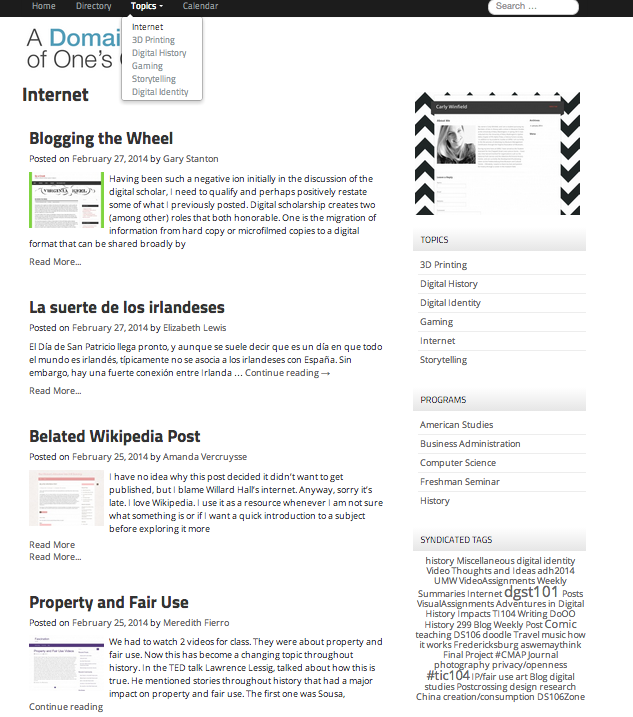
What’s more, thanks to the add-on plugin FeedWordPress Advanced Filters all the content coming into the syndication hub can be filtered by predetermined categories we want to highlight. For example, 3D Printing, Digital History, the Internet, Storytelling, Gaming, etc. Radical!
Topics for UWM Domains Community
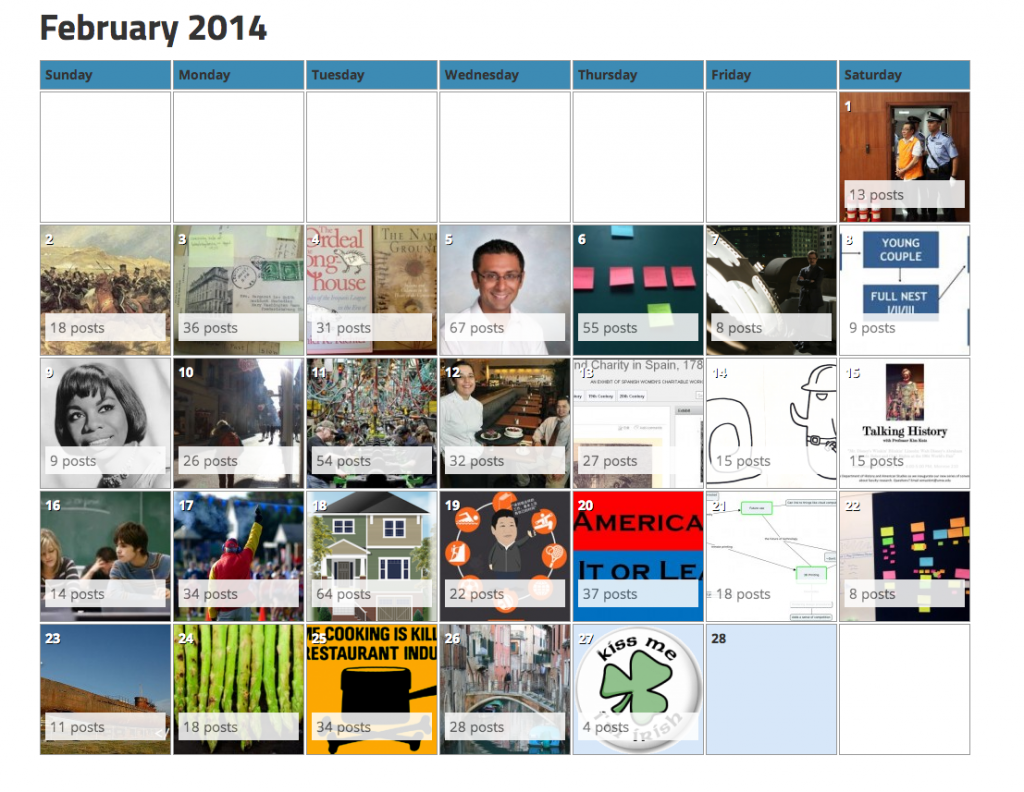
To make the whole thing even more amazing, Martha just built a feature so that provides a calendar view of all the posts thus far. Each day shows a featured image and the number of published on a specific day of each month. Each day of this calendar based archive links to page with all the posts for that day.

COmmunity Calendar
With the UMW Domains Community site we’re providing a much needed platform for our students and faculty to share what they’re doing. What’s more, it’s an open space that anyone can explore. Hopefully, as a result, this will lead to serendipitous discoveries along the way to finding what we’re looking for. This is exactly what Geocities offered in the mid 1990s that was radical. Geocities didn’t only provide simplified web hosting, they also provided a sense of neighborhoods and communities so that people could get a broader view of what was happening. This was rarely, if ever, the case with commodity web hosting. All we’re doing with the UMW Domains Community is taking the decade old reality of commodity web hosting and building an academic community around it. And that’s just the begininng, we currently have a group of UMW Computer Science students designing a Reddit-inspired suite of plugins for upvoting, downvoting, discussion,a nd more—but that’s fodder for my next post 🙂

Posted in Domain of One's Own | Tagged , , , , , | 9 Comments

Twitch Plays Pokemon: an Allegory for Scale?

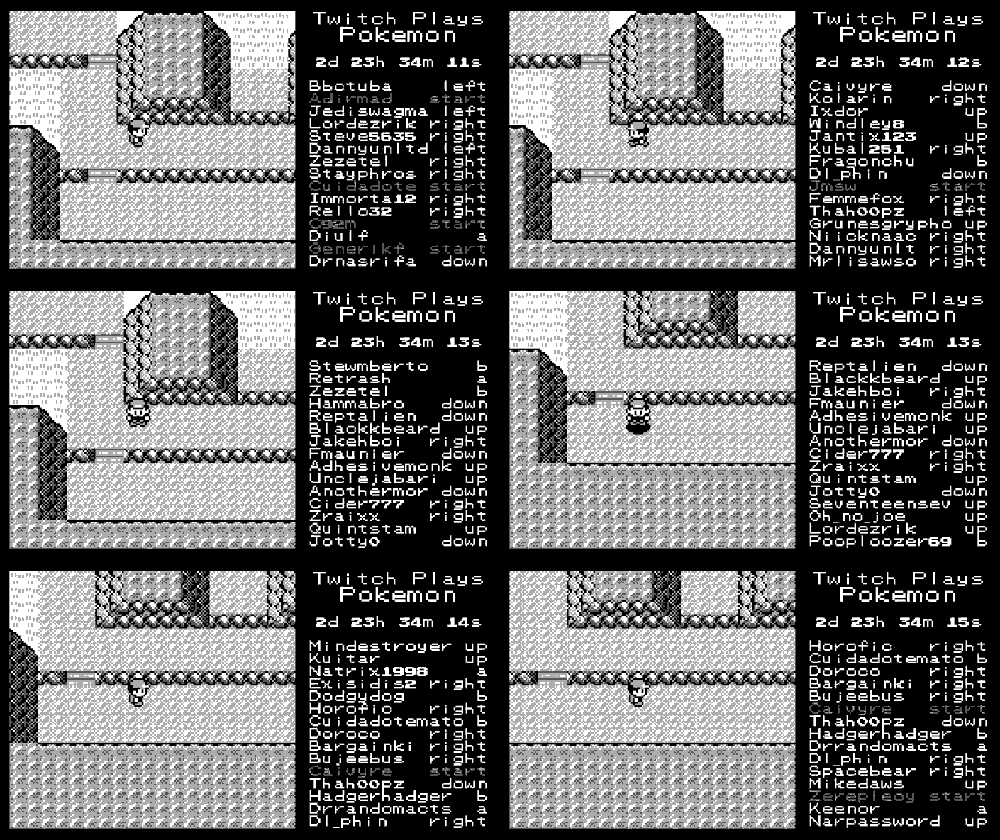
GIF from Twitch PLays Pokemon

GIF from Twitch Plays Pokemon

Last week, during a discussion in the Internet CourseMatt Arnold brought up the game Twitch Plays Pokemon while we were talking about consumption and creation on the web. He noted that currently thousands of people were playing a Pokemon game online together. What’s more, millions of people (more than 32 million as of today) have watched the stream since this social experiment started just over two weeks ago.

This experiment came up again in the DTLT offices yesterday when Ryan and Tim were talking about it in the bullpen. This time I actually spent some time on the webpage watching the game unfold. I have to agree with others folks that its hard to look away, kind of like an ongoing, glitching game that is at the same time hypnotic. Last night I was telling Ryan how on first impression Twitch strikes me as the opposite of Wikipedia. Whereas the open encyclopedia was a model of the new read, write web providing a demonstration of struggle but ultimately effective knowledge creation. Twitch reminds me more of a paralyzed attempt to lumber through a real-time, cooperative web. Something that can be accomplished realtively quickly by one person takes forever for hundreds of thousands. The dark side of scale? 🙂

That said, folks are trying to collaborrate and strategize to counteract trolls, but it still seems overwhelmingly difficult given how many people are sending commands. I’m interested to see if there can be a massive, distributed community that’s able to play this game together smoothly and intelligently. Or maybe that’s not the goal of this social experiemnt? The game’s creator has little hope the game can ever be completed. Either way, it’s wild that a massive social experiment resulting in a stream of “big data” involving millions of people is not only possible on the web, but a source of entertainment for millions more. We live in strange times.

Posted in fun, The Internet Course, video games | Tagged , , , , | 12 Comments

HTML is beautiful

We’ve been moving right along in the Internet Course, and it’s starting to find a nice rhythm. Last week the panelists led a lively, engaged discussion on the topic of consumption and creation on the internet. This week we’re talking about intellectual property and fair use, and that discussion has been excellent thus far. Looking forward to more from the panelists tomorrow.

In the mean time, the class has been working on is creating a HTML page. I didn’t teach them any HTML, they were instructed to go out and find a tutorial and then compose their own HTML page in a subdomain. I figured we’d spent a lot of time last week talking about creation and consumption on the internet, so this would be an opportunity for them to actually do it. I wanted them to create a page in html from scratch with the idea of demonstrating how a few tags and the hyperlink remain the foundation of what connects the various, distributed resources on the web. I also wanted it to be something other than an application. Over the last eight or nine years I’ve been application heacy, and for good reason, but stripping away is good too. A return, if only temporary, to the basic building blocks of the web: text, embedded media, and hyperlinks.

Looking through these projects I realized I’m going through a bit of nostalgia for mid-90s web design. I’m totally loving the HTML aesthetic right now. Below are a few examples that were volunteered during class yesterday, and I’m totally grooving on them.

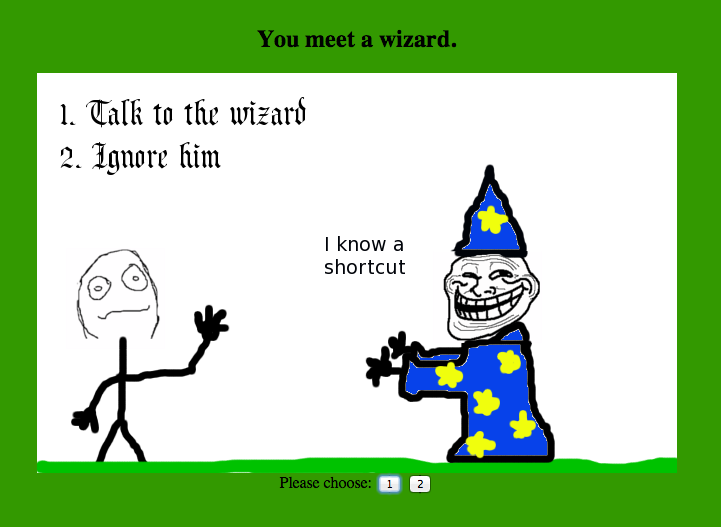
Amber May shared the following choose your adventure site she created for another Computer Science course she took last year. I’m gonna steal the basic code for this because I now want to create a choose your adventure site about this course 🙂 If you have a moment click through and go on a fantastic adventure.

Screen Shot 2014-02-26 at 3.09.53 PM

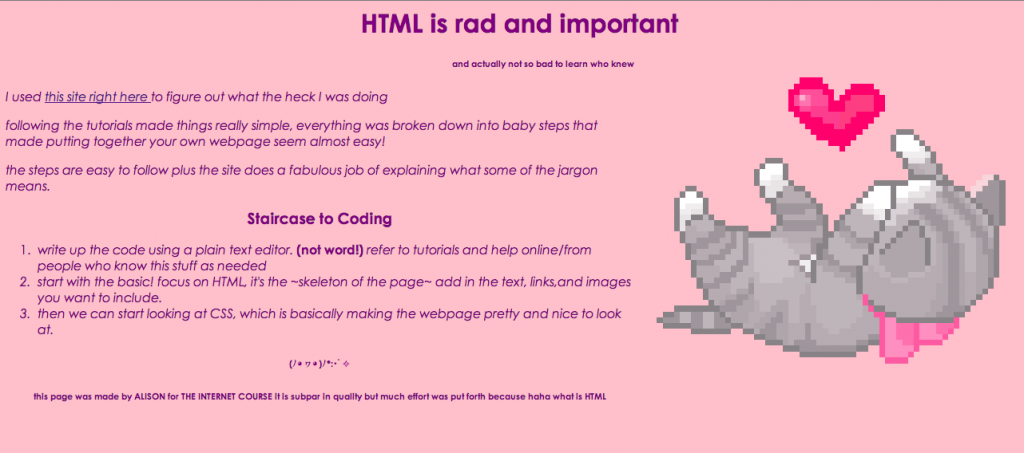
Alison Litvin brought back the full beauty of the HTML page with a pink background, purple text, and an animated, 8-bit GIF of a kitten. I’m in love.
Screen Shot 2014-02-26 at 3.41.37 PM

I included the animated, 8-bit GIF of the kitten separately because it’s that good.

tumblr_mrzhsydp3X1sau89xo1_500

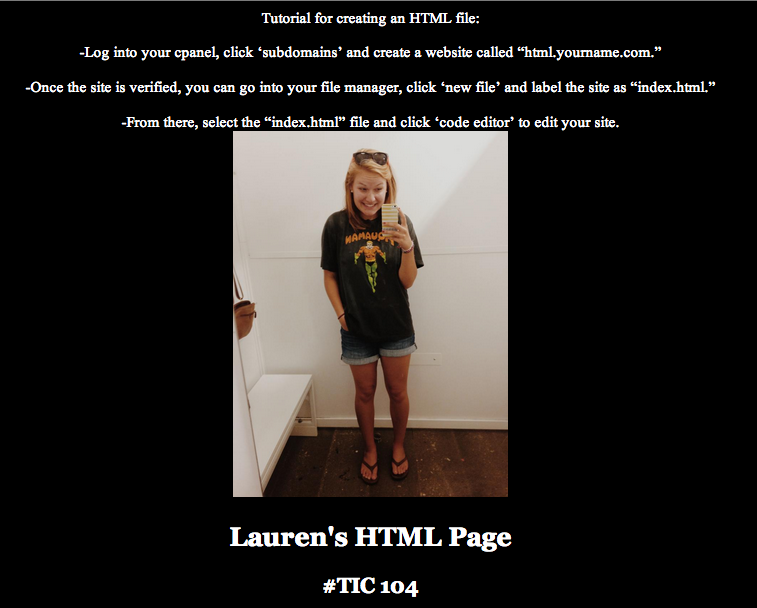
I love how Lauren Brumfield updated the HTML aesthetic with a selfie—this is the New Aesthetic people!
Screen Shot 2014-02-26 at 4.09.40 PM

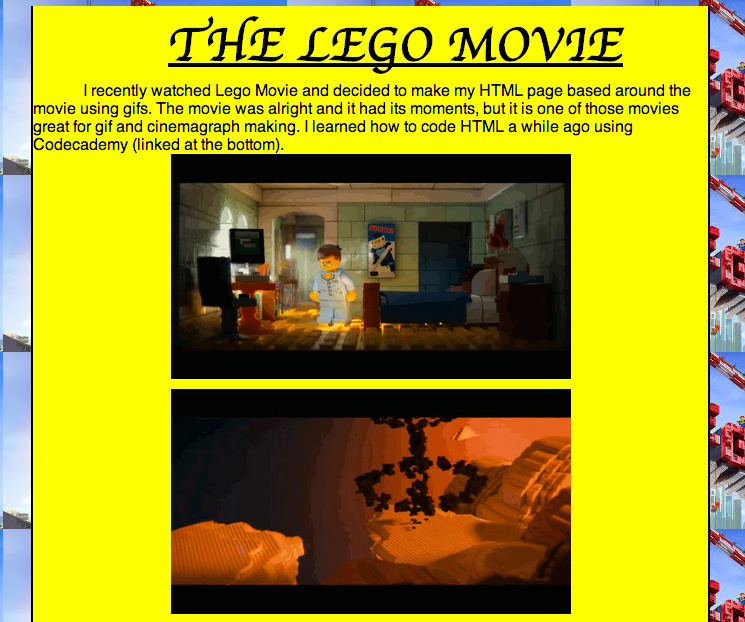
Jack Hylan goes retro contemporary with animated GIFs of The Lego Movie.
Screen Shot 2014-02-26 at 4.12.03 PM

Three out of the four students above used Code Academy for learning HTML (thanks to Jack Hylan sharing it on his blog early on), and they seemed fairly happy with the process. What’s intersting to me is ten or fifteen years ago we would have had entire sections of a course (or a workshop) dedicated to showing students (or faculty) how to compose HTML. Now it seems relatively normal to offload this process to a web-based learning resource like Code Academy. It’s a simple, yet important, acknowledgement that the resources the above students used to learn HTML were not those I was pointing to directly or writing as a custom tutorial, but resources they were sharing with each other as a matter of course. That’s pretty cool, and it expands the course that much more rather than shutting it down or making it obselete.

Posted in The Internet Course | Tagged , | 7 Comments

Tim Owens: Making it Happen

Free-Lance Star

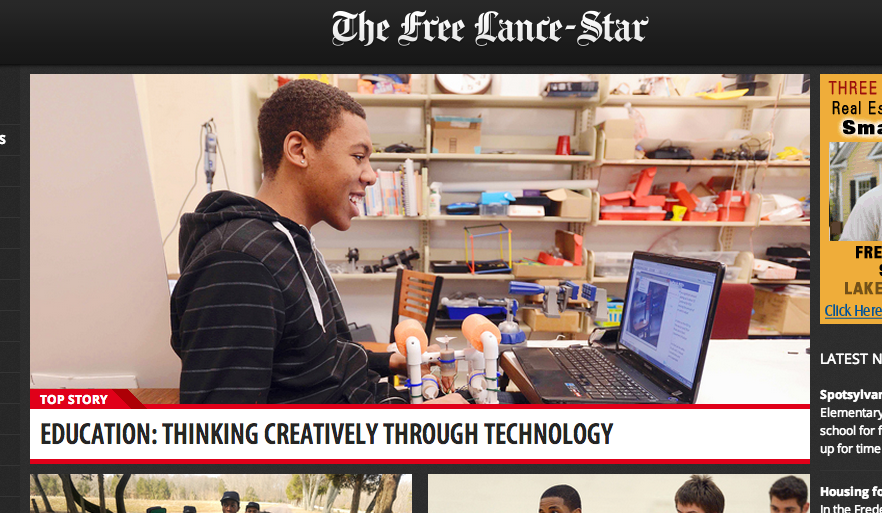
There’s an article by Lindley Estes in yesterday’s Free Lance-Star (Fredericksburg’s local newspaper) about UMW’s makerspaces. It chronicles the work  Tim Owens has done, alongside education professor George Meadows and library director Rosemary Arneson, to create UMW’s Thinklab—a makerspace in the library that provides an “interdisciplinary hub of activity” where students can create stuff both for and beyond a given course.

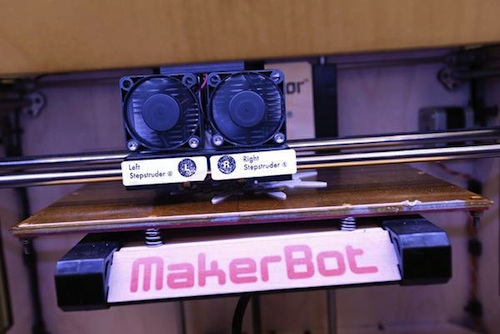
I’ve said this before, but of all the work DTLT has done in educational technology for the last decade, you could argue the collaborative  endeavor to introduce 3D Printing, build a makerspace on the cheap , and collectively architect a freshman seminar (“Makerbots and Mashups”) may be the most powerful demonstration of the amazing fruits that can result from cooperative work between departments.

What’s more, for all my UMW Blogs boosterism over the years (and I do love that publishing platform), the in-roads the makerspace vision has had with the local public libraries and schools suggests the work Tim started with George Meadows more than two years ago is still paying major dividends beyond UMW.  That is the best kind of result, a project at UMW that seeds possibilities for teaching and learning in the broader community.

What’s funny about this is that for Tim the makerspace was five or six projects ago now. He’s built a hosting co-op called Hippie Hosting that was the basis for our flagship initiative UMW Domains. After that he and Martha Burtis created the ultra-sick UMW Domains community site. Oh yeah, and there was UMW’s pilot Media Server and Reclaim Hosting somewhere in there too. And currently he’s working on a  federated wiki with Mike Caulfield. Oh yeah, and he’s also an edtech on the ground for the campus community. Let me be the first to cry “UNCLE!”

TIm locked into the matrix

TIm locked into the matrix

We have a word for this in UMW’s DTLT, it’s called en fuego, but somehow that’s still not enough. It’s been an honor and a privilege to watch Tim shred up edtech like nobody else I’ve seen. And if you aren’t watching his every move I would only ask you one question, “Why not?”

Posted in dtlt, umw | Tagged , , | 1 Comment

Classes I want to teach

One of the best things about my job at UMW is that I’ve been able to teach a wide range of courses across a few disciplines. So far I’ve taught nine different courses, and one of them six (soon to be seven) different times.

As the list above illustrates, ever since ds106 I’ve been effectively co-teaching all my courses. First alongside Martha Burtis (and a host of characters in ds106), then Alan Levine, and more recently with Paul Bond. ds106 taught me how amazing collaborative teaching can be. What’s more, the majority of collaborative work is done amongst adjuncts and/or staff that are doing this in addition to their day job for little or no pay.*  I’m looking forward to more and better collaborations for just about everything I’ll be doing in the future. ds106 changed my life!

As for this post, it’s just a way to jot down some courses I want to teach sometime in the relatively near future. I may never get the chance, but at least I’ll have the record of my best intentions.

Pirates, Zombies, and Copyright
Zombie_Pirates_by_madart84I’ve done a fullblown presentation and a series of blog posts about this course idea, but I still haven;t taught it. The idea would be to look at the cultural history of pirates and zombies over the last three hundred years leading up to their current re-valuation in contemporary culture as a popular frame for copyright. How does piracy and the zombie apocalypse inform the global discussion around international trade, undead labor, and the role of the state in protecting virutal property in the twenty-first century. This would make a fun Freshman Seminar or AMerican Studies special topics course, and I might propose it for next Spring is the stars align.


A National Film Registry MOOC
TAS_Poster_view-2_LATER_IN_THE_DAYI’ve already written about this idea, but I still want to teach an open class about how the National Film Registry works and have tons of folks writing about film, creating propaganda campaigns to get their favorite films on the registry, and generally going nuts. This class is clear as day to me how awesome it could be because the possibilities are so rich and so varied. Here’ s what I wrote:

Right now I’m thinking the class could sample a few films from each genre chosen for preservation, and then ask some basic questions about how the criteria of “artistically, culturally, and socially significant” might be understood for a number of those films….as of now there are 575 films on the National Film Registry’s list, and if enough people play along with this class—we might be able to cover quite a few of them within the wider community. I’ll pull a few examples that I’ll analyze and share out from each genre to talk about while using this as a way of encouraging others to pick a film on the list and share back their findings through their blog. I like how this allows for a lot of freedom and self-direction for anyone taking the course.

Whether or not I teach this course, it needs to be taught. In fact, it already may be, and if it is I am going to take it.

Domain of One’s Own
9516686867_043ea0be0c_zDTLT has already framed the curriculum for this course as a part fo the Domain of One’s Own Faculty Initiative. We would just need to bulk it up a bit for a fifteen week version. Ideally we would co-teach this as a group. I imagine it as a Freshman Seminar that could live in the Computer Science department. We could do one or two sections, and use it as way to dig deeper into the computational thinking/seven ways to think like the web literacy vision we’ve been talking about in relationship to UMW Domains.

Italy: the Years of Lead
I really, really want to teach a Freshman Seminar alongside Antonella about the social and political turmoil the rocked Italy for more than a decade from the late 1960s through the early 1980s, as called the Years of Lead. The focus would be on the 1970s in particular, looking at the various political, social, and cultural forces that led to unprecedented levels of all-out war on the streets of Italy between various political groups, the police, and organzied crime. One of the major themes of the course would be an examination of political terrorism in the 1970s, with the focal point being 1977. This cultural history would be framed through news media, literature, film, and TV. What’s more, I can sneak in a whole genre of Italian b-movies known as Poliziottesco 🙂 We would need to do a lot more research for this one, but I hope we can pull thsi one off sometime soon.

The 1980s
anti-reagan-concert-posterI want to teach a course with GNA Garcia about the 1980s. I would want it to be a fullblown cultural memory course in which we would read, share, and discuss ona wide sereis of topics from the 198s. For example, a week or two dedicated to politics in the 1980s, a week to music in the 80s, film in the 80s, TV, fashion, computer culture, labor, videogames, etc. There would be a few particular texts, some listening parties, screenings, etc. I thinking about about it like a happening of the decade, a series of impressionistic approaches to trying to help a group of students born in the mid-90s gain a sense of the decade somewhat holistically. GNA and I are the 80s.

Sharks: A Cultural History
cb_jaws_shark_ll_130806_16x9_992This  might be best taught alongside a biologist (or a Tom Woodward) that specializes in sharks.This course would oscillate between the science and cultural imagination of this predatory species of fish. Since Jaws sharks have remained one of the most powerful  icons of the world we live in—providing a frame for our violent fascination with power, violence, and absurdity with everything from Wall Street to the internet. This class would chum a cultural trail to try and bait one of our most deeply seated fears: the invisible predator.
There are several more I want to teach like a course on Mario Bava’s films (Paul Bond and I are ready for this one). A course about the politics of horror movies, and yet another class about film genres more generally to cut across film categories. There’s also a course I taught at CUNY’s Queens College on the literature of captivity narratives that I’ve been aching to revive in a new form. But, as is often the case, this post is already much too long and I have other work to do, so I’ll stop it here for now. Hopefully they’ll be a part two sometime soon so that I can spell a few of these out in more detail.

_________________________________

* There are much larger issues with the devaluation of intellectual labor in highered, and the adjunct army is one major part of that complex. Part of the horror of that situation is who could afford to collaboratively teach on the wages offered? What’s more, how can what many refer to as  one of the most innovative approaches to teaching online (namely ds106) come out of a motley band of edtech geeks, staff, adjuncts, and other folks on the margins of what we consider the traditional academy?

Posted in Teaching | Tagged , , , , , , , , | 9 Comments

Open is as Open Does

Open is As Open DoesYesterday I presented alongside Martha Burtis about ds106 for the OpenVCU Symposium. Martha and  I have presented about this course together before, and each time it’s a real treat because we tend  feed off each other’s excitment. It also helps that she actually plans things like presentations 😉  What became apparent to me while we were talking yesterday was not only how much ds106 embodies DTLT‘s hopes and dreams for the field of  edtech, but for the possibility for community more generally.

It was a real pleasure to finally come to VCU and get to see the movement their building down there around all things edtech first-hand. With so many folks I know, like Tom Woodward, Eric Johnson, Jon Becker, Jeff Nugent, Britt Watwood, Bud Diehl, and many more, it felt like a homecoming of sorts. That said, there was one conspicuous absence given their new Assistant Vice Provost of Awesome, Gardner Campbell, was nowhere to be found. I jokingly called him out only to hear afterwards he was at Hamphshire College with Jon Udell speaking at a conference I ‘d recommended them both for—serves me right! The symposium on open education was actually the larger indicator that Gardner was in the building, and in that spirit Martha and I wanted to try and get at the deep and variegated nuances that consititute open beyond the all too familiar catch-all:  open educational resources. In fact, I don’t think we even mentioned those once.

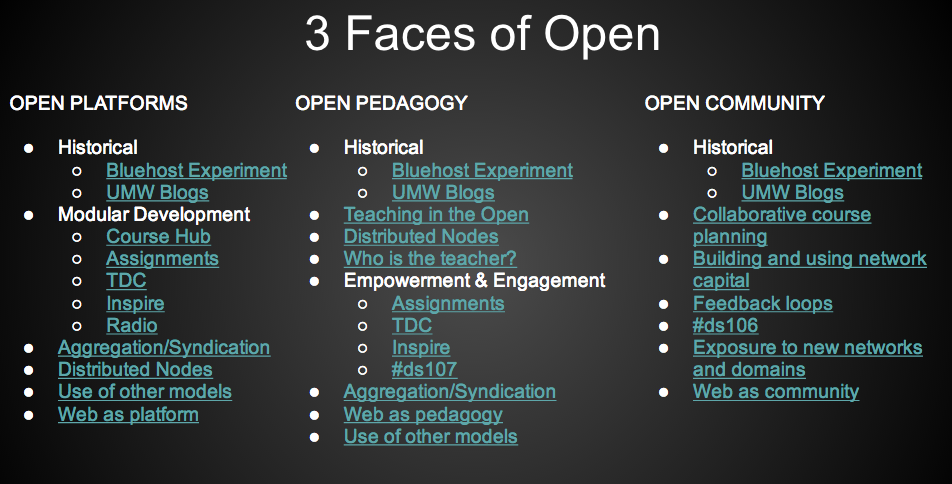
With that in mind, while planning earlier this week we decided to try a new approach to presenting ds106. We wanted to try and lay bare the various layers of open it operates through. We broke these layers down into three slices: open platforms, open pedagogy, and open community. What was quickly apparent as we were listing talking points under each category is how much each of these informs, and at times collapses into, one another. As a result, we came up with the idea of treating a number of the talking points in each of the categories as pieces we would return to later in the talk through a new lens (i.e. platform, pedagogy, community).

Slide #4

Slide #4: The Linked Presentation Homepage

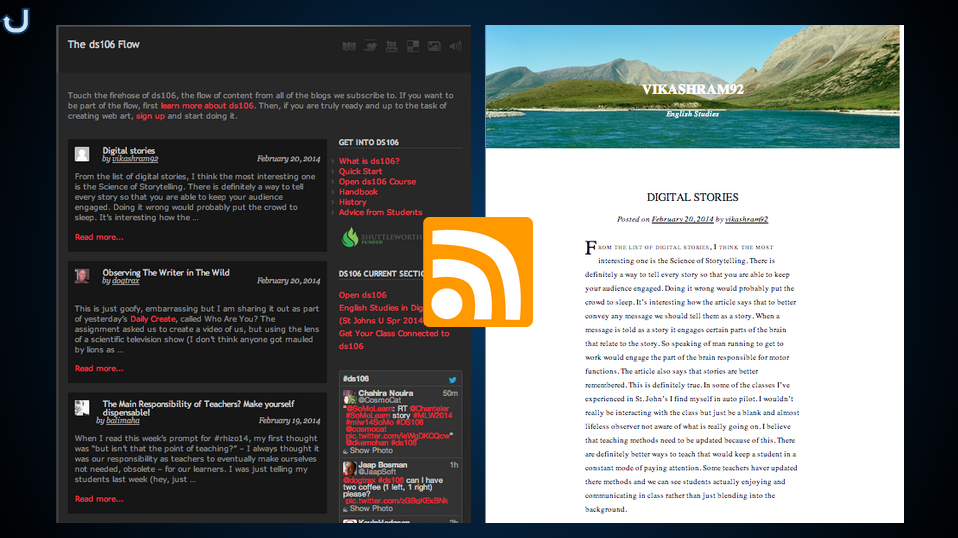
So, for example, we talked about the idea of syndication in terms of how it technically drives the platform of ds106 through RSS. About ten minutes later we returned to the same syndication slide under the topic of pedagogy examing how it provides a de-centered approach that liberates the faculty and students from a siloed, top-down teaching environment. Finally, ten minutes later, we talked about syndication, using the same slide, as a means of aggregating a wide variety of voices that made possible the open community. So rather than talking about syndication through a narrow technical facet divorced from its other qualities of augmenting pedagogy and building community, we explained it from three separate perspectives in the presentation with increasingly more context and complexity. As the presentation went on the blurring between the categories became more apparent on every return. Through a series of recursions within the presentation, I think we were able to give a deeper sense of the complexity of ds106 on every pass.

Screen Shot 2014-02-22 at 8.55.13 PM

Slide on Syndication

Now, we were limited  by the idea of a slidedeck when presenting this because we would regularly return to the same slide three times. In fact, the presentation was more like a  website than a linear slideshow. Given that, we tries to create it more along the lines of a website than a linear slide deck—even though we built it in Google Docs. In fact, Google Presentations allowed us to link various slides non-linearlly which helped us turn slide four into a homepage of sorts. On every slide Martha put a return icon in the upper left-hand corner bring us back home after every slide. Slide number four was the base slide from which we started talking about the three slices of open. It would be interesting to build this presentation as a website. And while we were planning Martha suggested it could be a ds106-o-matic presentation tool so that anyone could build a presentation about ds106 from a sets of slides and resources. I like that idea a lot 🙂

The other thing we did is send out a tweet asking folks how this course has impacted their exposure to online networks, people, and community. The response was overwhelming. The #ds106 community always brings it’s A-GAME!!! You can scroll through the responses below to get a sense of how a course can become a community—cults and all 🙂


There’s a video of the presentation on YouTube, but the audio comes in and out a bit at times. We also broadcast on #ds106radio, but I’m not sure the stream was archived—I was using Ladiocast 🙁  I guess this means Martha and I might just have to do this one again sometime soon. Will anyone have us? 🙂 Below are the slides, enjoy!

Posted in digital storytelling | Tagged , | 5 Comments

Domains in the Afterglow

Image of an early Geocities academic's site

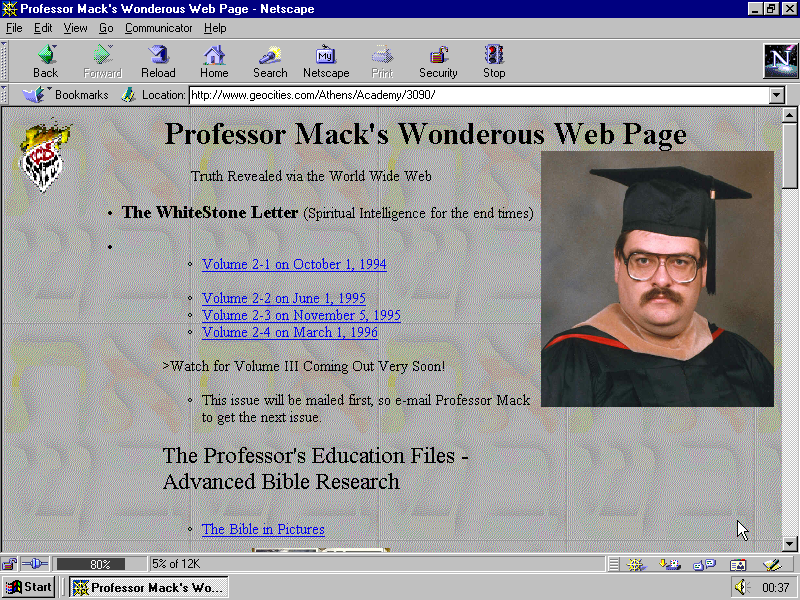
Below is an abstract of the presentation I’ll be giving at Emory Unviersity as part of the Domain Incubator event this Friday (Valentine’s Day!) Baruch College at the end of March. I came up with it a couple of week’s ago inspired by this presentation delivered by Bruce Sterling at the transmediale conference on January 29th. I already blogged about this presentation, but it got me thinking my talks about University of Mary Washington’s Domain of One’s Own project thus far have been primarily focused on the history of this project at UMW—the localized evolution of the idea.

I’m hoping this presentation will help me contextualize Domain of One’s Own within the broader history of the web. To accomplish this I’m going to be focusing on a specific web hosting community site of the early web: the now defunct Geocities. This is inspired by the art project “One Terabyte in the Kilobyte Age” which has archived a terrabyte of data from this discarded online datapolis. The images of these long forgotten ghost sites are remarkable, and speak volumes to the questions of how the web has changed? -who we are on the web over time? Not to mention it starts to underscore the fact that the web is an historical world that will itself have epochs. Virtual cities will rise and fall, and people will come and go. Who are we on the web in our moment, and how much of it is ours?

Below is the abstract I submitted to Luke Waltzer earlier this week. In addition to researching Geocities, I’m going to spend as much time as possible over the next month following up on a series of resources folks from all over North America shared with me about the evolution of personal web spaces on university servers during the 1990s. I’ll be blogging on this theme pretty consistently over the next four weeks, so consider yourself warned.

Domains in the Afterglow Or, What Can We Learn from Geocities about Digital Identity

The motto of the recent 2014 media art conference transmedial was “afterglow” which, according to the organizers, “symbolises the current state of digital culture – somewhere between trash and treasure, between high-tech brilliance and electronic junk – a culture of big-data firms and surveillance systems, where the digital revolution of yesterday has yielded media technologies that are rapidly consumed and discarded.” This talk will examine the state of the afterglow through the lens of an ongoing digital art project, One Terabyte of Kilobyte Age, that focuses on the web’s first major build-your-own-site community hub: the now defunct Geocities. What can internet kipple from twenty years ago tell us about the current state of publishing, community, and identity on the web? What’s more, how can it convince you to reclaim your domain?

Posted in Domain of One's Own, presentations | Tagged , , , | 7 Comments

Going Online

My oldest son, Miles, brought home this “Going Online” worksheet last night. I’m not entirely sure where to start on this worksheet, but the sixth question does sadden me a bit—bloggers still get no love. I had to break it to my son last night that his father is a degenerate blogger. In response he said “I was told I can’t blog until I’m 13.” I answered assuredly, “No son, you can’t get a Tumblr until you’re 13. You can blog whenever you’d like.”

To be clear, I’ve been happy with my son’s experience at school the last year and a half. I’m not trying to snipe and don’t mistake this for outrage, rather this instance reminds just how critically we need web literacy integrated into the curriculum. It’s time to give Miles a domain of his own.

Also, this reminds me of an idea that game up on Twitter the other night with Jenn Orr:

What if we start creating an elementary school curriculum that gets at the more dynamic and generative possibilities of the web rather than thinking about it like a set of static, scary resources. Richard Scarry anyone?

Posted in Domain of One's Own, fun | 19 Comments