Course Mangement Systems as the Gentrification of EdTech

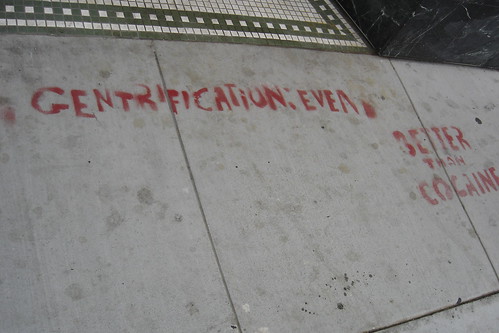
Gentrification Even Better than Cocaine

Image thanks to Lulu Vision

Here at UMW we have been going through a CMS Review. It has been a pretty interesting project, and while I only tangentially involved, I have been following the basic rhetorical thrust of the sales pitches from companies like Desire2Learn, BlackBoard, and Angel (well be getting in-house demos of Sakai and Moodle next week).

As any faithful reader of the bava may have already guessed, I’m not particularly a fan of Course Management Systems. But, at the same time, I am beginning to understand the perceived need for them in higher ed. I find it interesting that most of the questions in a CMS review center around issues of the gradebook and quiz functionality, which seems to really highlight—as Jerry would argue rightly, I think—that these systems are predominantly about administrative management of courses rather than teaching and learning. Fair enough, I should just swallow my medicine then, right? Maybe, and I’m trying to become more amiable and compliant. I really am, I swear.
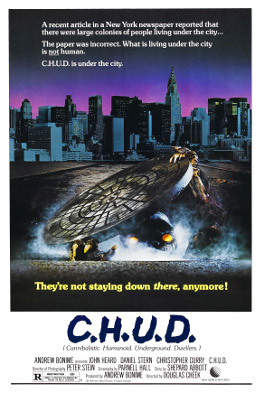
Image of CHUD posterBut humor me for second. This evening I was thinking about a particular strand of NYC movies such as The Warriors (1979) Times Square (1980), Fort Apache, The Bronx (1981), C.H.U.D. (1984), Alphabet City (1984), Crocodile Dundee (1986), Bright Lights, Big City (1988), State of Grace (1990), New Jack City (1991), and several others. While these films represent a wide range of genres, they have something in common in my mind which is a filmic framing of New York City as a wilderness, a frontier of crime, violence, and more generally fear. A vision feeding upon the perception of New York City during the 60 and 70s —with the white flight to the suburbs—as a reflection of the state of general “decline” of urban centers (we can understand that decline in a whole host of race and class-inflected ways). Just think about the title of the film Fort Apache, The Bronx, which alludes to John Ford’s Western classic starring John Wayne titled Fort Apache (1948) (though Ford’s film is far more sympathetic and complex a look at the Native Americans than Fort Apache, The Bronx is of the inhabitants of the South Bronx), it is a self-defined frontier film relocated back to the cities of the East Coast. During the late 70s, throughout the 80s, and into the 90s (when the process is just about complete), a new battle for a return of “civilization” in America’s “once great” cities emerges. It is the rise, in several different forms, of the “urban jungle” film, a space that must be exposed, condemned, and re-conquered—and film was one place this happened.

Image of Neil Smith New Urban FrontierNeil Smith’s The New Urban Frontier does a phenomenal job of examining the details of “urban renewal” as deep-rooted shift in both the political economy and culture of U.S. cities during the late twentieth century. The very language of the process of gentrification of urban areas has taken on the frontier imagery of the West: urban pioneers, urban homesteaders, urban cowboys, etc. Films like those above trace this shift in myriad ways, and capture the cultural impact of re-framing American cities as frontiers of crime, violence and difference that need to be both civilized and assimilated, which more often than not means the undesirable element of any given city need to be made invisible, hidden from public view, which C.H.U.D. does a wonderful job at suggesting with the transformation of the displaced populations of NYC living under the city in old Subway tunnels (also known as Mole People, a reality compounded in the 80s when President Reagan put the majority of America’s mentally ill patients from clinics, hospitals, and treatment centers around the country on the streets) into monsters that were created by the very government that tried to hide them (I love this movie!). And there is more to say about each of these films, I mean Paul Hogan as Crocodile Dundee is just the kind of rough and exotic cowboy needed to fight the rampant crime in NYC, and ultimately he liberates the city and himself from the violence that often characterizes any frontier (frontier, in my mind, proving a a very different linguistic formulation than the more nuanced and complex idea of a borderzone which examines the flow of fluid identities through space). And I could talk about all these movies at length, but that is another post, or series of posts, about New York City gentrification in the movies. Suffice it to say, you can read movies as social, political, and cultural traces of the re-imagining of the urban centers as frontiers that need to be subdued, and which are re-claimed and occupied by the middle and upper-classes during the late 90s and 00s.

So what the hell does any of this have to do with educational technology and CMSs? Everything, in my mind. Course management systems as we know them today emerged roughly 10 to 15 years ago (with the watershed year being 1997) as a means of creating virtual learning environments. The very logic of these environments was to create applications that could manage the administration, delivery, and discussion based components of a course online. About this time the CMS became ubiquitous in higher ed as a possibility for managing document distribution, rosters, forums, etc. Companies like BlackBoard emerged as all-in-one solutions for managing courses online due to the relative difficultly of using the open web in the late 90s given the unilateral nature of content delivery, limited access to the web, and the general difficulty designing and maintaining one’s own space. Course management systems fit a need, they were designed for a learning environment that posed a high threshold of difficulty for two-way participation.

Yet, over the the next ten years the web becomes a far more conducive space for dynamic interaction and participation, while at the same time internet penetration throughout the Western world becomes more and more ubiquitous. At the same time applications that offer similar functionality as course management systems begin to emerge at a fraction of the cost of centralized, proprietary systems. And the interest in emerging technologies with different approaches begins to appear, the early interest in learning object repositories and metadata might be understood as a foil to the parallel interest that emerges a bit later on with blogs, wikis, RSS, etc.—with the ease and simplicity of the later seemingly winning out over the labor intensive and static model of the former (I am treading on unfamiliar ground here, so feel free to fire away). So what we have here is a failure to communicate the emergence of a frontier in educational technology, the space of harnessing the possibilities for teaching and learning on the open web that are no longer limited to the logic of an outdated system like the CMS that provides a controlled space for basic interaction online around course materials given the apparent limitations of the early web. Yet, the logic of such a system morphs into a logic of institutional control, security, and convenience. What changes is not the actual underlying technology of CMSs as outdated systems of delivery and management centered around a course, but the general sense that the internet is a dangerous place (which it is) and teaching and learning needs to be cordoned off from that (which is questionable). The design of CMSs don’t change over this period of time, but their logic and raison d’etre does. And while the power of tools such as blogs, wikis, and RSS for creating engaging, interactive spaces for collaboration and discussion made simpler with syndication technology like RSS is amde more and more apparent, the rhetoric of fear, terror, and a protected and centralized space for teaching and learning becomes vocalized more and more.

So, what happens? The companies that make the CMSs gentrify the frontier, they try and assimilate the power of these tools within a controlled space that is safe, closed, and convenient. It is two pronged attack exploiting fear and protection of the students and teachers along with a promise of a centralized convenience and peace of mind. So, like the artists that moved into SOHO and the Lower East Side of NYC in the 60s and 70s, their pursuit of an affordable and diverse alternative to mainstream logic ultimately paves the way for capital to roll in and develop and gentrify these neighborhoods, eliminating most, if not all, of the original spaces that made them interesting and compelling to begin with. This is the lot of educational technology right now, those professors, IT folks, and instructional technologists who pioneered the field of educational technology on the open web over the last decade are watching their work be incorporated into a machine that is selling them back the fruits of their experimental labors as a shiny product that elides the very context of its relevance. Course management systems are the sterile environments of gentrified and wealthy cities like New York’s Manhattan that has very little left of its original luster, and what can be discovered comes at a cost that is prohibitive to the everyday citizen. The machine is, indeed, using us!

Are there alternatives? Is such a move irreversible? I don’t know, but when I read Barbara Ganley and trace her thought I do have hope for different models of thinking about teaching and learning within a digital framework. There are new frontiers emerging, and I want to be on them.

Posted in experimenting, films, movies | Tagged , , , , , , , , , , , , | 26 Comments

WPMu Sitewide Tags, Feeds, & Archives! Oh, My!

Image from The Wizard of Oz

So….so so so so so so, it’s time for a little walk down WPMu history lane. Last year at this time I was desperately scrambling for a way to have sitewide tags for UMW Blogs. I found the solution in Dr. Mike’s hack shared on the WordPress forums here, but it was kind of a mess even then. Yet, the concept was brilliant: a separate site that allows you to archive, search, and create a tag cloud for categories through a good ol’ spamming plugin—DIY ingenuity at work given the limitations of WPMu at the time. The set up ran on a separate single install of WordPress that was pulling in the sitwewide feed from WPMu (thanks to IT Damager –who has since disappeared along with his Sitwewide feed plugin) and running it through the outdated WP-Autoblog plugin, as well as a plugin for re-directing the permalink to the original blog it was fed in from (a process I detailed here). Moreover, once I got this hacked concept straight in my head and installed it, the WP-Autoblog plugin and the Sitewide feed plugin had to be further modified to work. Add to that the fact that when I updated UMW Blogs from 1.2.x to 1.3.3 the categories were no longer being pulled into the separate WP site properly, effectively breaking the tag cloud. Making the whole thing at least a partial bust right around February. In short, it was an extremely smart hack on Dr. Mike’s part, but in the long run it became more of a nightmare than an asset.

So, as soon as I saw the MuTags plugin for WPMu sitewide tags from Mr. Henry I jumped on that, and made that the default tag cloud for UMW Blogs, and used Dr. Mike’s hack as an archive for posts throughout the environment (sans categories). But Mr. Henry’s MuTags had two problems: it had no sitewide feed for each tag, and it couldn’t incorporate categories into the tag cloud. Moreover, when we bought the $50 extension for the plugin which allowed feeds for each tag, I found the feeds to be pretty poorly parsed and ugly 🙁 But I was hopeful enough to blog it, and when Stephen Downes took issue with our paying $50 bucks for this functionality I wore all black for weeks and couldn’t sleep at night (this was before he discovered and broadcasted the beauty that is EDUPUNK —welcome back Stephen 🙂 ).

So, that kind of brings us up to date, and it is also when a new era begins for WPMu. Because all the functionality I needed at least three plugins for, a separate WordPress installation, a brain surgeon, and a hammer to make work have all been bundled into one little WPMu plugin developed and shared by the inimitable Donncha: Sitewide Tags Pages for WPMu. This plugin gives you all the functionality that the original hack did, namely a searchable archive of posts and sitewide categories with feeds, but adds a few as well such as sitewide tags (which are really tags not categories called tags –we have figured out the difference, right?) and sitewide feeds for tags, a built-in “spamming tool” that just republishes the post from throughout the environment onto one blog in your WPMu environment at the URL http://tags.yourblog.com. And more than that, the permalink points to the original blog and the author is immediately populated in the tags blog making the whole process seamless and clean. Not to mention the fact that given it is a blog within your WPMu environment you don’t have the overhead of a separate install with outdated versioning because you don’t want to surrender the archiving functionality all together.

So, how to use this? First off, keep in mind Donncha has made it backward compatible for older versions of WPMu, but I would recommend using it on 2.6 only, for it seems there are still some glitches on older versions (at least WPMu 1.3.3). Here is how I am thinking about using it on UMW Blogs. As a sitewide category/tag cloud with feeds galore, which will actually be useful for syndicating class content as I talked about in the e-portfolios post here—not to mention a few other ways of thinking about course spaces -but more on that soon. And given all the posts with both their tags and categories are in one blog, I can actually use the Simple Tags plugin to display the tag cloud, make categories show up as tags, and get a consistent feed with some related tags and posts contextual goodness. Laying Simple Tags over this blog and playing with it will make all the difference in my opinion. I have started this process as an experiment here.

Image of sitewide tag cloud on WPMu

Moreover, we can starting thinking creatively about archiving the posts on UMW Blogs with little or no hassle. We could actually archive a whole semesters worth of posts, or year’s, by simply exporting the XML file for the tags blog, or dumping the database. In effect, starting fresh every semester, while creating a separate space for the large, searchable archive of all the posts in UMW Blogs. This plugin has the potential to solve so many problems all in one fell swoop, I’m excited about it, and will keep you updated with the process as UMW Blogs makes the transition to WPMu 2.6.

P.S>–After just checking my sandbox version linked to above, it seems like this plugin also pulls in pages from around the environment, which is fascinating. And I will have to think about the implications of this, if I am, indeed, correct.

Posted in plugins, UMW Blogs, Uncategorized, wordpress multi-user, wpmu | Tagged , , , , , , , , , , | 10 Comments

A List of Plugins Used on the Bava

I have been meaning to use David Benini’s Plugins List plugin (I love plugins about plugins–the meta-plugin!) which simply allows you to include a list of all the plugins you are using on your site. Simple, yet potentially very useful for others, and a way to give a shout out for all the hardworking folks out there who are truly responsible for making WordPress as great as it is (yep, I’m creeping back to the state of ecstatic fanboy!).

And while it won’t list the MultiUser plugins running on the bava, it will list all the standard plugins, and that may help some of you upgrading to WPMu 2.6 get an idea of what will fly, for all of these have been tested and work well with the beta 1 of WPMu 2.6. As you will probably notice, I don’t use all of these plugins, but many of them are also for UMW Blogs testing, as you can see UMW Blogs is the real deal! We don’t half step when it comes to plugins! Whose better than UMW Blogs, name me one blogging service…just one, damn it!!!

    [plugins_list]
Posted in plugins, UMW Blogs, Uncategorized, widgets, WordPress, wordpress multi-user, wpmu | Tagged , , , , | 6 Comments

Playing with WPMu 2.6 rc 1

I have upgraded bavatuesdays (and six other domains I tend on one WPMu install) to the beta release of WPMu 2.6 in anticipation of upgrading UMW Blogs come August 1st. In fact, the next few weeks are going to be an all out WPMu push. I will be working on updating all our documentation for the new admin interface—I’ll be borrowing liberally from Luke Waltzer’s awesome tutorials getting underway here—as well as making sure the upgrade of UMW Blogs from 1.3.3 to 2.6 is smooth (notice that WPMu has realigned the version numbers with the straight up WordPress). In short, I’ll be doing a lot of looking around for any bugs, especially plugin interference. So, after the seamless upgrade this morning, here’s what I got thus far:

  • There were really very few problems upgrading from WPMu 1.5.1 to 2.6 – 1.5.1 deactivates plugins during the install, and re-activates them in all the blogs after the fact. Making the chances for an immediate breaking of the install minimal (this will not be the case going from 1.3.3 to 2.6, however). There was an odd message in the dashboard about this version of WordPress not working with Simple Tags, which doesn’t seem to be the case.
    Odd Dashboard Message about Simple tags
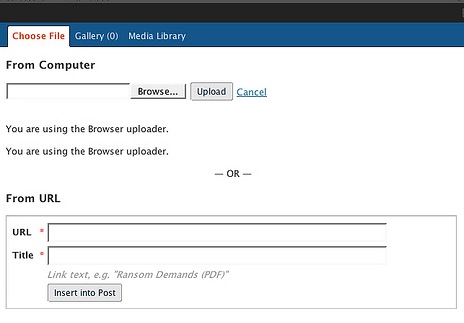
  • Also, while writing this I just realized that adding an image from a URL isn’t working properly in the Add Media function for writing a post or page. Moreover, it is missing the music/image/video icons for selecting the appropriate media. Image of Add media Tab in WPMu 2.6 rc 1
  • FeedWordPress, which is an awesome plugin that is allowing for all the inter-blog spamming going on at UMW Blogs, had some serious issues in WPMu 1.5.1 with the new interface and all the AJAX and javascripts, resulting in broken media uploads, inability to arrange widgets, and borked recent comments and incoming links feeds in the dashboard. All those issues go away in WPMu 2.6, but one remains: you can’t open up the Advanced Options sections on the Write Page screen (though they work on the Write Post screen) when FeedWordPress is activated. Odd I know, but true.
  • RSS feeds for latest versions of plugins is now a part of WPMu 2.6 (but not Multi-User plugins just yet). I love this feature, it saves me so much time, and as soon as I updated the Bava to 2.6, I got the lastest version of about twelve plugins I let lapse. This is my favorite feature, without question! Although, keep in mind that if a plugin you are using is not distributed through the plugins directory at wordpress.org, you will not get an update for the latest version, which is true in the case of Tan Tan’s Flickr Albums plugin, for example. Image of Plugin version update reminder
  • Seems like Gravatar support is now built-in to WPMu 2.6, which is an added bonus! Image of Gravatar setting s in WPMu 2.6
  • Also, there is the Turbo feature in this release that harnesses the power of Google Gears to speed up page loading time. Keep in mind you have to set up Google Gears, but the integration with such a service is interesting. I’m still a bit fuzzy on it, but I’ll be testing it out to see what it is all about.Image of Google Gears/WPMu Turbo
  • What I ‘m most excited about with WPMu 2.6, however, is the WPMu Sitewide Tags Pages plugin by Donncha that will change the way we use tags, tag feeds, and archive posts throughout the environment at UMW Blogs, it’s huge!!! But that will be my next post, I have a bit more testing to do first.

OK, that’s it for now, more soon.

Posted in Uncategorized | Tagged , , | Leave a comment

Prom Night (1980)

Last night I saw a coming attraction for the re-make of Prom Night (2008), which seemed so shiny and new compared to the original. In fact, while watching the trailer I found it to be a sign of the times of Hollywood for a couple of reasons: first, it seems an excellent example that the American film industry has given up all pretenses to having an original idea and has settled upon cannibalizing its own history; second, this particular remake (and this from the trailer alone) signifies just how polished and obsessed we have become with luxury, appearance, and all things empty. Now I know this is what people from the 50s and 60s would say about the 70s and 80s, but they’re wrong!

The trailer got me thinking about the original Prom Night from 1980 (the only one that’s true in my heart) and just how different the texture of that film is from the trailer I was assaulted with. The 1980 version of the film was a Canadian production (as was My Bloody Valentine (1981) another favorite slasher film of the era) filmed on location in Toronto, and it captures a really gritty and evocative image of a more modest and thoughtful moment in both cinema and culture. Take, for example, the trailer of the 2008 version, the students are all primped beyond belief (even the punks), it takes place in a fancy, rented-out ballroom, and the students all have $300 dollar a night hotel rooms. Compare that with the 1980 version: the prom is in the school’s gym, it’s a happening disco party, there are no limos in sight, and the dress has the undeniable flare and sexiness of the 1970s. It may seem odd to some that I would be hearkening back to the late 70s and early 80s for some sense of propriety and measure in terms of fashion and invidious consumption, but I’m convinced the decade we have been living through makes the late 70s and early 80s look like the Great Depression by comparison.

Take a look at the trailer for Prom Night (2008):

Now compare it with the Old Gold Prom Night (1980):

Which one do you want to watch? And while you could argue that the original Prom Night is a b-movie and we really shouldn’t be wasting our time trying to defend some exalted idea of when it is by its very conception second rate. However, that’s where you’re wrong. The 1980 version of Prom Night has one of the best opening scenes of any teenage slasher flick ever. It’s a powerfully poetic sequence tracing a group of kids playing a Gothic version of hide and seek (“The Killer is Coming”) in an old, dilapidated school that creates a really dark and scary setting. The very first shot of the scene (which you can watch below thanks to YouTube) frames the Gothic roots of this opening scene quite beautifully. How can you honestly re-make this film? It is impossible in this day and age, primarily because this Gothic structure is either long gone or has been turned into million dollar condos that the kids from the 2008 version of the film live in 🙂

Posted in film, films, halloween, movies | Tagged , , , , | 18 Comments

William Faulkner on “Kilroy was here”

The aim of every artist is to arrest motion, which is life, by artificial means and hold it fixed so that a hundred years later, when a stranger looks at it, it moves again since it is life. Since man is mortal, the only immortality possible for him is to leave something behind him that is immortal since it will always move. This is the artist’s way of scribbling “Kilroy was here” on the wall of the final and irrevocable oblivion through which he must someday pass.

Interview with Jean Stein, Lion in the Garden, p. 253.

Posted in Uncategorized | 4 Comments

Formative 10: Clash of the Titans & the Cinema of Attractions

Movie post of Clash of the TitansWhen talking about films I saw as a pre-pubescent adolescent, I think one of the most important would have to be Ray Harryhausen’s Clash of the Titans (1981). Now technically, keeping inline with the logic of discussing film, I should have said Desmond Davis’s Clash of the Titans because he was the director, and ever since the 50s and 60s we have gotten in the habit of attributing films to an author, which usually results in naming a director (it can be a problematic habit that I posted about in some detail here ). But Clash of the Titans is not Desmond Davis’s film, it is Ray Harryhausen’s film, and it is sadly his very last film before he retired, effectively closing the chapter on a very rich and personalized contribution to cinematic special effects.

This film holds a special place in the pantheon of formative films for me, and it needs to be contextualized a bit with some details of my experience back in the early 80s with movies, theaters, and long and lazy Summers. This film was released on June 12, 1981, and I saw it soon after that and it was amazing for some very specific scenes that I will talk about shortly. But it wasn’t until the Summer of 1983 that I really was able to “see” this movie. You see, the theater up the block from my house, the Baldwin Century Theater, was one of a classic chain of single house theaters that represents for me everything that was amazing about movie going. It was a huge auditorium by contemporary standards, and by 1983 it was in serious financial difficulty given that movie theaters on Long Island had already begun literally splitting these single screen cathedrals in half to show two films simultaneously. The logic of the multiplex was beginning to supplant the single house theaters all over the country, signaling the end of a movie theater experience that had been around since the depression (the Baldwin Century Theater was built in 1933).

Watercolor of an old school theaterAs a result of the larger trend towards cultural sterility and alienation, the Baldwin Century Theater’s economic struggles led the management to experiment a bit with imagining itself as a re-run theater. For the Summer of 1983 they got prints of pre-released films like Clash of the Titans and Star Wars (more on Star Wars in another formative 10 post) and showed them for the entire Summer for 75¢ a pop. That was an admission fee that even an eleven year old could easily afford, and it resulted in my sisters and I going to the theater regularly for almost two months. We must have seen Clash of the Titans and Star Wars twenty times that Summer, and watching the two films together like that was, in retrospect, an interesting juxtaposition of the future and the past of special effects in cinema. What’s more, by this stage of the theater’s rapid decline the management seemed to understand they were finished, so neighborhood kids who were just a little older than me, and that I knew, were effectively running the movie house. It was almost as if it were a fun place for kids to go and hang out, and while I never watched either of these films all the way through after the fourth or fifth time that Summer, there were scenes from each I never missed.

Laurence Olivier as Zues in Clash of the TitansAnd that brings me to the actual film, which was by no means a great film if one were to examine it in terms of narrative or acting. And while there was no shortage of great actors in the film, including Laurence Olivier as Zues, Maggie Smith as Thetis, and Burgess Meredith as Ammon, the actual screenplay and narrative thrust were not remotely adequate to the British thespian firepower at hand. These actors were just names on a card that meant nothing to an 11 year old (and having seen the film lately the acting is by no means remarkable), what was memorable however was Ray Harryhausen’s fantastic creatures. The film brings to mind for me a phrase Tom Gunning used to define the very beginnings of film: “the Cinema of Attractions.” This concept refers to early years in cinematic history, roughly from 1894 to 1908, when film was in an almost constant state of transformation, and its logic wasn’t so strictly dominated by any one particular sense of narrative or formative style. To quote Gunning:

[Cinema prior to 1908] did not see its main task as the presentation of narratives. This does not mean that there were not early films that told stories, but that this task was secondary, at least until about 1904. That transformation that occurs in films around 1908 derives from reorienting film style to a clear focus on the task of storytelling and characterization.

Rather than using film for outright entertainment purpose, the “cinema of attractions” offers the viewer something different: “the chance to take a journey somewhere else-a place to which he will likely never physically travel…films sought to transport the viewer through space and time, rather than to simply tell a story,” as Lila E. Stevens points out in her discussion of documentary film here. And while Clash of the Titans is anything but a documentary film, and I am admittedly re-appropriating Gunning’s phrase to define the earliest moments of cinema for my own nostalgic purposes. That said, I do think that a number of the formative films in my life have consistently represented a series of scene-based attractions that overpower the the narrative to focus on a moment that captures the dynamic qualities of the medium as a space for wonder. And it’s for this reason that I claim privilege to extend the scope of such a term, or at the very least an excuse for commandeering it.

Image of Calibos

The narrative of Clash of the Titans seems to be the occasion for Ray Harryhausen to transport the viewer to a fantastical time and place with his animated creations that themselves mark a point in time that seems irretrievable beyond the celluloid it was captured on. And for me remains one of the most formative films in my early career as spectator for this very reason. I wasn’t at the time so concerned with the some structuralist approach to narrative and story, I was eleven and fascinated by the visual magic that was in motion on the large screen before me. Kinesis in the raw! How can I forget the animated vulture carrying Andromeda’s spirit to meet Calibos in the Swamp of Despair. Or Calibos himself (a Harryhausen original), whose mangled, hybrid form became the symbol for me of the Satyrs I would later read about in Greek Mythology, or the goat-footed balloon man whistling far and wee in e. e. cumming’s “In Just Spring.

Image of the Scorpions from Clash of the Titans

Calibos was a memorable villain, not because of anything he did or said, but because of how he looked and how he moved, how he was animated. Much the same can be said of Pegasus or the three-headed dog Cerebus or the growth hormone spawned Scorpions. Image of Medusa from Clash of the TitansBut without question the greatest single scene in Clash of the Titans that may in and of itself be responsible for the impression this movie has had on me for all these years is when Perseus encounters and beheads Medusa. Now I fully understand that Harryhausen’s greatest single contribution to special effects in film comes almost twenty years earlier in Jason and the Argonauts (1963) with his animation of the fighting Skeletons scene (I’ve linked to this work of genius below). Acknowledging that, his animated gorgon will forever hold the honor of his greatest work for me. Not so much because I can’t objectively see that is far less complex and innovative than the fighting skeletons, but rather it was a ten minute scene that embodied the idea of movies as a series of attractions, each of which are often far greater and more powerful than a narrative whole.

Medusa Scene from Clash of the Titans

It is the narrative that we are ultimately trained to appreciate when we come to study in school, but the scenes of attraction are likes lines of visual poetry that contain those moments of pure and utter imaginative magic. It was the Medusa scene in Clash of the Titans that turned me on to Piers Anthony’s Xanth novels and got me playing Dungeons and Dragons. It was this scene that ultimately encouraged me to read Edith Hamilton’s classic work on Greek Mythology, and it was this scene that made me re-think the far more contemporary special effects I had been introduced to years before in Star Wars (the Sand People had a somewhat similar effect on me as Medusa had–which is interesting for me to consider). It was also this scene that made me think having a quiver of arrows strapped to your back was possibly the coolest thing in the entire world, not to mention having snakes for hair or being able to turn others to stone with a dirty look.

So, when I talk about Clash of the Titans it’s not so much about a movie as it is about a series of scenes that were meticulously handcrafted in their effect on my psyche. Medusa as a character may even be laughable to all those CGI babies out there, but it suggests one possible aesthetic of many, and a very individualized one with the distinctive marks of its creator. A form of craftsmanship in special effects (a world that has changed drastically) that we aren’t likely to see ever again. And while I may be wrong with this sentiment, the fact that Hollywood is re-making Clash of the Titan—which is slated for a 2010 release date—may allow me to think more closely about the transformation of special effects in cinema over the last thirty years, along with Harryhausen’s place in this history.

Interestingly enough, Harryhausen didn’t retire in 1981 because he was ready to stop animating, but because he was pushed out of the business. No one was interested in his work anymore given the rise of George Lucas’s visual effects house Industrial Light & Magic, the shop that revolutionized special effects in a little film you might have heard of called Star Wars (1977). Which, I imagine, has to be my next formative 10 post given how this one leaves off with a certain amount of unfinished business. But before I end it, here is the Skeleton Fight scene from Jason and the Argonauts, just in case you have haven’t seen it before. Just the way they come out of the ground is simply amazing. Though, you may want to get the DVD, or wait for it to come out in a single screen theater near you. Enjoy!

Posted in film, films, Formative 10, movies, Uncategorized | Tagged , , , , , , , , , , , , , , | 11 Comments

Sorry, We’re Open

Image

Sorry, we’re open used courtesy of oknovokght.

I have to be honest with you, I’m getting more and more confused with the term “open” when used in the context of educational technology these days. The term has been popular in software development for decades, particularly in relationship to free and open source software (FOSS). This approach is premised on community development which means sharing the source code freely, rather than patenting an application and closing it down. Open source applications have had considerable success over the past decade, and much of the usage of the term open in regards to education, such as Open Education Resources (OCR), Open Courseware (OCW), open content and open access, is credited to the principles and successes of the open source development initiative.

The term is often abstracted from any specific resource to signify a political position of “openness,” often referring to something both conceptual and concrete all at once. And while the technical definitions of what constitutes open content can quickly become a legal minefield of licenses and attribution clauses, the general idea of openness in education might be understood as something beneficial to the community at large by providing a means of freely sharing one’s work with others—all made infinitely easier given the new world order of “free and open” digital publishing and distribution platforms. Openness has for many in the educational field become synonymous with a kind of “common good” that benefits both teachers and learners worldwide.

Hell, bloggers I read regularly have the term open in their titles: David Wiley’s Iterating Towards Openness, Bill Fitzgerald’s Open Academic, and Alec Couros’s Open Thinking & Digital Pedagogy: Open, Connected, & Social (that’s two opens!). And over in Great Britain there is the legendary Open University, rich with an unfair advantage of knowledge and innovation represented by cats like Tony Hirst and Martin Weller. In fact, Brian Lamb’s struggles with publishing and distributing open content with loose syndication systems might be the best example of everything this term has come to represent in regards to expanding the educational resources available while thinking about the open web itself as the learning management system.

So, I thought I kinda knew what open meant when it came to educational technology and the like. Well, I thought I did, but there is some serious linguistic confusion emerging as of late that has me thinking about this ubiquitous term. Take a look at the following excerpt of an article (actually, it reads more like a press release) from Inside Highed Ed, which outlines BlackBoard’s announcement that they’ll be “connecting” with the open source course management system Sakai:

“There’s been some concern in the [open-source] community that this is a giant attempt to suck everything into Blackboard…. It really is done in the spirit of trying to be an open company, [to] really focus on something that will add value to the student experience,” Fontaine said.

So Blackboard’s an open company now? Is John Fontaine, Blackboard’s “technology evangelist” (yep there’s another fucking term out the window), confusing open with public, as in publicly trading? This may seem like a “knee-jerk” reaction—as the article promised there would be—but have we come to the point in our terminology where there are no fine distinctions anymore? What does “open” mean in this context? Is this the same open company that has re-opened its suits against Desire2Learn?–a fact that this article fails to mention, and kudos to Jeffrey Young’s article in the Chronicle which gives us at least that.

Point is that an announcement like this has very little to do with open source innovation, and everything to do with a marketing strategy to linguistically co-opt the term open. The word is used 21 times in this article, and while BlackBoard is working with the IT staff at Syracuse University to create a “dongle” (I refuse to call it a bridge) to connect with Sakai (hardly revolutionary),the actual language in the article is what’s important. BlackBoard is attempting to “brand” itself (which reminds me of a post I have brewing about the constant references to “personal branding” in education—but I digress) with the concept of openness. It’s a sales tactic, pure and simple. And the next time your BlackBoard rep comes to campus, they’ll not only be able to say we can do what those open source CMSs can, but he/she’ll even be able to say, “Hey, don’t worry about all those open source CMSs, we’re in bed with them now. We’re open too! Would you like me to show you the dongle?”

Which brings me to Sakai. After the Sakai Paris 2008 conference, Michel Feldstein suggests there is “a new Sakai” on the horizon. And he could very well be right, and while I was underwhelmed by what I saw of the old Sakai, the next two years could very well be a watershed for this open source application. Nonetheless, Sakai and Moodle have everything to gain by some kind of seamless integration with BlackBoard, and these open source applications by their very nature can take advantage of the opportunity thanks to the altruism(?) of BlackBoard. Let’s face it, by such a move to connect with these open tools (that aren’t that much cheaper in the end) BlackBoard gets that much more of a competitive edge in a market they already dominate. And, in my humble opinion 😉 , both Sakai and Moodle represent the worst kind of “learning” application (whether or not they are open source): course management systems. They ape the functionality of BlackBoard, but just in an open source model—they are course specific, they have few features that actually enhance learning, and they smack of an outdated model of ownership, control, and management—which makes them administrative tools, not learning tools.

What we have here is “large tools tightly joined.” And the moniker they are using to sell you this grand innovation is “openness.” In fact, why stop there, why not throw in another key term that has defined openness and innovation on the open web:

But Fontaine said that wouldn’t be the case. He said the connector would be “bi-directional,” giving users the ability to make a “mash-up” of data from different software systems.

Hey, it’s a data mash-up too! What it is is capital’s co-opting of the terminology of so many of these open tools and practices to erase any difference and assimilate any potential edge of a term like open into its brand.

I guess open is the new closed, and I’ll have to think twice before I use it so freely any time soon. Like lambs to the corporate slaughter. Looks like EDUPUNK is the only pure alternative 🙂

Posted in edupunk, experimenting | Tagged , , , , , , | 25 Comments

Bishop of Battle (1983)

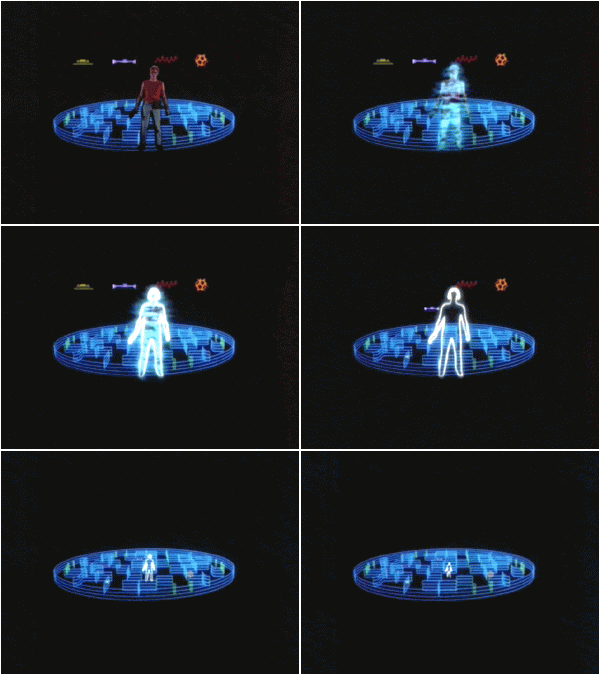
Image of fictional video game Bishop of BattleI have been thinking about certain movies from the 80s that kind of represent this moment in time, regardless of whether they are good or bad. And while movies are, for the most part, dependent on narrative, they also have the ability to capture the space, clothing styles, hairdos, music, and the overall built environment of a cultural moment. To riff on Frederic Jameson’s notion that the “the visual is essentially pornographic,” the act of re-watching “bad” films from the late 70s and early 80s is an act of desire-laden voyeurism for me. The narrative is often secondary to the pleasure of the film medium that captures the excesses of the visual that lay bare the nostalgia fueled yearnings of watching
While thinking about those emblematic films from the 80s (and more on this in some other post), I remembered a film from 1983 called Nighhtmares that is a re-telling of four urban legends, and while I will only focus on the second story titled “Bishop of Battle”–the other three are well worth your time, featuring the likes of Lee Ving, Lance Henricksen, and one of my all time favorites Veronica Cartwright. The “Bishop of Battle” stands out in my mind because I deeply identified with the video game-crazed kid J.J. Cooney in the episode, played by Emilio Estevez. The short starts off with J.J. hustling vatos in a downtown Los Angeles arcade in order to earn enough money to return to the Valley and get to the mythical 13th level of the game Bishop of Battle. The opening scene is rich with arcade imagery that beautifully captures the most popular coin-op consoles that ruled the era, and the game J.J. and his unassuming victim play during the hustle scene is none other than Pleiades (1981). What’s more, when J.J. really wants to get in the gaming groove, he puts on his old school Walkman headphones for a dose of some punk rock, his mixed tape features the likes of Fear and Black Flag amongst others (an early and interesting association between punk rock and video games, and perhaps one of the reasons why Estevez’s next role would be Repo Man ).

“Battle of Bishop” Part 1

After being outed as a hustler, J.J. and his friend barely escape to the Valley which is almost entirely represented by the shopping mall (a symbol in film that fascinates me—whether from Dawn of the Dead (1978) , Fast Times at Ridgemont High (1982) or Valley Girl (1983)—Malls in movies during the late 70s and early 80s deserve an entire space for thinking all to itself). While J.J. heads into the arcade to try and reach the elusive 13th level of Bishop of Battle, his friend Zock let’s him know that video games are turning him into a fiend. In fact, the rest of the short highlights this change in J.J. through some good bad scenes with a potential love interest he repudiates and an argument with his parents over his failing grades. All to highlight that he’s sick, he’s a video game addict: a vidiot! I love this early tracing in movies of the idea that video games are like a drug, and their addicting quality can be likened to all the terrible effects of alcohol or heroine. It hits home for me because my older brother used to call me a vidiot back in 1981 when Pac-Man hit the scene (my drug of choice), and I found myself on numerous occasions raiding my father’s coffee cans filled with quarters to feed the monkey at the local arcade.

“Battle of Bishop” Part 2

They got JJ
Finally, in the last part of this short J.J. breaks into the arcade in the middle of the night in order to beat the Bishop, and he does make it to the 13th level only to have the video game come to life. J.J. plays fiercely for the real stakes of life and death and seems to narrowly escape his demise. But, alas, the dreaded Bishop of Battle swallows him up in the mall’s parking garage, and with a very mildly “horrific” twist on Tron (1982), J.J. is seen by his friend Zock and his parents being ingested into the actual narrative of the video game.

“Battle of Bishop” Part 3

See where that addiction can lead you kids!!! I just love it that as early as 1983 video games had entered the mythical status of Hollywood urban legends. This short represents a deep-seated anxiety about this new and addicting digitized medium, and its projection here as an imaginative tale of being literally consumed by the actual game, which is by its very nature violent and premised upon battle and consumption, has stuck with me. A logic which immediately brings Bryan Alexander’s awesome blog Infocult to mind given its regular discussions of the gothic representations of video games in the media, especially when they deal with my hometown of Strong Island.

Yet, with all that said, for me the moral tales of such films are fascinating, but it’s a film’s ability through the visual to capture the actual spaces of an arcade during the 80s, which are for the most part gone, as well as the clothes, hairstyles, and the music of a moment that remains the true pleasure of the return to a movie like this. And with this new fangled technology called the internet, fans and hobbyists like those at Rogue Synapse can work on designing an actual version of the Bishop of Battle game for real, you can read the details and download a demo here. I love the internet, it makes my pornographic nostalgia that much more interactive 🙂

Posted in movies, video games, YouTube | Tagged , , , , , , , , , , , , | 7 Comments

Derek Jarman’s Wittgenstein and other philosophers on YouTube

Last night, Anto and I spent the evening playing with YouTube. Anto did her Laurea in Philosophy at the Unviersity of Milan and here thesis was on Ludwig Wittgenstein, so it is always a joy to listen to her talk about his thinking. As we were talking we stumbled upon a scene from Derek Jarman’s film Wittgenstein which featured an interpretation of one of his later lectures at Cambridge. I say later here to distinguish this as part of his thinking along the lines of The Philosophical Investigations rather than the Tractatus, which represent his only two published works (investigations was published posthumously) and signal two radically different approaches to the fundamental questions of his philosophy. The following scene from Jarman’s film Wittgenstein (1993) is both minimalistic, beautifully colored, and a dynamic re-creation of a fabled seminar fro his later thought while at Cambridge.

Jarman’s Wittgenstein

I intentionally avoided trying to explain the difference between Wittgenstein’s later and earlier philosophies because I don’t entirely understand them, and I won’t pretend to be able to articulate them. But Anto pointed me to the philosopher John Searle’s discussion of Wittgenstein’s work, found on this 70s looking talk show, which was extremely intelligent and helpful.

John Searle On Wittgenstein

Talking about Wittgenstein’s understanding of language as a description of fact that cannot begin to articulate questions of ethics or beauty brought us to how his contemporary Martin Heidegger dealt with these ideas with his notion of being. For Heidegger, the ability for deep thinking or connections is initially only possible to the few and might be attributed to a kind of poetics, an idea in Heidegger I am still struggling with. In the following video Heidegger touches on these ideas as well as offering a refutation of Marx’s famous “call to action” in the 11 Theses of Feurerbach which highlights the centrality of interpretation (or hermeneutics) to his thinking.

Heidegger

Listening to Heidegger is kind of mind bending, and we began talking about this question of interpretation in Heidegger and how it informs Jacques Derrida’s philosophy, for just as Heidegger was a student of Nietzsche’s philosophy, Derrida was very much a student of Heidegger’s philosophy. We found an outtake from the documentary Derrida wherein the philosopher gives a really cogent and fascinating overview of the primary inquiries that drive his thinking, and the impact of Heidegger’s ideas on his thought.

Derrida

And as an added bonus, here is a fascinating discussion of the violence of overly generalized categorization (much of what I am doing here mind you 🙂 ) as it pertains to the common distinctions between humans and animals.

Derrida On Animals

Now as we rounded of this fascinating trace of ideas through YouTube, we got to talking about the value of such resources, and whether or not returning to the actual texts is the only way to truly appreciate what was written. I don’t disagree with that logic, and a sustained and rigorous focus on a difficult text is both important and rewarding. Yet, at the same time, it is amazing to me how much you can get through a series of connections on YouTube to push you to re-visit these thinkers, here the ideas in their own words, and re-invigorate you desire to continue thinking and reading about their ideas.

I don’t believe this “new media” has taken away our ability to read more deeply or take the time to imagine complex ideas. Rather than being fiats of technological fate, I think the responsibility remains at the root of one’s willingness to seek out these connections, spend time thinking about them, and re-committing the time, energy, and intellectual labor to working through these ideas. Education is about lighting a fire, not filling a pail (to misquote Lord Byron), classes can do that, good company can do that, a brilliant special lady friend can do that, and a shared object of desire afforded by something like YouTube can make the experience that much richer.

Posted in philosophy, YouTube | Tagged , , , , , , | 11 Comments