At this year’s EDUCAUSE Southeast Regional conference UMW Biology professor Steve Gallik and I presented together on his Online Laboratory Manual project. I blogged this project last Fall, and it has exceeded just about every expectation we had set out for it —which were pretty high to start with. In short, Lablogs was the perfect marriage between a technically savvy professor who had programmed his own online laboratory suite in Flash and an instructional technology group that believes in the loose syndication structure that provides simple ways for delivering online content. On this occasion using the venerable UMW Blogs as a RSS-rich publishing platform that provided students with their own laboratory notebook (or lablog) with little or no overhead.
I’d go into greater detail, but you may be better served hearing Steve and I talking about the project on the latest episode of EDUCAUSE Now. Also, take a look at the screencast which details the logic and inner-workings of the Online Laboratory Notebook. In the end, It was a lot of fun to present with Steve on the cutting-edge work he is doing.
A special thanks to Gerry Bayne of EDUCAUSE Now for being such a gracious host and facilitator during the production of this podcast.
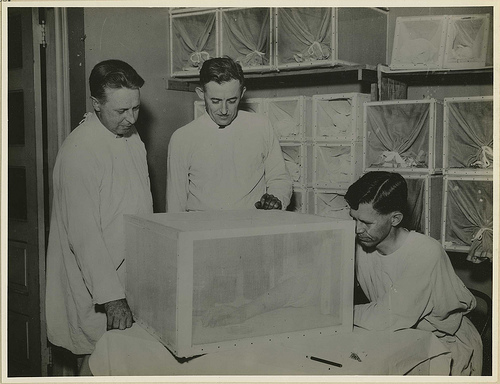
EDUCAUSE Now – Show #5 – P2P Update & Data-Rich Blogging photo credit: otisarchives3
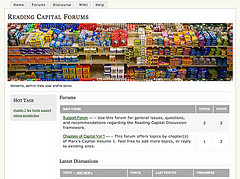
This part of the Reading Capital discussion framework looks at the Reading Capital Forums (powered by bbPress) and a feature called Discourse which is the theme Prologue for WordPress blogs that offers a similar functionality as Twitter without the 140 character limitation. Despite what the title of this post might suggest, this isn’t an either/or choice, but I would like to think about how the two might offer different approaches to online conversation and discussion
Forums
The forums for the Reading Capital site are using the bbPress software which has a number of nice features. First off, it integrates cleanly with WordPress Multi-User (the application that is powering the main site) which means if you sign-up for a blog or just a user name on the Reading Capital site, you are automatically part of the forums. You just login on the main site and head over to the forums, you can customize your space on the forums, get an avatar using Gravatar, and take advantage of the rich RSS possibilities with bbPress. This forum software allows you to subscribe to a feed for all of the forums or select forums of interest to you or just specific feeds on topics within a forum. Moreover, it allows users to tag specific topics that display on the main page, and users can add forum topics to a personal favorite list.
BbPress also has some cool plugins that add some nice functionality like embedding images and embedding video by simply copying the URL into a forum post (and it works with a host of different video services). Such a feature could make for some interesting postings of homemade YouTube videos of a reading or discussion within the forums. There is also the possibility of Private Forums, spam control with an Akismet plugin, and a feature that allows users to designate potential flamers as Bozos—which bans the user surreptitiously by keeping their posts effectively hidden from the rest of the forum, although it doesn’t appear that way to them 🙂 I like that feature!
Truth be told, I don’t have that much experience or success with forums, though I do think they could be useful for such an endeavor. I’m interested to see if they get picked up and used. Either way, the setup of bbPress is painless, and exploring its features has been fun.
Discourse
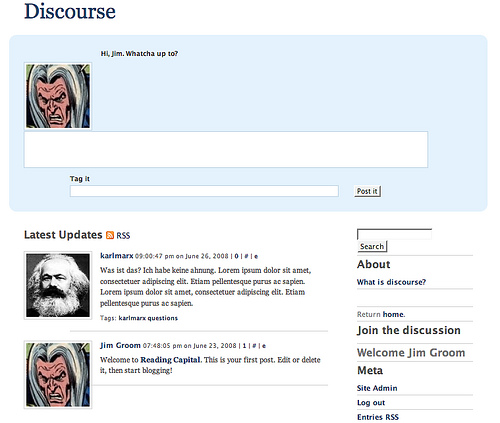
The Discourse feature of the Reading Capital site is simply a WordPress blog that is using the Prologue theme, which makes it akin to an interface like Twitter. Anyone who gets a blog on the Reading Capital site can easily create a similar space for conversation and discussion by selecting this theme (you can also do it just as easily with WordPress.com). The format of Discourse seems well suited for a distributed conversational space wherein people can quickly post replies and thoughts right from the front page of the blog without going back and forth into the admin section. It also has one feed for all the posts and another for comments.
As you can see above, it is a clean, straightforward interface that allows you to post quickly from the front page of the blog. You can also tag your posts. What’s more, the avatars give the space a very personable feel, and each user’s name is linked so you can see all their posts. On top of that, you can comment on someone’s post which can be threaded much like a forum with a reply to a reply.
The other thing I like about this approach is that it allows people who already have a user name or blog within the Reading capital environment to sign themselves up for this space by adding their email to the sidebar, using Andre Malan’s Add User widget. In this way, it would be quite simple for someone who is running a reading group to quickly create an on-the-fly conversational space with no overhead. I have been thinking about this format for courses, and blogged about it here. And while I am not sure such a space is conducive for discussion of a tome like Capital, I remain of the mindset to just throw it all out there and see what sticks, if anything.
So, now we have two more options for continuing the discussion through this distributed framework. Keep in mind, however, none of these tools need be thought of as exclusive to another or mandatory, rather they all represent just different approaches to communally thinking through and sharing ideas about a given text.
Marx and Engels lego photo used courtesy of Dunechaser
So I’m finally returning to creating a discussion framework for the Reading Capital site. I will detail my thinking for the design of the site below (and in at least two subsequent posts), and I invite any and all recommendations and criticisms. It’s a model that is far from perfect, but provides an opportunity to look at how we might provide a platform for aggregating and re-presenting posts and discussions in a distributed manner.
I am going to begin with blogs because I think they provide a powerful tool for conducting a discussion that allows for filtered feeds, more precise aggregation, little or no publishing overhead, and individual “ownership” of the original posts for archival posterity. More than that, it allows one to compose and publish their work from their own space, while at the same time pushing it out to a site like Reading Capital where others might see it, follow the link back to the original site, and engage in conversation on the author’s blog and beyond. Blogging is, at its core, a way of making connections around ideas, and what’s more it provides each person with their own space to feature, control, and share their work on a range of subjects.
So, how does blogging work in Reading Capital? Well, quite simply actually. If you have your own blog then you’ll just share your feed for aggregation (more on this in the next sections). If you don’t have a blog you have a host of free options. You can get a blog with WordPress.com, Blogger, TypePad, or even from the Reading Capital site itself (which is being run on WordPress Multi-User).
Note: a quick word on blogging platforms that I would love some input on, it is my experience that WordPress.com (based on WPMu) are the only large, commercial services that allow for feeds on categories and tags out of the box. Am I wrong with this? If not, then I highly recommend you get a blog on WordPress.com so that you get filter your site’s content using category and/or tag feeds (more on why and how to do this shortly).
Section 2: Adding and Filtering Feeds
So, once you have your own blog and you start writing and linking to things, discovering YouTube embed, the beauty of Flickr photos, and all kinds of other fun stuff that has nothing to do with your reading of Marx’s Capital, you are going to need a mechanism for filtering only certain content from your blog to the Reading Capital site. Here is how you do this with your own WordPress blog, a WordPress.com blog, or a blog you get on Reading Capital.
*Filtering content by category
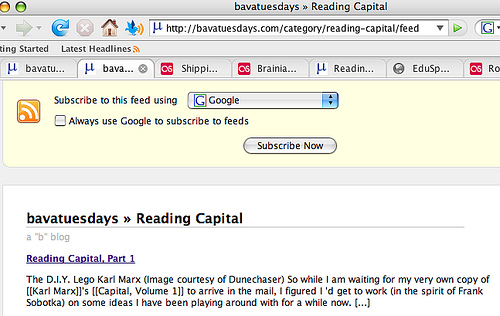
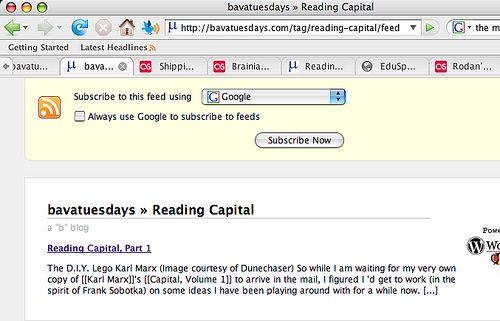
Filtering content by category is fairly straightforward. All you need to do is place the posts you want to filter out accordingly to a specific category, and then grab the feed for that category. For example, if I wanted to feed my posts about my reading capital from bavatuesdays out to the Reading Capital site, which I will, then I would just need to create a category called Reading Capital and put all my posts about this subject in that category. Then grab the feed which will look like this:
If you don’t want to create a separate category, that’s fine, just tag all your posts that have your readings with a consistent and unique term. For example, I will be tagging my posts that have my reading with “reading-capital” (no quotes in the tag), the feed for which will look like this:
http://bavatuesdays.com/tag/reading-capital/feed
Section 3: Aggregation of Content to the Reading Capital Site
The aggregation of people’s content from where ever they are blogging into the Reading Capital site is the ultimate goal. This is accomplished pretty easily (if you want the technical details go to this post) with the “Add RSS” field in the sidebar of the Reading Capital site. All you need to do is add the filtered feed for you blog that we detailed above, and the relevant posts from your blog with be republished on the site.
There are a couple of useful things about this setup. First, the post title (also known as the permalink) actually links back to original post on the author’s site. Second, comments are closed on the re-published post so that people will go to the respective post and comment there, keeping in logic with the distributed logic of blogs. Third, the entire posts are republished on reading capital so that it provides an aggregator for all relevant posts that anyone can subscribe to (http://readingcapital.org/feed), browse, or search.
We already have a useful example that may clarify a few things. Jack Stephens of The Mustard Seed fame has included the feed for his WordPress.com blog. By including the feed for his whole site (http://themustardseed.wordpress.com/feed) all of his content will show up on Reading Capital. Now if he were to create a category and/or tag titled readingcapital, or whatever he likes, and then tag or categorize the relevant poss according after adding the new feed to the sidebar —which would look something like this http://themustardseed.wordpress.com/category/reading-capital/feed—then only the relevant posts would be re-published, allowing for filtered content for very specific tags or categories. Pretty cool, no?
This post will detail how to create an aggregator site wherein people can simply add their feeds to a site and have their content automatically re-published. This example is specifically for WordPress and/or WordPress Multi-User. It depends upon three plugins, so download them ahead of time from the links below:
Here’s how (and note that all the images below link to larger versions for your viewing pleasure):
Setting up BDP RSS
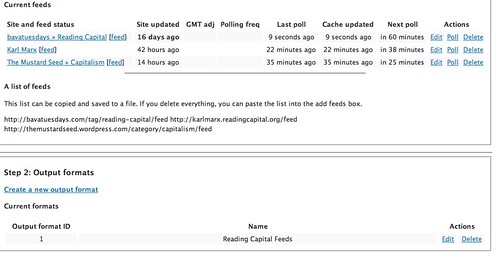
First you need to install, activate and setup the aggregator plugin BDP RSS. I will leave the installation and activation of this plugin to you, because it is the same as installing any other. However, the setup may benefit from some detailing. Once you have installed and activated BDP RSS, go to the Manage tab and find and click on the RSS Feeds subtab. You will then be taken to the space for managing feeds with this plugin. Which will look like the following:
This is pretty straighforward, you add feeds here, and poll them to pull all the newst conenct (which happens automatically based on the time you set). Andre Malan’s Add RSS Extension for BDP RSS actually automates this process from the front page of the blog, but more on this shortly.
If you scroll down a bit, you will be taken to the “Output formats” section of this page, this is where you control the output of the feeds you are aggregating, and this is the portion of this plugin that needs some explaining.
Once a number of feeds have been added, click on the edit button of the output formats (of which you can have several, but for this functionality you will only use one output format with the id 1). Once you click on the edit button you will be taken to a configuration page with a lot of options that can be overwhelming, so let’s take a look at them in some detail:
Here is where you an name the output format and decide how you want the aggregated feeds to be listed, whether chronologically, alphabetically, etc. Additionally, You have the choice to select only certain feeds, or to list all feeds, for truly automating this function so you don;t have to keep coming back to this page, I would just leave the radio box checked with the default of “List all sites.” After this you will see a series of other options below for how many post, how characters to display, in addition to other settings. The XHTML formatting for list presentation shown below is for custom formatting, but I never mess with this.
The XHTML tags to retain in this re-posting is something I do use, and you can see the options I select below:
After this, you get to a series of custom options for archiving, caching, or creating a feed of your aggregated feeds (an OPML feed). I will ignore the archiving and caching options, and focus on the “RSS feed from list” option you will need to create a feed of your feeds. Also, they don’t make this clear, but once you create an overarching feed, it will have the following url:
http://yourdomain.org/?bdprssfeed=1 (with the number being the ID of the Output format)
For example, the feed of all the aggregated posts on Reading Capital would be as follows:
http://readingcapital.org/?bdprssfeed=1
After you check the box for allowing an RSS feed to be provided for the list, then you can save your changes and you should be done with setting up BDP RSS.
Setting Up FeedWordPress
Now that we have set up BDP RSS, we can now install and activate FeedWordPress, which will actually syndicate the feeds that are being added into BDP RSS. The setup for this will actually take the feed for the list of feeds we created in BDP RSS, and simply republish these feeds within, for this example, Reading Capital. So, for our example, take http://readingcapital.org/?bdprssfeed=1 and go to the Syndicate tab in your WordPress backend.
You add the url for the feed (http://readingcapital.org/?bdprssfeed=1) in the “Add new syndicated site” text field, and click on the syndicate button, which will then test and preview the feed to make sure it works, after that click on the “Use this feed” button.
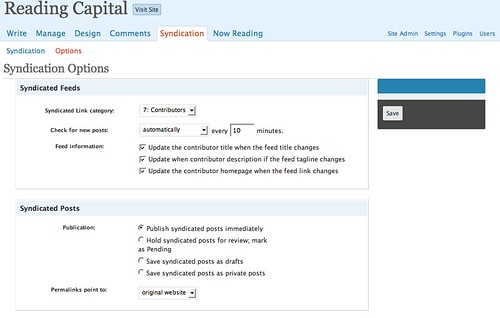
Once you have done this, you need to set up the publishing options for the feed under the Syndication–>Options tab. Below are the settings I am using, you have numerous choces, and you can choose what works for you, but I prefer to turn off comments on the aggregation site, and make the permalink link back to the original post on the author’s blog.
Once you have set these options and saved them, you need to go back to the main syndication page, check the radio box of your feed, and click on “Update Checked Links” –which is you follow my settings in the Options above will happen automatically from now on.
3) Allowing Users to Add their RSS feeds from the Front page
Finally, install Andre Malan Add RSS extension plugin for BDP RSS (follow his instructions for installation) and go to the design–>Widgets section of your backend, and drag the widget into the sidebar. After that, as people add their feed on the front page of your blog, it will automatically be inserted into the BDP RSS list of feeds, which i turn will be run through FeedWordPress and re-published on the blog. Genius? Yeah, it is, isn’t it! And it’s all Andre Malan, so kudos to him!
Last year at this time, while I was embedded deep in yet another bout of nostalgia, I posted about an old school video game called Killer Shark (1972). I had been lamenting the fact that this game was inaccessible to me now, and how much I loved the flailing shark as it moved back and forth across the screen. Well, yesterday I got a comment on that post alerting me to the fact that Loressa Clisby of Daemon Keep Games has developed a facsimile version of this arcade classic. She rules! You can download it here, just keep in mind that it only works with Windows (luckily I have one of those vestigial operating systems hanging around).
And to throw the gauntlet down, I have taken a minute and a half screencast of myself playing the game, and I have to say that despite the fact that I have only been playing for half an hour, I am the best already. I challenge any of you suckers!
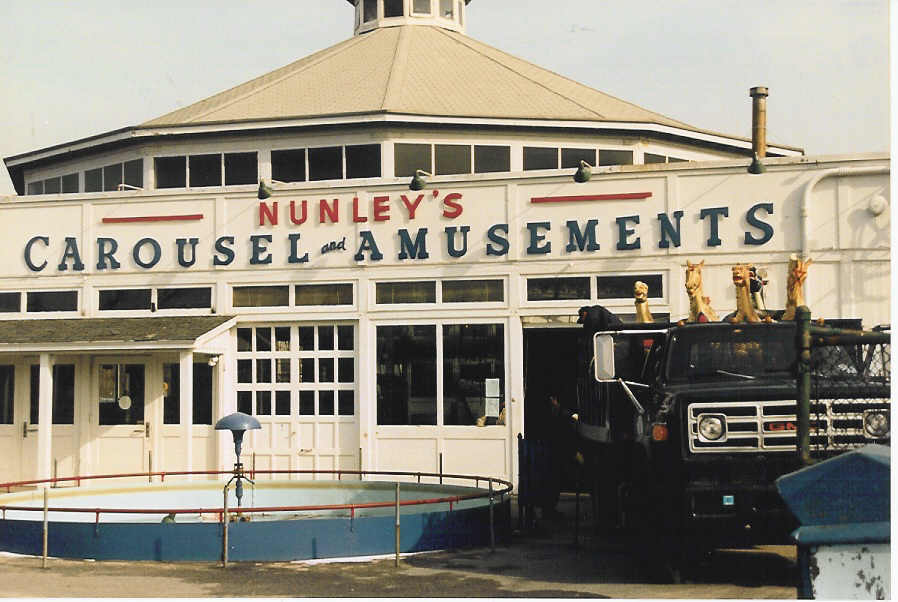
This whole thing led me to search out some information about the place where I played the original Killer Shark arcade game for years: Nunley’s Amusement Park in beautiful Baldwin, Long Island. It was a suburban family amusement park (the last of its kind) that had all the amenities of a large amusement park, in the classic style of Coney Island mind you, only in miniature. There was a miniature roller coaster, cups and saucers, ferris wheel, hand carts, miniature golf, and the famously opulent carousel that was designed in 1912 by Stein & Goldstein of Brooklyn and is one of the few that have been preserved and recognized as a landmark.
I think I can say with some certainty that it was a special place for just about every kid who grew up on the South Shore of Long Island (and far beyond I’m sure) for over half a century. That’ where I played Killer Shark as a kid, but it is also where my friends and I whiled away many a Summer’s day playing video games, skeeball, getting our fortune’s told by a gypsy automata, and beating each other up over a soft ice cream or a slice of pizza, which were served by “the Greeks” who wore white and red vertically striped shirts (all of whom must have worked there their entire lives, for over the twenty year span I frequented Nunely’s, there was never a new face behind the counter). It was were I took my first date in 5th grade, and where I got broken up with more times than I care to remember. I loved Nunley’s, it is a painful reminder of the fact that even the suburbs had some style and dignity at one time. It was closed at the end of the Summer in 1995, never to re-open.
On that day the South Shore of Long Island got that much more barren and desolate. The land was sold off to some speculator that brought in a chain auto parts store (what vision and imagination!). I actually think about Nunley’s on a regular basis these days while I struggle to entertain two young kids with things to do. I think about how much I would appreciate a place like Nunely’s which has some old school class, wasn’t in some fucking mall or surrounded by box stores, easily accessible by public transportation, and would be just as much fun for me as would be for my kids. All we got is Chuck E. Cheese’s and the rest of that corporate junk, it’s really disheartening how much we have gutted ourselves of any kind of unique and wonder-filled experiences. Everything remains the same, predictable, and utterly sterile. I want a time machine.
Actually, wait…I kind of found one! It’s called YouTube, and it has a great video discussing the history of Nunley’s, its fabled carousel, along with its (at the time) imminent demise. If you watch the video, you can see how the whole place was set up, and the video games actually were placed on the perimeter of the walls around the carousel, you can also see the skeeball if you look hard. Wow, how cool is that! YouTube, I love you!
Sparked on by encouragement from the great Brad Efford, I decided to finally finish up part 2 of my impressionistic history of Skateboarding series which has been neglected for more than eight months now. If nothing else, I figure part 1 won’t be so lonely anymore and yet another abandoned blog draft will be set free.
Skating in the 1980s was predominated by vert skatng, whether it be pools, half-pipes, quarter pipes, or small launch ramps. And while everyone vaguely recognized that the freestyle stuff Rodney Mullen was doing was re-inventing skating for the street (check this video out see just how amazing he was and is), I’m not sure that many kids at the time were that interested. In fact, street skating (as opposed to freestyle) didn’t really emerge as a popular alternative to ramps and pools until later in the decade. To quote Wikipedia’s Skateboarding article:
Since few skateparks were available to skaters at this time, street skating pushed skaters to seek out shopping centres and public and private property as their “spot” to skate. Public opposition, and the threat of lawsuits, forced businesses and property owners to ban skateboarding on their property. By 1992, only a small fraction of skateboarders remained as a highly technical version of street skating, combined with the decline of vert skating, produced a sport that lacked the mainstream appeal to attract new skaters.
It’s interesting that a series of forces came to re-frame skating in the early 90s as an outlawed, low-profile, and anarchic hobby, returning it in some ways back to the late 70s. The difficulty of accessing ramps or the resources to build your own given the risks of lawsuits meant that skating ultimately returned to the street—and that’s pretty much where it has remained ever since—despite the fact that during the mid-90s skate parks were being funded, built and maintained by local municipalities all over the country (fodder for part 3 of this history). An approach to skating as a community recognized sport that is a 180 degree shift from the vilified local response of towns and cities to skateboarders during most of the 80s.
Peralta’s documentary Dogtown and Z-Boyz (2001) nails how skateboarding during the 70s was re-imagined by writers like C.R. Stecyk as an expression of a disenfranchised generation that transformed the existing urban spaces they inhabited into a canvas for the aggressive, momentary art they performed. As we move into the 1980s, we might be able to trace another shift that is framed powerfully in yet another documentary: Helen Stickler’sStoked: The Rise and Fall of Gator (2004). This film examines the way in which the popular and commercialized era of vert skating transformed skateboarding from a kind of disorganized, anarchic collective of urban youth skating in backyards to a relatively organized, popular sport of cult celebrity. Stickler’s documentary examines Mark “Gator” Rogowski’s rise to cult stardom followed by his quick descent punctuated by a brutal murder. The film is an allegory that provides an interesting “sequel” to Dogtown and the Z-Boyz with a focus on the darker forces at work in the popularization and commercialization of skating. The clip below includes the first eight minutes of this documentary, featuring Gator on the phone from prison apologizing for the murder while examining the impact of skateboarding on his identity.
From Stoked: The Rise and Fall of Gator Rogowski
The documentary goes on to talk about the importance of image during the rise of the vert skating scene during the 80s. And for many this is most powerfully exemplified by Vision Street Wear, a subsidiary company of Vision Skateboards that mass marketed and mainstreamed the “alternative” qualities of skating which helped to turn it into more of a fad and popular trend than a transgressive youth movement (as John Hogan notes in the clip below, skating became somehow more palatable when it could be bought on the racks of Nordstroms). And during the mid to late 80s on just about every street corner you could see a white, red, and black Vision Street Wear shirt which was not only ugly, but all too often a sure fire sign of who was and wasn’t a skater.
Stoked frames the commercialization of skating in the 80s and the exploitation of style and the cult of personality. The clip from the documentary below traces a commodification of the dissent during the mid to late 80s that had distinguished skating during the late 70s and early 80s. As the great Steve Cabellero notes in this clip: the Vision skate team had money, backing, and success, but provided its skaters will little or no guidance. A telling remark that Vision was a parasitic enterprise that was more concerned with exploiting the sport for money than fostering the people that where making it for them.
From Stoked: The Rise and Fall of Gator
And as an added bonus, here is a Vision Street Wear TV Commercial from the mid to late 80s, I include it just so that you can get the full effect 🙂
But it would be unfair to focus entirely on Vision and Gator here to characterize skate teams and skaters during the 80s. For teams like the Bones Brigade, under the tutelage and direction of Stacy Peralta, was the most important and exciting group of skaters during this period. And Peralta himself was not only one of the sports earlier heroes, but he moved smoothly into the position of championing the sport while at the same time carefully documenting its history. In fact, my own history of skateboarding might be traced alongside Peralta’s early use of low-budget videos to popularize the sport. During the early 80s (circa 81 or 82) my brother and I built or first half-pipe, which was terrible but fun nonetheless. Yet, we didn’t really start skating until we starting building our second half-pipe which we finished in 1983, right around the time we got our first VCR, which immediately introduced us to the world of skate videos. These low budget videos, often no more than 30 minutes, opened up a powerful lens on the world and art of skating for us.
While we regularly read Thrasher and Transworld, video opened up some new possibilities for seeing and studying the tricks and getting a sense of each skaters individual style. In this regard, the VHS tape was truly amazing. We lived on Long Island, far, far away from the skating center of the world in Southern California. The skate scene in New York was somewhat smaller and quieter, even though there were local spots in the city like the Brooklyn Banks that were relatively famous and made all the better when kids started telling stories about NYC legend Harry Jumonji (who back in the day was said to be able to ollie a trash can, which was nothing short of amazing to me). Nonetheless, there was no infrastructure of skate parks and ramps like they had in California with the likes of Del Mar and Upland, or even in place like Virginia Beach with Mt Trashmore or the metal half-pipe in Texas (can’t remember the name). So video was our way of living vicariously though that scene, and we would watch them over and over to see how they did the tricks. So, like any good piece of nostalgia worth its salt, by memory of skating is deeply dependent on videos, and the video that has stuck with me more than any other is the Bones Brigade Video Show (1984), which encapsulates the best elements of skating during the 80s, and makes for a great 30 minutes history.
The logic of the video is simple, it follows Lance Mountain around the streets of Los Angeles for a day. He travels around Santa Monica and Venice on his skateboard and his peregrinations give way to features all the Bones Brigade skaters as well as the popular forms of skating at the time. What’s most memorable about the video for me is Lance Mountain’s street skating journey, which is probably what is most laughable or forgettable for anyone who came to skating much later.
Part 1 of The Bones Brigade Video Show featuring Stacy Peralta taking a skateboard from a TV, and lance Mountain skating the streets and pools of LA:
For Mountain’s tricks would be considered basic by today’s standards, yet his aggressive style and fluid grace are what make him and Steve Caballero (along with Neil Blender) my favorite skaters of the period. And while Tony Hawk’s technical genius is undeniable (particularly at Del Mar in the end of part 3 and the beginning of part 4 of the videos below), his style back then was somewhat robotic (compare it with the grinding fluidity of Steve Steadham, who is the other skater in this scene).
Parts 3 and 4 of The Bones Brigade Video Show featuring Rodney Mullen’s Freestyle skating, Lance Mountain’s street skating, along with Tony Hawk and Steve Steadham skating the Del Mar Bowl:
Watching Steve Caballero, Mike McGill and Lance Mountain skate a half pipe in this video, particularly Caballero (see part 6), was certainly the highlight for me because they were teaching me how to skate my ramp. The focus was more about grinding the space and aestheticizing the tricks with power and style, rather than becoming too focused on the technical acrobatics that came to dominate the logic of vert skating throughout the decade with trick like the 540 and 720 aerials, which kinda of equated skating with high diving twists.
Part 6 of The Bones Brigade Video Show featuring Steve Caballero, Mike McGill and Lance Mountain skating a half-pipe:
Now that scene may be four minutes of the best skateboarding ever: honest, aggro, and beautiful all at once. And more than that, it highlights the modest reality of a few skaters in their backyard (albeit these guys are professionals) skating within a communal space trying to encourage one another, push the envelope, and generally have fun. It was a scene and a moment I deeply identified with and tried to reproduce again and again in my own backyard (and on a few occasions with some moderate success).
Bonus Footage:
If you skated during the 80s, then Chris Miller’s slam at Upland might be one of those terrible memories you keep with you.
Vision Psycho Skates, a 30 minute video with some great footage of early 80s vert skating
While working my way through The Wire, I found myself thinking about the iconic rap song “The Message” by Grandmaster Flash and the Furious Five. A song which traces much of the same social themes of urban decay as this kick ass TV series. A point of interest, at least for me, is that this song focuses on NYC, and more specifically the South Bronx, the birthplace of rap that became notorious for crime and urban squalor during the 80s and 90s thanks to films like Fort Apache, the Bronx (1981) —a loaded and racist argument about the state of inner city America.
All of which made makes me think about a moment in the fourth season of The Wire when the cops are ordered to make “quality of life” arrests, which ultimately means busting citizens for small, insignificant infractions in violent, crime torn neighborhoods. During the general upheaval amongst the beat cops about the new orders, one of them notes reasonably, “It worked in New York.” Enforcing quality of life, unchecked development, rampant gentrification, and unlivable space for America’s working poor —all of which makes NYC the poster child for the future of American cities. To quote Clayton Davis, “Sheeeeeeeeeeeeeeiit.”
Well, I feel another bout of nostalgia coming on thanks to Brad’s comments here, and after doing some research on my past, I found this gem by Newcleus from deep in the depths of the early 80s. A band known for the first “wikki-wikki song” well before Wikipedia. I freely admit this song remains one of my favorite songs of all time, what a narrative, what a concept…ahh, the beginning of rap was a beautiful thing. And according to Newcleus’s Wikipedia article this early rap song is bonafide historic:
Their follow-up single “Jam-On It” has become their most famous single, ushering in a new sound altogether for hip hop: from the conga rock of the old school to a more programmed sound. This song was ahead of its time in production techniques and general atmosphere.
I figured it was high time to finish my reading of Ernst Jünger’s The Glass Bees (which was cut short in the original attempt here by a tangent that has receded considerably, dare I say thankfully) so that I can flesh out the Wikipedia article I started and further examine why I think this book is of particular interest to me as of late.
Jünger’s The Glass Bees has an extremely condensed and seemingly simple plot. In fact, the whole book follows Captain Richard, a former cavalryman and unemployed high-tech worker, who is down on his economic luck and desperately in search of a job. The majority of the narrative action is centered around his interview for a job (the details of which are never made clear to him) with the robotics mogul Zapparoni, who Bruce Sterling aptly describes in his introduction as “a hybrid of Bill Gates and Walt Disney” (ix).
One of the things that immediately struck me about the novel’s “hero” is that while caught up in the nostalgia of his cavalier past (more on the key role of nostalgia in the narrative shortly), his desolate financial situation makes him both vulnerable and real—the first five words of the novel are “When we were hard up”—as Sterling notes, “Captain Richard is a rare example of a science fiction hero who knows what it means when people line up for soup” (ix). The very textured quality of uncertain times within a recognizable depression-era future ruled by eccentric personalities, personal police forces, private property, and immensely powerful corporations marks a deep resonance with our current moment. When talking to his friend/job broker Twinnings about his options for employment he characterizes the situation beautifully:
The rest were jobs with a risk attached. They provided a comfortable life, sufficient means, but troubled sleep. Twinnings mentioned a few of these —they resembled police jobs. Who nowadays did not have his own police force? Times were unsafe. Life and property had to be protected, real estate and transportation closely guarded, blackmail and crime counteracted. Presumption increased in proportion to philanthropy. (5)
Jobs in high tech as police jobs, positions to guard information, control its dissemination, and protect investments. More than that, times are unsafe, and such a reality centers around a presumption (a term that can be interpreted many ways, but I will focus on the legal meaning “an inference of the truth of a fact from other facts”) that is formulated in relationship to how much an entity can give, donate, or volunteer to the greater good. Presumption is rigged, the act of giving in this world is premised on the very nodes of corporate power that control the means of capital. The inference of truth in this world is shaped by how much capital one is willing and able to donate to its creation. There is no mediating force between the nodes of capital, power and those who are employed to enforce this reality. Any idea of a social net in this world is entirely missing. And what is so subtly apparent in this novel is the complete evisceration of social welfare for the working poor (another truly resonant element of this novel with our moment).
The dark reality of the world in this novel becomes excruciatingly clear by the end of the first chapter:
I was still one mass of useless and antiquated prejudices. Since everything was now supposed to be based on a contract—which was founded neither on oath nor atonement nor Man—trust and faith no longer existed. Discipline had vanished from the world, it had been replaced by catastrophe. We were living in permanent unrest, and no one could trust anyone else. Was it my responsibility? (15)
I must admit I haven’t been reading as much literature lately as I have in the past, but the passage above captures beautifully the crisis and questions of our moment —“Is it my responsibility? Am I my brother’s keeper? Can I afford to believe in a community?” And the permanent unrest and steady dose of catastrophe keeps us all in order, constantly scared, meek, and ready and willing to capitulate trust and faith in one another for some false sense of security and comfort. The social contract has been made null and void through the constant din of uncertainty, fear, and repression. I, like Captain Richard, remain one mass of seemingly useless and antiquated prejudices.
These “useless and antiquated prejudices” give way to large parts of this narratives peripatetic peregrinations into the mental landscape of nostalgia. Which often accounts for the filling out of an otherwise very straightforward and deceivingly simple plot line. But the way in which the novel is structured around nostalgia is of particular interest to me, for anyone who reads this blog knows I suffer interminably from the nostagliadisease. What I find remarkable about the narrative style is that these nostalgic rivulets that take over the narrative logic are quite similar to the ways I read the internet. I follow links, search for things from my past, use sites like YouTube as a veritable nostalgia machine. The narrative structure of The Glass Bees is so very similar to the way in which I understand the internet for my own uses as to be uncanny. While at first I found the unpredictable links out to other ideas, stories, and anecdotes bothersome and disjointing, I soon realized it is not dissimilar to how I navigate my own story on the internet. Yet, these distractions form the loose threads of an important and meaningful past that has been obfuscated by the immediate financial demands is further compounded by the absence of anything resembling a community. The individual is isolated and alone, almost dehumanized:
Everywhere they [horses] had been replaced by automatons. Corresponding to this change was a change in men: they became more mechanical, more calculable, and often you hardly felt that you were among human beings. Only at rare moments did I still hear a sound from the past—the sound of bugles at sunrise and the neighing of horses which made our hearts tremble. All that was gone. (30-31)
Follow that with this:
Prognoses which have been made contend that our technology will terminate in pure necromancy. If so, everything we now experience would be only a departure and mechanics would become refined to a degree that would no longer require any crude embodiment. (38)
A horrific thought which beautifully counterbalances the notion our moment is caught up with, a kind of “elated technical optimism”—a phrase Captain Richard uses later on in the novel to describe Zapparoni (90). I think the struggle around the conception of technology and its impact on our understanding of history, community, and our humaness is at the heart of this naturalistic science fiction novel. For unlike Philip K. Dick’s work, this novel is not fueled by a drug-like paranoia —though Jünger was no stranger to mind-altering drugs— but rather more akin to a futuristic Frank Norris, framing a kind of virtual naturalism that is deeply preoccupied with the systemic logic of capital. I’m thinking specifically here of Norris’ The Octopus, The Pit, and McTeague. That to me is what is so deeply frightening about Jünger, the de-naturalized organics of capital which is seamlessly grafted upon the mad-made nature of the future.
This becomes readily apparent when we actually get to examine the automatons in the novel. They are introduced from the very first chapter, but it isn’t until chapter 12 that we get a precise descriptions of their workings. Sterling frames the paradigm shift Jünger’s automata represent beautifully in the introduction:
Robots as Jünger portrays them have nothing to do with common standards of 1957. These robots don’t clank, beep, or take any orders….on the contrary: these microminiature, computerized, buglike automata are straight out of the MIT Media Lab and Wired magazine circa 1994. Uncannily anticipating the scattered structure of the Internet. (ix)
The idea of these small, subtle robots that worked together in a loose organizational logic to accomplish tasks and reproduce nature makes them far more unnerving than an obedient Robbie the Robot. They work according to a systemic design through which each has a role, featuring a wide range of “diverse models and colonies.” In fact, Captain Richard’s interview with Zapparoni consists of a brief conversation followed by an outing in a garden where he is left alone with a swarm of automata, or glass bees, “about the size of a walnut still encased in its green shell.” Their functions were much the same as natural bees, to take the nectar from the various flowers, yet at the same time the question of whether they could also fertilize the plants was raised. Can these automata reciprocate a natural intercourse?
The relationship between these nut-sized robots and our contemporary realities of exchange and intercourse on the internet becomes increasingly similar to the system Jünger describes:
At first glance, the glass hives were distinguished from the old pattern by a large number of entrances. They resembled less a hive than an automatic telephone exchange…what if what I have been observing was not so much a new medium as a new dimension, opened up by an inventive brain; it was a key which unlocked many rooms. For instance, what if these creatures could be used—as they are used in the world of flowers—as messengers of love between human beings….? (129, 140)
This description of the hives as a loosely joined dimension of exchange that is de-centralized and automatic, yet potentially capable of connecting humans though messengers of love is a fascinating image that frames the imaginative space of Jünger’s novel as remarkably prescient in its subtle elegance. He frames a kind of proto-naturalistic system of exchange premised on nature, yet at the same time unnatural and frightening.
At the same time, the question undergirding the entire experiment with the glass bees is that “such economic absurdities are produced only when power is at stake” (139). “Technology is not pursued to accelerate progress but to intensify power” (x), and we must understand our relationship within this equation. Technical versus human perfection is at the heart of this system: are we going to move towards a technical perfection of such a system “that strives towards the calculable”? Or do we push toward human perfection which is incalculable? According to Captain Richard, the two choices are incompatible, and one must choose where their energies rest to do “cleaner work” (155).
Personally, I think the cleaner work rests in the latter, and hence the real focus on the human dimension of what it is I do as a “high-tech worker.” I don’t police or control data, nor am I so concerned about scaling enterprises or the next generation of Web 2.0 tools as sold by corporations or systems of technical complexity and control. The idea is to make real, localized, and human connections that echo out into some kind of circumscribed eternity.
Well, UMW Blogs is now on a dedicated server after a year of shared hosting to run over a thousand blogs. We are quickly approaching the 1500 blogs mark, and the database is 1.1 gigs with over 11,000 tables. Seems that once it starts approaching 5 or 6 gigs it might be time to start spreading the tables over several database to manage the load a bit better. More than that, the best dude in the universe, Zach Davis, informed me after the transfer to its new home that there were 1,181,116,010 characters of text! Wow, who knew? That is a lot of open content!
So, with all of this awesomeness, it’s high time I blogged UMW Blogs Begins, which was the opening presentation for this year’s Faculty Academy that I was fortunate enough to present alongside Gardner Campbell, Martha Burtis (by proxy), and Andy Rush. The presentation was a blast, it frames the experiments that led to UMW Blogs (Gardner and Martha), the state of the the application now (yours truly), and the future of this publishing platform (featuring the ever-subtle Andy “edu” Rush). Give it a spin, I think you’ll enjoy it, hippies!
is an ongoing conversation about media of all kinds ...
Testimonials:
Generations from now, they won't call it the Internet anymore. They'll just say, "I logged on to the Jim Groom this morning.
-Joe McMahon
Everything Jim Groom touches is gold. He's like King Midas, but with the Internet.
-Serena Epstein
My understanding is that an essential requirement of the internet is to do whatever Jim Groom asks of you while you're online.
-James D. Calder
@jimgroom is the Billy Martin of edtech.
-Luke Waltzer
My 3yr old son is VERY intrigued by @jimgroom's avatar. "Is he a superhero?" "Well, yes, son, to many he is."
-Clint Lalonde
Jim Groom is a fiery man.
-Antonella Dalla Torre
“Reverend” Jim “The Bava” Groom, alias “Snake Pliskin” is a charlatan and a fraud, a self-confessed “used car salesman” clawing his way into the glamour of the education technology keynote circuit via the efforts of his oppressed minions at the University of Mary Washington’s DTLT and beyond. The monster behind educational time-sink ds106 and still recovering from his bid for hipster stardom with “Edupunk”, Jim spends his days using his dwindling credibility to sell cheap webhosting to gullible undergraduates and getting banned from YouTube for gross piracy.

 At this year’s EDUCAUSE Southeast Regional conference UMW Biology professor Steve Gallik and I presented together on his Online Laboratory Manual project. I blogged this project last Fall, and it has exceeded just about every expectation we had set out for it —which were pretty high to start with. In short, Lablogs was the perfect marriage between a technically savvy professor who had programmed his own online laboratory suite in Flash and an instructional technology group that believes in the loose syndication structure that provides simple ways for delivering online content. On this occasion using the venerable UMW Blogs as a RSS-rich publishing platform that provided students with their own laboratory notebook (or lablog) with little or no overhead.

 The aggregation of people’s content from where ever they are blogging into the Reading Capital site is the ultimate goal. This is accomplished pretty easily (if you want the technical details go to this








 Last year at this time, while I was embedded deep in yet another bout of nostalgia, I




 I figured it was high time to finish my reading of