Preaching teetotaler from opening scene of The Wild Bunch

Here is a great scene featuring a preaching teetotaler (Reverend Wainscott) from Sam Peckinpah’s brilliant The Wild Bunch —definitely in my top five, maybe top three films of all time.

[kml_flashembed movie="http://www.youtube.com/v/OcRUgwCiy9A" width="425" height="350" wmode="transparent" /]

Man I love the way this reverend talks. It is such a melodic, syncopated idiom, almost song-like. I will do a presentation with this accent and intonation at some point soon. I love the way this reverend preacheth. The transcript is below if you couldn’t make it out, it’s a bit hard because it seems so antiquated.

Do not drink wine nor strong drink, thou nor thy sons with thee least ye shall die. Look not thou upon the wine when it is red and when it bringeth his color in the cup when it moveth itself aright. At the last, it biteth like a serpent and stingeth like an adder. Now folks, that’s from the Good Book. But in this here town, it’s 5 cents a glass. Five cents a glass. Does anyone really think that that is the price of a drink?

Posted in fun, movies | Tagged , , , , , , | 1 Comment

Permapunk

On the heels of unleashing EDUPUNK on the internets (see here for more), I’ll give the first of, hopefully, many examples of what EDUPUNK is—examples being one way at defining EDUPUNK if you should be so brave. I have a few of my own in mind, so here goes the first.

Keira McPhee’s front lawn is EDUPUNK!

Image of Keira Mcphee on the cover of the Vancouver Sun

Keira is featured front and center on the cover of last weekend’s Vancouver Sun (click the image for the article).

Keira Mcphee is an extremely cool cat, and my favorite permaculture freak. And while I may be biased because she has invited me graciously into her house on several occasions to break bread and talk seriously about the world, culture, and everything in between, but I don’t really think that’s the case. Why? Well, because Keira is more than a friend, she is a sterling example of taking your beliefs to the streets. She has converted her front lawn from a useless showpiece that consumes unknown quantities of wasted energy and resources, into a lush, fecund organic garden that burgeons with the fruits of her labor. She is an activist, teacher and mentor all at once.

Let there be no question about it, Keira and her garden are EDUPUNK! And she uses some of the most powerful of technologies, that of the shovel and hoe, but such tools have been used for far less imaginative and inspiring purposes in the hands of others.

You can read the article from the Vancouver Sun here, see the photo gallery here, and the video here.

Image above care of the Glusniffer himself.

Posted in edupunk | Tagged , , , | 7 Comments

The Glass Bees

Cover of Ernst Jünger's The Glass BeesWith my no-internet, hippie-like vacation to Montauk behind me now, I can return to the bava and continue the excruciating futility that is my life online. I enjoyed the time away because I was able to do something I hadn’t done in too long, i.e., read a few books that have nothing to do with a course I was either taking or teaching. One of the books I read that has me both excited and scared is Ernst Jünger’s 1957 novel The Glass Bees (Gläserne Bienen).

I got this novel back in 2000 when it was re-published by the New York Review of Books, and it sat on my shelf for almost eight years. And I am now convinced it had to sit there for that long. For this book wouldn’t have meant half as much to me had I read it before my full-fledged, self-obsessed foray into the land of the lost, a.k.a the internet, almost four years ago. I happened upon this novel last week when I was searching for something to read on my shelves. I was immediately drawn in by the fact that Bruce Sterling wrote the introduction, whose talk on “The Internet of Things” I had recently listened to. I took this as a sign that the lattice of coincidence was in full effect, and I decided to give it a go.

Sterling’s introduction immediately grabbed me, his description of Jünger’s novel as anachronistic in the most uncanny of ways is perfectly put when it comes to the social and economic realities of this dark, visionary novel. This quote from Sterling’s introduction (which you can read in its brief entirety here) made me realize that this isn’t just a novel I should read, but one I need to read:

Jünger perceived that industrial capitalism is a ridiculous game, so he proved remarkably good at predicting its future moves….[He] understands that technology is pursued not to accelerate progress but to intensify power. He fully understands that popular entertainment comes with a military-industrial underside.

This passage brings into sharp focus a scary reality that often gets overlooked (or is it intentionally downplayed?) in educational technology, namely that the Utopian, blue sky ideas of technology as a singular harbinger of possibility and liberation ignores the cold and all-consuming role that capital plays in the shaping of technology as means of control. Now I understand that this struggle is by no means unilateral, and that for every instance of technology as a means to consolidate power for capital, there is another instance in which that same technology can be used to undermine the fallacious logic of capital’s vision of progress.

So the question that this book (as early as the introduction) immediately forced me to consider is where do I stand in this equation. More specifically, how do I understand the work I am doing in the field of EdTech when in comes to the intersection of progress, power, and the voracious appetite of capital to co-opt and re-package the labor of others as its own, patented, insanely expensive, proprietary product?

This line of inquiry came into sharper focus when talking to Brian Lamb and Keira McPhee at Freddy’s Bar in Brooklyn soon after finishing the novel. After my vociferous and impressionistic explanation of the ways in which the novel was not about technology, but the relations of power and capital through an idea of technology as a figure of progress, Brian suggested how this wasn’t unlike BlackBoard’s newest product announcement, their “Next Generation” of Learning Management Systems, BlackBoard 8.

What is BlackBoard doing? Well, they are taking the experiments and innovations of thousands of people and re-packaging them as their own, unique contribution to the educational world of Web 2.0. And why are they doing this? Well, to survive as a LMS, but that survival is not necessarily dependent on a technology or an innovation, rather it is a means of taking the imaginative experimentation of others and wrapping them up as a product that can be bought and sold like a pair of shoes. The insanely irresponsible advertising for BlackBoard 8 suggests that Academic Suite release 8.0 will “enhance critical thinking skills” and “improve classroom performance.” What LMS can do this? What Web 2.0 tool can do this? This is total bullshit, how can they make such an irresponsible claim? These things are not done by technology, but rather people thinking and working together. Our technology may afford a unique possibility in this endeavor by bringing disparate individuals together in an otherwise untenable community, yet it doesn’t enhance critical thinking or improve classroom performance, we do that, together.

And this move by BlackBoard to commodify the labor of others is exactly the problem with the idea that educational technology “is about the technology,” which Gardner exclaimed in his swan song presentation at UMW’s Faculty Academy.. It was a great talk, but an insistence that what we do is about the technology and not the community around the ideas is a dangerous one. The two go hand-in-hand, and I am sure Gardner realizes this, but; (in fact, this was a poor reading on my part, a full apologies toGardner for my being so caught up on a phrase and not an idea —an ongoing problem I have 🙂 ) in my mind the technology is often the means through which the communal acts are traced, recorded, and archived. The learning happens not as a by-product of the technology, it is, or rather should be, the Raison d’être of the technology. The teaching and thinking happen within the medium of texts, videos, film, images, art, conversation, game playing, computers, etc. Technology may provide new ways of delivering and accessing this information, and mark the basis of many a medium, but the idea of a community and its culture is what makes any technology meaningful and relevant.

This is why the idea that “it is about the technology” makes BlackBoard 8 so troubling to me. If it is about the technology, then capital can quickly recognize this fact and co-opt all the hard work by so many to move outside of the taylorized vision of educational technology grafted upon our institutions. If the technology is what is important, than what do we say if a faculty member or student notes that Bb can do what del.icio.us can, or can “mash up” YouTube, Flickr, and Google Earth maps like WPMu, or can make content at long last open, or has a slick AJAX interface, then we what what can we say about the technology?

BlackBoard will leverage their relative omnipresence to gouge schools everywhere into using their tools because they can, and they’ll sell them up with all the administrative, vending machine, and surveillance cameras one could dream of. This is what we are missing. BlackBoard makes an inferior product and charges a ton for it, but if we reduce the conversation to technology, and not really think hard about technology as an instantiation of capital’s will to power, than anything resembling an EdTech movement towards a vision of liberation and relevance is lost. For within those ideas is not a technology, but a group of people, who argue, disagree, and bicker, but also believe that education is fundamentally about the exchange of ideas and possibilities of thinking the world anew again and again, it is not about a corporate mandate to compete—however inanely or nefariously—for market share and/or power. I don’t believe in technology, I believe in people. And that’s why I don’t think our struggle is over the future of technology, it is over the struggle for the future of our culture that is assailed from all corners by the vultures of capital. Corporations are selling us back our ideas, innovations, and visions for an exorbitant price. I want them all back, and I want them now!

Enter stage left: EDUPUNK!

My next series of posts will be about what I think EDUPUNK is and the necessity for a communal vision of EdTech to fight capital’s will to power at the expense of community. I hope others will join me.

Also, sorry this tangent went so far afield, I am currently working on a Wikipedia article for The Glass Bees, which hopefully will fill in all the gaps I left here. But in the end, you should really just read it!


Posted in books, experimenting, Uncategorized | Tagged , , , , , , , , , | 158 Comments

Faculty Academy Videos, or the beauty of our New Media Specialist

Faculty Academy 2008Faculty Academy posts will be streaming in irregularly as I grok this year’s amazing event. So much to say, but for the time being I’ll be relatively brief. This year’s conference was about many things, pushing the boundaries, going boldly, and refusing fear as an alternative. One thing from this year’s Faculty Academy that I think embodies all of these themes beautifully was Andy Rush’s video work this year. He took the webcasting and video presentation/archiving of this event to the next level (and a special shout out to David Dean who was the audio Godhead throughout the two days).

Faculty Academy 2008
We all bust his chops about his new position as a New Media Specialist and joke him about the nature of his work, but that’s only because we don’t understand just how far he is pushing the web envelope to make video an integral, sharp, and professional part of the academic environment at UMW. There is no better New Media Specialist, and the very fact that we now have that unique position occupied by Andy Rush is a measure of the genius behind the imagined future of DTLT.

This genius is no surprise to all of you who caught the event via UStream, for you got a taste of Andy’s beautifully produced streaming videos of the plenary sessions and Keynote firsthand. It was awesome, and he even built it into a self-reflexive moment within his unbelievable talk about New Media during the “UMW Blogs Begins” plenary (I will blog this when that video is published, it is a gem!).

Not only was the Ustreaming top notch, but Andy has archived all the videos and is now republishing them over at the Faculty Academy blog here. (Keep in mind he is using the high-powered h.264 codec he explains here for extremely high resolution–another element of how new media was the star this year —Andy notes in the comments below that he is not using this codec for the Faculty Academy videos, but you should still read his post about h.264).

So far he has published the following videos:

Image of Deck Wars with Jeff MCClurkenThe Deck Wars competition, which was an event that Jerry Slezak did a phenomenal job re-imagining and organizing. This fun-filled event was inspired by a similar event at SXSW called Battledecks that we found out about thanks to Tom Woodward’s web surfing savvy. Our’s was harder than SXSW’s though because our four bold contestants (Jeff McClurken, Jennifer Pollock-Wahl, David Rettinger, and Barabra Sawhill) presented on a deck of slides they had never seen before (not like the SXSW prima donnas who got a full two minutes 🙂 ). The amazing slides Cathy Derecki created for the four players made this process far harder than you might think. Jeff came away with the title of “First Annual Deck Wars Champion,” for this will surely be the first of many Deck Wars.

Image of Janet Murray presenting at Faculty Academy 2008Dr. Janet Murray’s Keynote address: “Inventing the Medium: Learning and Symbolic Expression from Knucklebones and Senet to Second Life and Spore.”

This talk was amazing, and while Dr Murray may seem to start off a bit slow (this excludes a classic Gardner Campbell introduction), this talk may have opened up the most conceptual possibilities for thinking about gaming, humanity, and the shared future of symbolic spaces. Murray talks to the arts, social sciences, and hard sciences at once, offering an amazing framework for conceptualizing games and the development of human communication. It is a truly thoughtful and provoking talk, and I will definitely be re-watching this soon before I blog it, for it is definitely one of major importance that I haven’t fully wrapped my head around.

Posted in fa08, faculty academy, umwfa08 | Tagged , , , , , , , , | 4 Comments

Finally, Course Aggregation Made Easy


Creative Commons License photo credit: Tambako the Jaguar

Well, it took us over a year, and with several iterations along the way, but I think UMW Blogs will now be able to provide dead simple aggregation of posts from numerous, distributed blogs with very little work, but a little bit of money for the plugin extension ($50 to be exact). Henri Simeon’s MuTags plugin and the $50 extension we bought from him gave UMW Blogs a RSS feed for each and every site wide tag.

Once sitewide tags have an RSS feed, the whole problem of grabbing each student’s RSS feed, and making sure you have the right URIs becomes irrelevant. The only thing that needs to be done is that the class has to decide upon a unique tag for their posts. After that, any post a student wants to be fed into that course blog must be tagged appropriately. So, for example, if I am teaching a pirate class and I want students to tag posts in their blogs with “pirategroom” (no quotes), then all they have to do is tag the post correctly. On the course blog I just activate the FeedWordPress plugin and put in one very simple URI:

http://umwblogs.org/tag/pirategroom/rss

That’s it (you can see the test here). The only caveat being that this site wide tag feed only works for UMW Blogs (or your local WPMu installation). If students are using other services to host their own blogs then this solution won’t work. However, you can throw in a little BDP RSS coupled with Andre Malan’s Add Feed plugin which will provide a quick and elegant solution for solving this—read more about this here.

Wow, we are getting closer and closer, and while the MuTags RSS feeds is choking on images and video (annoying!), we are going to get that straight over the next month and have a full fledged, scalable solution for aggregating posts from numerous student blogs into one, central course blog with no overhead. Yeeeeeeees!!!

BTW: This is my first post on the bava using WPMu 1.5.1—so I can finally get used to   and document the new WordPress backend interface.

Posted in experimenting, plugins, tags, wordpress multi-user, wpmu | Tagged , , , , , , , , , , | 7 Comments

Night of the Living Republicans

Anand Rao put together this fun JibJab mashup as an added bonus for the lunch festivities. The main event was Faculty Academy’s first annual Deck Wars —which was a blast and has officially crowned its first annual champion: Jeff McClurken, video forthcoming .

Night of the Living Republicans

Click on image above for the JibJab

Posted in fa08, faculty academy, prologue | Tagged , , , | 2 Comments

Tiltfactor

Image of PeacemakerDr. Janet Murray’s unbelievably intelligent and thought-provoking talk, “Inventing the Medium: Learning and Symbolic Expression from Knucklebones and Senet to Second Life and Spore,” examined the historical role of games and game play upon the evolution of humanity, communication, and representation (read the abstract here and video will be forthcoming). Immensely interesting stuff that will take me a while to process and make sense of. During her discussion she talked about PeaceMaker, a game that provides varying mediated perspectives upon the Israeli-Palestinian Conflict by allowing you to play both sides of the struggle (the game’s tagline is “Play the News. Solve the Puzzle”). This got me thinking about Tiltfactor, and organization that creates games for social change (an organization Jeff Drouin pointed me to with his comments here).
…we create games for change, educational games, artwork, and social software. We hope to make effective interventions in thinking about how games, and software in general, can evolve to take into account social activist principles. For example, how can one design for multiple learners and multiple play styles? Can games improve the self-efficacy of underrepresented groups? Can games teach equity? What is an excellent design solution which focuses on collaboration, yet also satisfies competitive urges?

You can find out more about the lab from the video below.

Posted in fa08, faculty academy, prologue, video games | Tagged , , , | Leave a comment

Shark Surfing

This is awesome, found it via Dan Coleman’s Open Culture blog, and it is just amazing how insane people can be (if it isn’t a fake, but I tend to agree with Dan that this is the real deal). Sometimes I love humanity, and the minute and half video below is why. Despite the bill of goods the Age of Enlightenment sold us, reason has no place in the greatest of human genius! And what was that Adam Smith said about self interest?

Posted in fun, general, YouTube | Tagged , , , | 8 Comments

This ain’t yo mama’s e-portfolio, part 3

So, to pick up on parts 1 and 2, part 3 is an examination of some of the uses and possibilities of feed-driven architecture for dealing with the varying ways we might understand a portfolio, which—as Stephen Downes notes here—is in the midst of a pretty significant transformation. A change premised on re-imagining the portfolio as not so much a static receptacle for work completed, but a dynamic space for both reflection and presentation of an on-going development, or “portfolio-ing” as Alan Levine’s comment points out. This shift parallels the way many are approaching their actual work in this field (and many others, something Jon Udell calls professional blogging) as part of an ongoing, networked conversation about process and collaboration, rather than some isolated, fixed product.

An RSS-Driven Departmental Portfolio Review Project

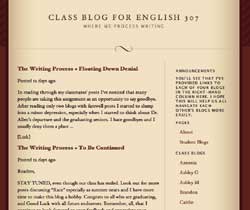
Writing processAll of which makes me think about the project Professor Sarah Allen and I have been working on for her Writing Process course. Each member of the class was asked to create their own blog and post various papers and revisions to the blog as a kind of digital notebook in which they would publish the work for peer review and feedback (all of which fed back into the course blog, a now “classic” course aggregated model for using blogs at UMW). The class was focused on process, and part of the approach was to understand writing as a dynamic, unfolding art form that must be labored over with numerous revisions, iterations and approaches.

During this year’s Tech Fellows program Sarah and I came up with an RSS-driven framework for delivering the “final” version of a English majors essays to a secure space so that faculty could conduct a blind review for assessment purposes. The samples would come from a select group of English courses (Sarah’s Writing Process course being the test case). Traditionally this was handled through a BlackBoard drop box, wherein the essays were uploaded without students names and then reviewed by faculty. To do this they would have to download the papers, print them out, comment on them, than convene with other members of the review committee to discuss the them.

The thought Sarah and I had was there’s has gotta be a better way to streamline this portfolio review process. So, what we did was rather simple, Sarah had all her students writing in their own blog throughout the course of the semester, and publish their revised essays as they finished them. Once a student considered an essay to be a final version, they tagged it with “final paper.” We got the sitewide RSS feed for every post tagged with “final version” and fed them into a blog called ELC Assessment.† The assessment blog is now populated with final, anonymous essays that the department review committee can comment upon from anywhere and have a distributed discussion about the writing, better yet it is all easily protected so that only English, Linguistics and Communication faculty can access it (we left the example open, because it’s a proof of concept).

UMW Lablogs

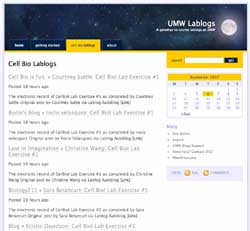
Image of UMW LablogsUMW Biology professor Steve Gallik provides yet another example of how an RSS-driven infrastructure can make things a whole lot easier, and provide students with a practical portfolio of their lab work. I posted about this project earlier this academic year and Steve and I will be presenting it at the EDUCAUSE Southeast Regional Conference. This was a grand experiment, and I think it has some serious possibilities for thinking about managing a scientific portfolio of experimentations and labs.

In short, Steve Gallik developed an entire suite of online laboratory resources wherein students can record the results of their experiments, something he terms an Online Laboratory Suite. Well, if that’s not impressive enough, Andy Rush and Steve Gallik conceptualized a way to take the experiment results for each student and create a RSS feed for it. When each student signs up for an account on Steve’s Online laboratory Suite, they are immediately sent an RSS feed that they place within a spam-blog plugin like FeedWordPress on their own blog, choose the category to publish it to, and before you know it they have an aggregated, feed-driven lab notebook (or a LabLog) of their work that automatically updates as they complete their online labs.

What I like about this project is how clearly it suggest that whether or not you can program your own laboratory software like Steve Gallik, having a publishing platform that is framed around syndication effects everyone. If we do have online lab software being used by a department, isn’t it about time we expected to have an RSS feed for student work? Steve’s LabLogs represents a powerful model for thinking about how students can easily re-publish their own labs into a format they can control, re-publish, and re-purpose as they see fit.

The Macaulay Honors College E-Portfolios Using WPMu

Image of Macauly eportfolios siteJoe Ugoretz, who is the Director of Technology and Learning at The Macaulay Honors College (part of the CUNY system), has been pushing the envelope in terms of the small pieces loosely joined approach to integrating technology into teaching and learning. Joe, with the agile help of Jeff Drouin, has been using open source CMSs, wikis, and blogs to great effect during his first yearat Macaulay. After a few brief e-mail exchanges with Joe about using WPMu as an e-portfolio system, he invited me up to talk his crack cadre of graduate student Tech Fellows about the small pieces loosely joined approach to educational technology. And as always, I focused on the work UMW has been doing with WPMu in particular.

It was great fun for me, in particular because I started out in this field as a tech fellow at the CUNY Honors College almost four years ago. So going back talking about this stuff was pretty cool, and I could warn them to resist getting too deep into blogs and wikis lest they get hooked and never finish their dissertation, only to find they have become a fanatical, raving EdTech lunatic 🙂

So I recently discovered that Joe has decided to pull the trigger on a WPMu driven portfolio project, and it is alrady up and running, you can read more about it on his blog here and see the actual site here. How cool! Joe is an impressive guy, and he is not afraid to experiment with these powerful, open source publishing platforms, which at CUNY means a lot. To quote Jon Udell talking about UMW two years ago, Joe has really put the Macauly Honors College in the catbird seat when it comes to instructional technologies. He is not afraid to experiment with a wide array of open web and open source tools, and he understands the importance of deploying them rapidly and always already as beta to see how they will fare. That is the pace you need to keep currently, and it is why most of the rest of CUNY is screeching to a devastating standstill when it comes to instructional technologies (Bernard L. Schwartz Communication Institute’s Blogs@Baruch being the other brilliant exception, thanks to Mikhail Gershovich and Luke Waltzer).

Moreover, Macaulay has a manageable incoming class of 300 students every year, all of which are distributed amongst seven different senior colleges of CUNY (I think it’s seven?). A small college loosely joined that may prove an extremely powerful example of how these tools might bring a de-centralized learning community into some kind of online focus. Needless to say, I love Joe’s style and I’ll be watching the Macauly Eportfolio project closely over the next year.

OK, that’s enough about e-portfolios, now it’s time to get ready for Faculty Academy, miles to go before I sleep.


† We got the feed for this tag by first using sitewide categories feeds for WPMu where all the posts were categorized as “final paper,” but the MuTags RSS feed extension—which you have to pay $50 for—will prove the better option, for students can just tag their posts as final paper (or what ever) and you get a sitewide feed for the tag without the sitewide categories feed hack which can get ugly. Once you have the sitewide RSS feed for this tag, just activate the FeedWordPress plugin and it will automatically re-publish any post within the WPMu environment tagged “final paper.” What’s nice about the FeedWordPress plugin is that it will sync all changes to a previously published post. Also, you have options to not include post author, you can prevent a linkback to original post, as well as the ability to place all feeds for a certain tag into a specific category of the assessment blog (so all of Sarah’s class papers will be placed in the category “Writing Process”). Groovy! —or should I say Groomy?

Posted in e-portfolios, eduglu | Tagged , , , , , , , , , , , , , , , , , , | 3 Comments

Authority is not truth

Stephen Downes already linked to it, so this may be irrelevant, nonetheless if you missed Mike Caulfield’s post about Monica Hesse’s article in the Washington Post, be sure to check it out, it is awesome. Without question one of the best deconstructions I have yet to read of how the traditional nodes (or is it modes?) of authority attack all kinds of web-based information as amateur and unreliable which often leads to a conflating of their established positions of authority with truth. His analysis and research centers around a quote in Monica Hesse’s article from Abraham Lincoln, “Calling a tail a leg doesn’t make it a leg,” that establishes the conceit of her critique of the current state of online research and amateur culture. His precise “unraveling” of this argument is awesome.

Authority isn’t truth, and this reading offers a phenomenal example of how all too often those self-appointed defenders of “truth” are the one’s we should be worried about. Behind their righteous vision of reality there lies motives for power and control. Boy is it nice to have Mike back on the blog feeding gems like this to his fellow amateurs.

Posted in general | Tagged , , , , , | 4 Comments