This ain’t yo mama’s e-portfolio, part 2

So, in an attempt to galvanize my mania to its most chaotically productive for Faculty Academy 2008, I’ll go on with this e-portfolio madness, as promised. However, the comments on part 1 are already making me wonder whether this post shouldn’t be written by D’Arcy, Chris, Phaedral, or Cole (or perhaps all of them)?

That acknowledged, I want to particularly note Chris and Phaedral’s comments about the importance of each individual controlling the sequential nature of their portfolio, giving them full control over this nuanced space for extensive creativity, expression, and order. I couldn’t agree with either of them more, and hopefully some of what I suggest below will point in that direction, but by no means put to rest the challenges and demands of such important caveats, and one can only hope for meaningful serendipity.

Ok, no more backsliding, avanti! The examples below will be centered around the work we have been doing at UMW with WordPress Multi-User (much of what I discus below can surely be done with Drupal and Movable Type —and probably several other applications I don’t know about), but this is my blog and I ain’t going to talk about those hippie applications anymore, ya hear?

Good.

An Example of a blogfolio?

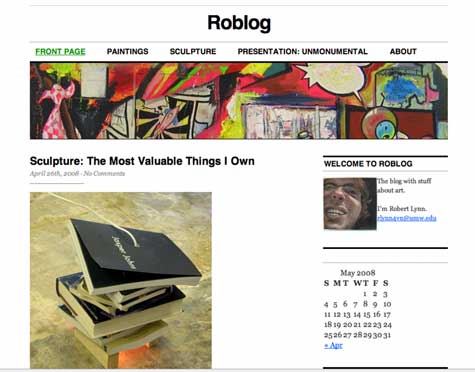
Robert Lynne, a graduating Art major at UMW, will be my example for this post. I hope he can forgive me constantly harassing him, but his blogfolio (to quote D’Arcy) is a model of at least one way you can imagine the portfolio logic working. Rob has used his blog for several classes, an Art History course, an Art Studio course, a Sculpture course, as well as a Poetry Workshop course. He has had his blog for the 2007/2008 academic year, and the space demonstrates some of the questions of creative control, sequence, and serendipity that I mentioned earlier in regards to Chris and Phaedral’s concerns.
Roblog

In his blogfolio he chronicled his trip to NYC, helped shape a manifesto, blogged for classes, sang songs, and even had time to heckle yours truly. All of this was an on-going stream of ideas and thoughts that framed a process, being an art major he also had a lot of completed work to present to his audience, and this is where the use of pages on his blog became the space for what many might understand as a more traditional portfolio. He has a page dedicated to his paintings, sculptures, final thesis presentation, as well as a more focused about page. In these pages he controls the sequence, presentation, and obviously decides what goes in and what is left out. The space captures a fascinating part of both his creative process and experience throughout the year, but italso quickly became a space for him to represent the products of that process. He controls his space, he can delete my comments, delete his blog, or export the contents and take them somewhere else. In fact, there is no reason why he couldn’t have done all of this on Blogger or WordPress.com. That said, I think the major reason he started it (but it probably was not the logic that ultimately drove it) was the fact that he was asked to blog for at least three different courses this academic year. Not all of which were in his discipline. I think the major reason his work branched out beyond the classes was that there was an audience, the UMW culture encouraged it, and he found it useful (at least to some degree) to frame his work and experience.

The Name of the Game is Spam-like Aggregation

The reason why blogs can be understood as more powerful, dynamic, and complex portfolio system is because of their Houdini like RSS ability. It really all revolves around the syndication infrastructure which makes all the difference, it affords flexibility, dispels the myth of a monolithic system, and allow for the more complex levels of filtering of content I will outline below. But for a portfolio system to work (and I think I feel the term portfolio falling apart right about now but bear with me) it has to be more than that. It has to be a space where people post there ideas for class, react to topics more informally, add resources about various issues they are thinking through (course related or not), and frame the academic work that they are amassing through their career as learners more generally. This is not a technological issue at all, this is a cultural one, and we have begun to see the beginnings of this at UMW (Roblog being an excellent example), but it is by no means ubiquitous, and there is much, much work to be done in terms of fostering the community to think about these elements together in a more orchestrated fashion.

One of the things about blogs more generally that have made this cultural leap a bit easier is that they are excellent at pulling together all the various online spaces a person may occupy and they are inherently open. Both of which allow for updates from Twitter or Facebook; embedding videos from YouTube or images from Flickr; providing extensibility for a wide range of multimedia and traditional site design. All of which forms a platform that is inviting for its protean ability to incorporate various media and one’s distributed presence into one, simple space. This is key, and it is beautifully illustrated by an imagie engineered by Tom Woodward, which once I am able to annoy him enough to post it will be below as a big, beautiful illustration of this profound point, but geared to all you visual learners.
[ Imagine an image of an Octopus here with many loosely joined Web 2.0 tools ]

So, while Roblog is an excellent example, how does this make sense across a larger campus, and can you create both a culture and harness a simple enough technology process so that Roblog (and hundreds of other students) can easily blog for three or even six different courses during the year, while at the same keep it all on spaces they control yet share it as need be with the appropriate class. That is where the questions of filtering, aggregation, and a little bit of spam-blogging emerge.

Let me outline how this might at our current stage of development.

Thanks To Andre Malan’s widgets BDP RSS Add Feed and Add Sidebar User, it is getting simpler all the time, but we still have to make a couple of more jumps. I’ll outline them all below.

Leap of faith, I’m a professor and I ask my 25 student to get blogs (whether on UMW Blogs or elsewhere, it doesn’t matter) and once the do to come back to my course blog and add their RSS feeds. This is made easy with Andre’s Add Feed widget, for I can easily limit who adds a feed by the blogging community. So, once the student set up their space they can drop the feed in in the text field on the sidebar. Easy enough. But wha if they are using their blog for three diferent classes, a film hobby, and to document their Buffy the Vampire Slayer obsession? Well, then they could do one of two things, create a category for my class on their blog, lets call it bmoviemania, and if they are using WordPress (not sure how other blogging platforms handle category feeds) they can just add the RSS feed for that category like so:

http://myblog.com/category/bmoviemania/feed

Thereafter, everything they category as bmoviemania will be fed out to the course blog, keeping their Buffy posts and biology labs out of the b movie class blog (thanks goodness!). They could also do the same thing with a tag on wordpress, it would look like this:

http://myblog.com/tag/bmoviemania/feed

Now, we have a pretty straightforward method of taking these student blogs post for a specific course category or tag, and feeding them into an aggregated course blog. Now how does the aggregated course blog work? Well, it is much easier than it was a semester ago, but there is a little more automation that we need. (Warning: It gets a bit technical for the next few lines! But this information is not essential to the overall logic, so don’t let it throw you off, it is me calling or help šŸ™‚ ) The feed, once entered by the student, is immediately fed into the BDPRSS aggregator, this would need to be activated and the widget in the sidebar as soon as the professor creates this blog (any ideas Andre?).

Moreover, all the feeds that are fed into the BDP RSS aggregator would then have to be treated as an overall OPML which in turn is placed in the FeedWordPress plugin which actually taking all the posts from the respective student blogs and post them on this course blog (with the permalink pointing back to the students blog). Another automation needs to occur here, FeedWordPress needs to be automatically populated with the OPML feed from BDP RSS: http://bmoviecourse.com?bdprssfeed=1 The suffix will always be the same for this code, but the log domain, depending on the course will change.

So, save for two small bits of automation, we have a self-service aggregated course blog for aggregation, that allows all of the students responses, interaction, and posts to remain within their own space, while still capturing the logic of the course. A beautiful example of this is Gardner Campbell’s Rock/Soul Progressive course from Spring 2008. One additional benefit would be an automatically generated blogroll from the list of students who entered their feed, possibly drawn from the URLs in BDP RSS.

Sorry for the programmistan talk, I hope feedistan isn’t reading, but the larger point is that individuals now have their own space that they can grab the feed for, and even drill down and determine a feed for any given class with tags or categories, and then add it to a course aggregated blog.

But why all the talk about course blogs and aggregated such and such when this is about portfilios? Well, because I believe that this process is part and parcel of the archive/raw material that will ultimately populate this portolio. And as we saw with Roblog, the process is often just as relevant and important as the “product.” This is also where the importance of community and the push for students to have their own space and create within their own Personal Learning Environment (their I said it), but alow it to be fed and captured within an aggregated course blog navigates liminal space between the increasingly irrelevant LMSs, and the free-for-all hippie PLEs šŸ˜‰

Also, think about what just happened with the course blog for a second. What was outlined there is now the basis of a publishing framework for an individual’s portfolio that pulls from his/her blog archive of posts and class materials in a way that, like the course blog, they have the option to further tag or categorize the work in their personal archives that deal with all sorts of subjects, topics, experiences, and projects from their experience, and allow them to feed it into a site that reflects them in some way outside of the more conventional ideas of a blog (this would be available for UMW Bloggers and those who self-hosted—not free, hosted solutions like wp.com, Blogger, etc.). Now some might be saying but why? The blog is them? And Roblog is an excellent example of this, so I don’t necessarily disagree, yet the overarching archie blog may not be where they want to frame their work as a photographer, present lab work, field work, films, music, poetry, or business case study. The idea here is that anyone can choose how the fed out the relevant categories, that let’s say are tagged with portfolio, and these spaces become more elegant and malleable presentation spaces for for particalar elements of their work wherein they control the sequence, aestheitc, and in many ways the experience of the visitor.

In many ways the is the aggregation/syndication infrastructure brought down to the human scale. yet, if you have students adding feeds to course blogs, why couldn’t they do the same to directories, aggregated discipline channels, a Blogging platform hompage, or what have you. The fact that the syndication architecture is brought down to the atomic level of the individual, makes for the power of the site to scale more globally. More than that, the community will have a good sense of what it is they are doing and why!

I’ll end here because it’s three am, and a man’s gotta sleep, but sometime tomorrow look for part 3 of This ain’t yo mama’s e-portfolio

Featuring: Biology Lab portfolios at UMW & an experiment with an English course using portfolios for anonymous assessment? Who knew?


Posted in e-portfolios | Tagged , , , , , , , , , , , , , , , , , , , , | 12 Comments

This ain’t yo mama’s e-portfolio, part 1

It’s been over a year now since my full-fledged burn, baby, burn conversation with Gardner Campbell about WordPress Multi-User, ELS Blogs, the Digital Five Ring Binder, and the underpinnings of re-imagining an online distributed space for teaching and learning that both encompasses and moves beyond e-portfolios, capturing a whole range of activities both for class and beyond.

Image of a hydra

This is a conversation that hasn’t happened in a vacuum, see Cole Camplese’s post about using the blog as an e-portfolio back in May, 2006 (and several subsequent iterations on that idea). Or Mike Caulfield’s posts here and here on the topic of e-portfolios. Or Helen Barrett’s ongoing discussion of all things e-portfolio. Or Gardner’s vision of the feedbook back in the day. Or Stephen Downes on the subject of the space of RSS, aggregation, and distributed student and course content way, way back in the day. The conversation has been one that has unfurled over time for a long while and I enter it very late and only capture a snippet of its history. It’s by no means new, in fact it has held a pretty steady space in the imagination of educational technology for well over a decade, if not longer. In fact, many have moved away from the idea of an e-portfolio altogether, re-framing it as a Personal Learning Environment that can take into account the dynamic, distributed personalized spaces wherein we network, interact, create, commune and by extension learn.

All this said, I want to return to one simple and very unrevelatory idea, how might we imagine a campus cyber-infrastructure for managing a cheap, flexible, and dynamic e-portfolio system? And with that, I’m off…

Barbara Ganley’s 21st century proverb, “Twitter to connect, the blog to reflect,” will lay the groundwork of how we might think about the blog as e-portfolio and much more (I’ll ask many of you to forgive the limitations of my terminology as we get started). This blog/e-portfolio creature might be better understood as a digital frame for experiences or a personal archive of one’s thinking over time (an idea laid out nicely here by Martin Weller as he articulates our collective wondering whether the blogosphere is moribund). I like the idea of understanding a student blog/portfolio as an archive of their throught over the course of their time as a member of an academic community. A space that they can share, interact in, take with them, and build upon as they move onwards and upwards with their lives.

But a portfolio isn’t an archive, right? Well, yes, you’re right smart guy, but we need to spend a bit more time here to move to the idea of featuring and presenting one’s best work as a portfolio so often connotes. An archive becomes the raw material of thought that can be categorized, tagged, fed out, and re-worked in whole series of different and exciting ways. I have said it before, and I’ll say it a gain. With a blogging platform like WordPress and Drupal† you can feed off of categories or tags, which makes the work students file under a particular tag or category easily syndicated to an aggregated course blog –I talk at length about this here, here, here, and here and see Andre Malan’s frighteningly lucid post on the subject of different kinds of course blogs). And by extension, students can use categories and tags to filter specific work for a course blog, a group blog, or even a separate portfolio blog that they feed in only the things they want to feature (keep in mind that students, faculty and staff can have as many blogs as they want, wither on the campus system or elsewhere–more on this soon).

Cole Camplese had brought up the point of using the PSU network drive, or storage space, as a private repository for files that students wanted to keep separate from the blog. I think this is a great feature, and given that PSU has the infrastructure to integrate it with their blogging system it is a bonus. Fore those who don’t have it, I’m not sure you would require a locally supported infrastructure for the job. Might this be better provided by services like divShare, Google Docs, Blip.tv, YouTube, Flickr, and so on. The more I think about it, the shear simplicity of integrating selected Google Docs, YouTube videos, Flickr photos, divShare files, etc. into a blog often makes these services easier to work with then a centralized campus storage/file sharing network. The small pieces loosely joined approach guarantees that everyone takes ownership of their work, takes responsibility for the services they choose, and defines their own digital management plan which isn’t premised on the outdated notion of a central network/storage backbone provided by colleges and universities. Universities can make recommendations, and IT departments and/or libraries might make recommendations, but the choice rests with the individual. Jon Udell outlines the logic of a syndication oriented infrastructure which makes far more sense for universities and colleges than the current practices of continually trying to maintain and host everything locally. As Brian Lamb put it (and I shamefully keep quoting this, sorry Brian!):

Schools should be in the business of managing data flows rather than in supporting an end to end user experience. We can only dream what might result if the energy going into the campus-wide LMS’s would go into creating flexible and easy to use “syndication buses” or to addressing pragmatic instructor challenges to using the “small pieces” approach — things like student management tools, gradebooks etc. And what about providing the service of institutional archiving and data backups to mitigate the risks of using third party tools?

In my mind, the key to such syndication driven architecture has everything to do with tweaking a few tools (like Andre Malan’s Add BDP RSS and Add User widgets) and perhaps a hack or two to make this work so that the the campus community is sharing their work with one another in a way that is visible and open, while at the same time as simple as a tool like Facebook (which qualifies under Ganley’s notion of connect), but unlike Facebook this system would be open and students, faculty, and staff would control their data (see Justin Ball’s post here).

This is the key, we cannot build a monolithic system that will represent the new breed of “Learning Management Systems” on campus, rather we need to provide possibilities for a community to come into conversation with itself and the rest of the world by making it easy for everyone to share their feeds, filter their work to appropriate spaces, and become part of larger community that is not dictated by an overarching logic of management, control, and isolation–those are the tools of nefarious capital šŸ™‚ D’Arcy Norman and Bill Fitzgerald have come up with an excellent prototype of such a system for Drupal both here and here, respectively.

So, with that, I’ll end the overview, albeit a brief and idiosyncratic context, and move into some specific examples and how blogs (and in my case WPMu specifically) might be used for e-portfolios. I just wanted to stop here and pace myself a bit because my posts are becoming ever-longer, and Jerry reminded me I should break this stuff up so that someone will actually read it.

Part deux out at 3 am tomorrow morning šŸ™‚

† I imagine applications like Movable Type and Blogger can do something like this with tag/category feeds, I’m just not familiar enough with them, so I haven’t been able to find such features on blogs that are using these applications.

Posted in eduglu | Tagged , , , , , , , , , , | 14 Comments

Bestiaries, Lockdown, and Twitter

Image from Bionic Teaching flickr site

I went down to the University of Richmond today to see Tom Woodward’s Blog Bestiary presentation at UR’s Learning 2008 event. Tom’s presentation was a lot of fun, and his ability to take the medieval bestiary metaphors and images and graft them onto the flexibility and possibilities for re-imagining blogs was masterful. Hopefully he’ll put the presentation on his blog shortly, for the images (see them on Flickr here), the sophisticated conceits, and the outrageous playfulness are well worth your time. Some quick quotables are (and I paraphrase): “Hand coding a site or using Dreamweaver is like an old woman fighting a dog.” A statement accompanied by the image above— classic!

The other classic quote was how blogging has been likened by many to a Bonnacon, or a medieval horse/bull that can propel its flaming excrement for acres. And, of course, there was the indelible image…

Image of a Bonnacon

The faculty Tom presented with, Darrell Walden (Accounting) and Patricia Stohr-Hunt (Education), are doing some amazing stuff with podcasts. Dr. Stor-Hunt’s Open Wide, Look Inside class blog features a series of podcasts from students framing how they use a series of books in the classroom, namely outlining themes, relevance, and possible approaches in the classroom. Dr. Walden’s approach was to have his Accounting class create enhanced podcasts, and build an awards system out of it, wherein the class was asked to review and rate the others in the class, and vote on the best presentation of an accounting theme (you can see them here).

The following group of presentations dealt with some of the documentary filmmaking going on at Richmond, and there is some pretty impressive stuff, but it was interrupted about halfway through by a very strange and frightening series of events. It started with the director of the Help Desk at UR coming into the computer lab where the presentation was being held asking us to turn off the lights, remain quiet, and lock the door. That was it, he disappeared. After a little bit of murmured confusion, and some fumbling with cell phones, e-mail logins, and the like, it was quickly determined that there was a suspicious individual at-large on campus and he is believed to armed and possibly dangerous. It was at that moment that someone remarked, “not again,” and I found myself at first being confused and then full on frightened as I looked at the locked door and remembered the insane reports from VA Tech just over a year ago. It was an insane moment that thankfully passed quickly. And while I was certain this was not “it,” I’d be lying if I didn’t say that the thought hadn’t crossed my mind –and in that split second I found myself daydreaming about Tess and Miles.

What followed was pretty surreal. We all sat in the computer lab nervously talking, some suggesting those of us closer to the door move to the front of the room, and others calling out any information they might have received via e-mail. It was a bit tense, but I think everyone was more confused than scared, and there was a certain amount of levity in the discussions that were at times less than the ordered quiet (there was shushing). I had no internet access on my laptop, and asked Tom to log me into a UR computer so that I could get a sense what was going on. I went immediately to Twitter, as did several other folks from UR who were holed up in a different computer lab. It was bizarre gauging what was going on through their tweets, almost a sixth sense. Soon enough, I started tweeting what was going on in the room (as did others) , and I found the act to be really soothing. People at UR were sharing information and giving advice to one another, while the larger network from around the world was sending regards, prayers, questions, and their well wishes. I had a very powerful sense that those “others” were there with us from beyond that lab, or even the UR campus. I can’t fully explain why that felt so good, someone even offered a Safety dance from abroad, nothing like a laugh during a moment of untold strangeness šŸ™‚

After about a half hour (I think we were in lockdown for over two hours, but I am really not sure about this, time kinda stood still and flew by all at once) there was a certain amount of talking that at times seemed to get a bit loud. And I got my first experience with how truly crazy a tense, potentially life threatening situation can radically impact a dynamic amongst fifteen or twenty people stuck in a room together. I kept thinking of Stephen King’s novella The Mist the whole time, just wondering what the hell is out there, and how it will get us. One of the group said tensely that we were ordered to be quiet, and if the situation is as serious as it seems shouldn’t we be quiet. I appreciated this statement, it manifested the anxiety many of us felt, yet at the same time I felt suffocated by it. The idea that we might be in danger was exactly what I didn’t want to think about. The room quieted down, and the tension rose higher, during this time Andy Morton (a UR librarian and tech guru) had been escorted from the other lab across the hall to go to the library to get an image of the suspicious gunman from the libraries security camera. I knew this all because of Andy posted the details to Twitter along with the image.

Image of Suspicious Gunman at UR

Those of us on Twitter brought this to the attention of the room, which made for some marveling at Twitter, as well as a sense of security that we are well-armed with information about the situation. In fact, not too long after this many in the room signed-up for Twitter and were monitoring the situation there. Things did get better from here, Tom had us playing scrabulous (I won!) and the UR police came in a while after to scan the room for anyone matching the description. This put many at ease, and not that much later we got the all clear. Crazy for sure. I don’t have a moral to draw from this whole thing, but I did notice something that has me thinking a bit. Of all the technologies we had at our disposal, very few were more effective than Twitter. I got access to the latest news reports outside the campus from fellow twits, I got an image of the alleged perpetrator, I got support, and vital information. My cellphone had no signal, and my e-mail was useless to me because I am not part of the UR community, hence I wouldn’t be notified there. For those thinking about a means to manage a crisis, I would put Twitter, or an application like it, at the top of the list. It proved invaluable today for all sorts of reasons, and it made all the other means of connecting with others and collecting information dreadfully inadequate. The recent case of a journalism student using twitter in Cairo to let others know he had been arrested by Egyptian authorities, which then alerted others to his whereabouts allowing for his speedy release, is another excellent example of how effective it might prove in a crisis -for people can care about one another together in this space, despite how far away they might be.

Today was strange, and I often think about how technology is used in movies to great effect. For example, Night of the Living Dead and Dawn of the Dead are two excellent examples of George Romero integrating radio and television into the actual dramatic action of the narrative. Scorsese failed miserably at this in The Departed with text messaging. The presence of Twitter in today’s narrative was real, compelling, and a welcome, re-assuring space during an uncomfortable moment. Anyway, we live in strange times, and the Zombies seem to be coming out in greater numbers as the economy tanks, the presidential race goes sour, and the War in Iraq marches mindlessly and endlessly on. Twitter won’t stop any of these realities, and it isn’t a panacea for the abundance of guns, violence, and terror in our communities (even those that are traditionally “immune” to these outbursts), but it gave me a bit of solace today.

Posted in general, twitter | Tagged , , , , | 22 Comments

MistyLook Theme for MediaWiki Toolbar Fix

This can be filed under obscure hacks. For those of you out there who are using the MistyLook theme for MediaWiki and haven’t been able to get the editing toolbar to show up in the later versions of MediaWiki, then this hack is for you.

Toolbar

I found this fix thanks to Hal’s comment on Jason Pearce’s blog.

Find the following code in the MistyLook.php file

MediaWiki Toolbar Fix

That’s it, it should work. How easy!

Posted in plugins | Tagged , , , , , , , | 9 Comments

Judges 5:27

“…At her feet he bowed, he fell: where he bowed, there he fell down dead.”

I’ve spent much of the early morning hours reading through Brad Efford’s awesome Judges 5:27 blog—the Reverend’s last man on ELS Blogs! It is, without question, worth putting on your blogrollif you are into discovering an amazing range of thoughtful reflection on all kinds of film, music, and mashup craziness. I’m learning a ton from him, for example his post about truth and The Evolution Control Committee video “Rocked by Rape” is out of control (and brand new for me). He also makes passing reference to Plunderphonics in this post while introducing his logic for his formative 10 albums (a great series I’m following hungrily- I’m loving Squirrel Nut Zippers). I hadn’t heard the term Plunderphonics before, but it certainly is extremely relevant to music’s current, entrenched battle against copyright. I was already familiar with this concept/artform/movement? to some degree given Negativeland’s “work”—but Plunderphonics as a term framing this movement was one I hadn’t been aware of until now, thanks Brad!

What struck me like a lightening bolt this morning was how much Brad’s blog might illustrate, to some degree, the power of the ELS/UMW Blogs experiment for the UMW community more generally. I first came into contact with Brad’s blog when he was taking Gardner Campbell’s Film/Text/Culture class during the Spring, 2007 semester. We have since had several other occasions to talk movies, music, mashups, and everything else interesting, and he is only a rising junior, so I have at least two more years of on-site goodness. After spending several hours reading Brad’s posts that range back over a year, I was reminded of just how integral to the learning community the work DTLT has been doing at UMW truly is. One small example of this was the conversations Gardner and I had in both June 2006 and January 2007 about harnessing the power of multi-user, distributed blogging which resulted in a series of experiments with his Film/Text/Culture classes, which I think was beautifully captured during the Spring 2007 experiment with ElS Blogs.

“Back in the day” of ELS Blogs when we were running WPMu on a Bluehost account and had under 100 blogs (most of which were Gardner’s students) I invested a lot of time reading the posts quite closely, but I still couldn’t read everything. I read enough, however, to get a good sense of how cool that class was. Gardner took the idea of distributed, individual blogging for a class to the next level during that semester. Exemplified by when he asked the students to post their final papers on the blogs, which would include at least three trackbacks to posts by other students in the class over the course of the semester that had informed their thinking about a particular, film, theory, idea, reading, etc. He presented on this approach at Faculty Academy last year, likening it to re-imagining how we use the library to cite the work of others that inform our scholarship. I thought it was a great conceit to frame his always amazing work, but I haven’t thought too much more about it until I began reading Brad’s blog in its entirety this morning.

Gardner’s course featured some great films by Errol Morris, and one of the posts by Brad I stumbled across this morning beautifully illustrates the power of this distributed community of class bloggers to create links, references, and an engaged community of thinkers. In this post Brad voices an interesting and intelligent take on Fast, Cheap and Out of Control that has me re-thinking that film a bit. Below is an excerpt from Brad’s critique of Morris’ film:

Fast, Cheap & Out of Control felt like a neverending trailer for a film that never actually presented itself….The problem is, this trailer is 80 minutes long….I was a big fan of Morris’ idea of filming his subjects in natural environments (their homes, a park bench, on a boat), so watching this movie seemed like a huge step backward for the filmmaker…This is what made Morris’ earlier films so much more brilliant: the idea of letting the people speak for themselves, without distractions or cheap camera tricks…there were too many of those, too, those cheap little skewed camera angles & slow-mo edits.

I felt cheated, having to watch an Errol Morris film that didn’t feel fully there. It felt too edited….whereas Vernon, Florida’s intrinsic beauty as a film was all in its seemingly shoddy editing….it felt to me like Errol Morris tried too hard to make them interesting for the sake of fleshing out some larger themes. Show me something that isn’t trying to impress me & I’m far more likely to be impressed. The style was too big for the movie, the characters too small for the style, & the whole thing way too Hollywood.

After reading this I think part of me agrees with Brad when I compare it to Gates of Heaven or Thin Blue Line, (still haven’t seen Vernon, Florida but that will soon change after spending a good chunk of this morning reading and trying to figure out Brad’s paper on the film –wow, what a cool/trippy essay that reads like a biblical exegesis with Dante’s Divine Comedy standing in for the Bible!—As a further aside: how many people can go back and read a students essay and get excited about it?—Brad now has an archive of his thought that I can interact with, argue about, and learn from -I love that!) for while Thin Blue Line starts to play with the re-enacted, slo-motion “visions” of what might have really happened, it is the conversations and the way in which those characters talk candidly about the events surrounding the murder that remain truly compelling.

But Brad’s differing perspective on the place of Fast Cheap and Out of Control in Morris’ filmography didn’t go unnoticed by Tyler Babbie in his final paper when he recognizes Brad’s reading and his problems with the film, yet still provides his own reading of this film as a kind of visual poem about obsession. To quote Tyler’s final paper:

This post wouldn’t be complete without mentioning Brad’s blog, and trying to speak to the issues he raises in Fast Cheap. Brad felt like it was a big trailer for a movie, which never happened. This movie worked for me, obviously. It cannot be approached as a normal film. To watch it, you need to get into a sort of trance where you relish every word the characters say, every image on the screen. It’s not a novel, it is a long poem
….

I do not watch many movies, and I’ve learned how little I know about them in this course. Maybe the flashiness of Fast Cheap appeals to me because I’m not silver-screen jaded. I don’t like most films I see, and I can’t say what makes a good film for me. Vernon Florida was fantastic. Fast Cheap seems more epic. Morris took a big risk in this film, making it so colorful and editing with such intent. To me, it is a complete success. I can see why it wouldn’t be so great for Brad and other people, how the charm of Vernon could trump the power of Fast Cheap. But as poetry student trompling around in another medium, it pushed all the buttons I like to have pushed. I guess it’s like the Faulkner/Hemingway debate. I’m Faulkner all the way, I like rich language and color and strange angles in novels and in films. As Brad says, the people in the film ā€œare chosen purposely & precisely for their absurd nature.ā€ I don’t know about the absurd nature so much, because I think they are great (not good) examples of humanity at its most obsessive.

Regardless of where you fall on this debate about Fast, Cheap and Out of Control, I think the fact that had me full of respect, wonder, and excitement during the wee hours this morning was the fact that Gardner had encouraged these students to engage and challenge the works they were watching as I’m sure he always does in any given class he is guiding, but he has also come up with a powerful way to both trace and archive these discussions, disagreements, and meditations beautifully. And it doesn’t hurt to have folks like Brad, Tyler, and the rest of the UMW faithful to make the reading, thinking and engaging that much more rewarding.

Posted in experimenting, fun, general | Tagged , , , , , , , , , , , | 4 Comments

Classic Video Game Emulation

C3P0 UnderoosI recently came to the realization that my best friend in Fredericksburg is my 12 year-old neighbor. I just can’t avoid the fact that I have never really progressed beyond the sixth grade; I am still so dearly enthralled by the product-inspired wonder of my youth. Whether it be Star Wars (and this encompasses everything from the movies to figurines to stickers to trading cards to comic books to UnderRoos), Raiders of the Lost Ark, Clash of the Titans, Pac-Man, our first family VHS player, or the Atari 2600, culture from the late 70s and early 80s is the wellspring of my strong penchant for nostalgia. My 12 year-old neighbor feels the brunt of my unfortunate condition.

Our relationship began benignly enough talking about Lego Star Wars sets, the associated video games, and the current state of Star Wars culture more generally. When I found out he hadn’t seen the real Star Wars movies (namely episodes IV, V, and VI 1/2) I lent him my DVDs and asked him to think about where our shared myth system began. I haven’t been able to convince him of my opinions on the far superior quality of the original trilogy, but I am working on it.

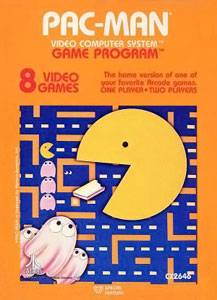
Image of Pac-Man cartridge for Atari 2600More recently, we’ve been focusing on video games. He is enjoying [[Battle Front II] at the moment, and the thought occurred to me that he is experiencing modern video games devoid of their beautifully vectorized history. He has no real sense of the Old Gold games, and that’s a crying shame. So while I didn’t walk 5 miles to school in the snow, I did experience the colossal disappointment that was the Atari 2600 version of Pac-Man first hand, and I thought he might need to understand my pain and experience a bit more intimately. So, how do I go about this? What method should a video game sensei take?

Well, in the age of educational technologies and the beauty of the internets, there is really only one way to emulate the experience…that’s right, you guessed it: to actually play those games and experience their dislocating magic. There are many ways to do this, and luckily I have access to just about all the original consoles and games I am talking about here so I don’t have to worry about all the moral, ethical, and copyright ramifications that bog down those with fewer resources. The fact that we have to agonize over “stealing” the culture” they” (who the hell is ‘they’?) used to shape us with, the very culture we made relevant bac —it’s an outrage! So, in sympathy (or is it solidarity?), I’ll share below some of the resources available for getting your hands on a few select emulators that are freely available online. And, if you use them in the spirit of enlightening your 12 year old neighbor with an impressionistic history of video games, you may even be able to claim educational fair use šŸ™‚

CLASSIC CO-OP ARCADE GAMES:

GalagaIt all really starts with classic Co-op Arcade gems, games like Pac-Man, Galaga, Ms. Pac-Man, Tempest, Pole Position, Donkey Kong, Dig Dug, Asteroids, Gyruss, Ghosts and Goblins, Battlezone, Asteroids, Punch-Out!, Star Wars, Rampage, Q*Bert , Galaxian, Joust and on and on. In fact, two of the first things I did when I first got on the internet in 1994 was search out all resources on the classic 60s show The Prisoner along with any and all information on the history of classic video games. A bit later, my friend and co-worker at UCLA’s Audio Visual Services, John Spellman, discovered MAME, and it has been an on-going love affair ever since.
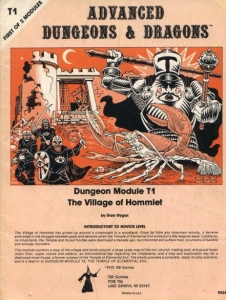
Image of D&D moduleThe stand-up arcade games are a treasure trove of memories. Our local comic shop “The Incredible Pulp” had Galaxian and Joust in the back of the store, and my friends and I would spend hours playing those games in a really amazing setting surrounded by comics, beautifully painted D&D lead figurines, the beautifully illustrated AD&D handbooks and modules, along with countless other artifacts that make up some of the most vibrantly imaginative and obscure objects of my adolescent desire. And there was the Grand Bald Pizzeria that had some pretty good pizza (even by NY standards) and a new series of arcade games constantly streaming in, everything from Track & Field, to Ghosts and Goblins to World Karate Champion to the grand poobah of them all Pac-Man (and still my all-time favorite video game bar none). Finally, their was the Baldwin Pool Hall, a smoke-filled billiards parlor that took a corner of its huge floor plan and put in an arcade, with everything from Make Trax to Pole Position to the Star Wars vector game, Tempest, Battlezone, Defender, Ms. Pac-Man, Galaga, Popeye, Pooyan, and a few more I can’t remember because I didn’t play them.

Image of Grand Avenue, BaldiwnIn fact, these stand-up coin-op games are so intricately linked with the small stores of the community I grew up within. And while I had Atari 2600 when I played most of these games, the experience of going up the block with friends to various stores to play these games was different. It often led to other connections and discoveries in the community, whether making new friends, getting in the occasional fight, or having a space as a ten or twelve-year old that was not entirely dominated and dictated by one’s parents. having these video games in these various stores allowed you to hang out regardless if you had bought anything (well before box stores like Borders made this a “unique experience” and charged you accordingly for it). You were in many ways a part of the world you played in, and I knew the proprietors of each of these stores quite well. I was a kid in the neighbor and that meant something to me, my friends and I were people they knew and the folks behind the counter were people we also knew quite well, joked about, and imagined lives for them beyond their role as shopkeeper.

I wasn’t a god damn number they were ordered to sell a rewards card to; I don’t want your stinking rewards card, I want to talk to a human being! Sorry for that…but arcade games were an integral part of the built environment of my growing years and they framed my person in so many ways beyond the actual game itself. it is complex series of relations that often get discounted when you just look at the game, or isolate that game within one family’s living room.

For some more information on the Golden Age of Video Arcade Games check out this great Wikipedia article.

So, in short šŸ™‚ , if you are looking for the Classic Coin-Op Arcade games for your computer then MAME (for Windows) and MacMame (for the Mac) are one, precarious way at it. Precarious because when it comes to getting the actual ROMS for each of the games, you’re on your own because they’re still under copyright and it is illegal to distribute them. This doesn’t mean they aren’t easy to obtain. In fact, a quick Google search will do the trick, but you still have to weigh the onus of ownership and how our culture is being imprisoned by draconian copyright laws that are incongruous with the digital flow of information and resources.

ATARI 2600:

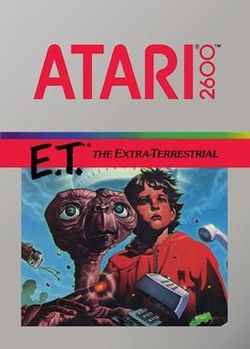
Without question the Atari 2600 home game console will forever be a part of some of my most splendid memories of consumer culture. The idea of going to Sears or Playland to buy a video game cartridge remains one of the most vividly expectant moments of possibility in my paltry life. The history of Atari 2600 is in many ways a fundamental history of media in the 80s that is as important as the VHS home recorder or the death of the single-screen movie theater. I didn’t know this at the time, but as of 1981 there was as many as eight million Atari 2600 systems sold, at a $100 some-odd bucks a pop that’s $700 million dollars. Moreover, the Pac-Man cartridge alone sold 7 million copies, making it the best selling 2600 cartridge of all time, not to mention one of the greatest disappointments for any console since. Check out this list of ten Atari 2600 cartridges that sold over a million copies. It seems kind of crazy now, but when you do the math from just the two figures above, Atari in the early 80s was probably a billion dollar company, insane! And seems like the dividends won’t ever stop coming in. Interestingly enough, according the the Pac-Man Atari 2600 Wikipedia article, the video game crash of 1983 is linked to such disappointments like Pac-Man and E.T., in fact despite selling seven million copies of Pac-Man and 1.5 million of E.T., Atari seems to have lost on both:

Although Atari sold seven million units (of Pac-Man), out of a 2600 user base of ten million, twelve million cartridges were manufactured, under the expectation that the game would re-stimulate sales of the console. When this did not happen, Atari had to write off the five million unsold copies, incurring large losses.

The same held true for E.T a year later, four million copes were manufactured, but only 1.5 million sold. The millions of unsold cartridges have become part of an Atari landfill legend that gets mentioned in the E.T. wikipedia article (so fun!):

In September 1983, the Alamogordo Daily News of Alamogordo, New Mexico, reported in a series of articles that between ten and twenty[18] semi-trailer truckloads of Atari boxes, cartridges, and systems from an Atari storehouse in El Paso, Texas were crushed and buried at the landfill within the city. It was Atari’s first dealings with the landfill, which was chosen because no scavenging was allowed and its garbage was crushed and buried nightly. Atari officials and others gave differing reports of what was buried,[19][20][21][22] but it is widely speculated that most of Atari’s millions of unsold copies of E.T. ultimately ended up in this landfill, crushed and encased in cement.[23]

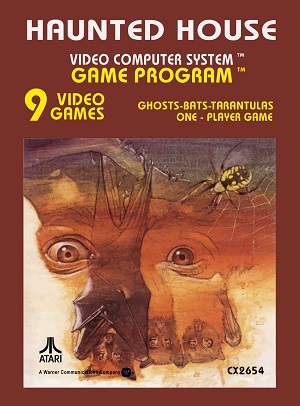
Image of Haunted HouseSo much of this waste had to do with Atari’s move to capitalize on a video game or film’s popularity, which meant entirely disregarding both the design and play of their games. Raiders of the Lost Ark is one of the few games in this circumstance that most agreed was relatively unique and forward looking with the use of more than one controller for action/adventure narrative game play. Raiders of the Lost Ark for the Atari 2600 still remains one of my personal favorites, along with Popeye (a beautiful adaptation from the original Coin-op), Kaboom!, Pitfall!, Warlords, Asteroids, Chopper Command, Superman, Haunted House, Adventure, Night Driver, Combat, and Space Invaders. For a full list of all Atari 2600 games go here.

And while the Atari 2600 games occupy a large part of my imagination from back-in-the-day, they were just about all inferior to the arcade coin-ops save a select few (Pitfall! being one of them). Nonetheless, the limitations of this gaming systems offers a fascinating space for disorientating a contemporary game fan. I plan on having my neighbor play the 1979 Atari 2600 game Superman, which may be one of the most de-familiarizing and confusing games for a kid who is used to a more seamless and congruous narrative game play. Not only are the sound effects extremely grating, but the game play is terribly disorientating. Try mapping space in this game, it ain’t easy (in many ways these early games are similar to the early 1900s films that film historian Thom Gunning talks about as experimental and alternative spaces that would later be modified and codified into more dominant film narratives, most famously exemplified by D.W. Griffith’s Birth of a Nation).

One more thing, I recently discovered a whole series of adult-themed games for the Atari 2600. A whole underground I never knew about šŸ™‚

So, all this nonsense to say that there are a number of Atari 2600 emulators (see the list at Atari Age here). I have played with the Z26, which works with both Windows and Linux, and it gets the job done. Stella is an emulator for Windows and the Mac that I haven’t played with, but plan on trying out sometime soon. Same drill with the ROMS for the Atari 2600, they are available, but the questions remain.

COMMODORE 64

ConanHallOfVolta_ingameI have far less experience or knowledge of Commodore 64, and much of my experience with this system comes from friends who actually had one. I got one second-hand almost a decade after it was popular, and it is quite fun, but I wasn’t really into computers in the 80s as much as I was into video games, and a full-blown computer seemed like a whole lot of overhead for what I wanted to do. That said, I wasn’t oblivious to the classic games like Pirates!, Boulder Dash, A Nightmare on Elm Street, Conan: Hall of Volta, Lode Runner, and Choplifter. I still have a lot to learn about this platform, and the list of games is actually two Wikipedia articles, which suggests just how many there are (it’s kind of overwhelming!).

The emulator available for the C64 is called VICE, and the ROMS once again are plentiful. In fact, the amount of non-copyrighted material for the C64 will probably be far more plentiful than the Atari or classic Coin-Op emulators which are almost entirely proprietary.

OK, that’s it, I’m officially shot. This post is all over the pace and I could still talk about the first Nintendo system and how games like Mario Bros. and Blades of Steel were amazing to me, but I don’t have it in me at this point. Just more fodder for the next nostalgia outburst.

Posted in video games | Tagged , , , , , , , , , , , , , , , , , , , , , , , | 1 Comment

Mashups, Italian Style!

Image of TotòWell, Antonella Dalla Torre’s Italian 202 class had its first annual La Mattina degli Oscar (The Morning of the Oscars), and it was quite a special event. Good food, everyone well-dressed, and the culture was first rate, now that’s Italian! The occasion was a celebration of the recent work this class put into creating a series of pretty impressive Italian Mashups for their final projects.

The rules of the game were pretty simple:

  • Each group had to use freely available, public domain clips from the Internet Archive to create a narrative.
  • They had to write the script in Italian and get it approved.
  • They were expected to perform the dialogs with passion.
  • Finally, they needed to subtitle the entire film in Italian (most of which range from 2 to 3 minutes long)

The project seemed like a really fun experiment from what I could tell of the classes overall reaction this morning. There was a lot of laughter and kidding once the films were finally screened. Which is a good thing given the tight deadlines and intense collaborative work forced upon the students over a two week span at the end of the semester. I have to hand it to the class as a whole, they met the challenge with gusto. And I particularly have to hand it to Antonella for following and engaging so many of the conversations in regards to teaching and learning in our current moment (some of which happen in her dining room!) and framing out an impressive, pointed, and very powerful example of coalescing various media, languages, and cultures to give rise to some extremely fun and challenging projects. Bravo!

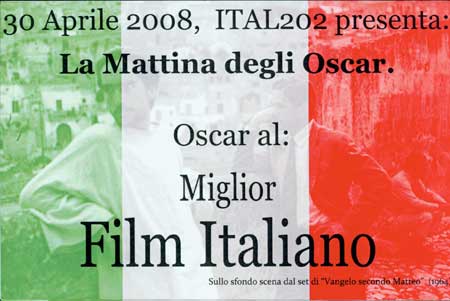
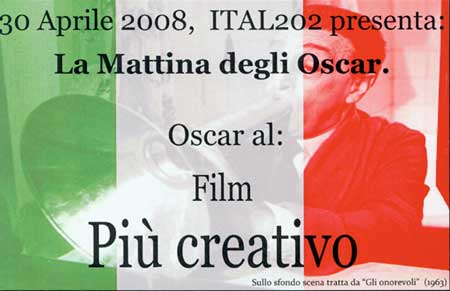
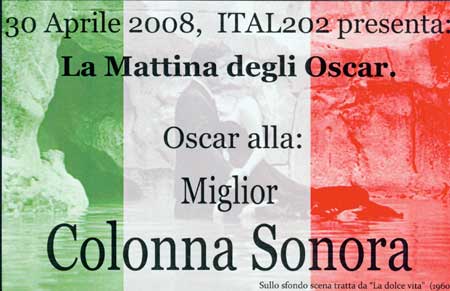
Below are scanned versions of the official “Oscar cards” for each of the five major categories which are followed by the actual mashups: 1) Best Film, 2) Best dialog, 3) Most creative, 4) Best Special Effects, and 5) Best soundtrack/music. (The Oscar cards featured below were designed by Michele Fontefrancesco.)

You can also see higher-quality versions on the class project blog “Il Mashup.”

Image of Oscar card for best Italian Film

Alien Pizza (Best Italian Film)

[youtube width=”425″ height=”355″]http://www.youtube.com/watch?v=Np_JfAxuqlc[/youtube]

Image of Oscar card for best Italian dialog

Maria! Maria! (Best dialog)

[youtube width=”425″ height=”355″]http://youtube.com/watch?v=hUEdSB8fO1c[/youtube]

Image of Oscar card for best Special Effects

Libidine e disonesta (Most creative film)

[youtube width=”425″ height=”355″]http://www.youtube.com/watch?v=CVNCr4B0Gfw[/youtube]

Image of Oscar card for best effetti speciale

La specie femmina (Best Special Effects)

[youtube width=”425″ height=”355″]http://www.youtube.com/watch?v=NOoz5znR0y0[/youtube]

Image of Oscar card for Sonnorra

La storia di Giovanna (Best use of music)

[youtube width=”425″ height=”355″]http://www.youtube.com/watch?v=9rZFuaUTrgc[/youtube]

Posted in experimenting, fun, Italy, mashup, movies, video, YouTube | Tagged , , , , , , | 4 Comments

Literary Journals Class, the sequel

Last week I got to see the second iteration of Claudia Emerson’s Literary Journals course present their work, and you can color me impressed (for my post on the first iteration see here). This course was first taught last Spring as a kid of experiment in seeing if students could spend the first half of the semester studying contemporary literary journals, then put that knowledge into action by building their own. The results were impressive.

So the class was run a second time under the fearless leadership of professor Emerson, and the results were just as impressive. While I wasn’t around for the entire semester, missing much of the true labor of creative conceptualization (which was handled astutely by Martha Burtis) I found it interesting just how little assistance the three groups needed. They were extremely self-sufficient, and the technical struggles were far less apparent this year than last, providing far more time and energy for the most important parts of the process: the creative, administrative, and marketing facets that compromise any publication.

Two of the three groups used UMW Blogs to create their journals, and they worked beautifully within the constraints of this publishing system (which are very few šŸ™‚ ). The third created their site from scratch, which afforded them a tremendous amount of control over the visual aesthetic and layout (those might be the few constraints).

Below is a quick rundown of the three journals in the order they presented.

EcollectiveECOllective : This journal’s mission statement is really sharp and imaginative framing itself as a very strongly themed publication dealing with the relationship between the artist and his or her environment. During their presentation i was really impressed on how they worked within the limitations of the UMW Blogs publishing platform (that was all Martha!), and also used a whole series of loosely joined tools to work through the submission, selection, revision, and publication process.

Check out how smart the following process is: Artists submitted their work through an online submission form created with Dagon Design Form Mailer which then went to the journal GMail account. From there, the work (if text) was immediately converted to a Google Doc which was shared with all the editors. And the reviews were then listed in a collabortive Google Spreadsheet to record all of the journal editors reaction to the piece, and if it was accepted they would send the artist an email inviting them onto Google Docs to take care of any needed revisions. A pretty sophisticated workflow handled seamlessly be freely available online tools.

Much of the same holds true of the marketing aspect of this journal. They used both MySpace and Facebook (having much greater success with MySpace interestingly enough) to spread the word, creating page for their journal on both of these social networks. More than that, they got some unbelievable submissions from a wide range of international artists, take a look for yourself here.

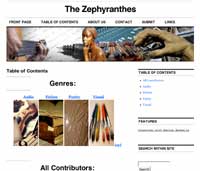
The ZephyranthesThe Zephyranthes (zef-uh-ran-theez): I borrow their phonetic spelling here because I would kid them every chance I got about how easy this journal title is to pronounce for a my lazy NY tongue. The Zephyranthes journal was very much about thinking through the future of American voices and featuring contemporary art on the digital frontier. As they say in their mission statement:

The journal is published exclusively online in order to provide the creative minds of a changing world the freedom and versatility to express within the bounds of their imaginations, unhindered by many limitations of the printed page.

In fact, they were extremely interested in framing the experience of what it takes to publish in this new medium, and have a featured interview with UMW’s own science fiction writer Warren Rochelle. One of the things that amazed me about the Zephyranthes group was their portean ability to shape shift their journal at th last minute when they realized that they were using the same theme as ECOllective. Within two days time the site visual and presentational aesthetic was dramatically altered and to great effect. The navigation and presentation of the works in this journal are exemplary, and it was fun to watch them re-imagine themselves almost instantaneously, which in many ways is in keeping with their mission. Check it out here.

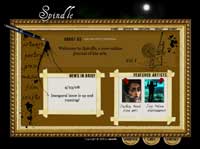
Spindle JournalSpindle: Last, but not least, there’s Spindle, what I like to think of as a beautiful abstraction. This journal pushed the aesthetic boundaries far beyond the meager boundaries of WordPress. The site was designed entirely from scratch, and it provides an extremely powerful, consistent aesthetic which moves the user through the site experience seamlessly. I particularly like the way this group created a space where artists, genres, biographies, and artworks became readily available within one click. It was quite nicely designed.

The site has a far more abstracted and loosely coupled theme than the other two: “This journal’s purpose is to evoke a dream-like state of creation. Spindle weaves together seemingly unconnected works of art and literature, constructing a new and inspiring way of approaching artistic content.”

The “Explore” feature of the site in many ways embodies the mission statement by brining together disparate works in a random, yet suggestive, fashion. This journal also did an excellent job focusing on less traditional media in literary/artistic journals such as crafts and video, featuring local creative talent from artists at the Liberty Town Arts Workshop. A true treat, there are innumerable gems in this journal.

Posted in experimenting, google docs, UMW Blogs | Tagged , , , , , | 6 Comments

Dawn of the Dead, take 3

Finally, the last and mashed installation of my Dawn of the Dead (1978) series which took far more technical and creative energy than I originally imagined. The idea behind this experiment was simple: create three commentaries upon the social/political sub-themes dealing with consumer culture embedded within Dawn of the Dead usingĀ  video-based approaches. Oh yeah, one more thing, all of this was to be completed in three days.

The first take was a simple, edited argument in which I juxtaposed clips from Romero’s classic horror film. The second take simply added my own running audio commentary on these selected clips from the movie. Two days, two clips, no problem.

This take, the third take, the mashup, threw a bit of a wrench in my work flow (that’s for you, Andy šŸ˜‰ ). I labored over this version far longer than I anticipated, which in the end says something to me about some of the formal elements and challenges of video more generally, but the demands of imagining and executing a mashup more specifically. For the other two takes I had the argument in my head from having seen the film so many times, and analyzed it in my usual way, i.e., informally, idiosyncratically and questionably.

Yet, the mashup was far more demanding. I wanted to take the mall footage from Dawn of the Dead and mash it up with some of the public domain resources available on the Internet Archive. I found two good marketing films for shopping centers (Shopping Can be Fun (1957) and In the Suburbs (1957)) and was planning on using both, but here is where the difficulties began. After watching all three movies a number of times to find moments that might work, deciding on clips, and then editing them down, I found that the most important element for framing my own commentary in this mashup was going to be a consistent narrator and background music. This ultimately led to me to limit the “straight” narrator and documentary footage to just Shopping Can be Fun. A choice which meant I had to abandon some amazing commentary and narration from In the Suburbs.

I think this is illustrative of the mashup process, it is all about framing a narrative, making editorial choices, and, in my case, working creatively within the very specific limitations of new media. I’m not so sure limitations necessarily lead to interesting, creative side effects, yet the technical skills, time commitment, and found material necessary meant that I wouldn’t be able to do all that I had imagined. I was forced to recognize the restraints, compromise, and produce.

For example, my limited understanding of editing and manipulating audio led me to simplify the sources, and helped me recognize what I need to do to create a better mashup next time (and there will be a next time!). I am fully aware that the version as it stands now is mediocre at best—this is a “b” blog after all—but I really enjoyed the creative stimulation, despite the fact that I need to work a lot harder to hone my technical and formal approaches to what should be understood as yet another way of framing an argument using the archives of our culture as the creative canvas.

More than that, however, the idea that I might be able to galvanize an idea or reaction by re-working these cultural artifacts is pretty cool. Mashups might be understood as the imaginative re-orchestration of culture through sounds, text, and images that depends upon, as much as it diverges from, the history of narrative. A medium that is by no means new, yet promises to become ever more prevalent in the future given the multi-modal web of connections we inhabit on an increasingly regular basis.

Posted in experimenting, Formative 10, mashup, movies, YouTube | Tagged , , , , , , , , , , , , , , , , , , | 4 Comments

Classic horror movies on the Atari 2600

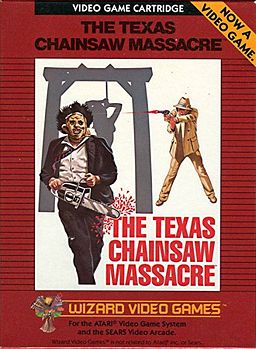
I have been using emulation to give my twelve-year old neighbor the people’s history of classic video games and home consoles (much more on both the emulation and the history shortly). While preparing these rigorous classes, I came across a couple of gems that I can’t believe I hadn’t known about until now—so if this is old news please forgive my enthusiasm. The classic horror movies The Texas Chainsaw Massacre and Halloween were made into video games for the Atari 2600 back in 1983 by Wizard Video Games.†

Texas Chainsaw Massacre Video GameIn the Texas Chainsaw Massacre video game you are Leatherface and are charged with “murdering trespassers while avoiding obstacles such as fences, wheelchairs, and cow skulls. Each victim slain gives the player 1,000 points. The player receives additional fuel at every 5,000 points (5 victims). A life is lost when the player’s chainsaw runs out of gasoline. Gameplay ends when the last tank of gas is consumed.” ¹

In the Halloween video game, you are a babysitter “who must save children from a knife-wielding Michael Myers. The player obtains points in two ways: by rescuing children and bringing them to ‘safe rooms’ located at both ends of each floor of the house, and by stabbing Michael with the knife (if it can be located). The player advances a level either by rescuing five children or stabbing Michael twice. The killer gets faster with each level increase, and the game continues until all of the player’s three lives are lost.”²

Halloween video gameSeems like the games are remarkable for a few reasons other than the game play, for even by the standards of 25 years ago they were nothing short of terrible in terms of graphics and narrative conception. A fact that may make them candidates for the illustrious title of the earliest b-video games. The story surrounding their release is kind of interesting in regards to more recent backlashes against violent video games, such as the furor over the Grand Theft Auto franchise. They are considered the first video games in the horror genre, and their adult themes and “graphic” depiction of violence resulted in many retailers refusing to carry the games. And those who did often kept them behind the counter on a request-only basis. Given this controversy, the game sold extremely poorly. Wizard Video Games soon after went out of business, yet these two titles are considered extremely valuable today by collectors given how rare they are as well as the fact that they cross over ito the horror memorabelia manaics, making them a rather valuable commodity.³

Thanks to the beauties of emulation, you can see examples of the game play for each of these gems below. The whole idea of these “ultra-violent” Atari 2600 games is both puzzling and fascinating to me. Most video games for the Atari 2600 frame a certain amount of violence depending how you look at them, Kaboom!, Pitfall!, Space Invaders, Combat, etc., etc. Yet, the idea of Michael Myers severing heads and Leatherface cutting up pixels with a chainsaw, no matter how bad the graphics are, is too much. Not necessarily because they are too gory or difficult to look at—for they are ridiculous in that regard—it’s simply the idea of violence, the idea the developers of this game gambled on exploiting and lost, yet that was only the beginning. The state of video games today offers a totally different level of verisimilitude, yet I still think it is the political valence of an idea that is controversial, not the actual violence regardless of how good or bad the graphics are. I’ll have to re-visit this idea again soon, for it is half-baked but interesting to me.

A clip from The Texas Chainsaw Massacre video game:

A clip from the Halloween video game:

† Wizard Video also distributed the Texas Chainsaw Massacre on VHS, which marks an interesting relationship between home video and home gaming consoles during the early 80s, which may be just as obvious and trite as it reads here, or it may tie into the idea of a new market for all things “b” that I have always believed the VHS made possible, despite the fact that it killed the single-screen movie house (which I love and miss dearly). Oh yeah, and it aliented the moviegoer by keeping him or her in their living room. Oh yeah, and the quality of VHS tapes was terrible…

Posted in halloween, movies, video games | Tagged , , , , , , , | 8 Comments