
Marking Digital History at UMW

Digital HistoryJeff McClurken’s Adventure’s in Digital History seminar is (or is it “was” now?) a pretty amazing thing. The driving logic of the course was that four distinct projects, each dealing with a unique facet of local history, were be framed for the world-at-large as online digital resources. This is a quite ambitious goal, and as the class finished up today I think most would agree it did far more than meet expectations. I saw two of the groups present their projects last Friday, and all four groups presented their work today (or is it now yesterday, which I unfortunately missed). The projects, in no particular order, are as follows:

  • The James Farmer Project This group focused on the life and achievements of James Farmer, Civil Rights Activist and late Professor at the University of Mary Washington. They capture this larger than life historical figure through quotations, video, an extensive biography, and countless photographs.
  • The James Monroe’s Papers: Both a site for the James Monroe papers housed at UMW as well as a focused site on Monroe’s letters while an ambassador in France during the 1790s.
  • The UMW Alumni Project: This group interviewed various alumni of the University of Mary Washington. They produced a site where other alumni can also add your own biography. They also created an extensive time line of the school’s history to commemorate UMW’s centennial year (1908-2008).
  • The Historical Markers Project: This group created a functional website containing the Fredericksburg City, Stafford County, and Spotsylvania County Historical Highway Markers of Virginia. For each marker, they provided extensive research and further reference material for seventy different markers.

Take a look at each of them, for they collectively represent a valuable contribution to historical resources online. What’s more, each of these sites are Google-friendly, free, and open to the public, as knowledge subsidized by the public should be. And finally, to seal the deal, they even have Creative Commons licenses! It’s a model for future courses that want to use the web as a place to create and share a series of long-standing historical resources.

I was at Richmond for the bulk of this course and the rest of DTLT did all the heavy lifting, yet I was lucky enough upon my return to sit down with Shannon and think about making WordPress Multi-User bend to the imagined site design of the Historical Markers project. The group had to research and present 70 markers within Fredericksburg, Stafford, and Spotsylvania counties. Each marker had an extended resource framer a broader context for its historical significance. This is remarkable because the few sites that deal with historical markers in Virginia that are online only reproduce the marker text, failing to give any larger frame of its history. This group filled that void by remaining keenly focused on the extended history, buttressed by a bibliography for further reading. It’s an invaluable resource, and this group put a tremendous amount of labor into amassing the sources for each of the markers.

Image of Fredericksburg Thinking about the site architecture with Shannon was a lot of fun. The guiding question was as follows: “How do you get enable visitors to easily browse, search, and find markers within a puny “blogging” platform like WordPress?” This was further complicated by the fact that the search function on WordPress displays keyword searches chronologically. For example, if you search for a common term you’ll get numerous results but it won’t sort for relevance by that term based on it’s place in a post title or its recurrence, but rather chronologically. For example, when searching “George Washington” the first five search results make only passing reference to him, while the sixth item is a marker dedicated to his childhood home. The logic of this search is determined by how recently the post was published rather than its relevance to George Washington. So, we were further restricted by an inadequate search engine, so what to do?

Well, we came up with three simple things: First, categorize each of the markers by county, by century, and by common topics and have these on the sidebar for quick browsing. Second, use tags to keep track of keywords and then use the Simple Tags plugin to create an alphabetical index of terms in the form of a tag cloud as well as integrate a related post feature for each post. Third, create a page where all the markers are listed by county, each of which has a link to the post for that marker. This worked in large part because there are a finite number of posts. Nonetheless, I think it manages the task at hand well, and does a nice job of getting to any marker on the site in two clicks, much like a search.

And as I often do, I tried to push Shannon into including all the historical marker images as well as the geo-tagged google maps locations of the 70 markers. All of which, by the way, is freely available on the Virginia Department of Historical Resources site (a good sign when a gov’t agency is geo-tagging all its markers with Google Maps, then making that info freely available along with high resolution images). But Shannon was smart for she understood that the key to this project was not the bells and whistles, which while potentially useful, would only detract from the core mission of this site: the research, extended bibliography and discoverability —all of which was accomplished brilliantly. Bravo!
Posted in civil rights, experimenting, google, James Farmer, maps, museums, open education, UMW Blogs, umw centennial | Tagged , , , , , , , , , , , , , , , , , | 4 Comments

Snakepliskens remix

I got my first video response on YouTube today, and it is a pretty cool feeling. Much has been said about how bad the commentary can be on YouTube, and I tend to agree though I have had better luck than most. That said, the real genius of YouTube is in the video response feature, and I got a taste of it today.

Vproducerofbeats from Brisbane Australia took the audio from an Escape from New York clip I posted and remixed it into an amazing beat. What I really like about his re-mixes is that he actually takes a video recording of himself in the process of playing the re-mix with a contraption that I don’t fully understand, but dig nonetheless. Kudos to the creative genius of Vproducerof beats, and long live Snake Pliskens!

Posted in YouTube | Tagged , , , , | 5 Comments

Dawn of the Dead, take 2

Being good for my word, below is the second version of the Dawn of the Dead clip I published yesterday here, but this time with a running commentary of the edited scenes. It is far from perfect, and Jerry gave me a ton of good recommendations for making it better, so I will return to it. Nonetheless, think of it as my ode to director’s commentary when they meant something during the heyday of Laser Discs. In fact, I think my favorite quote from a film commentary was by John Singleton on the Boyz n the Hood laser disc where he refers the use of slow motion during a particular scene of drive-by violence as “Peckinpah shit.”

Posted in Formative 10, movies | Tagged , , , , , | 7 Comments

Dawn of the Dead, Take 1

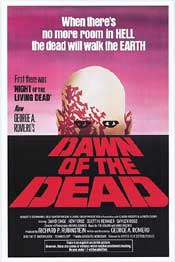
Dawn of the Dead PosterOver the next three days I am going to be publishing three different videos dealing with George Romero’s genius horror film Dawn of the Dead (1978). The first of the three (this post) is a six-minute, edited “argument” of scenes that I think frame the power and importance of this film as both horror and social/political commentary. The next post (take 2) will be my recorded commentary upon the edited argument presented here. And the final take will be a mashed up version of these clips. This is really just an experiment to trace how we might take various approaches to media for analysis, critique, and the creation of something new. Two recommendations for your viewing pleasure: be sure you have a pretty fast internet connection and use the full-screen option! Enjoy. Rather than pushing the h.264 codec for high resolution playback, seems like YouTube proves a bit more reliable across browsers and operating systems.
Posted in Formative 10, mashup, movies | Tagged , , , , , , , , | 4 Comments

10 ways to use UMW Blogs

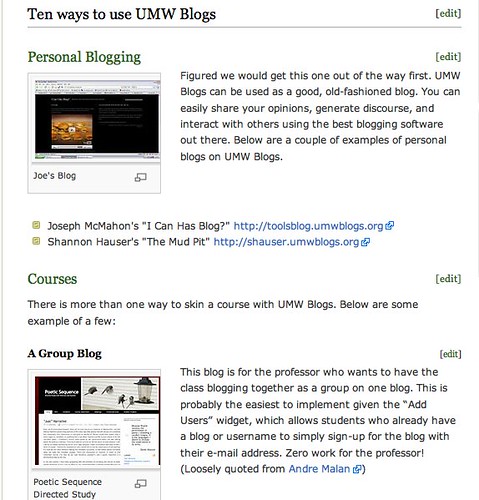
About two weeks ago I asked our kick ass student aids Joe and Shannon to start a wiki page outlining ten possible ways to use UMW Blogs. Soon after I went in and re-arranged, added, edited, etc. Last week DTLT’s newest ITS star for the Social Sciences, Michael Willits (who now gets a link back because he has finally announced he is moving off TypePad to WordPress 🙂 ), gave some feedback on the list in the wiki page.


Image of 10 ways to use UMW Blogs wiki page

So, given that the list won’t ever really be done, and in the interest of making it available sooner than later you can find the wiki page here, and keep in mind that it is open for anyone to edit. So, if you are inclined to comment, edit, add another example, or re-use the list, please do. I have borrowed liberally from Andre Malan’s post here when doing the course blogs section, and the general idea is based on James Farmer’s 10 ways to use your edublog to teach.
Here is a quick breakdown of the ten uses:

* 1 Ten ways to use UMW Blogs
o 1.1 Personal Blogging
o 1.2 Courses
+ 1.2.1 A Group Blog
+ 1.2.2 A Ghost Blog
+ 1.2.3 An Aggregated Course Blog
o 1.3 E-Portfolios
o 1.4 Websites
o 1.5 News
o 1.6 Collaboration
o 1.7 Publications
o 1.8 Multimedia
o 1.9 Creating New Web Applications
o 1.10 Presentations

Posted in UMW Blogs, wordpress multi-user, wpmu | Tagged , , | 2 Comments

Pickering Institute (ab)using WPMu; or what’s in a domain?

PI EduThis is kinda fun, the for-profit online college Pickering Institute is using WordPress Multi-User to spread the good word about consolidating student loans, Vegas deals, and domain parking. Now I have championed WordPress Multi-User for a while now because it is what I am comfortable with, and I find it can be pretty effective for creating an online community for teaching and learning. But I wasn’t imaginative enough to think about puttin one of these installations on a .edu domain at charging advertisers $50 a month “to reach an education-minded audience that is difficult to reach with mass-market blogs such as Blogger or Blogspot.”

Martha pointed me to this Chronicle article that reports on the incident and the subsequent concerns it rasies about the “abuse” of .edu domains. What’s interesting is, according to the Chronicle, “renting blog space on an .edu address may not violate the rules of the educational Internet domain, which is overseen by Educause.” (As a sidenote, I love that Harvard and Stanford blogs are the blogging systems on the Pickering Institute blogroll.)

What seems to be the concern is the threat to the legitimacy of the .edu domain such an instance poses. Yet, the larger question for me seems to be how much value should we invest in a domain in the first place. As Martha suggests, is it fair to assume that the .edu has the same “cachè” that  it once did? For this seems to be something that the Chronicle and others are assuming here. For example, UMW has  been hosting UMW Blogs on a .org for almost a year now, and well before that several departments had their own .org addresses using Bluehost accounts. I think people got over the fact that it wasn’t a .edu domain pretty quickly.

What’s in a domain? Does the .edu make it somehow more official? It seems absurd that the advertisers who signup for the Pickering Institute blogging service believe it will give them some kind of authority beyond perhaps a quick glance at the site. Maybe an incident like this will open up some questions about what makes one domain more reliable and authentic than another? I see that Canadian schools use the .ca domain, which seems to be far less restrictive than .edu, and it appears they seem to be making out all right. Which begs the largest question, could I host the bava on a .ca address despite my being a red-blooded American? What do you think, bavatuesdays.ca? If so, I could then compete with universities like ubc.ca or ucalgary.ca? Hmmm, there’s a project.

Posted in Uncategorized | Tagged , , , , , | 5 Comments

The Mist (2007)

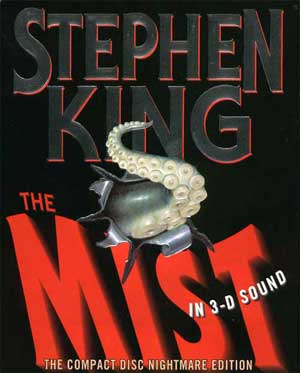
Mist BookI can’t resist a Stepehen King film adaptation, it is one of my great weaknesses and has accounted for many wasted hours in my life. I had already voiced my excitement about Frank Darabont’s film adaptation of Stephen King’s novella The Mist, which was a particularly special for me because it was one of my favorite King stories, which says a lot because I think he has written some great shorter stuff in the 70s and early 80s. So after seeing The Mist last week, I was planning on letting it go and sparing everyone but Anto my rant. At least until Scott Leslie’s comment here brought up an interesting trend in recent movies that is really beginning to annoy me, in directly providing the occasion to vent I was looking secretly looking for

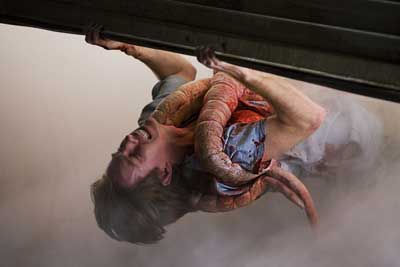
And while in the end I had major issues with the adaptation, the first hour and a half of the movie was pretty enjoyable. It was a relatively solid b-movie adaptation of the story with sub-par acting, under-developed characters, and a solid monster plot to make it engaging. I liked the scene in the back of the grocery store when the bag boy gets ripped apart by the horrific tentacled monster. I also enjoyed the whole idea of people hauntingly disappearing into the mist never to be seen again, or the huge bugs on the plate glass windows of the grocery store, or even the factions that emerge amongst the terrified refugees of the grocery store. And while underwhelmed by the scene where a band of heroes brave it to the pharmacy-cum-spider-lair next door to the grocery to get medicine for an injured compatriot, I still watched it greedily. All these scenes invoked the vivid pictures in my mind I had drawn twenty some-odd years ago when I first read the story (though by no means more powerful as Kubrick’s version of The Shining proved to be).

Mist tentacles

So what’s my problem and what the hell does Scott Leslie’s comment have to do with any of this? Good question, I’m getting to that. My problem is that the film was doing a pretty good job of knowing its limitations and reflecting a solid, but by no means great, b-quality adaptation of a very good pulp horror story. I wouldn’t write home about the adaptation, but I might have recommend it to like-minded maniacs. At least up and until the last five minutes of the film, which absolutely drove me crazy. If you are familiar with the novella, you might recall that King outlines some potential endings for this apocalyptic monster tale through his main character of his story:

But you mustn’t expect some neat conclusion. There is no And they escaped from the mist ino the good sunshine of a new day; or When we awoke the National Guard had finally arrived; or even the old standby: it was all a dream.

It is, I suppose, what my father always frowningly called “an Alfred Hitchcock ending,” by which he meant a conclusion in ambiguity that allowed the reader or viewer to make up his own mind about how things ended. My father had nothing but contempt for such stories, saying they were “cheap shots.” (pg 132 of the First edition of Skeleton Crew -which I own 🙂 )

And, in fact, that is how the story ends, in a certain amount of gray ambiguity, very much in line with the imaginative power of the story. The very questions of what happened with the Arrowhead Project to create such monstrosities, as well as the characters quick regression into fear and violence marked moments of strange uncertainty and troubling ambiguity that worked powerfully on my imagination decades ago. MistSo much so, that when I first read Benito Cereno in undergrad The Mist was the first story I thought about during Melville’s magical gray-filled opening garnished with the impenetrable fog weighing down on the reader like a dew-filled mist of uncertainty and misapprehension, all of which beautifully frames that underlying themes throughout the narrative. And while King is admittedly no Melville for descriptive power, allegory, and literary allusion, I do think the comparison marks a shared sense of craft between the two which values the powerful realm of the readers imagination.

Darabont’s version of The Mist goes explicitly out of its way to break this rule in an attempt to invoke the “hopeless horror that is life” for some cheap allegory about the current War in Iraq, a trend in Hollywood as of late. And because they need to fill up the special features on DVD nowadays, there are two versions of the ending available for this film —as if one wasn’t bad enough. They both suck, but the version they actually decided on makes my point that much clearer, take a look:

Original ending:

Alternate ending:

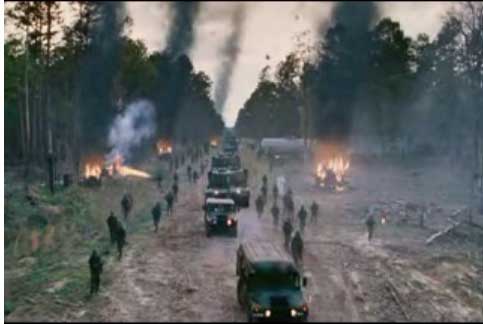
What both of these endings illustrate is the terrible realization on the part of the filmmaker that his confused political commentary—lacking all subtlety–has failed. And rather than writing it off as a lost cause given the lack of any art, the final scene becomes a hammer with which to assault the viewer with the message, in this case how much this story is in fact “an allegory” for the War in Iraq. The final minute features a wide shot of a war torn landscape, replete with Desert Storm Hummers, military transports for refugees, imposing tanks, flame throwers, all which tries to suggest what exactly? That the war in Iraq is horrible? Thanks for that obvious public service announcement! That the military lies and is bad? Hmmm, about as facile as saying they’re good and honest. That you, the viewer, are an idiot and need to be punched in the face with a point because they dislike you so vehemently? I guess the latter works best.

The ending scene of The Mist film

So not only does the original ending feature one of the most unnecessary moments of desperation that has the main character murdering everyone in the car because there “is no hope,” only to realize the National Guard has arrived and is gaining the upper hand in the war against the monsters. But it is all too late, right? He is a tragic figure that reflects the horror of our moment, right? But why? Why are these filmmakers, like with No Country for Old Men, so transfixed with the lack of hope and promise? Which finally brings me to Scott Leslie’s point in the comment that I’ll reproduce here:

I’m not arguing that it’s a film *about* the war in Iraq, but I had the distinct sense while watching the film that its makers were painfully aware of not just the war but larger global concerns, that its bleakness was, if not a reaction to, somehow influenced by.

The fact that these films are reacting with in the cultural moment, and our predominant filmic response is “all hope is lost” makes me kind of cringe, and wonder how much, for me, is what rings so cheap about both these films, though obviously different for their technical artistry, they each seem hollow as larger commentaries on our “historical moment.” They are too caught up in being relevant and timely, making them terribly forced and disingenuous. And this isn’t to say it hasn’t been done effectively in the past, just thing of films like High Noon, Dr. Strangelove, Night of the Living Dead, and the list goes on and on.

I prefer the ending of the actual story far more:

I’m going to bed now. But first I’m going to kiss my son and whisper two words in his ear. Against the dreams that might come, you know.

Two words that sound a lot alike.

One of them is Hartford.

The other is hope.

Posted in movies, Uncategorized | Tagged , , , , , , , , , , , | 4 Comments

Alien Pizza, a preliminary mashup

Image from Brian lamb's mashup article in Educause ReviewI just came across this beautiful, nutty video mashup on Sean Comerford’s blog titled “Alien Pizza.” Sean was in Carole Garmon’s Video Art seminar last semester and did some pretty amazing videos. This semester he is taking Italian 202 with the ever wonderful Antonella Dalla Torre who has introduced a final assignment that asks the class to take videos from the Internet Archive and mash them up into a two to three minute clip that creates a narrative featuring Italian dialogs they perform and record separately then dub onto the movies. Each of the mashups will also be subtitled with those dialogs in Italian so that the project incorporates both the oral and the written elements of the language.

Image of Internet Archive LogoThey just started the project on Monday, and from my brief time in the class today, they all seemed very excited about the possibilities afforded by the fusion of the Internet Archive and their unbounded imaginations. Sean is working with two others on the project, and I think “Alien Pizza” is just a mashup test run they threw together without the dubbed dialogs and/or voice over. I’m not sure if Sean is the sole author of this video, but I’ll try and clarify that shortly.

In the meantime, however, be sure to check out the thrilling results —I personally find them astounding. What I find so remarkable is that a mashup project like this demands focused attention not only to the details of the particular linguistic components of the assignment (oral, written, grammatical, etc.), but also to a more abstracted creativity, playful collage, and a strong command of both musical and visual narrative to achieve the desired effect. Integrating all these elements together seamlessly looks far easier than it really is, and making it look easy is often the tell tale sign of a carefully crafted narrative. Alien Pizza hits the mark on all these points, and must have been as fun to make as it is for me to watch. Enjoy a far out slice!

Download Alien Pizza

Posted in mashup, video | Tagged , , , , | 1 Comment

Viper’s Video Quicktags Plugin works with WPMu

I stopped using Viper’s Video Quicktags plugin a while back when I started playing in earnest with WPMu. Reason being is that this plugin didn’t really work well with WPMu last year at this time, and Anarchy Media Player was, and still is in many regards, alternative media player of choice for WPMu. However, I saw some yet undisclosed things today via Andy “I am video” Rush using the Viper’s Quick tags’ FLV player that made me want to test this plugin once again for WPMu 1.3.3. So I did, and guess what it? It worked fine, it even gave the YouTube, Google, and FLV icons in the visual editor, which was a long-standing issue as far as I could tell from the forums. So, I don;t think we will be getting rid of the Anarchy media Player anytime soon, but we may just have that many more options for playing media on UWM Blogs, but not until Mr. Rush blogs his findings (c’mon Andy!).

Posted in video, WordPress, wordpress multi-user, wpmu | Tagged , , , , | 4 Comments

The WP plugin I use the most

Image of Wikipedia IconI was thinking about this after publishing my last post, and without question I use one WordPress plugin far, far more than any other, namely the Wikipedia Link plugin by Andreas Krennmair. I has been a core plugin in my WordPress blogs for a relatively long time —I’d say about three years, or whenever WP 1.5 hit the internets. In all that time it hasn’t gone through any major overhauls because it is so beautifully simple. If you place any word or phrase within your posts or comments within two square brackets [ [Star Wars] ] (without the space between the brackets) it creates a direct link to the specified Wikipedia article. Now this may fail at times if a word or phrase has several articles that need some disambiguation, but it works a majority of the time for me.

We even played with this plugin a little bit at DTLT in order to see if we could have it link to articles (or even create new articles) within a MediaWiki install other than Wikipedia. All we did was change the base domain in the plugin from http://wikipedia.oreg/wiki/ to the domain of the other MediaWiki install, say http://jimgroom.org/bavawiki/ and it worked without a hitch. A very simple and powerful little plugin, one that I use so regularly that it has become such an integral part of my blogging that I don’t even think about it as a plugin, but rather a built in feature of the bava.

Posted in plugins, WordPress | Tagged , , , | 1 Comment