
Who the hell is Sol LeWitt? Some kinda artist or something? Anyway, Tom Woodward is cutting his teeth on some audio mashup goodness, for what I’m not sure—who is Sol LeWitt?—but I like the sounds of conceptual freedom.
Download Sol Lewitt
Who the hell is Sol LeWitt? Some kinda artist or something? Anyway, Tom Woodward is cutting his teeth on some audio mashup goodness, for what I’m not sure—who is Sol LeWitt?—but I like the sounds of conceptual freedom.
Download Sol Lewitt
My favorite Twilight Zone episode for the last six or seven years is “Stopover in a Quiet Town.” I think the whole idea of two people waking up after a bender in an abandoned town in which they discover everything is artificial—one gigantic prop—is one of the scariest ideas I can imagine. It is also a brilliant social commentary right up there with the 1978 Dawn of the Dead. For me it is also the perfect allegory for postmodern notions of simulacra and the very idea of living within a culture (or this case world) premised upon signs and conventions that are absolutely ludicrous when they are taken out of their original context. Also, it doesn’t hurt that Barry Nelson (a.k.a as Stuart Ullman from Kubrick’s The Shining) plays the lead masterfully—it’s as if you can almost here him waving awkwardly and saying “Goodbye girls!” on closing dayat the Overlook.
It’s a masterpiece of the highest order in my mind and if you haven’t seen it, you can now on YouTube—but act fast because it will be taken down soon if my history with Twilight Zone epsidoes on YouTube is any judge.
A funny thing happened to me when I found this episode on YouTube, I opened up all three episodes simultaneously in separate tabs to make sure they were all there (I was a bit excited and just wanted to be certain)—and as a result of my haste the soundtracks of each of the sections began to overlap and meld into one another. It was actually pretty amazing, the way in which the voices of the two characters in the episode talk over one another yet still keep some odd and very creepy symmetry. And what so cool about it is that it is arbitrary given the fact that someone cut the episode up to fit on YouTube—perhaps using the commercial breaks as cues—but it makes for one of the coolest, unintentionally overlaid audio files ever—what I am calling the “YouTabbed edition.” Don’t believe me? Well, then have a listen and tell me I’m not on to something.
Download “Stopover in a Quiet Town”–The YouTabbed Edition
Also, the latest Episode of the 1967 Spider-man arrived yesterday, featuring the Scorpion and Sandman—classic villains that any kid would love. I’m particularly impressed with Sandman’s phlegmatic evil and very cool super-villain abilities.
In September of 2007 Steve Stedman invited Patrick and I to UVA to talk about the work we were doing with WPMu and UMW Blogs. It was somewhat difficult to get folks to meet with us, and we really didn’t get a chance to frame out the work we were doing, although we did get a rather in-depth look at Collab (their installation of Sakai) which I blogged about here. It seemed apparent after this outing that Sakai was going to meet the needs of UVA, and while WPMu might be interesting—it just wasn’t robust enough for a larger, research university—despite Steve’s pleadings otherwise (he was a forward thinker, that Stedman 🙂 ).
What a difference a year and a half makes! This time around Sean McCord invited us to talk with David Germano, an associate professor of Tibetan and Buddhist Studies, and one of the movers and shakers on the Digital Humanities Initiative at UVA. Patrick and I showed up to a room full of about ten people from various programs: the Scholars Lab, the library, CIT, and Instructional Technology. It was a group of various people who were all interested in UMW Blogs. I was kind of surprised, I wasn’t actually expecting this kind of turn out, and I was pleasantly surprised that so many of these folks were excited about the work our faculty and students are doing through UMW Blogs. This group had a clear sense of the advantages of a lightweight, flexible system like WPMu, and were interested in innovating and moving quickly, and saw UMW as a model for this.
So, in less than a week UMW Blogs has been showcased at Duke University and the Univeristy of Virginia—how wild! It’s really cool to think that both Duke and the UVA might be playing with WPMu in an open and innovative fashion sometime very soon. This is exactly the logic I have been envisioning with this constant WPMu boosterism—Reseach 1 schools with deep pockets who have the money and people for development and high-profile projects that have the potential to give back to this open source community, as well as offering some credence to open source tools for innovating, sharing and building rich networks for teaching and learning—much like the University of British Columbia has done so brilliantly over the last year.
These developments also open up some unique opportunities for UMW to work creatively with schools like UVA and/or Duke. Why can’t classes between these institutions start sharing resources and collaborating in new and exciting ways. Using each others courses as resources, team-teaching, re-imagining discplinary connections, syndicating in work from another school for comment and feedback, and a million other ways I’m not smart enough to imagine. The thing is UMW is uniquely positioned to start re-thinking the way courses can be imagined and the work we are doing can be shared beyond the walls of the institution. We can start framing networked academic relationships that will certainly be the future of all this stuff. We are the “city on the edge of forever” and we should really be thinking strategically about not only sharing everything we know with any institution out there, but making inroads to bring the teaching and learning aspect of UMW Blogs to these other schools by promoting and recognizing the amazing work our faculty and students are doing there. Let’s face it, no other institution has such a large cadre of faculty and students that have been formally experimenting with this stuff for close to three or four years, and they work hard and are getting tired. They need to be recognized, rewarded, and encouraged so that we can continue to make the myths!
 I’ll be posting the video and some more commentary of the “Magic Trick Talk” I did last week at Duke when it’s available, although I’m a bit nervous about it because I am under the illusion the talk went well and I fear the video will burst my bubble. As I remember it, the talk was fun—at least for me—because I was particularly nervous about it before hand, yet when the time came I found the whole thing just flowed in some odd way. It was disjointed, at times anecdotal, at times technical, at times silly, at times a serious plea for “doing good,” nonetheless it somehow seemed to connect in my mind, although I may be very, very wrong about that. And while I was planning on doing a write-up of the talk, Lauren Pressley of Wake Forest University did a far better job than I ever could with both the CIT Conference as a whole as well as the talk I gave—thank you Lauren! You can see the presentation site/magic trick blog I created here.
I have to say that Duke is quite a place to visit, the campus is phenomenal and the services there are top notch. The new learning space in the basement of the Duke Library, The Link, was one of the coolest things I have seen in a long while. People buzzing around, talking, sharing, writing on walls, eating, drinking, and generally learning in a bizarre-style fashion that challenges the cult of silence and production line studying in cubicles that has for far too long dominated our understanding of “learning.” I could live in The Link—I love chaotic spaces, and finally could see first hand the allure of the whole learning spaces push.
The faculty presentations I caught illustrated that a solid cadre of folks are experimenting with a wide range of web-based tools and resources in the classroom. In fact, Victoria Szabo’s students spent the semester designing a toolkit of web-based applications to support a fascinating mapping project in Muhuru Bay, Kenya—although mapping and Africa always makes me think of Conrad’s The Heart of Darkness and the great unchartered darkness that only we can not see from here.
In particular, I would like to thank Shawn Miller who I think was responsible for getting me the gig, and hanging out with him was a treat—he’s an instructional technologist who sees all this stuff so clearly and is a tremendous asset for the Duke academic community at large. It was also a real pleasure to catch up with Tim Bounds (did the ‘Canes win?), a fellow twitterer, who I finally got to meet and hang out with. I’m particularly interested in how a Duke WPMu space might bring the work of folks like Shawn (on the academic side) and Tim (on the student affairs side) together in some interesting ways, for nothing has been more apparent on UMW Blogs than just how much the distinctions between academics and student life blurs. I imagine seeing this might be that much easier with an open and accessible publishing platform for the Duke community.
Finally, special thanks to the assistant director of the Center of Instructional Technology Amy Campbell for making my stay and presentation go so smoothly, and Lynne O’Brien for bringing together an event that enables a necessary discourse around imagining and opening up new ways for sharing and accessing the life of the mind at Duke.
Image credit: Lauren Pressley’s James Groom, Magician
Sometime in November or December of this past year Serena told be that there was a core, underground group of Bryan Alexander fans here at UMW. It doesn’t entirely surprise me given I’m one myself, but I found that the attraction to the internet’s favorite mountain-dwelling goth was not necessarily about his blog (which is my favorite), but rather his tweets. In fact, when we were at the ELI conference in January of this year Serena decided to develop a WordPress plugin dedicated to Bryan Alexander’s tweets, and she has been sporting it on her blog for a while now.
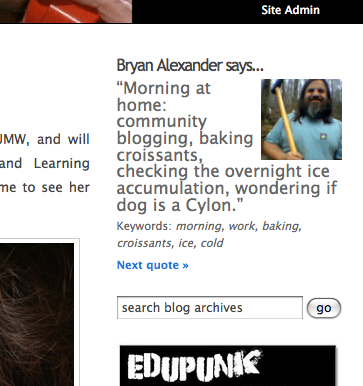
But it was until this afternoon that she finally gave me the code she has been guarding jealously for months, so that the bava too can show its appreciation of everyone’s favorite backwoods vampire hunter. I’m trying to hack the code a little more so that the quotes from Bryan’s twitter stream come pre-populated in the plugin, and if I get Serena’s (And Bryan’s) approval-this will be UMW Blogs’ first home-grown plugin available to the entire communtiy. It just seems so appropriate to me to honor a patron anti-saint and further accentuate that this technology is all about people 🙂
In less than a week’s time Serena Epstein will be graduating from UMW, and will therefore no longer be working for the Division of Teaching and Learning Technologies. And even though we fight like cats and dogs, it pains me to see her leave for it will be a huge loss for us.

Serena whipped through her undergraduate career in three short years, and during that time she might have amassed one of the most awe-inspiring portfolios of the web-based work she has done for more than 10 different classes at UMW.
Just this afternoon one of her professors, Judith Parker, was raving about a recent presentation she did, through which I got introduced to yet another masterpiece by Serena I was unaware of. Serena, along with her classmate Brian Thaler, did a Prezi presentation on visual interaction for her Lingusitics course that is nothing short of mind blowing.
Don’t get me wrong, I’m not one of those fickle zombies that fawns over every slick tool that comes around. On the contrary, I’m a rather loyal WordPress zombie. Nonetheless, their presentation with Prezi is so intelligently imagined and executed that I came away re-thinking that tool. The presentation became the canvas upon which they painted their way through the topic of visual interaction, and in this example the medium was the message in every sense of that concept. Hats off to Serena and Brian for both imagining and executing this fact so brilliantly. Nothing like having faculty raving about these new fangled web 2.0 tools after the students rock their world! Check out their presentation blog, and be sure to feast your eyes on the Prezi here (or above if the iframe worked).
What struck me is that along with faculty like Gardner Campbell, Anand Rao, Mara Scanlon, Claudia Emerson, Susan Fernsebner, Jeff McClurken, Steve Greenlaw, and so many more here at UMW, our community is cultivating some pretty amazing students and projects—what’s more is that DTLT is an integral part of that reality. Serena is in many ways our first graduate (Joe McMahon notwithstanding who is a network geek and is back at UMW already 😉 ), and I’d put her up against any instructional technologist out there pound-for-pound—she’s visually amazing, creative, hard working, and can design like there is no tomorrow. More than that, she conceptually gets all the work we are doing and is building upon it, from the Semantic web to syndication to small pieces loosely joined.
So, this is my call out to the edtech world, if you are looking for a creative person to join your crew, I have no doubt she will blow your mind and be an invaluable addition to any group–if you were smart you would do everything you could to hire Serena (if she’ll take you). It seems almost ridiculous that DTLT is losing her, and I still think we need to talk to the higher-ups and free up some money, but I have no power save the bava—so here is my plea to keep Serena out of the Peace Corps (what kinda hippie, imperial nonsense is that?) and in a field where she can further build and hone her creative genius. Check out her portfolio, and get in touch with her—she’s ready to spread the good word of UMW Blogs to institutions far and wide—and she comes DTLT approved.
The fearless Anand Rao just tweeted a link to two Public Service Announcements from 1976 about the Swine Flu (via the Daily Beast). They are pretty awesome, the 70s aesthetic is absolutely one of my favorites of all time. I spent the whole minute and a half waiting for the zombies from Romero’s Dawn of the Dead to bust out and start giving people the Swine Flu.
Yet another Spider-man, and this episode is a 2-for-1 with two shorter episodes featuring the Vulture and Spencer Smythe. The real joy of these episodes are the villians, in fact it is through their names that my son remembers each episode.
In doing some surface research on the villains, I found it interesting that what is considered Spider-man’s greatest weakness is that he refuses to use his powers for profit—I guess that’s what makes him a my favorite super-hero these days. But more on the villains, the Vulture is an older villain who created a harness which both allows him to fly and gives him super-human strength. I particularly dig him because he is extra-ornery, and calls Spider-man a “boorish boob” and “webhead” (kind of like Electro always calling him a loser). He also has a moment when he gets his $2 million in ransom and says “And my mother thought I would never amount to anything!” I don’t know, there is something beautifully pathetic about the Vulture.
But it is actually the second part of this episode that has me most intrigued. In this episode the inventor Spencer Smythe approaches J. Jonah Jameson with a remotely-controlled robot that can track and capture Spider-man, moreover it can actually reproduce the talking visage of Jameson on its TV-like faceplate.
What’s cool about this is that the remote control console for the robot actually looks and plays like a video game, which seems kind of wild for 1967. What convinces me about the video game vision is that it employs an impossible technological point-of-view. Jameson and Smythe watch the robot capture Spider-man on the remote console screen from a perspective that would be technically impossible because the screen shows both the robot and Spider-man from afar, how can that be? It would actually depend on all kinds of satellite imaging for this kind of shot to be represented on their console, yet what it does suggest is an early Spider-man video game played by Jameson. It may just be video game obsessing or a really bad over-reading (I fully understand I’m splitting hairs about technical possibilities within broader reality of a terribly animated cartoon that has spider-tracking robots with octopus like arms—but I can’t help it). Anyway, it kinda tripped me out. Take a look at an edited clip featuring Jameson playing the remote-controlled unit:

Find out more about me here.