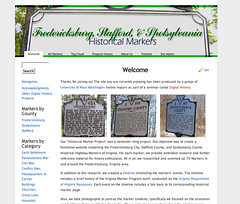
Forgive me for the re-publishing, but I just wanted to bring my page from the ELI 2009 presentation into the bava in an ongoing effort to build my personal brand and leverage my innumerable distributed online efficiencies and sweat equity while building a global micro-brand. Thanks for your patronage, please come back soon!
–The Management.
I. Blog: “You keep saying that word, but I don’t think it means what you think it means….”
 What if we didn’t understand what we do in education with blogs as “blogging” but as a quick and easy way to publish online within a learning community? Or a place to feature a portfolio of students’ best work? Or a site where professors and staff track their professional and personal development? What if we understood “campus blogging initiatives” as a community publishing platform to share, learn, and integrate various resources from around the Web into a more specific community?
[youtube=http://www.youtube.com/watch?v=G2y8Sx4B2Sk&hl=en&fs=1]
Then what does it mean?
We need an alternative means of conceptualizing how university networks might approach supporting teaching and learning technologies by designing their online publishing systems around an RSS-rich aggregation system of open syndication, rather than closed repositories and Learning Management Systems (LMS) that seldom, if ever, allow or enable communication outside the walls of the course. More specifically, below are some examples of how the University of Mary Washington has used WordPress Multi-User to build an enterprise-level educational publishing platform, which has fundamentally transformed the online component of teaching and learning beyond the tools of the standard LMS.
II. It’s Really Simple, use Syndication
 One of the most exciting and important elements of mashing together a web-based publishing platform is that with the right technology it quickly becomes a powerful, open, and lightweight syndication hub. What this basically means is that every author on UMW Blogs is able to create their own space in seconds, and then quickly and easily syndicate it out to a series of other sites. You can think of the course blogs as an aggregation of specifically tagged feeds from student blogs that populate a course space, but still allow students to keep control over their own work which they own, and can export and take with them as they see fit. Kind of an aggregation of individualized digital notebooks, portfolios, or what have you that can be transferred between spaces quickly and easily, allowing a wide-range of publishing and mobile possibilities.
Moreover, the idea of a syndication bus like this allows anyone within the UMW community to publish from whatever service they want. In other words, their blog need not be on UMW Blogs, but can be part their own publishing space on WordPress.com, Blogger, Typepad, etc., or even a self hosted publishing application like Drupal or WordPress—more to the point, anything with a feed can be re-published within the UMW Blogs environment seamlessly.
Take for example a student at UMW, Serena Epstein, who recently bought a domain and web-hosting space for less than 10 bucks a month and transferred all the work she has done over the last three years at UMW into her own space which has been transformed into a very attractive portfolio.
How do we do this?
We do this with WordPress Multi-User, using a few key plugin for aggregation, syndication, and sitewide tags:
- FeedWordPress: This is a plugin which republishes feeds from just about anything with RSS. This plugin has been key to creating the syndication hub, and with Andre Malan’s Add Link widget (linked to below), we can now place a field in the sidebar so that authorized users can simply add the URL of their site to a course blog now matter where they publish from.
- Sitewide Tag Pages Plugin: This plugin creates an über-blog that brings in all the posts (along with tags, categories, etc.), which allows you create tag or category feeds across the entire environment. This plugin enables the tag and category based feeds which allow individuals to syndicate out selected posts from their own publishing space while leaving others untouched.
- Add Link This widget allows you to place a text field in the sidebar so that a feed URL can immediately be added to any blog (which can be hosted anywhere). Think of it as self-service feed addition, taking the labor out of setting up the aggregation.
- Add User: This widget, again by Andre Malan, allows users you have a username on UMW Blogs can add themselves to any blog as an author that has this widget activated. Think if it as self-service author addition, taking the labor out of setting up the space.
III. Some course examples at UMW:
-
Literary Journals
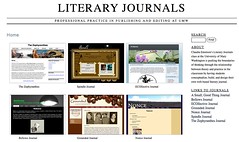 Claudia Emerson’s Literary Journals course (which is three years in the running this Spring) will dovetail with her new role as Poet Laureate of Virginia. The class will not only create a series of literary journals from scratch, they will also record interviews with poets from around the state and publish them on the course website. A collaborative process that create a unique resource for all Virginians, and well beyond given it will be openly published on UMW Blogs (although the domain we just got may suggest otherwise: http://virginiaisforpoetry.org). And despite the intense workload of this course, it remains one of the department’s most popular because it engages “today’s learner” by providing them the means to both analyze, collaborate, and create simultaneously.
Listen/watch Claudia Emerson discuss the impact of this course (which is now part of the Creative Writing curriculum) in the video here or below:
[youtube=http://www.youtube.com/watch?v=f-7jHgWfwE8&hl=en&fs=1]
-
Eighteenth-Century Audio
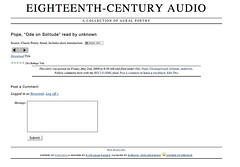 Professor Marie McAllister’s Eighteenth Century Audio site was a conception for podcasting. But given the possibilities available through UMW Blogs it became much more. The students both collected and aggregated audio of eighteenth-century poetry readings from around the web, as well as recorded their own interpretations and published them online in the public domain. Their work remains an frequently visited online resource, and has even inspired a group at LibriVox to create an anthology of 18th Century poetry, which is currently well under way.
-
Lablogs
 One of the biggest experiments on UMW Blogs is Steve Gallik’s Cell Biology Lablogs. Prof Gallik designed an entire suite of online laboratory resources wherein students can record the results of their experiments in what he terms an Online Laboratory Suite. Well, if that’s not impressive enough, Andy Rush and Steve Gallik have conceptualized a way to take the experiment results for each student and create and RSS feed for it (Steve once again did all the programming). Now, let’s think about this -we have students with online labs that have both an HTML version and an XML version that is RSS ready and that can easily append every new experiment to the XML file. Do we have any technology that may be able to publish the individual students labs automatically on some kind of digital space that is their very own and that they can do whatever they see fit with it? UMW Blogs, baby! More specifically, we have UMW Lablogs.
-
Venice Exhibit
 Professor Marjorie Och’s online exhibit featuring the impact of art in the history of Venice was the culminating project of this upper-level Art History seminar on Venice. During the Fall, 2008 semester professor Och and her seminar students dedicated themselves to researching the rich art history of the “City of Water”, and tracked their research and discussion over the fifteen week semester in a designated course space. At the end of the semester they transformed their research into a site which acts as both an exhibit and a course publication wherein you can read first hand the work they have been doing on topics ranging from Titian’s Altarpieces to Early Modern Women’s Clothing to Conserving Venice to the Venice Biennale. But the homepage of the online exhibit sums it up best:
This site offers visitors the opportunity to see our students’ research on this remarkable city in a format we have referred to as our online exhibit. An actual exhibit on the city of Venice is clearly impossible — one could never transport the Grand Canal or Palazzo Ducale into a museum space. But technology allows us to bring together different aspects of the city, its visual culture, and history in a format where we can discuss the great palazzi along the Grand Canal or the magnificent space in front of San Marco.
10 Ways to Use UMW Blogs
This is a resource we created at UMW to suggest the myriad possibilities for using blogs in ways that re-conceptualize the often limited connotations associated with blogs. Link.
And you can find many more examples can be found in this list of links featuring a wide range of course sites that have used UMW Blogs for a number of interesting projects that don’t necessarily fall under our more traditional understanding of blogging: http://delicious.com/tag/wpcoursesites
IV. Radical Re-Use:
[youtube=http://www.youtube.com/watch?v=8DHdUkkiIWE&hl=en&fs=1]
Hey, wait just a minute! Sharing isn’t just limited to course materials, syllabi, and other educational “objects”? We can also share platforms? That’s right, honcho, with these new fangled open source tools many possibilities become available that you could only dream of in your paltry FUD philosophy
 For example, UMW Blogs recently setup Longwood University with their own blogging platform within minutes by simply using the Multi-Site Manager plugin and mapping an additional domain on the WPMu blogging system we currently have running. This way, Longwood can benefit from what UMW has done and save money on server infrastructure and the like, and focus on thinking through the practical implications of such a system on teaching and learning within their community.
 And, UMW has also reached out to a local high school, Fredericksburg Academy, to give them the core plugins, themes, and overall setup (along with documentation, etc) to quickly create their own publishing platform, Fredericskburg Academy Blogs, for the low, low cost of 8 bucks a month. That is solution one can warm up too in these cold economic times 🙂




 Well, there are many meanings for the term bava, so it might be useful to go through them briefly:
 In the
 However, I think the term bava is probably best known in the Western world as the last name for the Italian filmmaker