Bava does S&M

I watched Mario Bava’s The Whip and the Body (1963) last night, and I found it rather provocative, or should I say evocative? 🙂 I hadn’t yet seen this “lost classic” of Bava’s, and I finally talked Antonella into watching it with me, which was no small feat. We were ready for an over-the-top sadomasochistic free-for-all, especially given the description on the Netflix DVD sleeve (which is one of my favorites so far):

Sumptuously twisted imagery, gorgeously surreal colors and fever-pitch emotions are all clues that Italian horror maestro Mario Bava is behind this cult classic that finds Christopher Lee playing a 19th-century aristocrat shunned because of his sadistic sexual appetites. But no sooner does he return to his ancestral home than he turns up dead. His kinky spirit lives on, however — and comes back to punish his betrayer.

The clues referred to in the description above reference the fact that Bava is not listed as the director for this film in the credits, rather he was credited under the pseudonym John M. Old (which if you search on Wikipedia re-directs to Mario Bava’s page—pretty sneaky). What was remarkable about The Whip and the Body was how subtle this film is in so many respects. And while there is at least one scene that is outright radical—and genius—in regards to visualizing sadomasochism, which I’ll discuss shortly, the majority of the film is a study in psychological compulsions by means of lighting. In fact, I would argue the most radical part of this movie is the fact that it elevates a taboo as great as sadomasochism to the level of a compelling phantasmagoric love story.

But, I would be remiss if I didn’t take a moment to talk about the film’s most memorable S&M moment wherein the sadistic baron Kurt Menliff (Christopher Lee) seduces, by-way-of-whip, his cousin Nevenka (played by Daliah Lavi who is a dead-ringer for Barbara Steele from Black Sunday). The scene is outlandish in so many regards–I particualrly like the music) but an analysis I read by Lindsey Hallam really hits the mark, she notes that “the film was ahead of its time, with its portrayal of a woman’s immersion into a world of sadomasochistic fantasy, four years before Buñuel’s own Belle de jour” (and here’s a great scene from Bunuel’s masterpiece). This really puts the film in perspective for me, and framing such a charged theme within a b-movie horror film is in many ways genius—and makes the following beach scene wherein Christopher Lee’s classic line “You always loved violence” interrupts a brutal scene that is at once evocative and kitsch.

And while that scene will remain one of my all-time favorites from the Bava oeuvre, I found myself even more compelled by the lighting in a series of scenes that follow this one. After the Baron is mysteriously killed, his ghost returns to haunt Nevenka, and it is in moments like this that Bava brings Nevenka’s simultaneous compulsion and revulsion for sexualized violence into sharp focus with some wonderful acting, an acute camera, and genius lighting. Take for example the scene wherein Nevenka hears a mysterious cracking of the whip shortly after Kurt Menliff was murdered. As Ed Gonzalez notes in this 2001 review for Slant Magazine, “Passageways are downright vaginal,” and the following scene offers an excellent display of this fact. But more than that, take a look at the lighting of Nevenka’s face as she moves from the lying on the bed room to gliding through the hallway, a scene which beautifully captures her oscillation between revulsion and compulsion for the sound of the cracking whip.

And then there is the actual settings and art design on the scene that move so seamlessly into the shots. Check out the following transition of sequences from a model mausoleum outside the window to a painted night sky with reflecting light to a magical shot of Nevenka’s eyes pronounced through an inverted mask of darkness. The shot of here eyes is absolutely amazing, and reminds me of of my favorite shot from another Bava classic The Girl Who Knew Too Much, which was made the same year.

Screenshot from the Woman Who Knew Too Much

Screenshot from the Woman Who Knew Too Much

At the same time, notice how steadily the camera follows the sound of the ghostly footsteps through the camera, which are in many ways perfectly sutured with those brilliantly framed eyes.

I mean, come on, that is such a supple and subtle vision of horror, and it is all done with smart camera work and some really intelligent use of colored lighting. But, even beyond the lighting and the shots, there remains throughout the film a surprisingly compassionate focus on the love relationship between Kurt Menliff and Nevenka. The last scene of the movie really highlighted this fact for me when the final meeting and embrace between Nevenka and the ghost of Kurt Menliff is far more gentle than anything that comes before it in the film—-well, at least until Nevenka kills herself. It’s one of the few scenes where the Baron is not completely ominously sadistic. It’s an odd thing for me to come away from a film that is so explicitly examining Sadomasichism in a rather kitschy manner to actually get the feeling that what I have been watching was more a love story than a horror film. I guess I can chalk it up to the beautiful bizarreness of Bava at the top of his game but aesthetically and thematically.
Posted in bavapick, film, movies | Tagged , , , , , , , , , , , , , | 3 Comments

“I’m the Reverend”

I have been returning to reading and commenting on a wide range of UMW Blogs with a vengeance today.  I have fallen woefully behind because the beginning of this semester has been longer than most, and I am just emerging from a pile of work–although I  still have a few loose ends to tie up.

That said, it’s always awesome to return to UMW Blogs and read and comment wildly on the work going on in this space.  Not only is it amazing to me how quickly I can discover all the cool things happening, but I’m convinced it makes all the difference for the folks out there writing. Not only do comments rule, but those who receive them quickly realize the work they are doing is not composed within a vacuum—an idea so many of us have to unlearn after being forced into the ugly world of course-grinding applications like BlackBoard. The Cogdog understands the importance of this all too well, and today marks his annual week long sabbatical from blogging to comment on the work of others— a practice which continues to inspire me.

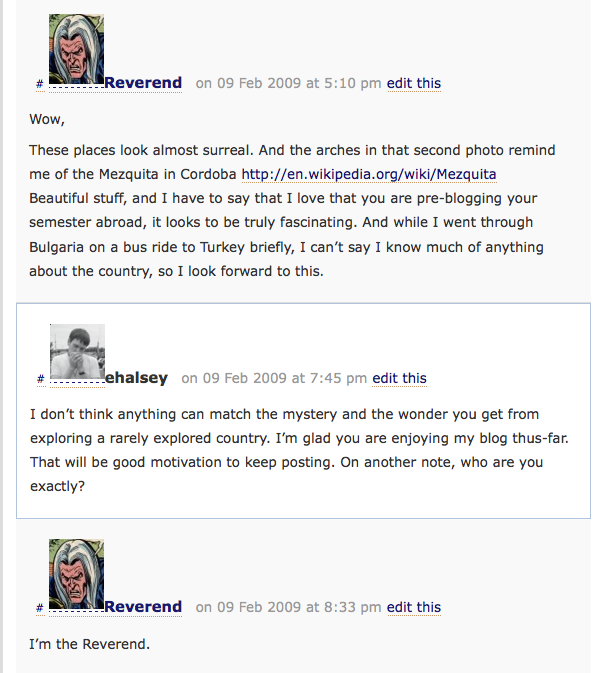
So, that said, here are a couple of comment conversations I had today with some folks around UMW Blogs. The first is from the “An American in Bulgaria” blog which is going to be the online home for Eric Halsey’s study abroad in Bulgaria.  He has done something really cool already and he’s not even in Bulgaria yet. He’s actually blogging all the places he wants to go, and including some unbelievable images of the countryside and sites he wants to see. It makes me want to go with him.  I commented to that effect, and his response was great–not only had he been wondering if anyone was reading, but he also was wondering who the hell I was.  So….I told him 🙂

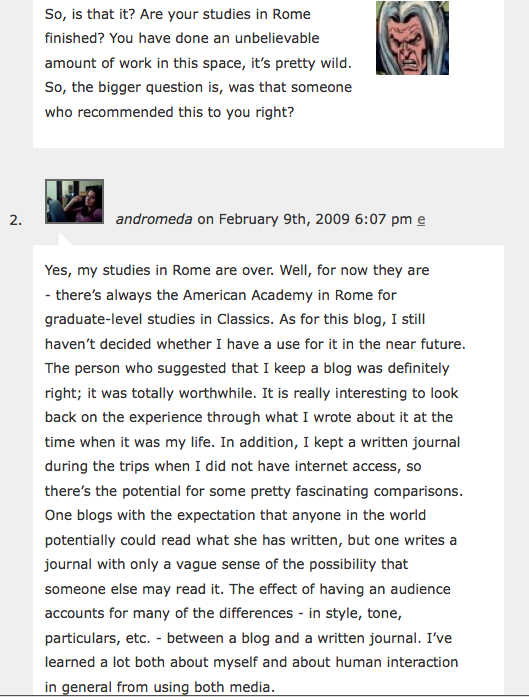
The other comment was for Andromeda’s “Close Enough to Walk Away” blog. She is a student in the Classics department that has been brilliantly blogging her study abroad in Rome over the last six months, and—as her tagline suggests—she is just one of several Mary Washingtonians putting the class in Classics (though she does it with online style!). She recently finished her study abroad, and for all I know may even be stateside by now. I saw her final post from ac ouple of weeks back earlier today, and felt compelled to comment because while I read her work along the way I didn’t comment nearly as much as I normally would under different circumstances. In fact, my comment today was rather generic, but her response nails the reflective spirit of her blog more generally. I highly recommend you read her thinking through the differences between her blog posts and her written journal. God, it is so cool to see this kind of thinking out there.

Blogging ain’t dead, baby, it’s only just begun!

Posted in UMW Blogs | Tagged , | 7 Comments

How not to monetize WPMu

Stephen Downes linked to a post recently by James Farmer discussing how he successfully monetized WPMu through Edublogs. And while the post might be an interesting read of trial and error for those who want to monetize WPMu, one of the things that is ellided is how Edublogs practically forced non-paying customers to upgrade by including some of the most god awful ads as content links you’ll ever see. And while there was an attempt to downplay this by pointing people to a forum post about this very issue months before the random content links were rolled out in earnest, the fact remains it seemed pretty underhanded. And while the terms of service allow for such a sudden shift and yadda yadda yadda, the relationship Farmer defined with the educational community was one who was giving back—and there is no question he has done this extensively on many accounts and I, for one, have benefited from it.

In fact, I have no issue with his charging folks for a service like Edublogs, it has been a solid mainstay for the educational blogging community, and what Farmer and his crew have done with WPMu is impressive to say the least. Moreover, I completely understand that he is a businessman, and while I really don’t find monetizing the web that interesting, I’m acutely aware many of us have “families to feed.” Regardless, I wasn’t too crazy about the way inline ads went down. If, as a for-profit business, you are gonna go this route being above board and transparent about the whole thing would have gone a long way. I mean Edublogs announces everything from when they release a new theme to each time the Edublogs crew changes their underwear, you’d think such a drastic change in policy would get at least a little bit more press. But, there were no email announcements and not posts on the main Edublogs site until the new monetizing plan was worked out. But, to be fair, there was a forum post about the topic months before the ads were rolled out in earnest, but that is different then a more general, global announcement that inline ads would become a means of creating a revenue stream that Edublogs would be relying more heavily upon.

edublogs ads

Amazingly, to the Edublogs crew’s credit, they seemed to have found their way through a potentially dangerous decision relatively unscarred, even though the inline ads are still being served as far as I can tell (the image above was taken yesterday). And while bloggers like Chris Sessums and Steve O’Connor (to name just a couple) have already raised a number of valid concerns and questions far better than I ever could, there was no response from the Edublogs staff. But hey, let bygones be bygones, we all know the Edulogs crew need to get paid for their work because maintaining over 250,000 blogs that people have signed up for free-of-charge costs money and in these tough economic times money isn’t easy to come by. So, while I didn’t care for how they rolled out ads on Edublogs, I held my tongue for a bit because I wanted to see where all of it would go.

Well, as I mentioned already, two days ago Farmer posted his “How to Monetize WPMu” post which chronicles the trials and tribulations of Edublogs to turn a profit, a narrative in the tradition of one of those entrepreneurial fables that undergirds the great men and women of business theories. I found it irksomely self-promotional, but I’m guilty of that very thing—I just don’t make any money off of it— so I had to chalk it up to style and posturing. However, a follow-up post by Farmer referencing a comment by Matt Mullenweg on the original post caught my attention. And opened up yet another dimension of this whole story which might in many ways get to the root of the larger problems I have with monetizing WPMu when it is at odds with the basic values of an open source community, and this is at the heart of the tension where many of my own deep-seated concerns about monetizing an application like WPMu really boils to the surface. It brings back memories of almost a year ago when I announced that UMW had paid $50 for a plugin to get feeds off of sitewide tags that Downes called us out for paying for free software. Now, I understand that charging for a  service like Edublogs is different than charging for plugins based on GPL code, and to quote Downes in the comments on the OL Daily post about our $50 purchase when referring to the plugin developer who sold us the code:

I’d have more respect for him if he developed his own system and charged $50 for it.

Instead, he just rides on the backs on the many developers who have made WordPress a great *free* resource – what makes him so special, he’s the only one who gets $50 for the work.

And the point of my pointing to my own code is to trivialize his accomplishment – what he did isn’t such a great advance, it’s no fantastic thing so special it deserves the cash that nobody else gets.

Couldn’t that “instead he just rides on the backs of the many developers who have made WordPress a great and *free* resource” also apply to the WPMUDEV Premium service that James Farmer and Andrew Billets run? What makes them so special? Is it the capitalist narrative? The idea of being first? Isn’t the GPL the logic behind a social contract for sharing work freely that makes the very existence of Edublogs possible? I don’t know much about licenses and legal stuff, but Matt Mullenweg raises a concern about re-selling plugins in his comment response to Farmer’s post on monetizing WPMu that is worth reproducing here:

Long story short, it’s fine to sell things, including exactly what you’re doing on the site today, but insofar as the code links or uses any core WP functions it should also be GPL licensed.

Our CSS editing feature is not distributed to any third-parties, so it doesn’t need to be GPL any more than a wp-config.php file does, but no one has every asked me for it before and and if you want it we could take a few hours to clean it up for release.

The idea behind the GPL license seems to be if you are developing and selling code that uses core WP functions or hooks it should be freely available after you have gotten paid for your time and effort. So, re-selling code like they do on WPMUDEV Premium seems to be in violation of the GPL license. And this is where the whole monetization thing gets a bit questionable for me. At least one of the WPMUDev Premium scripts have been crucial to the work we have done with UMW Blogs—the Multi-DB feature—and it was well worth the money for us to get this code. Yet, do we run some real risks by re-selling code that was built on the backs of an open source community?—the greastest virtue of which is that this stuff is freely re-distributed for anyone to use and profit from as long as they are compliant with the GPL license—which basically boils down to acknowledging the work you have done is an extension of a larger community and that the individual narratives for monetizing this stuff should at the very least recognize this fact and act accordingly. What would happen if everyone started monetizing their WordPress plugins, code, and themes?  Well, that would be the death of this amazing experiment, and I think this is the worst possible model for monetizing WPMu—so perhaps we need to think twice before we celebrate the values of monetizing free software until we are sure the ways in which it is being done will ensure its survival as a “great *free* resource.”

Posted in Uncategorized | 8 Comments

EdTechRoundup: Student Blogging and WPMu

edtechroundupThis past Sunday I had the good fortune to be invited as part of a podcast to discuss using WPMu in educational institutions with a great group of educators primarily based in the UK.  It was a fun discussion, and I really liked hearing about the particular uses and challenges of blogging in the K-12 environment.  I keep meaning to open up a discussion between higher ed and K-12 with my favorite guy Tom Woodward in the form of a podcast, joint blog, or what have you, because I’m far too caught up in thinking about this stuff for universities and colleges. I seldom stop and think about the far more difficult and crucial battles that are happening in primary and secondary schools all over the world where the fear quotient and concerns about privacy open up a far greater series of difficulties.

For my small part in the podcast, I think I was the weak link because I could only focus on my obsession with plugins and syndication hubs, but the rest of the folks picked up the slack beautifully and tolerated my non sequiturs gracefully. In fact, the beauty of this group is that they refused to get caught up in the logic of the tool for its own sake, rather they spent a solid portion of the show thinking through and sharing examples of the ways in which blogs are being used in the classroom and the unique challenges and opportunities they present educators and students alike. Thanks go to Doug Belshaw for being a gracious host,  Dai Barnes for inviting me along, and Andrea R for recommending me as an “expert” on WPMu in education, which I’m afraid is an overstatement—I’m more like a diletante with attitude.

[cetsEmbedRSS id=’http://feeds.delicious.com/v2/rss/jgroom/edtechroundup?count=15′ itemcount=’1′ itemcontent=’1′]

Posted in wordpress multi-user, wpmu | Tagged , , , , , , , , , , | 2 Comments

UMW Blogs wants you!

I wrote a post over at UMW Blogs that introduces a new feature allowing anyone at UMW to highlight a post or blog from around the community. I tried this over a year ago, but it was on a blog other than the homepage, and I don’t think enough people really saw or understood the idea yet (which still may prove true).

But now, given the Add User widget is such a layup, it is simple for anyone within the UMW community to signup as a contributor and feature a post. And once they do (or should I say “if they do”), their posts will immediately queue up and after a quick review be published to the front page, think of this last feature as a built in safety valve. One which will also help me catch any shameless self-promoters, because I reserve that right for myself alone on UMW Blogs 🙂 But the real push behind this is that there is so much stuff being published on UMW Blogs, that we really need some mechanisms to start making the great work people are finding more visible to the community at large, and I guess this is one simple way at it amongst many.  No one could possibly read everything at this rate, but many of us easily could, and by sharing our favorites we might introduce a whole different layer of interaction and encouragement through such a framework.

Special thanks to Serena Epstein for the photoshopping.

Posted in UMW Blogs | Tagged , , , , | 3 Comments

The revolution will be a bus

Image of a Revolution Bus
Revolution by Lawrence Whittemore

Every generation needs a new revolution.
Thomas Jefferson

What blogging brought to the table, in addition to the liberating power of personal publishing, was a new take on the venerable publish/subscribe pattern, expressed now in terms of the familiar metaphor of news syndication. In any version of the new Internet OS, syndication-oriented architecture would have to play a crucial role.
Jon Udell “What is an internet Operating System”

At the heart of any transfer of power there must be a concomitant shift in the distribution of information. Moreover, for such a shift to be sustained, an individual’s ability to access, manipulate, and interact with information must remain easy, open and free. Our generation’s revolution can be characterized by the “liberating power of personal publishing,” and it is the architecture underlying this transformation which is germane to tracing the decentralized, multitudinous vectors of fragmented power, ownership, and control that the new model affords. Syndication must be understood simultaneously as a digitally networked dispersion of conversation, as well as an idiosyncratically aggregated diaspora of data. And it is the re-constitution of variegated voices which offers the means to easily circumvent centrally organized, unilateral vacuum-tubes of distribution.

The revolution will not be televised, it will be syndicated!


Rohit Khare’s conception of syndication-oriented architecture helps us frame the implications of this revolution. We no longer need to build massive repositories to warehouse learning objects, rather we should be “RSSifying everything in sight, then flow all the feeds through a ‘syndication bus’.” Applications like Facebook have already brought this architecture mainstream through a feed-driven framework, yet it has done so at the cost of mining people’s personal data and forcing them to surrender certain rights over their work.

Syndication buses need to be open, free, and public hubs of aggregation that allow both individuals and communities to trace the flow of information relevant to them, while at the same time enabling them to filter and visualize that stream in numerous ways. Applications such as Bloglines and Google Reader are just two examples of feed aggregators that allow an individual to easily subscribe, filter, and visualize information from a variety of sources. But how do we represent this phenomenon on the scale of an educational community consisting of potentially thousands of members? Additionally, what does it mean for an educational institution to represent this process openly?

At the center of both these questions is the root of the revolutionary route for the future of education. You can only truly represent and scale an institution with thousands of members at the atomic level of the individual. People scale through their own publishing space. But in order to embrace this fact educational institutions must first move away from the centralized logic that learning management systems have come to symbolize through both their design and routinized use. The LMS is little more than an administrative system for record keeping and basic file management that is ultimately fueled by institutional efficiency and instructor complacency, a complicit relationship between vendors, administration, and faculty that has enabled an ongoing marketing masquerade that erroneously terms these systems learning technologies. The very logic of the LMS might be understood as a mausoleum for the internment of any and all possibilities for an individual to control, manage and openly share their own thinking with the community at large—it is within these darkly sealed crypts that you will find the mummified corpses of learning.

Alternatively, syndication buses represent a space through which individuals within a learning community can share their work through personal publishing platforms that they maintain ownership over. Rather than locking information into centralized systems, institutions should be designing a syndication-oriented framework that empowers its members to add their own syndicated voices to a larger, streaming conversation that can be filtered and visualized through semantic tags and categories. All of which is undergirded by a staunch belief in the fact that openness is no longer the exception, but the rule for learning institutions. It is their obligation, their mission, their raison d’ĂŞtre to provide the conditions of possibility for inspired thinking, while at the same time enabling this inspiration to be broadcast far and wide over and open network.

Posted in open education, rss | Tagged , , , , , , , , , , , | 9 Comments

What I learned from UMW Blogs today….

I have been trying to catch up on my reading of UMW Blogs, but it is getting hard with a torrent of posts averaging about a hundred a day.  The campus-wide use and resulting community on UMW Blogs is really coming together in some exciting and fascinating ways, and I will talk more about them when I have time.  But for now I just wanted to share something I learned from this post I read today on Melinda’s Blog.

Did everyone else already know that Salvador Dalì worked with Disney in 1945 and 46 on an animation piece called “Destino”? I had no idea, and while it was theatrically released with select films in 2003, I never heard about it. According to the Wikipedia article it was more widely released as an opening short to Beverly Hills Chihuahua this year.

It gets better though, Melinda points to a Looney Tunes classic which highlights Dalì’s influence on other animators of the period well before his arrival on the animation scene, particularly in the Porky Pig episode “Porky in Wackyland,” also known as “Dough for the Do-Do” (1938)—a classic episode I had yet to see.

Did I ever tell you I love UMW Blogs?

Posted in UMW Blogs | Tagged , , , , , | 5 Comments

WordCamp ED Northeast

Image of WordCamp Ed logoHere’s a quick shout out for  WordCamp Ed Northeast which will be happening on Monday, February 2nd up in sunny Worcester, Massachusetts. It looks to be an impressive schedule of presentations and speakers. Matt Mullenweg will be keynoting on the “State of WordPress.” And I was excited to see that Ken Panko—who I recently had the pleasure of hanging out with at ELI—will be presenting on the work Yale is doing with WordPress. Wesleyan is also presenting on their work with using WPMu as a campus-wide blogging platform, a project I’m really looking forward to learning more about.

Also, Casey Bisson —whose Scriblio project is an extremely impressive re-imagining of WordPress as an OPAC–will be co-presenting with Bob Stein of CommentPress frame and the Godfather of WordCamp Ed himself, Dave Lester, who will be talking about the ScholarPress plugins.

All-in-all, an impressive line-up, and I really hope they capture this action-packed event for those of us below the Mason-Dixon line.

OK, so now this has got me all excited, who is up for running a WordCamp Ed in Freddy’s Bar and Backroom in Brooklyn this Spring or Summer? We’ll see if we can’t get the backroom, and make it a 5 or 6 hour event that approaches the WordCamp Ed series as a space where you drink and perform your work (preferrably in drunken song) to one another. I’m dead serious about this, and I have some NYC connections–what do you say people? Isn’t it time we took this stuff into the backroom, so to speak. We’ll call it WordCampFred, which is actually a nice play on my current predicament 🙂

Posted in WordCampEd, WordPress, wordpress multi-user, wpmu | Tagged , , , , , , | 5 Comments

The time people will spend watching crap

I was talking to Andy Rush and Jerry Slezak recently about the fact that the over 90 videos I have uploaded to my YouTube account have almost 360,000 views. A figure that is modest by YouTube standards, but still kind of blows my mind.  And then Jerry asked the simple question, “How much time do you think people spent watching your YouTube videos?”

So, I did a very rough estimate.  The average length of a video on my site is around 3 minutes, although the most watched video is a screencast of the game play of The Texas Chainsaw Massacre for the Atari 2600 with over 80,000 views, and it’s only a minute and a half long.

So, for arguments sake–and because I’m not smart enough to come up with some weighted mathematical equation to approximate a true figure—let’s just say the average time of each the views of these videos is 1.5 minutes. At that rate here is the total amount of time people spent watching videos on my YouTube account:

538,797 minutes

8,979 hours

374 days (or one year and nine days)

Isn’t that trippy? Add to that the fact that all of these videos are just throw away clips from movies, video games, and stupid home made videos. Nonetheless, the fact remains that there is an insane amount of people out there watching videos of all kinds all over the web, and despite the fact that GoogleTube is cracking down more and more on copyright, this trend in video consumption will only increase with or without YouTube. The sheer volume of video out there and the number of people watching them might finally push academies and institutions of higher learning to take web video far more seriously than they currently do. The history of narrative film, television, visual aesthetics, and media genres have never been more important to educational institutions, yet they still remain the novelty course taught ever fourth semester, usually in an English or American Studies department. I’m a big fan of texts and all that, but when are we going to start take the dominant media of the 20th century seriously for study?

Posted in video, video games, YouTube | Tagged , , , , , , , , , , , , , , | 5 Comments

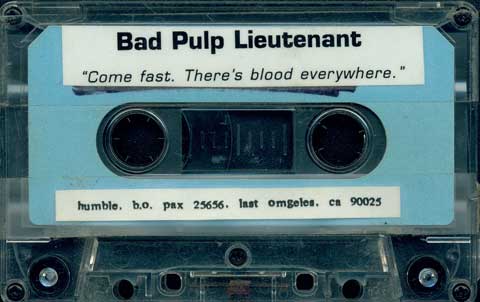
Bad Pulp Lieutenant

Image of Bad Pulp Lieutenant
I could write all about it, but I really think you should just listen to it.

Download Side 1 (16:42)

Download Side 2 (10:02)

Posted in insanity | 1 Comment