The Changing Role of Instructional Technologists

Almost a month ago to the day Gardner Campbell and I hooked up at the EDUCAUSE Southeast Regional Conference to talk about “Supporting Faculty Adoption of Emerging Technologies.” Gardner got me into the UMW racket and is always an intense source of inspiration, energy, and relentless intellectual generosity. So, I have edited down the original audio file of our presentation to our discussion which runs twenty five minutes long. I also included the twenty minutes of Q&A discussion for posterity.

I always enjoy walking in Gardner’s presentation footsteps because his fun and free-wheeling abundance of imagination always gets me going. And with the conversational style of this presentations (we were in armchairs!) the ability to focus on sitting and talking about ideas without slides, the internet, or some other kind of perpetual motion machine was quite a nice change.

Truth be told, I had a lot of fun stealing from Brian Lamb yet again by re-working a conversation we had about the rapidly changing role of an instructional technologist from someone who is concerned with programming, tools, and hardware to someone who needs to be thinking about and engaged in online communities for teaching and learning. Anyway, enjoy!

Posted in experimenting | Tagged , , | 2 Comments

Damn kids these days…

Image of a kid playing terrorist

One of the greatest plagues of the educational blogosphere is the whole idea of labeling generations of learners in these pre-fabricated categories of millennials, digital natives, immigrants, NetGens, or what have you. Now I have no more evidence that these terms are harmful, as the innumerable people who insist on using them have that they are remotely useful. That said, if you are in education and you spend a lion’s share of your time thinking about teaching, learning and scholarship, than what use would it be to frame a whole generation of people under a banner that simply reinforces the obvious: computers are ubiquitous in the wealthy, Western world for distributing information, and we have to wrestle with that if we are serious about education. That’s it in a nut shell, we can theorize the import of this cognitive process over that, and imagine how the brain is being “re-wired” as we frame the various populations out their as experimental subjects, or we can actually engage the process through the tools that are available.

I often find the educational theories to be less than compelling, and I tend to fall back on either one of two things: “literature” and movies (I put literature in quotes here because there is no real term for literature to describe a wide range of tastes as there is for film with a less loaded term like movies). Those things drive me, and while theory can be fun, it is often a way of helping me get excited about things I already love, like literature and movies. So, I have been pretty blown away by a blog I have been reading lately (more on that later), and it got me thinking about a lot of these issues, more specifically, it got me thinking about Jon Udell’s post “The once and future university.” I actually find myself coming back to this post regularly when thinking about these issues, particularly because it examines the space of a college education as a kind of unique experience “outside of the flow of normal time.” The other quote I remember from the post actually comes from Rick Perlstein’s NYT Magazine article “What’s the matter with college?” Following is the quote I am referring to:

You used to have to go to college to discover your first independent film, read your first forbidden book, find freaks like yourself who shared, say, a passion for Lenny Bruce. Now for even the most provincial students, the Internet, a radically more democratic and diverse culture …. take care of the problem.

The idea that rung true for me here is that college is traditionally understood as a space outside of the “flow of normal time” because it allows you to be a freak and makes possible the conditions for the discovery and sharing of mind-bending, off-the-wall, and generally cool stuff. That is one of the best and hopeful definitions of what college might be, yet it begs the question whether it is limited to the physical space of a campus as it once was? If this experience is premised on a connection between people, ideas, and culture that frame a series of personal relations around meanings and ideas, we are beginning to see other ways, in their infancy mind you, in which this connections can be re-imagined and re-mapped. Yet, what is essential is the ability to foster and sustain an open and tolerant marketplace for ideas that might encourage others to passionately dig into things alongside others who provide camaraderie, guidance, feedback, and enthusiasm. Moreover, a willing and intrepid interdisciplinary engagement with one’s culture in all its liberal art facets, which includes politics, sociology, economics, science, literature, film, philosophy, religion, art, drama, etc.

Yet, there is a fine line here to walk when talking about college, learning, and some kind of cultural rite of passage. I discovered this for myself while an undergraduate, for while I enjoyed taking a 20th century British literature survey course, I found it infuriating when my professor stood up in front of 300 people and suggested that reading T.S. Eliot’s “Wasteland” made us all somehow different, an act that would make the transition back into the world “you all left behind” difficult. Such a relationship to experiences and learning seemed, at least for me, to dangerously flirt with the idea of culture and passion as an intellectual rite of privilege, difference, and ultimately power. Once you walk down that road, where does it end? Does the fact I took a seminar on Joyce’s Ulysses make me anything other than a masochist steeped in ironic modernist propaganda of art as salvation and artist as deity (a modern malady only cured by a Samuel Beckett sponsored rehab)? While I think literature and movies are great and all, I hate that they are often leveraged for some kind of invidious distinction, rather than a means to a transcendent (or just psychedelic) communion and commonality.

Image from Let Us Now Praise Famous MenThe passage by Perlstein captures this idea of passionate communion over ideas and unique cultural connections that arguably lie marginal to the canon, but this same energy is without question at the center of the greatest works in the Western Canon as well. James Agee nailed this in the introduction to his and Walker Evans’ masterpiece Let Us Now Praise famous Men when he insisted that what we so often praise and place on a pedestal in terms of art loses the impact it made when people first read, watched, or listened to it. The act of engaging in a work is an act of mental and bodily submission. He then calls for a re-reading of Shakespeare or a re-listening of Beethoven. If you want to re-acquaint yourself with these works and their revolutionary spirit you have to put Beethoven’s Seventh on the phonograph and “turn it up loud” and then “get down on the floor” and “jam your ear as close into the loudspeaker as you can get it and stay there, breathing as lightly as possible, and not moving, and neither eating nor smoking nor drinking.”

You won’t hear it nicely. If it hurts you, be glad of it. As near as you will ever get, you are inside the music; not only inside it, you are it; your body is no longer your shape and substance, it is the shape and substance of the music.

Without the book on hand, I quoted from here.

This is a book I have to return to because I think Agee’s notion of internalizing the work so that it doesn’t ever become and object of distinction to beat others with over the head is essential to an honest education. Rather, the moment provides an opening for rapture and revolution. For me, that is the idea of an education, a losing oneself within a thing and believing, if only for a time, and pushing it beyond a limit. How do we measure this? Does the fact that we have more information than ever at our fingertips change this? Are educational theories themselves always already poisoned by a systemic view of learning?

Probably, and that finally brings me to my small point. It isn’t only in the experience of putting your head to the loudspeaker that such moments occur, it’s in sharing the experience out and taking a risk on trying to relate, or even narrate, what you saw or heard or felt in your own imaginative way. And this is what I have been experiencing lately with Brad Efford’s Judges 5:27, a blogger who is consistently blowing my mind in some powerful ways. Now some might call him a netgener, or even a millennial, or a native, or some other offensive term that would only further distance the moment of communion that is ripe and ready. But all that nonsense is besides the point when you interact, spend time with, and forge a relationship beyond the meager boundaries of age, education, and degrees. A space that Perlstein hints at, and which exists as interstitial moments of sharing the freaky thoughts that thrill us, or the narratives that creatively dog us.

Brad Efford has been doing this with impressive regularity over the past months, and just this past week or two he has stepped it all up a notch. And while his blog intersects with classes and projects at UMW as needs be, it is the platform of a thinker who is sharing such experiences freely (by this time I have talked about him enough that I am bordering on just plain annoying, or maybe even cyber-stalking), but I find it important to my sense of this space as something more than a technologist. For an integral part of what we must be doing is pushing the boundaries of engaging, communicating and encouraging a networked approach to openly thinking and sharing ideas and interests. This is the crux of the changing role of instructional technologists, and we need to be focusing on this reality rather than the getting wholly sucked back into the technical tool talk. Why aren’t we forming communities around ideas and sharing out beyond the obligatory dead celebrity post or how we did, indeed, download Firefox 3 with 8 million other people. If the educational community honestly believes that these tools are revolutionary for the future of education (and folks recite this mantra all the time like its inevitable), then why do we blog so robotically? Where are the communal connections within the institutions? Where are the academic accretions into a stark and creativity raw community of peers who are thinking about an alternative form of expression? Why do we feel the need to report?

Reporting is not the experience that will transform this space, rather I think a fearless imagining will and Brad exemplifies this beautifully. Read his post on perspective and song which illustrates the point through an amazing examination of three versions of “O Death.” His sharing on the problem of music and concerts and his own way of dealing with it. Or his philosophical ruminations about the most hopeful and bizarrely amusing de-contextualized fragments of people the internet provides us with. Or yesterday’s post, a stunningly well written narrative that frames some fascinating questions age, authority, and power I have read in a while. In fact it is the unabated energy, faith, and willingness to share creatively in this last post that inspired me to think about all of this. And it is this kind of distributed possibility outside of any classroom, but very much germane to the classroom and the educational experience, that makes these spaces the one’s that interest me most these days

My strangely long, overly righteous, and problematic point is simply that “being there” in this space in terms of the latest tools or downloads is only part of what the experimentation is about. It overlaps at points, but the idea is to form meaningful relationships around a creative sense of sharing, a freezone of imagination that will push you to continue thinking and creating long after you return to the normal flow of your job. The communities surround us, I am proud part of several of them, and they are not limited to any one classroom, but have been known to emerge there on occasion. How do we move our communities out of the often limiting logic of educational theory and the latest tools in order to span the range of ideas that will demonstrate and exemplify the power of the distributed space for learning on a wide range of axes.

Posted in experimenting | Tagged , , , , , , , , , , , , , , , | 9 Comments

BitTorrent: An Educational Autopsy of the Hydra

The Disclaimer comes first 😉

The following post is a ton of stuff I have collected over the last year or two on BitTorrent and its implications for educational institutions. This will all be fodder for an article in the EDUCAUSE Quarterly I have been promising for months, and I found the only way to get it out was to blog it ’cause I’m a sick addict. If you are brave enough to read through it all (it’s frighteningly long), feedback and some healthy peer review, additional sources, and perhaps a public flogging would be greatly appreciated. I am not an expert on BitTorrent, nor on much of anything for that matter, but I have been fascinated with the technology for years now, and have always wondered how educational institutions can, for the most part, categorically deny or ignore ways of distributed sharing that is currently revolutionizing the means of delivering media more effectively and efficiently than anything else out there. Our organizational love affair with corporate solutions like iTunesU is in many ways symptomatic of our refusal to truly explore and examine how the means of distribution and production are changing more radically than we are willing (not able) to acknowledge and adapt to.

What is BitTorrent?

BitTorrent is a peer-to-peer file sharing protocol developed by Bram Cohen in 2001 and designed to share large files efficiently by breaking a regular file into several different pieces which are each independently exchanged within a network of peers. The dispersed logic of such a system enables the delivery of large files without any one website or host incurring the entire costs of hardware, hosting, and bandwidth resources. In fact, BitTorrent does not depend upon a sole origin for a file, but rather a loosely joined network of file ‘bits’ that are simultaneously downloaded from and uploaded to various peers’ computers. The more people sharing a particular torrent file (which has a ‘.torrent’ extension), the more distributed it becomes and the faster it can be downloaded. All of which results in a more efficient and effective use of resources because the bandwidth needed to serve the file centrally is now spread amongst those who are downloading it.

How does it work?

Given that BitTorrent is a communications protocol, it has a specific set of standards for tracking, sending and receiving information over the internet. Using BitTorrent can be broken down into two categories: 1) creating and publishing torrent file and 2) downloading torrents and sharing files.

1) Creating and publishing torrent file

To create and publish a torrent file (also know as seeding) you will need a BitTorrent client, keep in mind there are a number to choose from, such as Vuze (formerly Azureus, and now billing itself as an “Open Entertainment Platform”), uTorrent, BitComet, and Transmission to name just a few. Once you download a client, you can create new torrent and associate it with a centralized tracker that will allow others to find it and initiate the process of sharing pieces of the file amongst and between various users. Peers that have a complete copy of the torrent and still offers it for upload are called seeders.

2) Downloading torrents and sharing files

To download torrents and share files you will also need a BitTorrent client, but unlike seeding, you simply have to find a torrent file online and then open it. The client then connects to the tracker specified in the torrent file, from which it receives a list of peers currently sharing pieces of the torrent file. The client connects to those peers and begins downloading various parts of the file. Such a group of peers connected to each other while sharing a torrent is called a swarm. Individuals that download far more than they upload are known as leeches, and they generally have a negative effect on such a network. For more BitTorrent terminology see this article on Wikipedia.

Changing IT Infrastructures and the Lesson of BitTorrent

The summary definition of BitTorret on Wikipedia is rather instructive. Not only does it trace the implications of this technology for sharing hardware, hosting, and bandwidth resources, but it also subtly suggests why it has been outlawed by a majority of the universities and colleges around the US.

BitTorrent is a method of distributing large amounts of data widely without the original distributor incurring the entire costs of hardware, hosting, and bandwidth resources [emphasis mine]. Instead, when data is distributed using the BitTorrent protocol, each recipient supplies pieces of the data to newer recipients, reducing the cost and burden on any given individual source, providing redundancy against system problems, and reducing dependence on the original distributor [emphasis mine].

Of particular interest here is how such a description of BitTorrent intersects on certain points (which I have emphasized above) with larger conversations and concerns campus IT organizations are currently having regarding the increasingly prohibitive costs of owning, maintaining, and monitoring data services locally. In fact, this an issue with much larger scope that is not limited to the education sector by any means. Much of this is a result of our particular moment wherein a plethora of externally hosted options provide college communities the same, if not better, services with infinitely more storage space. And all of this at a fraction of the cost. For some campus IT shops in the business of supporting themselves financially, or even making money, the risks of not going in such a direction are much more dire. The recent news that the University of Washington’s IT department will be laying off 15% of their staff speaks directly to this. In fact, a number of schools have already begun offloading IT staples such as file storage and email to externally hosted solutions. Arizona State University was one of the the first large universities to do this in a deal with Google back in the Fall of 2006, and it is a trend we will continue to see much more of in the coming months and years, particularly as budgets shrink and the economy continues to tank.

So given the changing nature of campus IT strategies, why aren’t more campuses exploring the distributed logic of BitTorrent as a self-sustaining network for sharing large files (particularly media) by using various computers throughout campus (or even amongst campuses) that would save everyone on hardware, hosting, and bandwidth costs? Not to mention how a decentralized network like this safeguards against a single point of failure. It would seem that such possibilities for sharing large media files and applications would be an integral part of any campus’s strategic technology plan? Yet BitTorrent technology is all but outlawed on most college campuses across the country. And while there may be several reasons, the most obvious and seemingly insurmountable is the fact that P2P applications provide, to return to the Wikipedia article on BitTorrent, “freedom from the original distributors.” So rather then exploring BitTorrent as a way to provide possible solutions to clogged bandwidth (an increasingly precious commodity) and the centralized, inefficient serving large files, the question of circumventing traditional means of distribution through a decentralized network has transformed campuses into full blown legal war zones with entertainment industry interests over copyrighted material, the pressure from which has pushed most universities to block or tightly control any and all peer-to-peer file sharing on campus.

Universities, P2P, and the Internecine War over Media Distribution

What could be more uncomfortable for higher education IT departments than serving as the copyright police for entertainment industry interest groups like the Recording Industries Association of America (RIAA) or the Motion Picture Association of America (MPAA)? Yet, if you look at the current legal and political landscape of copyright on campus, increasingly institutions are being asked to police, report, and share personal information related to individuals illegally downloading files on campus. Yet, as Kenneth C. Green’s Web Seminar for EDUCAUSE last December, “Swiftboating Higher Education on P2P: Why Higher Education Is Not the Real Problem, and Technology Is Not the Real Solution,” suggested, rather than categorically blocking or villifying peer-to-peer applications like BitTorrent, we need to do education, outreach, and a frame a broader, informed discussion about the implications of this technology that does not reduce it simply to a means of breaking the law. for, if we think long and hard about BitTorrent, much of the fear and terror aimed at college student by the entertainment industry has everything to so with power behinf this technology as an open, free, and distributed platform for educational resources. The fact that some may use it to break copyright should not be the primary logic steering the conversation (if we can even call it that!).

Moreover, recent studies from the University of Washington have suggested a couple of interesting points about the both figures of illegal downloading as well as the degree of accuracy with which the entertainment industry tracks such activity on college campuses around the country. As to the overstated estimates of college students illegally downloading on campuses around the US, Inside Higher Ed reports:

The [MPAA] often notes that according to a 2005 study it commissioned, 44 percent of the money the industry lost within the United States that year was attributable to peer-to-peer file sharing by college students. It now appears that the figure was closer to 15 percent, or $243 million. Mark Luker, a vice president at Educause, an organization promoting technology use in higher education, said the numbers reflected college students both on and off campus even though college Internet service providers, the target of pressure from both Congress and the MPAA to step up anti-piracy efforts, typically only serve on-campus residents. It would be “reasonable,” Luker said, to divide the MPAA numbers by five, since about a fifth of college students live on campus, leaving the figure somewhere around 3 percent of domestic losses.

Now take these real figures (as opposed to the insanely inflated figures of the MPAA) and run them through a recent study conducted by the University of Washington, “Tracking the Trackers: Investigating P2P Copyright Enforcement” that suggests that entertainment industry’s warning are often targeting innocent users. According to the report which is “the first scientific, experimental study of monitoring and copyright enforcement on P2P networks,” they found the following, disturbing results:

  • Practically any Internet user can be framed for copyright infringement today.
    By profiling copyright enforcement in the popular BitTorrent file sharing system, we were able to generate hundreds of real DMCA take down notices for computers at the University of Washington that never downloaded nor shared any content whatsoever.Further, we were able to remotely generate complaints for nonsense devices including several printers and a (non-NAT) wireless access point. Our results demonstrate several simple techniques that a malicious user could use to frame arbitrary network endpoints.
  • Even without being explicitly framed, innocent users may still receive complaints.
    Because of the inconclusive techniques used to identify infringing BitTorrent users, users may receive DMCA complaints even if they have not been explicitly framed by a malicious user and even if they have never used P2P software!
  • Software packages designed to preserve the privacy of P2P users are not completely effective.
    To avoid DMCA complaints today, many privacy conscious users employ IP blacklisting software designed to avoid communication with monitoring and enforcement agencies. We find that this software often fails to identify many likely monitoring agents, but we also discover that these agents exhibit characteristics that make distinguishing them straightforward.

Given the results (and you can download the pdf version of the entire study here), the level for error and inaccuracy is so high that the adjusted figure that institutions of higher education account for roughly 3% of the domestic losses to the entertainment industry may themselves be greatly inflated. Which makes colleges and universities an even smaller fraction of the overall loss sustained by these companies, yet they continue to mercilessly target educational institutions with take down notices and “pre-litigation letters,” which according to several sources have been coming with greater frequency over the last couple of months. One needs to ask why? And while I have a few theories, none of them really account for the bizarre fact that the greatest distribution crisis they will ever face has provoked them to further alienate, criminalize, and attack the very population that represents their greatest consumer base. It seems counter-intuitive, yet in many ways remains in line with the fear and terror tactics that have characterized the spirit of both domestic and international relations over the past eight years in this country. Moreover, if the recently proposed copyright bill c-61 in Canada is any indicator, then the impact of US copyright interests are beginning to reverberate internationally with real and severe consequences for open education.

What is most frustrating about these draconian measures to control copyright supported and funded by entertainment industry interest groups, and framed as measures of economics, morality, and legality when in fact the bigger question is one changing models of production, distribution, and consumption. Matt Mason’s “The Pirate’s Dilemma” deals with some of the larger questions surrounding the changing business landscape and how current models employed by a number of industries, including the entertainment industry, are outmoded, reactive, and ultimately doomed

It’s hard for large organizations that move at glacial speeds to compete with individuals taking their content and creating new distribution systems, revenue streams and business models, but the fall of the major record labels taught the rest of the corporate world a lesson. In many cases, piracy it is helping people to innovate and create new legitimate market spaces. Link.

And this:

The Internet is in its infancy. Electronic information still travels along copper wires left over from the industrial revolution, but the information age is about to hit puberty. Fiber optic cables are sprouting in unexpected places. The piracy and chaos we are collectively experiencing is growing pains. Link

Pirates as economic pioneers that help frame the future of legitimate market spaces? The entertainment industry should be exploring the implications here and partnering with universities rather than alienating students and commandeering IT departments as local soldiers in their war against the future. And if the don’t, why should higher education institutions around the country abandon using these technologies to develop their own means of media production and distribution?

Cutting-edge BitTorrent Research at the Ivy Leagues

Harvard University did something last year that seems almost insane given the increasingly aggressive legal landscape associated with copyright, the DMCA, and draconian state legislation in regards to file sharing. They have researched, designed, and released their own BitTorrent client called Tribler that they are encouraging their campus community to use! In fact, like Vuze, Tribler is a social-based BitTorrent client that not only makes Internet TV easier and sharing files throughout the campus more effective, but encourages interaction and connection. To quote TorrentFreak on the issue of Harvard’s renewed interest in BitTorrent research:

Yes, Harvard, the richest University in the world recently started a new line of P2P research. They have an army of law professors to protect them, so unlike others, they must feel safe to do this controversial research in the land of the free and the home of the RIAA/MPAA.

The Harvard project is all about a fresh new approach…

The Harvard researchers are currently working on one of the hardest P2P problems, ensuring uploads. P2P dies or thrives depending on how much upload people donate. By introducing electronic “currency” for uploads they think they can make P2P HDTV Video on Demand possible.

In fact, Harvard University is doing what the entertainment industry has failed to do for close to a decade now, namely explore the possibilities of this powerful and effective media delivery platform in order to make downloading and sharing movies, TV shows, documentaries, large images and music faster and easier. A crucial factor being ignored by media corporations that Chris Sogholan, using the example of NBC’s defection from iTunes last year, makes quite clear in his article TV Torrents: When ‘Piracy’ is easier than legal purchase. Yet, beyond ease the questions of legality and compensation still loom large, and Harvard is using the Tribler client as a way to explore bandwidth as currency for P2P file sharing in an attempt to wrestle with the economic issues that have been the root of the legal and political fear and terror campaigns launched by the entertainment industry against technologies like BitTorrent. In fact, Harvard’s is using Tribler as a practical implementation of the mechanism design theory, the Nobel Prize winning theory in Economics last year, to see if it can’t be useful to motivate people to share. Here’s a bit more from this TorrentFreak post on the subject:

A lot of people probably wonder how an economical theory can improve the performance of a BitTorrent client, Pouwelse explains: “A structured scientific advancement of P2P file sharing was really lacking. With Mechanism Design we can go beyond the current trial-and-error methodology. We are working on a mechanism design based solution for all 9 elementary actions in P2P by using a distributed reputation system and mechanism that does not degrade to a single shot prisoners dilemma, such as BitTorrent tit-fot-tat”

What Pouwelse is basically saying is that the mechanism design theory will be used to improve download speed and to make sure that content will be available for the long run, even when it’s not really popular. This is especially useful in BitTorrent streaming solutions where the incentive to keep sharing is relatively low.

The Nobel-powered BitTorrent/P2P client supports both regular .torrent downloads, but can also be used to stream videos from YouTube and Liveleak. As we reported earlier, the client also enhances the standard tit-for-tat BitTorrent algorithms with a so called give-to-get algorithm where bandwidth is used as a currency.

Bandwidth as currency, reputation systems, and a give-to-get algorithm suggest something that all of us already know in one abstract form or another. The future of media is now and it isn’t CDs and DVDs, it is a distributed network of sharing between and amongst large number of people. And while BitTorrent may not necessarily be the long-term answer to such a question, it seems highly likely that some peer-to-peer file sharing will be at the heart of such a future.

In fact, Harvard is not alone with such research. The Computer Science department at Cornell University has been working on a project called Cubit, what they are describing as a peer-to-peer overlay. In other words, while BitTorrent is currently a decentralized means of sharing files, the information about torrent files is still indexed and aggregated centrally by trackers such as Pirate Bay. Cubit promises a “good quality, approximate keyword searching directly through BitTorrent networks—a truly decentralized system that doesn’t rely on aggregators” allowing direct searches for files apart from any centralized tracking service–more in line with the Napster model from the late 90s. Hence the recent suggestions from around the web that sites like the Pirate Bay may become obsolete.

Educational Applications and the Future of Now

I have spent some time thinking about this one, and I have still been hard pressed to articulate specific use cases, because the rel power behind BitTorrent, and peer-to-peer more generally, for educational institutions would be to frame their own distributed media production and distribution spaces. In fact, this could provide a far wider network of resources being shared not only within a particular campuses, as we see with Harvard, but also amongst several campuses. As BitTorrent clients become increasingly “social,” adding the ability to follow and share with friends, the ability for a truly wide net of public domain resources from the Internet Archive, The Library of Congress, and various other archives can be distributed fast and more effectievly, all the while saving institutions the outlandish costs of high end media servers. A kind of cooperative between a wide range of campuses that may afford a way to network and share around the ever important, and increasingly more dominant, role of media in education.

Whn faced with a moment of flux and change we have couple of options, let the corporations and politicians dictate the terms of our future, or get familiar with the technologies, become active in the dicusion, and push back with both the technologies and their possibilities so that we have a clear idea of what we have to lose. The educational applications of BitTorrent are so meager as of now because so few schools allow the technology to operate freely, in order to understand it we must be allowed to use it. And in using it, we may very well discover why billion dollar industries have chosen to push so hard to criminalize this technology until tey can figure out how to monetize it, and my then it may be too late for everyone.

Posted in Uncategorized | Tagged , , , , , , , , , , , | 12 Comments

The Many-Headed Hydra, or a Useful Figure for the Quotidian Revolution

Image of Hercules slaying the Hydra

Jon Beasley-Murray recently posted about the political term multitude, the concept itself is rather complex and can be traced through the political texts and philosophical thought of Machiavelli and Spinoza, and more recently the concept has been employed by Michael Hardt and Antonio Negri in their book Empire. After a little digging I realized Jon has an earlier post from 2006 called Multitudes wherein he enumerates some of the different ideas surrounding the term. As one respondent notes about Jon’s discussion, he outlines a particular mode of multitude, “‘an actually existing one’, the multitude which exists in (points of the growth of new) hydra heads”:

A multitude that forms and coalesces along the lines of flight within each and every social formation? A multitude then that is sociological, incarnated in piracy, in everyday life, in Temporary Autonomous Zones, in the quotidian refusals and resistances by which we make our lives bearable. This multitude is actual, rather than simply virtual. We already share in and participate its activity.

Now I won’t pretend to be able to give an adequate overview of all the theoretical implications of this term, for it is an idea I am currently struggling with. Nonetheless, I want to bring it up here because many of the points Jon makes around this idea in his more recent post are quite resonant with the political, social, and relational space in which we find ourselves at this particular moment:

The multitude is common. It is ordinary and everyday, and it is also both the product and the producer of shared resources….The multitude seeks connections based on what we already hold in common; its polyvalent powers of connection open up new bases for commonality….the common and the corrupt often overlap: both are products of informal and unsupervised networks….Again, the multitude is ambivalent and the state has no monopoly on corruption.

Now granted, I am taking Jon’s quotes above out of their original context by placing them in a kind of loosely joined series of impressions of how his thinking about multitudes provides an interesting framework for theorizing loosely joined, heterogeneous networks for production, connection, sharing, and a form of everyday resistance. And while George Siemens’ theory of Connectivism frames the impact of new modes of technology on learning using the figure of the network, the metaphor (for me at least) is tied too closely to a kind of neuroscience model of connections, that while invoking complexity and chaos, seems overdetermined by a series of comparisons that are predominantly technological and scientific. Which, in turn, under emphasizes the relations of power at work in any series of economic, political and social connections (all of which play a key factor in any larger learning theory). What happens when you externalize learning not as a space of power between people, but within “non-human appliances”? That is truly a question, and many of these ideas are what I’ll be interested in tracing during George and Stephen Downes’ course on the topic this Fall, itself a grand experiment in the theory of multitudes given there are already almost 800 people expressing interest.

Image of a many headed hydraSo what if, alternatively, we were to think of learning networks not so much along the metaphorical axis of techno-scientific language (for is learning a science?) or displaces learning theories, but within a more social, historical, economic, and political framework? What if we were to imagine the space of the multitude and its relationship to power in terms of motley crews full of pirates, sailors, commoners, laborers, and slaves? Push that a bit further, what if we were frame the unpredictable processes of learning that occur on the open web (regardless of institutions and their hierarchies) with the metaphor of a many-headed Hydra. The Hydra is a figure for imagining and examining the networked relations in which we currently learn, share, and organize through a series of social relations to power, property, and politics that are often outside of and in tension with the predominant logic of large, centralized educational systems. Many of these struggles are amplified by the constantly changing landscape of information and infrastructures, making the ability for people to connect, share, publish and learn outside of traditional currents of education a potential (if not necessary) threat to an established hierarchy premised on anything but diversity. (Just think of higher education institutions in regards to diversity, they may some of the least diverse institutions on the planet. Think about it, it’s a space where just about everyone with power has a Ph.D. and has been run through a relatively homogeneous intellectual process at a similar institution filled with similar people, is that at all consistent with a commonly touted value system of some kind of excellence through intellectual diversity?) How much would these institutions change if that weren’t the case? And would we see some interesting challenges to the ways in which we approach teaching, learning, and expertise? The resonances for this particular metaphor , at least for my use of it here, comes from Peter Linebaugh and Marcus Rediker’s text on the history of the revolutionary Atlantic titled, you guessed it, The Many-Headed Hydra: Sailors, Slaves, Commoners, and the Hidden History of the Revolutionary Atlantic. Here is a series of cobbled quotes from the introduction that frames how the myth of Hercules versus the Hydra has been employed during the 17th and 18th centuries as a means to both imagine and control loosely connected networks of resistance:

Cerebus and Master The labors of Hercules symbolized economic development: the clearing of land, the draining of swamps, and the development of agriculture, as well as the domestication of livestock, the establishment of commerce, and the introduction of technology. Rulers placed the image of Hercules on money and seals, in pictures, sculptures, and palaces….these same rulers found in the many-headed hydra an antithetical symbol of resistance and disorder. A powerful threat to the building of state, empire, and capitalism. Hercules’ second labor was the destruction of the venomous hydra of Lerna. The creature born of Typhon (a tempest or hurricane) and Echidna (half woman, half snake), was one in a brood of monsters that included Cerberus, the three headed dog, Chimera, the lion-headed goat with a snake’s tail, Geryon, the triple-bodied Giant, and Sphinx, the woman with a lion’s body. When Hercules lopped off one of the hydra’s heads, two new one’s grew in its place.

From the beginning of English Colonial expansion in the early seventeenth century through the metropolitan industrialization of the early nineteenth, rulers referred to the Hercules-hydra myth to describe the difficulty of imposing order on increasingly global systems of labor. They variously designated dispossessed commoners, transported felons, indentured servants, religious radicals, pirates, urban laborers, soldiers, and African slaves as the numerous, ever-changing heads of the monster. But the heads, though originally brought in to productive combination by the Herculean rulers, soon developed among themselves new forms of cooperation against those rulers, from mutinies and strikes to riots and insurrections and revolutions.

It would be a mistake to see the myth of Hercules and the hydra as merely an ornament of state, a classical trope in speeches, a decoration of ceremonial dress, or a mark of classical learning….the hydra became a means of exploring multiplicity, movement, and connection, the long waves of planetary currents of humanity. The multiplicity was indicated, as it were, in silhouette in the multitudes who gathered at the market, in the fields, on the piers and the ships, on the plantations, upon the battlefields. The power of numbers was expanded by movement, as the hydra journeyed and voyaged or was banished or dispersed in diaspora, carried by the winds and the waves beyond boundaries of the nation-state. (The Many-Headed Hydra, pgs. 2, 3, 4, & 6)

Now I fully understand there may be some conflation here between the early formation of global capitalism and our particular moment—historical specificity is crucial and it is something I will be working towards in the coming weeks, especially while reading Capital, Volume 1—yet this idea of multiplicity, constant movement, and connection as a human space of thought may afford a real opportunity to re-imagine spaces, nation-states, and commonalities beyond the often reactionary logic of national identities. More than that, the currents of our networks afford a cultural exchange and individual empowerment that allows us to work and think amongst distributed connections of people that similarly have a tangential allegiance to their structured workplace, their labor. Now, I’m sure the anti-capitalist language of Redicker and Linebaugh may anger some when talking about something as ‘pure and apolitical as learning,’ nonetheless the social relations in which we operate are always already political and the sooner we start recognizing our institutions and the jobs we do as extensions of a particular kind of politics that are often wrapped in the tattered garments of the humanist tradition, even if hastily patched together by the neo-liberal cliches of “excellence,” “development,” “liberty,” “globalization,” and “productive competition.”

Finally, the many-headed hydra as a figure may seem relatively removed from our moment, given its employment by the “rulers” over the motley organizations of a multi-ethnic class of commoners in the 17th and 18th century. I would argue, however, that in many ways the metaphor has never been more with us, and as one might expect, it can be found in one of the most embattled and politically charged networks on the internet: Peer-to-Peer, and even more specifically bitTorrent. Take, for example, a post last year at this time on the TorrentFreak blog titled “BitTorrent Survival: The Way of the Hydra,” which discusses how too few bitTorrent tracker sites account for more than half of all the traffic and served torrents on the internet:

Although it’s great initially for the mainstream to have visible big ‘brands’ such as The Pirate Bay, Mininova and TorrentSpy [since deceased], it’s a precarious situation to have such a top heavy structure to the BitTorrent community. It’s great having a ‘multi-headed hydra’ but not so great when just one of those heads carries half of all the public torrents. This situation must be addressed. Resources need to be spread around in a manner which ensures that a few ‘big bombs’ are unable to dismantle major parts of the infrastructure.

And also this…

“So public message to people – start up your own torrent sites, make the internet the hydra it is and needs to be. If there’s hundreds of sites, they can’t all be shut down. And well, if they shut down the few that are today, there will be hundreds of sites, I’m sure, but let’s start them before so we can spread the word of them easier.”

Now while bitTorrent specifically, and P2P more generally, may seem a contentious example to use given it is fraught with questions of copyright, ownership, illegal sharing, and makeshift communities of resistance, but on the contrary I think that makes these networked and politicized communities a perfect example. The many-headed hydra metaphor is already being employed to define the complexity of this massive and decentralized nexus of connections. There is a new notion of multitudes that is networked, constantly changing, ever-adapting, and often premised on bottom-up organizations. They are everyday communities that are constantly changing and always re-imagining their relationship to power, property, and politics through “quotidian refusals and resistances.” The times we live in are about much more than being networked or connected as a way to “add value” to traditional ideas of learning, they are about understanding the potential for change and recognizing the power of possibility such a reality holds for us collectively, as a multitude in the shape of and everyday hydra, with, many, many heads.

Posted in Uncategorized | Tagged , , | 9 Comments

Internet Archive howto for digitizing LPs


Creative Commons License photo credit: amy_b

I thought this was pretty cool, the Internet Archive blog has a recent post on the process they follow to digitize vinyl. And they share this information all in the name of preserving and distributing ephemeral culture. Nothing like an organization that preserves some of the coolest stuff on the net throwing people a quick guide for digitizing their own records. Talk about sharing the love. I don’t know, maybe its just me, but the Internet Archive is really something special.

Posted in Internet Archive | Tagged , , , , | 4 Comments

Worst music video ever

I was doing a little YouTube nostalgia surfing with the bambini, and after our fair share of old cartoons I decided to dredge for early 80s music videos. After enjoying the brilliance of “I Ran” by Flock of Seagulls I searched for “Saftey Dance” by Men Without Hats. And after watching that video, it brought back some really strong feelings, namely how much I hated that video. Here it is, and below you’ll find my brief rationale as to why the is the worst music video ever made.

Now I loved this song, it came out when I was in seventh grade, and I remember thinking that it was up there with Def Leppard’s “Pyromania.” That said, once I saw the video I was forever scarred. I mean how can an 80s new wave band who should be modeling their work on the likes of Devo and Kraftwerk offer up a video set in a kind of Renaissance fair environment? The whole renaissance fair thing is perhaps the most odious aesthetic ever, and having a 1980s dance/new wave song teleported back to the idyllic fields of maypoles and horse drawn carriages is not only wrong, but unforgivable. Where’s the hairspray, parachute pants, and the zippers? How about the insane eye make up and mesh shirts? All they could come up with is bodkins and codpieces? It damaged me when I first saw it, and it hurt just as much last night. What have I done to my children?!

Posted in Uncategorized | Tagged , , , , | 19 Comments

Reading Capital, Part 1

Image of Karl Marx Lego figure

The D.I.Y. Lego Karl Marx (Image courtesy of Dunechaser)

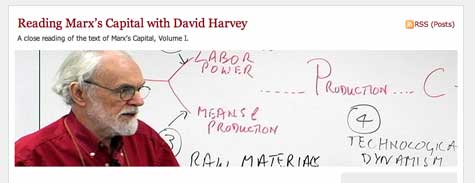
So while I am waiting for my very own copy of Karl Marx’s Capital, Volume 1 to arrive in the mail, I figured I ‘d get to work (in the spirit of Frank Sobotka) on some ideas I have been playing around with for a while now. In short, how might you quickly create a syndicated framework for a a wide variety of loosely joined discussions around a course like the one David Harvey is offering up here? My first question when I initially saw this amazing resource was how would you capture the various traces of discussion surrounding these readings that might galvanize a intellectual community of ideas, activism, and critiques?

I originally thought opening up comments on the actual blog where the videos are being published might be one way, but it occurred to me that it kind of centralizes the discussion around one resource, begging for a kind of interaction with professor Harvey that is not only unlikely, but impractical. Think of all the open resources out their right now, they come pre-packaged in iTunesU or some other anemic, branded delivery system that gives you the resource, but fails to actually frame any kind of community around the space. Learning does not happen within a tube of consumption, but rather through a series of relations within a community of engaged and excited thinkers.

Reading CapitalThis being the case, I figured I would take yet another stab at framing a space where discussion around a resource like this one can be easily traced, engaged, captured, and archived in a manner as distributed or centralized as one likes. So I started creating Reading Capital this weekend (an independent discussion space for David Harvey’s course) that is first and foremost a proto-type of the syndicated architecture that a bunch of folks have been thinking about for a number of years now. I really don’t expect anyone to use this site extensively (though anyone is free to, and that would obviously be fun), rather I see it more as a space to kind of fine tune the thinking and technical process I have been going through so I can finally accomplish a few of things I have been meaning to do:

  1. There has been a lot of talk about Do-It-Yourself educational technology, and I figured an occasion like this would give some of us the opportunity to really think about the possibilities and limitations of such a model. There is always a lot of theoretical talk about what we do or do not need, but I find a project like this helps me focus on praxis, a marriage of the technical details of what is currently possible, with the larger vision of what makes more sense and allows us to truly frame a distributed community for thinking, learning, and sharing together beyond the boundaries of any given classroom, institution, or geographically determined reality.
  2. Focus on explaining and documenting my thought process when creating a discussion hub like this using freely available, open source tools. In many ways it is working on the same model as UMW Blogs, but I have included some additional features like allowing anyone to add their blog’s RSS feed (or whatever other kind of site you are using that has syndication), anyone can signup for a blog, discussion forums, a wiki, and a twitter-like discussion space that I’m calling Discourse–that is simp;ly a theme that anyone could reproduce on this site or WordPress.com.
  3. Keeping my own skills in developing these spaces honed. Ever since UMW Blogs went live last Summer, the whole thing ran so smoothly I found I was spending a good amount of time shepherding communities on that site more than playing with the actual technologies. Which, by the way, is a more rewarding and effective use of my time. Nonetheless, I like thinking of the Summer as an opportunity to get a bit deeper into the general hacking of these open source applications to see what they can and cannot do.

All that said, the site is still under construction. I will be finishing up the details over the next week, and will be providing in-depth documentation for using each element of the space. Also,there will be four more blog posts in rapid succession detailing the different, RSS-rich features of this syndicated framework, and why I choose to include them, and what they might provide in the way of discussion. I have to freely admit the site is overkill, but in many ways I needed that along with some honest critiques and discussion about this model so that we can keeping examining the possibilities without getting to mired down in the details.

Posted in Reading Capital, Uncategorized | Tagged , , , , , , , , | 6 Comments

Frank Sobotka on EDUPUNK

To quote the inimitable Luke Waltzer, Frank “It ain’t about me!” Sobotka is “one of the great characters in TV history.” I have to wholeheartedly agree, the stevedore who “knew he was wrong, but believed for the right reasons,” was an amazing presence on television—a working class guy whose not a ridiculous stooge like The King of Queens. For some more great clips featuring Sobotka struggling with the death of the American working class, check out this clip.

And while I know I am Johnny-come-lately to The Wire, I have been blown away by the shows institutional scope and its intense drilling into the dark and depressing post-9/11 landscape of the US, using Baltimore as a fascinating microcosm. After just finishing up the second season, I have to say that so far this series has surpassed just about every TV show I have seen—save perhaps The Prisoner and The Twilight Zone. In retrospect, The Wire kinda makes The Sopranos seem narrow, tired, and cartoonish.

Posted in Uncategorized | Tagged , , , , , | 11 Comments

Web Spaces of Hope: David Harvey shares his Capital

If you follow this blog with any regularity then a) you’re a masochist and b) you know every so often I start talking about the City University of New York. I can’t help it, I was a wayward English Ph.D. student at the CUNY Graduate School, and before I got sucked into the vortex of the instructional web, I always thought I would be a CUNY lifer.

“But why?” you ask, “Especially given your posts about CUNY rail against their management of centralized IT, lack of any real online policy for openness, and a system-wide loyalty to canned learning management systems.” Well, I guess my answers would be the following: because I taught there for seven years (at the very moment when open admissions was ending); I have a deep and unbridled respect for the student body; I got my start in instructional technology thanks to CUNY’s Honors College; not to mention I had some unbelievable intellectual and extracurricular experiences with colleagues, professors, and good friends in the graduate program that really shaped so many of my terrible ideas. But more than all of that, I am first and foremost nostalgic, and the history of CUNY always fascinated me because it seemed so radical, important, and humane all at once:

CUNY has historically served a diverse student body, especially those excluded from or unable to afford private universities. CUNY offered a high quality, tuition-free education to the poor, the working class and the immigrants of New York City until 1975, when the City’s fiscal crisis forced the imposition of tuition. Many Jewish academics and intellectuals studied and taught at CUNY in the post-World War I era when Ivy League universities, such as Yale University, discriminated against Jews.[2] The City College of New York has had a reputation of being “the Harvard of the proletariat.”[3]

Over its history, CUNY and its colleges, especially CCNY, have been involved in various political movements. It was known as a hotbed of socialistic support in the earlier 20th century.[4] CUNY also lent some support to various conferences, such as the Socialist Scholars Conference.[5]

With over 450,000 degree seeking students, CUNY is the biggest public urban university system in the U.S., and the third biggest system in the country (behind California and New York’s State systems). But it isn’t the size, it is this idea of CUNY as “the Harvard for the proletariat” that has fascinated me. Imagine that, a solid, affordable education that serves the poor, working class, and immigrant populations, and frames a core educational mission of social responsibility in the greatest city in the world.

Enter David Harvey’s open experiment sharing his semester long reading of Karl Marx’s Capital, Volume 1 with the world. Here is the link to the site which was setup with freely available tools, and will be broadcasting fifteen videos (all hosted on Google Video) to the world for the next two or three months, at the rate of one lecture a week (note that there are already three videos posted thus far).

I was extremely excited to hear about this project from the coordinator Chris Caruso, who has spearheaded this incarnation of returning CUNY to its rich history of open and social minded education. It is particularly wonderful for me because while at the CUNY Graduate Center I really wanted to attend professor Harvey’s acclaimed course on Marx’s Capital, a text he has been teaching for 40 years now, but never got the opportunity. Well, I no longer have any excuse, and this is just the beginning of my discussion of this amazing free and open resource. Over the next couple of months I’ll start reading Capital, Volume 1 together with the video recordings of the class (all of which are from the Fall 2007). And, I’ll be using this blog as a space to grapple, reflect, and discuss the text alongside Professor Harvey’s reading of it.

One of the things I immediately thought of when I saw the site was how can it trace the discussions of the lectures that will take place over time in a distributed manner throughout the internets. If I want to refer back to the original blog with my ideas and reactions to a particular lecture, how can that site capture these discussion? A forum? Opening up comments? Allowing trackbacks and pings? I think allowing comments and trackbacks would be one way to suggests who is reading along and interacting with the lectures, I also thought something like Simple Forums might provide a way for folks to interact around the lectures who may not want to blog it regularly, or set up a separate space. In fact, tracing the discussion around these open resources is in many ways as important as the impetus to share them, and I’ll be thinking about this over the coming months as I endeavor on this project. Should be fun!

Posted in Uncategorized | Tagged , , , , , , , | 8 Comments

What religion you profess, preacher?

Fifteen seconds into this clip comes one of my favorite lines from one of the best films of the last century, Night of the Hunter (1955). The other eight and half minutes is just a bonus 🙂

BEN HARPER: “What religion you profess, preacher?”
HARRY POWELL: “The religion the Almighty and me worked out betwixt us.”

I could go on all day about this film, it is a masterpiece on so many levels. But I’ll spare you the verbiage (at least for now), and encourage anyone who hasn’t yet seen it to get it, and anyone who has to watch it once again. It never disappoints.

As a side note: Interesting how the annotations for this YouTube video were used to let the viewer know that Part 1 of of the film was taken down.

Posted in movies, YouTube | Tagged , , , , , | 1 Comment